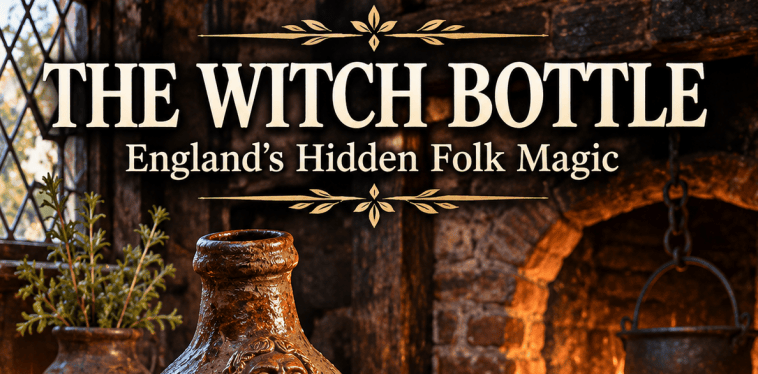
Imagine renovating a centuries-old English cottage and discovering a strange, sealed bottle hidden beneath the floorboards. Inside are bent pins, rusty nails, and traces of substances that have remained undisturbed for hundreds of years.
It might sound like the beginning of a supernatural mystery, but these objects are real. They’re known today as witch bottles, and they offer a fascinating glimpse into the folk magic of 17th-century England.
During a period when unexplained illnesses, sudden misfortunes, and other hardships were sometimes blamed on witchcraft, people sought ways to defend themselves against what they believed were harmful spells. One method involved preparing a bottle intended to counteract an alleged curse.
The practice is well documented from the mid-1600s onward, although its precise beginnings remain uncertain. These bottles were often ordinary household vessels, including brown stoneware jugs decorated with distinctive bearded faces.
Historical accounts describe filling a bottle with urine from someone believed to have been bewitched, along with sharp objects such as pins or nails. Some recipes also included salt or hair. The vessel might then be heated or buried.
The reasoning was rooted in sympathetic magic: the belief that objects connected to a person could influence that person through an invisible magical relationship. Practitioners believed the bottle could cause discomfort to whoever had supposedly cast the spell, forcing them to withdraw it.
In 1671, the English astrologer and medical practitioner Joseph Blagrave described a version of this treatment in his book Astrological Practice of Physick. His instructions provide valuable historical evidence that the custom was more than a legend invented centuries later.
And the physical evidence is just as intriguing.
Archaeologists have discovered witch bottles concealed beneath floors, near doorways, and around fireplaces. One remarkable example uncovered in London contained approximately 60 bent copper-alloy pins and the remains of iron nails. The stoneware vessel dated from approximately 1670 to 1710.
Why hide such an object beneath a hearth or threshold? These were important parts of the household, and concealed objects were sometimes associated with protection. However, historical researchers caution that surviving 17th-century written accounts primarily describe witch bottles as attempted cures for bewitchment, rather than general household protection charms.
According to the beliefs surrounding the practice, the bottle’s contents could torment the supposed witch and break the connection between the accused person and the afflicted individual. Such claims belong to historical magical belief, not demonstrated supernatural fact.
The archaeological discoveries, however, are genuine. The vessels, their contents, their hiding places, and the surviving written instructions provide compelling evidence that people practiced this form of counter-magic.
These discoveries also reveal something deeply human about the past. In an age when illness and misfortune were often poorly understood, people searched for explanations and ways to regain control. Unfortunately, beliefs about harmful witchcraft also contributed to accusations and persecution of innocent people.
Centuries later, a bottle discovered beneath an old floor can still tell a remarkable story about fear, hope, healing, and the mysterious traditions once woven into everyday life.
The witch bottle may not have possessed supernatural power, but it remains a powerful reminder of how seriously our ancestors took the unseen world.
Historical distinction: The existence of witch bottles and their use in counter-magic are supported by archaeological discoveries and historical documents. Claims that they could inflict pain on witches, reverse curses, or repel supernatural forces are traditional beliefs rather than established facts.
Sources: Museum of London Archaeology (MOLA), The Holywell Witch-Bottle and Witch Bottles Concealed and Revealed; English Heritage, Historical Ways to Protect Against Evil Spirits; and the historical research article What Is a Witch-Bottle? Assembling the Textual Evidence from Early Modern England.
A little magic is always waiting. Subscribe and step inside the circle. 🖤🔮✨


Leave a Reply