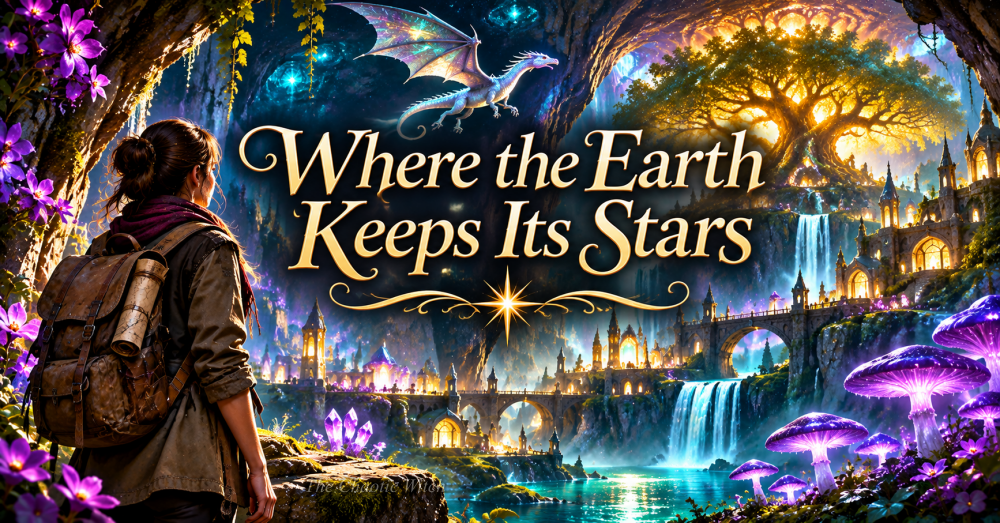
Dr. Tamsin Reed had spent seventeen years searching for a place that most of the scientific community insisted did not exist. She had followed ancient maps across continents, translated forgotten manuscripts, explored abandoned temples, and descended into caves where no human footsteps had been recorded for centuries. Her colleagues called her brilliant but eccentric. Her university called her research unconventional. One particularly unkind archaeologist had suggested that she might be better suited to writing children’s fairy tales than conducting serious academic research.
Tamsin didn’t particularly care what anyone thought. She wasn’t searching for gold, legendary treasures, or some magnificent discovery that would make her famous. She had never dreamed of having her name carved into a museum wall. What fascinated her was the possibility that somewhere beneath the familiar world existed another one, an extraordinary place that had survived untouched by human civilization. She wanted to know what lived there, how it had evolved, and whether the fantastic creatures described in ancient folklore might have been inspired by something real. More than anything, she wanted to understand a mystery that had captivated her since childhood.
Her fascination had begun when she was eight years old, sitting beneath an enormous oak tree in her grandmother’s garden. She had asked why the roots disappeared into the ground, and her grandmother had explained that they stretched far beneath the surface, searching for water and nutrients. Tamsin had immediately wanted to know what else might be down there. Her grandmother had laughed and told her that the Earth was full of secrets, and perhaps one day she would discover one of them. Thirty-four years later, Tamsin was standing inside a forgotten mountain passage, staring at a stone doorway that had no business existing.
The discovery had begun with a fragment of parchment found inside a collection of medieval astronomical records. Most of the pages concerned planetary movements, seasonal changes, and observations of the night sky. But one contained an unusual illustration: a mountain divided into layers, beneath which an enormous underground landscape stretched toward a second, smaller sun. Strange creatures surrounded the drawing, including winged serpents, antlered animals, and figures that appeared to be made of stone. Beneath the illustration, written in a language Tamsin had spent nearly two years deciphering, was a single sentence: “The world below does not sleep. It simply waits for those who remember how to wonder.”
The parchment had led her to the Greyglass Mountains, a remote range of jagged peaks and deep valleys where ancient settlements had once flourished before mysteriously disappearing. Local legends spoke of strange music drifting from the mountains at night, glowing animals wandering through the forests, and travelers who entered caves only to return days later insisting that they had been gone for mere minutes. Tamsin had heard enough folklore during her career to know that stories often preserved fragments of forgotten history. She had also learned that dismissing something simply because it sounded impossible was a particularly effective way of ensuring that you never discovered anything extraordinary.
For eleven days, she had explored the mountain’s limestone passages, carefully recording every unusual marking, geological formation, and trace of ancient activity. On the twelfth morning, she found the doorway. It stood at the end of a narrow cavern, concealed behind a curtain of mineral deposits. Its surface was carved with thousands of tiny symbols, arranged in spirals that resembled constellations. Unlike the surrounding rock, the doorway was perfectly smooth, and the stone possessed a faint warmth that seemed impossible in the cold mountain air.
Tamsin brushed her fingertips across the carvings. She recognized several symbols from the parchment, but the others were unlike anything she had encountered. Near the center was a circular depression shaped like a human hand, surrounded by seven small stars. She examined the mechanism for nearly an hour before realizing that the circular depression was not a lock. It was an invitation. With her heart pounding, she placed her palm against the stone.
For a moment, nothing happened. Then a soft vibration traveled through the doorway, followed by a sound like distant singing. The carved stars began to glow, one after another, until the entire surface shimmered with pale blue light. The stone slowly separated down the middle, revealing darkness, warm air, and the unmistakable scent of rain. Tamsin took a deep breath, adjusted the straps of her backpack, and stepped forward.
The passage descended gradually, its walls lined with luminous veins that pulsed like the heartbeat of something enormous. Strange plants grew between the stones, their translucent leaves glowing whenever she passed. Tiny insects floated through the air, leaving trails of golden light that lingered for several seconds before fading. After what felt like an hour, the passage widened. Tamsin heard rushing water, the distant calls of unfamiliar animals, and something that sounded remarkably like wind moving through trees. Then she reached the edge of an enormous cavern and forgot how to breathe.
An entire world stretched before her. Far above, a vast ceiling of dark stone glittered with millions of luminous crystals, creating the illusion of a star-filled night sky. Great rivers wound through valleys covered in forests of silver-leaved trees. Waterfalls cascaded from floating islands suspended impossibly in the air, disappearing into lakes that reflected colours she had never seen. Mountains rose from the cavern floor, their peaks wrapped in glowing mist, while enormous mushroom forests shimmered in shades of violet, turquoise, and gold.
And there were creatures everywhere. A herd of graceful, deer-like animals moved through a meadow, their antlers branching into delicate patterns of blue light. Enormous butterflies with transparent wings drifted between flowering trees, leaving clouds of sparkling pollen in their wake. Along a distant riverbank, several creatures resembling tortoises carried miniature gardens on their shells, complete with tiny trees and flowering vines.
High above the valley, something magnificent swept through the air. Tamsin looked up just in time to see a dragon. It was enormous, with pearlescent scales that shifted between emerald and silver. Its wings were nearly transparent, threaded with glowing veins, and its long tail trailed behind it like a ribbon of moonlight. Rather than breathing fire, it released a cloud of shimmering mist that transformed into tiny floating lights before dissolving into the atmosphere.
Tamsin slowly lowered herself onto a nearby rock. “Oh,” she whispered, tears filling her eyes. “You’re real.” She sat there for a long time, overwhelmed by the realization that everything she had spent nearly two decades searching for existed directly beneath her feet. The Hollow Earth wasn’t an empty cavern or a forgotten geological formation. It was a living world, complete with its own landscapes, ecosystems, and extraordinary inhabitants.
A small rustling sound interrupted her thoughts. Something was watching her from behind a cluster of luminous ferns. At first, Tamsin thought it was a fox. The creature had pointed ears, a narrow muzzle, and a magnificent bushy tail. But its fur was pale lavender, tiny mushrooms grew along its shoulders, and two delicate antlers curved above its head, glowing with soft golden light. The creature regarded her with enormous amber eyes.
“Hello,” Tamsin said gently. The creature tilted its head, and she smiled reassuringly. “I’m not going to hurt you.” It approached cautiously, sniffed her boot, and sneezed a cloud of glittering blue spores directly into her face. Tamsin coughed, blinked, and burst out laughing. “Well, that’s certainly one way to introduce yourself.”
The creature appeared pleased with this reaction. It circled her twice, tugged at her jacket sleeve, and began trotting toward a narrow path between the trees. After several steps, it stopped and looked back expectantly. Tamsin hesitated. Following an unknown animal through an unexplored underground ecosystem violated practically every safety principle she had ever learned. On the other hand, she had just watched a dragon fly beneath a mountain, and conventional expectations were becoming increasingly difficult to maintain. She followed.
The little creature led her through forests where flowers opened as they passed and trees whispered in voices that sounded almost human. They crossed a stream over stones that floated just above the water, passed a colony of tiny winged beings constructing elaborate houses inside enormous blue mushrooms, and wandered beneath a towering arch formed entirely from intertwined roots. Eventually, the trees opened onto a city, and Tamsin stopped so abruptly that her guide nearly collided with her legs.
The city was unlike anything she had ever imagined. Elegant towers rose from enormous stalagmites, connected by delicate bridges that appeared to have grown naturally from the stone. Buildings were carved into cliffsides and illuminated by softly glowing plants. Water flowed through transparent channels suspended above the streets, and intricate gardens climbed the walls of structures that seemed centuries, perhaps millennia, old.
The inhabitants were just as extraordinary. Some resembled humans, although their eyes glowed faintly and their hair shimmered with colours that changed beneath the underground light. Others were small, with bark-like skin and delicate wings resembling autumn leaves. Tall, graceful beings with branching antlers walked alongside creatures covered in feathers, scales, or soft moss. Near a fountain, a group of children laughed as a tiny dragon attempted to chase its own tail.
Tamsin was so absorbed in everything around her that she failed to notice the woman approaching until she spoke. “You have come a very long way, surface-dweller.” Tamsin turned to find a tall woman with silver hair braided down her back and eyes the colour of polished amber. Her clothing was woven from a material that resembled moonlight caught between strands of silk. Small golden leaves decorated her sleeves, and a curious symbol was embroidered over her heart.
“My name is Seryn,” the woman continued. “I am one of the Keepers of Nareth. And I believe you have been searching for us.” Tamsin stared at her in astonishment before asking whether she spoke her language. Seryn smiled and explained that her people spoke many languages, adding that the world above had never been quite as distant from them as Tamsin might imagine.
Tamsin looked around at the extraordinary city and asked whether the inhabitants knew about the surface world. Seryn assured her that they did. They had watched human civilizations rise and fall, kingdoms change, and people learn to cross oceans and reach the stars. Humanity had made remarkable discoveries, she explained, although it had occasionally been rather careless with them. Tamsin gave an embarrassed little smile and admitted that it was a fair criticism.
Seryn studied her thoughtfully. Most surface-dwellers who discovered fragments of Nareth’s existence, she explained, searched for something they could possess. Precious stones, ancient power, or forgotten knowledge that might give them an advantage over others. Yet Tamsin had arrived carrying notebooks, measuring instruments, and a rather battered camera. Tamsin glanced down at her equipment and explained that she hadn’t come looking for treasure.
“Then what did you come looking for?” Seryn asked. Tamsin considered the question carefully. She could have explained the years of research, the ancient texts, the countless expeditions, and the ridicule she had endured. But none of those things truly answered what Seryn was asking. “I wanted to know what was here,” she said simply. “I wanted to know whether the stories were true. I wanted to understand how a world like this could exist.” Seryn’s expression softened as she murmured that curiosity, particularly curiosity without greed, was a refreshing thing indeed.
Over the following days, Tamsin discovered that Nareth was only one of several great civilizations scattered throughout the Hollow Earth. Beyond its borders lay the Glasswood Forest, where trees grew from transparent crystal and stored memories inside their branches. Farther east stretched the Ember Plains, inhabited by enormous salamanders whose bodies glowed like living coals. To the south lay the Sea of Whispers, an underground ocean where luminous whales swam beneath floating islands and ancient creatures sang songs older than human language.
There were libraries containing records preserved in living stone, gardens where plants responded to music, and vast chambers where the movements of underground stars were studied by astronomers who had never seen the surface sky. Tamsin spent every waking moment learning. She listened to historians describe civilizations that had existed long before recorded human history. She watched tiny craftsmen weave clothing from spider silk that changed colour with the wearer’s emotions. She helped feed a young moss-backed tortoise that had developed an unfortunate habit of eating the flowers growing on its own shell.
She even met one of the stone giants. His name was Orrun, and he stood nearly thirty feet tall. His enormous body resembled a walking mountain, covered in moss, flowering vines, and small trees. He moved so slowly that entire conversations could pass before he finished turning his head, but his voice was deep and gentle. When Tamsin asked how old he was, Orrun considered the question for several minutes before replying that he remembered when the western mountains were young. Tamsin nearly dropped her notebook.
One afternoon, while exploring an ancient archive with Seryn, she noticed a series of carvings depicting a great underground river. The images showed water flowing through elaborate stone channels beneath the city, feeding what appeared to be an enormous tree. When Tamsin asked about it, Seryn explained that it was the Heartroot, one of the oldest living things in their world. Its roots extended through much of Nareth, carrying the energy that nourished their forests and sustained the light above them.
Tamsin studied the carvings more closely. Several sections appeared to show a network of gates and underground reservoirs. She realized that these were not simply ceremonial drawings but engineering records. Seryn looked surprised and explained that the channels had been built by their ancestors, although much of their purpose had been forgotten. Tamsin traced a series of markings along the edge of the stone before asking whether something had happened to the river.
For a long moment, Seryn said nothing. Then she explained that the Heartroot had begun to weaken. Its leaves were losing their light, and several distant forests had already fallen into an unnatural sleep. The underground rivers had changed course after a series of tremors, leaving ancient channels dry. Nareth’s scholars had searched for a solution, but the oldest records were incomplete.
Tamsin felt a familiar excitement stir within her. Not because she had found another mystery, but because this was precisely the kind of problem archaeology could sometimes help solve. Ancient structures often revealed their purpose through patterns, wear marks, and relationships with the surrounding landscape, even when written explanations had been lost. She asked whether she could examine the original channels, and after a moment’s hesitation, Seryn agreed.
The following morning, Tamsin, Seryn, Orrun, and her little lavender-furred guide traveled deep beneath the city into a network of abandoned tunnels. The passages were lined with enormous stone mechanisms, their surfaces covered in centuries of mineral deposits. Some had collapsed, while others were concealed beneath thick curtains of roots. Tamsin examined the structures carefully, sketching their arrangement and comparing them with the carvings she had studied.
After several hours, she noticed something unusual. The channels had not simply been designed to transport water. They were arranged to distribute it through a network of chambers, each marked with symbols corresponding to the seven stars carved on the doorway through which she had entered Nareth. The same pattern appeared again and again, and suddenly Tamsin understood what she was looking at.
“The stars aren’t stars,” she whispered. When Seryn looked at her questioningly, Tamsin explained that the symbols represented seven reservoirs connected through the mountain. Nareth’s ancestors had designed a system capable of redirecting water when the natural rivers changed course. She pointed toward an enormous circular structure partially buried beneath stone and announced that she believed it was the control mechanism.
Unfortunately, the mechanism was trapped beneath a massive section of collapsed rock. Even Orrun struggled to move the largest stones, and the ancient channels had become clogged with hardened mineral deposits. For two days, they worked together. Orrun carefully shifted enormous boulders while Tamsin mapped the original structure. Seryn summoned skilled craftspeople who understood the properties of the ancient stone, and several small winged creatures squeezed through narrow passages to inspect sections that were impossible for anyone else to reach.
Tamsin’s little lavender companion contributed by stealing her pencils and depositing them inside a hollow rock. She eventually named him Thistle, although he showed absolutely no indication of understanding the name or any intention of returning her stationery.
On the third day, they uncovered the mechanism. It consisted of seven circular stone plates arranged around a central column. Each plate was carved with the symbol of a reservoir, and deep grooves connected them to a network of channels beneath the floor. Tamsin studied the arrangement, comparing it with her sketches. If her interpretation was correct, the plates had to be turned in a particular sequence. Otherwise, the pressure could damage the entire system.
Seryn watched her with concern and asked what would happen if she was wrong. Tamsin swallowed before explaining that they would stop before making anything worse. They worked slowly, testing each movement and listening to the sounds traveling through the stone. When the final plate shifted into place, a deep vibration rolled through the chamber.
For one terrible moment, nothing else happened. Then water thundered through the ancient channels. The floor trembled beneath their feet as long-dormant reservoirs filled. Blue light spread through the stonework, racing along the walls and disappearing into the darkness beyond. Far above them, a sound like distant thunder echoed through the mountain. Seryn closed her eyes and whispered a single word: “The Heartroot.”
They hurried back toward the city, and when they emerged from the tunnels, Tamsin stopped in astonishment. Across the valley, an enormous tree rose from the center of Nareth, its trunk wider than a castle and its branches stretching toward the luminous ceiling. Earlier, its leaves had been pale and lifeless. Now golden light flowed through its roots, climbing the trunk and spreading into thousands of branches.
One by one, the leaves began to glow. The light traveled outward through the forest, awakening flowers, illuminating rivers, and filling the underground sky with shimmering colours. Above the city, the crystalline ceiling blazed with thousands of new stars. The inhabitants of Nareth gathered in the streets, their faces lifted toward the extraordinary sight.
Tamsin watched in silence. For seventeen years, she had dreamed of discovering the Hollow Earth. Never once had she imagined that the knowledge she’d spent her life acquiring might help preserve it. Seryn stood beside her and told her that she had given their world something precious, but Tamsin shook her head. She reminded Seryn that her people had built the system, Orrun had moved the stones, and Nareth’s craftspeople had repaired the channels. She had only helped them understand what was already there. Seryn smiled and told her that this was often the greatest gift knowledge could offer.
Several weeks later, Tamsin knew it was time to return to the surface. She had spent longer in Nareth than she had intended, and although she could happily have remained there for years, she understood that her life above still awaited her. The decision was harder than she expected. She had grown fond of the extraordinary creatures, the gentle rhythms of the underground city, and the endless mysteries waiting beyond its borders. She had filled three notebooks with observations, sketches, and questions, although she suspected she had barely begun to understand the world around her.
On her final evening, Seryn invited her to the highest terrace overlooking the city and asked whether she intended to tell her people about Nareth. Tamsin looked out across the illuminated valley and admitted that she didn’t know. Part of her wanted to share everything she’d seen. She wanted people to understand how extraordinary this world was, but she also knew what could happen when something beautiful became something people wanted to own.
Seryn remained silent as Tamsin explained that she didn’t want to be the person who brought danger to their home. Nareth deserved to be understood, but it also deserved the right to decide who came there. Seryn studied her for a long moment before telling her that perhaps she was beginning to understand the most important lesson Nareth had to teach.
She reached into her cloak and withdrew a small, smooth stone. It was dark blue, with seven tiny points of light glowing beneath its surface. Seryn explained that it was a waystone, an object that would guide Tamsin back when the time was right. Not every passage between their worlds remained open, and not every visitor was welcomed twice.
Tamsin accepted the gift carefully and asked whether that meant she could return. Seryn smiled and explained that there were seven great realms beneath the Earth, and Tamsin had seen only one. Her eyes widened in astonishment as she repeated the number. Seryn confirmed it, adding that each realm held wonders that even the people of Nareth had yet to understand.
Somewhere behind them, Thistle sneezed a cloud of blue glitter into a passing nobleman’s elaborate silver hair. Tamsin burst out laughing and declared that she was going to need a few more notebooks.
The next morning, she began the long journey back through the mountain passages. Thistle accompanied her as far as the ancient doorway, where he sat beside her boots and regarded her with an expression that seemed almost disappointed. Tamsin knelt and scratched the soft fur behind his ears, promising that she would come back. Thistle sneezed, and she decided to interpret that as approval.
When Tamsin finally emerged onto the mountainside, the surface world seemed strangely quiet. The familiar sky stretched above her, pale blue and filled with drifting clouds. Birds sang in the trees, and a cool breeze moved through the grass. Everything looked exactly as it had before, and yet nothing felt quite the same.
For the first time in her life, Tamsin understood how much of the world remained unknown. She had spent years studying the remnants of ancient civilizations, carefully piecing together the lives of people who had vanished long ago. But beneath the mountains, she had discovered something entirely different: a civilization that had never disappeared, a world that continued to grow and change, and countless beings whose existence had been reduced to fairy tales and forgotten legends.
She returned home with her notebooks, her photographs, and the small blue waystone tucked safely inside her coat. She did not publish the location of the doorway or announce her discovery to the world. Instead, she began the careful work of organizing what she had learned, separating what she had witnessed from what she still needed to understand. For the first time in seventeen years, she no longer felt the need to prove that Hollow Earth existed. She knew, and knowing was enough for now.
Months passed. Tamsin returned to teaching, researching, and living the ordinary life she had temporarily left behind. She still attended archaeological conferences, still argued passionately about ancient history, and still spent far too much money on old books. But every evening, before going to bed, she opened the wooden box on her desk and looked at the little blue stone resting inside. Most nights, its seven tiny lights remained still.
Then, one rainy Thursday evening, something changed. Tamsin had been sitting at her kitchen table, reviewing an ancient manuscript, when a soft blue glow spread across the room. She looked up to discover that the waystone inside the wooden box was shining. One of its seven stars had begun to pulse.
Tamsin slowly approached the desk. As she reached for the stone, a delicate pattern appeared across its surface, forming the outline of a mountain range she had never seen before. Beneath the mountains was a symbol resembling a great winged serpent curled around a burning sun. Then a voice, faint but unmistakable, whispered from somewhere inside the stone, calling her by name and announcing that the Ember Kingdom had awakened.
She stared at it for several seconds before a delighted smile spread across her face. “Oh,” she whispered, already reaching for her notebook. “Now that is interesting.”
Outside, the rain continued falling against the windows. Somewhere deep beneath the Earth, an ancient dragon opened its eyes, and a kingdom forgotten for ten thousand years began to stir. Dr. Tamsin Reed, who had never wanted riches, power, or fame, was about to discover that the greatest adventures were often born from the simplest and most wonderful question of all.
What else is out there?
A little magic is always waiting. Subscribe and step inside the circle. 🖤🔮✨


Leave a Reply