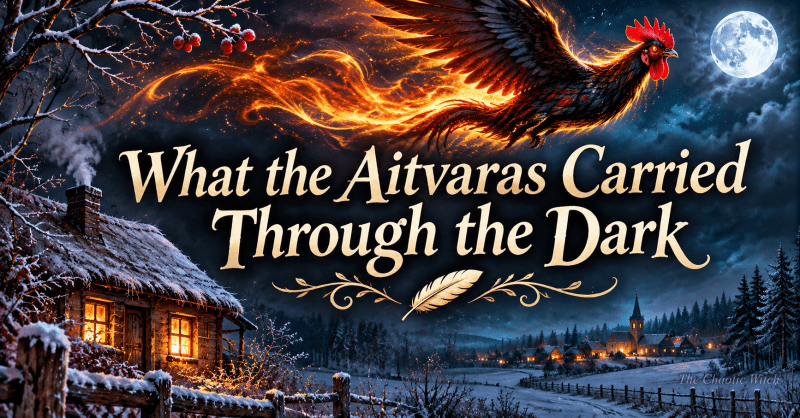
A mysterious tale inspired by the forgotten household spirits of Lithuanian folklore
The first sign that something unusual had entered Rūta’s house was the butter. It appeared on a Tuesday morning, sitting in a beautiful yellow mound upon the kitchen table, wrapped in a linen cloth that nobody in the household recognized. By Wednesday, there were three sacks of rye beneath the stairs. On Thursday, a small collection of silver coins appeared inside her father’s oldest boot. By Friday, Rūta had begun to suspect that either someone was playing an exceptionally elaborate joke or the house had developed a rather troubling habit of acquiring other people’s possessions.
Her aunt Ona, however, seemed considerably less surprised. “Did you happen to bring anything unusual home recently?” she asked, examining the butter with narrowed eyes.
Rūta considered the question. “A cracked bowl, two buttons, and a piece of rope I found beside the old bridge.”
Ona stopped cutting the bread and looked up sharply. “What sort of rope?”
“Brown. Frayed. Rather ordinary.”
“Where is it?”
“In the cupboard.”
Ona set down her knife and sighed. “Oh, you foolish girl.”
Outside, the November wind rattled the shutters, and somewhere above the chimney, something made a sound remarkably like a rooster clearing its throat.
The village lay among the forests and rolling fields of eastern Lithuania, where the autumn mornings smelled of woodsmoke and damp earth, and old stories were still treated with a certain cautious respect. Rūta was twenty-six, practical by nature, and employed as the village seamstress. She repaired everything from wedding dresses to grain sacks, although she maintained that the latter were generally better behaved.
Her aunt Ona had lived with the family for as long as Rūta could remember. She possessed a sharp tongue, an excellent memory, and an alarming collection of stories about things that sensible people were better off leaving alone. That evening, Ona placed the mysterious rope upon the kitchen table and regarded it as though it might suddenly bite her.
“Have you ever heard of an aitvaras?” she asked.
Rūta shook her head, and Ona settled into her chair. “It’s a creature that brings wealth into a household. Grain, money, food, whatever it thinks its master might desire.”
“That sounds rather wonderful,” Rūta replied.
“Does it?” Ona leaned closer, lowering her voice. “Where do you suppose it gets those things?”
Rūta looked toward the unexpected butter and felt her enthusiasm disappear. “Oh.”
“Precisely.”
According to Ona, an aitvaras could take many forms. Sometimes it appeared as a black rooster or a dark cat. Sometimes it crossed the night sky like a burning branch, dragging a long ribbon of fire behind it. It might be acquired deliberately, but unfortunate people could also bring one home without knowing what they had found.
“And the rope?” Rūta asked, glancing uneasily toward the table.
“Some stories say that’s all it takes.”
As if in answer, three heavy knocks sounded from the attic. Neither woman moved. Then something began scratching at the ceiling.
At midnight, Rūta climbed the attic stairs carrying an oil lamp, with Ona following several steps behind. “If anything leaps at us,” Ona whispered, “I intend to be extremely disappointed in you.”
The attic smelled of dust, old timber, and something faintly sweet, like warm grain. There, perched upon the wooden beam above the chimney, stood a magnificent black rooster. Its feathers shone with strange copper reflections, although no light touched them. Its eyes were the colour of burning amber, and its long tail seemed to move even when the rest of its body remained perfectly still.
The creature regarded Rūta with an expression of extraordinary intelligence. “Well,” she whispered, taking a cautious step forward. “Hello.”
The rooster opened its beak, and a thin curl of smoke escaped. Ona seized Rūta’s arm and began pulling her toward the stairs. “Downstairs. Immediately.”
But the rooster had already spread its wings. For one impossible instant, its body lengthened into a narrow streak of brilliant orange fire. It passed through the attic window without breaking a single pane and vanished into the darkness above the forest.
Rūta rushed to the glass and stared in astonishment. Across the night sky travelled a fiery shape, twisting and turning like a ribbon caught in an invisible wind. It was beautiful, it was terrifying, and it was heading toward the neighbouring farms.
The following morning, Rūta discovered six new sacks of grain in the pantry. She recognized the stitching immediately. One sack had a crooked blue patch she had sewn herself for old Petras, whose hands trembled too badly for needlework. Another bore the green thread used by the widow Kazlauskienė, who insisted that ordinary brown stitching was depressing.
Every sack belonged to somebody else, and by noon, half the village was complaining about missing supplies. Rūta spent the afternoon returning what she could, inventing increasingly ridiculous explanations for how the grain had reached her house.
“Perhaps the sacks were delivered by mistake,” she told Petras, attempting to look convincing.
“Through your locked pantry?” he asked suspiciously.
“An unusually determined deliveryman?”
Petras regarded her for a moment before shaking his head. “Rūta, have you been eating mushrooms from the forest again?”
That evening, the sacks returned. Not only those she had given back, but several more. This time, there was a little heap of silver beside the fireplace, and the unmistakable smell of scorched feathers drifting down from the attic.
Ona stared at the growing collection with a troubled expression. “It’s trying to please you.”
“By robbing everyone we know?”
“An aitvaras doesn’t concern itself with such details.”
“Well, I do.”
“Then you’d better be careful,” Ona warned. “These creatures are not known for accepting criticism graciously.”
As she spoke, something struck the roof with enough force to shake dust from the rafters. A low, furious crow echoed through the house, and both women instinctively looked toward the ceiling.
Over the next three nights, Rūta attempted everything she could imagine. She carried the rope back to the bridge, but by morning, it lay neatly coiled upon her pillow. She locked the pantry, only to discover the grain piled inside her bedroom. She scattered the coins outside, but they returned inside her father’s boots, which now seemed to have become the creature’s preferred treasury.
Meanwhile, the aitvaras grew increasingly restless. At night, its fiery shape circled the house, illuminating the windows with strange orange light. The chickens refused to enter their coop, and the horses stamped and whinnied whenever it passed overhead.
Once, Rūta found the black rooster standing upon her sewing table, watching her with such obvious displeasure that she felt compelled to apologize. “I’m not ungrateful,” she explained. “I simply don’t want my neighbours going hungry.”
The creature tilted its head, regarded her silently, and then knocked her best scissors onto the floor. “That was unnecessary,” Rūta informed it.
A thin thread of smoke curled from its beak, and Rūta decided the conversation was over.
The answer came from an unexpected place. On Sunday afternoon, old Petras arrived carrying the blue-patched grain sack. “I found this outside my door again,” he said. “Full to the brim. I thought you ought to know.”
Rūta frowned. “Again?”
He nodded and examined the sack. “And there was something peculiar about it. Someone had sewn a little white flower beside your blue patch.”
Rūta examined the stitching and immediately recognized her own work. She had sewn the flower weeks earlier while repairing the sack, simply because she had been bored. Yet she remembered seeing the same flower on the sack that had appeared in her pantry.
She suddenly understood something important. The aitvaras wasn’t creating wealth. It was moving the same possessions from house to house, carrying them back whenever she returned them. And perhaps, she thought, there was another way to deal with that.
That evening, Rūta invited every household in the village to bring their missing grain sacks to the old communal barn. Ona watched the preparations with deep suspicion.
“You’re planning something foolish,” her aunt observed.
“Almost certainly,” Rūta admitted.
“Will there be food?”
“Yes.”
“Then I’ll help.”
By nightfall, the barn was filled with villagers, each carrying a sack, a basket, or some small possession that had mysteriously disappeared during the week. Rūta stood before them, her heart hammering, wondering whether anyone would believe what she was about to say.
“I owe you all an explanation,” she began.
She told them about the rope, the black rooster, and the fire travelling across the sky. When she finished, there was a long silence. Then Petras scratched his beard and nodded thoughtfully. “My grandmother used to tell stories about such things.”
Mrs. Kazlauskienė nodded in agreement. “Mine too.”
Someone at the back whispered a prayer, while Ona folded her arms and surveyed the gathering. “Well, at least nobody’s mentioned the mushrooms.”
Rūta explained her plan. Instead of returning the stolen goods to individual homes, they would gather everything together and keep watch through the night. If the creature came, they would see exactly what it intended to do. The villagers agreed, although several looked considerably less enthusiastic when the barn doors began to tremble.
At eleven o’clock, the air grew strangely warm. At midnight, a long ribbon of fire appeared above the trees. It swept across the fields, circled the barn, and descended toward the roof. The aitvaras had come.
Rūta stepped outside and looked upward. The creature hovered above her, its body a twisting streak of flame, its fiery tail illuminating the frost upon the grass. For the first time, she understood why the old stories spoke of it with both wonder and dread. There was something magnificent about its wildness, something ancient and utterly indifferent to human rules.
“You’ve brought us plenty,” she called into the darkness. “But none of it was yours to give.”
The creature circled lower, and a shower of sparks scattered across the yard. Behind her, the villagers began carrying buckets of water toward the barn.
Rūta held up the frayed brown rope. “I don’t know whether you understand me,” she continued, trying to keep her voice steady. “But I won’t keep what you’ve stolen.”
For several moments, nothing happened. Then the fiery shape folded inward, and a black rooster landed upon the fence. Its amber eyes fixed upon Rūta, studying her with an expression she could not begin to understand.
She placed the rope on the ground, and the rooster stared at it. Then, with an indignant crow, it seized the rope in its beak, spread its wings, and rose into the air.
For one breathtaking moment, the night sky seemed to split open with orange light. The creature swept above the barn, over the waiting villagers, and beyond the dark line of the forest. Then it vanished.
Nobody spoke for a very long time. Finally, Ona broke the silence. “Well,” she said, brushing a little dust from her shawl, “that was considerably more exciting than Sunday usually is.”
Winter arrived early that year. Snow settled upon the fields, smoke rose from the chimneys, and the village returned to its familiar rhythms. The missing grain remained with its rightful owners, and no more mysterious coins appeared in anyone’s boots.
Rūta occasionally wondered whether the creature had truly departed or merely found another household to trouble. Ona refused to speculate, insisting that some things were better left wandering.
But one evening, shortly before Christmas, Rūta was sewing beside the window when she noticed something unusual above the distant forest. A narrow streak of orange light crossed the sky, moving swiftly and trailing sparks like scattered stars. Then it disappeared beyond the hills.
Rūta smiled despite herself. “Good evening, you dreadful thing,” she whispered.
From the kitchen, Ona called, “Who are you talking to?”
“Nobody.”
“Good. Keep it that way.”
Rūta returned to her sewing, but not before glancing once more toward the darkened sky. Far away, somewhere beyond the sleeping fields, a rooster crowed.
And although the village chickens were safely locked inside their coop, Rūta could have sworn that, for just an instant, the frost upon her window glowed the colour of fire.
The Folklore Behind the Story
The aitvaras is a genuine supernatural being from Lithuanian folklore, traditionally associated with households, wealth, fire, and mysterious nighttime activity. Unlike familiar household spirits that perform chores or protect their owners, the aitvaras is especially associated with bringing valuable goods into a home, often by stealing them from neighbours.
In traditional accounts, the creature may appear as a black rooster, a cat, a toad, or another small animal. When travelling through the sky, it is frequently described as a fiery object, a burning streak, or an elongated flame.
Some Lithuanian traditions describe people acquiring an aitvaras by purchasing it, hatching it from an unusual egg, or unknowingly bringing home an ordinary-looking object, such as a piece of rope. Its owner might feed it scrambled eggs or other prepared foods.
The aitvaras is not necessarily benevolent. Although it can bring prosperity, its gifts come at other people’s expense, and stories describe the creature becoming dangerous or destructive when mistreated.
Its folklore is especially fascinating because it reflects historical rural concerns about unexplained wealth, theft, household prosperity, and the belief that one family’s sudden good fortune might conceal another family’s loss.
The story incorporates several traditional characteristics: the creature’s changing appearance, its fiery flight, the mysterious rope, its theft of grain and valuables, and its unpredictable temperament. Rūta, Ona, the village, the particular encounters, and the method used to persuade the creature to leave are fictional inventions created for this story. The ending should not be understood as a documented traditional ritual for removing an aitvaras.
Sources: The Visuotinė lietuvių enciklopedija (Universal Lithuanian Encyclopedia), entry titled “Aitvaras,” documents the creature’s appearances, behaviour, origins, and household associations. Lina Būgienė, “The Supernatural Milk-stealer in Lithuanian Folklore and Its Counterparts in Other National Traditions of the Baltic Sea Region,” published in Archaeologia Baltica, Volume 15 (2011), examines the aitvaras and related beings in Baltic and Northern European folklore. “Negotiating Cultural Otherness: Translating the Names of Lithuanian Mythological Household and Water Beings,” published in Vertimo studijos (2025), discusses the aitvaras’s fiery nature, transformations, and complex relationship with household prosperity. The Lexicon of Baltic Mythology also provides historical descriptions of the aitvaras and its appearance in Lithuanian sources dating back to the sixteenth century.
A little magic is always waiting. Subscribe and step inside the circle. 🖤🔮✨


Leave a Reply