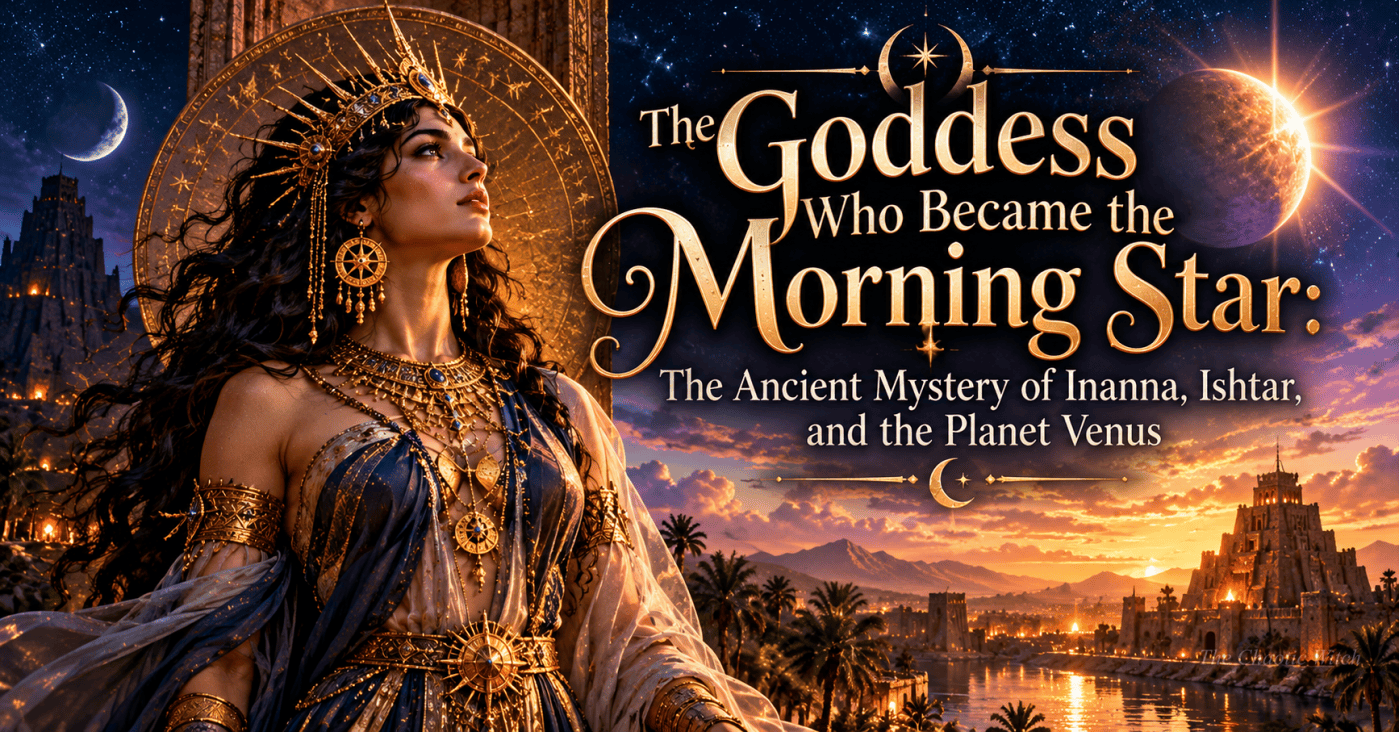
Long before humanity understood that the brilliant light appearing before sunrise was another planet, the people of ancient Mesopotamia believed they were witnessing something divine. In the darkness before dawn, when the world was still quiet and the horizon had only begun to brighten, a magnificent celestial light appeared in the eastern sky. It shone with extraordinary brilliance, sometimes outshining every other star visible to the human eye.
Then, after a period of time, it disappeared.
The same mysterious light could also be seen in the western sky after sunset, lingering above the horizon as darkness settled over the land. To ancient observers, its movements seemed almost supernatural. It appeared, vanished, returned, and shifted between morning and evening, as though travelling between the world of the living and some hidden realm beyond human sight.
That wandering light was Venus. But to the ancient Sumerians, Venus was far more than a celestial object. It was associated with Inanna, one of the most powerful, fascinating, and unpredictable goddesses in their mythology. Later, among the Akkadians, Babylonians, and Assyrians, she became closely identified with Ishtar, a goddess whose influence extended across love, sexuality, fertility, political power, and warfare.
She was beautiful, but she was not gentle. She could inspire desire and devotion, yet she could also bring destruction. She represented passion in all its forms, from the tenderness of love to the terrifying fury of battle. Perhaps most remarkably, she was a goddess who dared to enter the kingdom of death. Her story became one of the ancient world’s most extraordinary myths, a tale of ambition, sacrifice, humiliation, disappearance, and return.
Inanna was worshipped in ancient Sumer thousands of years before the classical Greek and Roman civilizations emerged. Her worship was especially important in the city of Uruk, where she was associated with the great temple complex of Eanna. She was not a minor goddess concerned with a single aspect of life. Inanna was a figure of extraordinary complexity, embodying qualities that might seem contradictory to modern readers.
She was associated with love and sexual desire, yet she was also a fierce goddess of battle. She could bestow favour upon kings, but she could also challenge authority. She was connected with abundance and fertility, yet her mythology frequently explored conflict, danger, and the unsettling consequences of power. Her divine identity resisted simple boundaries.
In one famous Sumerian myth, Inanna and Enki, she travelled to the city of Eridu and obtained the me, sacred powers or principles associated with civilization, culture, authority, and social order. She brought these powers to Uruk, strengthening the city’s prestige and her own divine influence. Inanna was not content merely to possess beauty or inspire devotion. She sought authority, knowledge, and recognition.
Her myths repeatedly portrayed a goddess determined to extend her influence, even when doing so brought her into conflict with other divine beings. This restless, formidable personality was reflected in her celestial association with Venus, a planet that seemed unwilling to behave like the fixed stars surrounding it. Venus wandered, changed position, disappeared, and returned. To those who worshipped Inanna, such a celestial presence was fitting for a goddess who refused to be confined.
One of the most remarkable features of Venus is that it appears in two distinct roles in Earth’s sky. At certain times, it rises in the east before the Sun, becoming the brilliant Morning Star. At others, it shines in the west after sunset as the Evening Star. Because Venus orbits the Sun inside Earth’s orbit, it never appears very far from the Sun in our sky. Its visibility changes as the positions of Venus, Earth, and the Sun shift.
Ancient Mesopotamian observers recognized Venus’s recurring appearances and carefully studied its movements. Its connection with Inanna and Ishtar was among the most significant celestial associations in Mesopotamian religion. The goddess’s relationship with both love and warfare has sometimes been interpreted in connection with Venus’s different appearances, although the precise origins and meanings of these associations remain subjects of scholarly debate.
In later Greek tradition, the morning appearance was called Eosphoros or Phosphoros, the bringer of dawn, while the evening appearance was known as Hesperos. Greek astronomers eventually recognized that the two appearances belonged to the same celestial body. Yet the mythology surrounding Venus was much older. For the people of Mesopotamia, its recurring appearance and disappearance made it a particularly compelling symbol of divine presence, absence, and return.
Among the surviving works of ancient Sumerian literature is Inanna’s Descent to the Netherworld, a story preserved on clay tablets written in cuneiform. It begins with a startling decision. Inanna, already a powerful goddess of heaven and earth, sets her heart upon the great below. The underworld was not a place that gods or mortals could visit casually. It was a kingdom governed by its own terrible laws, ruled by Ereshkigal, the formidable queen of the dead.
Ereshkigal was Inanna’s sister, but their relationship offered no guarantee of safety. The realm of death was not simply another territory that could be entered and conquered. Those who crossed its boundaries were subject to its authority. Before beginning her journey, Inanna prepared herself with the magnificent objects of her divine power. She wore her crown, jewels, and sacred garments. She carried the symbols of her authority, including the measuring rod and line associated with divine order. She was entering the kingdom of death, but she intended to arrive as a goddess.
Inanna also understood that she might not return. Before departing, she instructed her trusted minister Ninshubur to seek help from the great gods if she failed to emerge after three days and nights. It was a precaution that would prove essential.
When Inanna arrived at the gates of the underworld, the gatekeeper Neti demanded to know why she had come. She announced her identity and requested entry. Neti reported her arrival to Ereshkigal, who responded with anger and suspicion. The queen ordered that Inanna be admitted according to the ancient laws of the underworld.
There were seven gates, and at the first, Inanna was required to surrender her crown. At the second, another ornament was removed. At each successive gate, she lost another item of clothing, jewellery, or divine regalia. The objects differed in significance, but together they represented her status, beauty, and authority. Each time Inanna questioned the loss, she was told that the customs of the underworld could not be challenged.
By the time she passed through the seventh gate, the magnificent goddess who had entered with such confidence had been stripped of the symbols of her power. She stood vulnerable before the throne of Ereshkigal. The queen of the underworld was not impressed by her sister’s former glory. Inanna was judged, condemned, and killed. Her lifeless body was hung upon a hook.
The goddess who had commanded devotion, inspired passion, and carried the brilliance of Venus had been reduced to a corpse in the kingdom of death. For three days and three nights, she remained there. The goddess who had entered the underworld believing herself powerful enough to face its mysteries had discovered that even divine authority had limits.
Inanna’s journey was supposed to have an ending. Ninshubur waited for her return, but the goddess did not emerge from the underworld. Remembering her instructions, the faithful minister began seeking help. Ninshubur approached the great gods, pleading for intervention, but not all were willing to challenge the laws of the dead.
Eventually, help came from Enki, the god associated with wisdom, freshwater, and creative intelligence. Rather than attempting to defeat Ereshkigal through force, Enki devised a different approach. He created two extraordinary beings, commonly identified as the gala-tura and kur-jara, and sent them into the underworld with instructions. They were to approach Ereshkigal and respond compassionately to her suffering.
When they reached the queen, they found her in distress. Rather than confronting her or demanding Inanna’s release, they echoed her cries and acknowledged her pain. Their response pleased Ereshkigal. She offered them a reward, but they requested only the corpse hanging upon the hook. Ereshkigal eventually granted their request, and the beings used the life-giving substances provided by Enki to restore Inanna.
The goddess of love and war returned to life, but escaping the underworld would not be so simple. Although Inanna had been revived, the laws of the underworld still held power over her. She could leave, but she could not simply depart without consequence. A substitute would have to take her place.
As Inanna returned to the upper world, she was accompanied by fearsome underworld beings who sought someone to surrender in her stead. They encountered individuals who had mourned her disappearance, including Ninshubur. Inanna refused to give them up because their grief and loyalty mattered to her.
But when she reached her husband, Dumuzi, she discovered something that enraged her. Rather than mourning her absence, Dumuzi was depicted seated in splendid clothing upon his throne. To Inanna, his behaviour suggested that he had continued enjoying his royal status while she suffered in the realm of the dead. In her anger, she designated him as her substitute.
The underworld beings seized Dumuzi, and his fate became the subject of another cycle of mythological stories. In related traditions, Dumuzi’s sister Geshtinanna eventually shared his burden, spending part of the year in the underworld while he spent the remaining portion there. Their alternating presence and absence became associated with recurring cycles of loss and return.
These stories were deeply connected to Mesopotamian religious ideas about death, mourning, fertility, and the rhythms of existence. They also reveal something unsettling about Inanna. Her return was not a simple triumph of goodness over evil. She had survived death, but another life had become entangled in the price of her freedom. The goddess was powerful, passionate, and capable of cruelty. Ancient mythology did not require divine beings to be morally perfect. It allowed them to embody the same contradictions that existed within humanity itself.
For generations, scholars and interpreters have explored the possible relationship between Inanna’s descent and the astronomical behaviour of Venus. The connection is certainly tempting. Venus periodically disappears from the evening sky as it approaches the Sun’s apparent position. After a period of invisibility, it may emerge again as the Morning Star. Later, the pattern reverses.
A brilliant celestial light seems to vanish into the Sun’s radiance, only to return in another part of the sky. To ancient observers, such an event could inspire stories of divine journeys, concealment, and rebirth. Some modern interpretations understand Inanna’s descent as a symbolic reflection of Venus disappearing from sight and subsequently returning.
The seven gates have also inspired esoteric interpretations in which each gate represents the surrender of a particular attachment, identity, or spiritual burden. However, the surviving Sumerian text does not explicitly state that the seven gates correspond to seven astronomical stages of Venus’s disappearance. Nor does the myth provide a straightforward scientific description of the planet’s movements. The relationship between the myth and Venus is therefore best understood as a compelling interpretation rather than an established explanation for every element of the story.
Still, it is difficult not to appreciate the poetry of the connection. A goddess associated with one of the brightest lights in the sky descends into darkness, loses her power, dies, and eventually returns. The Morning Star disappears, and then, one day, it shines again.
As Mesopotamian cultures developed, Inanna became closely identified with the Akkadian goddess Ishtar. An Akkadian-language version of the descent story, commonly known as Ishtar’s Descent to the Netherworld, preserved a related but distinct narrative. In this telling, Ishtar enters the underworld ruled by Ereshkigal and passes through seven gates, losing her ornaments and clothing as she descends.
But the consequences of her imprisonment are described in especially dramatic terms. With Ishtar absent from the world above, sexual desire and reproduction cease. Animals no longer mate. Human fertility is interrupted. The ordinary continuation of life is threatened, and the world becomes strangely still.
Her disappearance reveals that her power is not merely decorative or symbolic. It is essential to the living order. Without the goddess of love and desire, life itself begins to lose its capacity to renew. Divine intervention eventually secures her release, but the story again emphasizes that passage through the underworld carries a price. The myth portrays a universe in which love, death, fertility, and loss are inseparable. The goddess who brings desire and life must confront the kingdom where all living things eventually go, and the world cannot fully flourish until she returns.
Ishtar’s association with Venus made her one of the most recognizable divine figures in the ancient Near East. She was frequently connected with the eight-pointed star, a symbol that became strongly associated with her identity. Her influence extended beyond individual myths. Kings invoked her favour, worshippers sought her blessings, and her temples occupied important positions in the religious and political life of Mesopotamian cities.
In hymns, she could be praised as a majestic queen whose power reached across heaven and earth. She was associated with erotic attraction, but also with victory in battle. She could elevate rulers and bring down enemies. The eight-pointed star became a visual reminder of her celestial identity, while the planet Venus remained one of the brightest and most remarkable objects in the night sky.
Her mythology survived in different forms and influenced later cultural traditions, although it is important not to treat every subsequent goddess of love as a direct continuation of Ishtar. Aphrodite, for example, shares certain themes and possible historical connections with Near Eastern goddess traditions, but her Greek mythology developed its own distinct identity. Over centuries, the names changed, the stories evolved, and the religious worlds that sustained them transformed. Yet Venus continued to inspire associations with beauty, desire, and divine power.
Today, Inanna and Ishtar continue to fascinate people interested in ancient mythology, goddess traditions, astrology, and modern witchcraft. For some practitioners, Inanna’s descent has become a powerful symbolic story of personal transformation. The seven gates may be interpreted as stages of releasing fear, pride, grief, unhealthy attachments, or identities that no longer serve a person’s growth.
Her death in the underworld can symbolize a period of profound change, while her return represents the emergence of a transformed self. Others find meaning in her refusal to remain powerless, her association with feminine sovereignty, or the complicated relationship between love and strength.
Venus itself continues to hold a special place in contemporary astrological and magical correspondences. The planet is traditionally associated with Friday, the colour green in many modern systems, copper, roses, beauty, friendship, affection, and harmony. Its appearance as the Morning Star may be interpreted spiritually as a symbol of awakening, courage, and renewed beginnings. Its Evening Star appearance is sometimes connected with reflection, relationships, and the quieter mysteries of desire.
These are contemporary spiritual interpretations, not uniform beliefs held by all ancient Mesopotamians, and they should be distinguished from the historical religious practices surrounding Inanna and Ishtar. Yet the symbolism remains evocative. The Morning Star is a light that returns after disappearing, and sometimes that is precisely the story people need.
There is something particularly haunting about the story of Inanna because she was not a helpless figure dragged unwillingly into the underworld. She chose to descend. She entered a kingdom where her power could not protect her, where her magnificent possessions meant nothing, and where even a goddess could be brought to her knees.
At each gate, another symbol of her identity was taken away. Eventually, nothing remained of the splendour with which she had entered. And yet her story did not end there. Through the loyalty of Ninshubur, the wisdom of Enki, and the strange intervention of beings who answered suffering with compassion, she returned to the living world.
Her journey was neither painless nor without consequences. It was a story of death and survival, but also of pride, loyalty, sacrifice, and the complicated nature of power. Perhaps that is why it has endured for thousands of years.
Long after the temples of Uruk fell silent, long after the great civilizations of Mesopotamia disappeared into history, the planet associated with Inanna continued its journey through the heavens. It still appears before sunrise, shining above the eastern horizon while the world remains wrapped in darkness. On other evenings, it glows in the west, following the Sun toward the horizon.
Modern astronomy can explain precisely why Venus appears and disappears, but science does not erase the ancient stories people told about it. The goddess may no longer be worshipped in the great temples that once honoured her, but her mythology survives in the words preserved on clay tablets, in the eight-pointed star, and in the enduring image of a divine woman who entered the kingdom of death and returned.
Every time Venus emerges again from the brilliance of the Sun, the sky offers a reminder of the ancient goddess who vanished into darkness. The world may have forgotten many of her temples, her priests, and her sacred ceremonies, but the Morning Star still rises.
And Inanna’s story is still being told.
A little magic is always waiting. Subscribe and step inside the circle. 🖤🔮✨


Leave a Reply