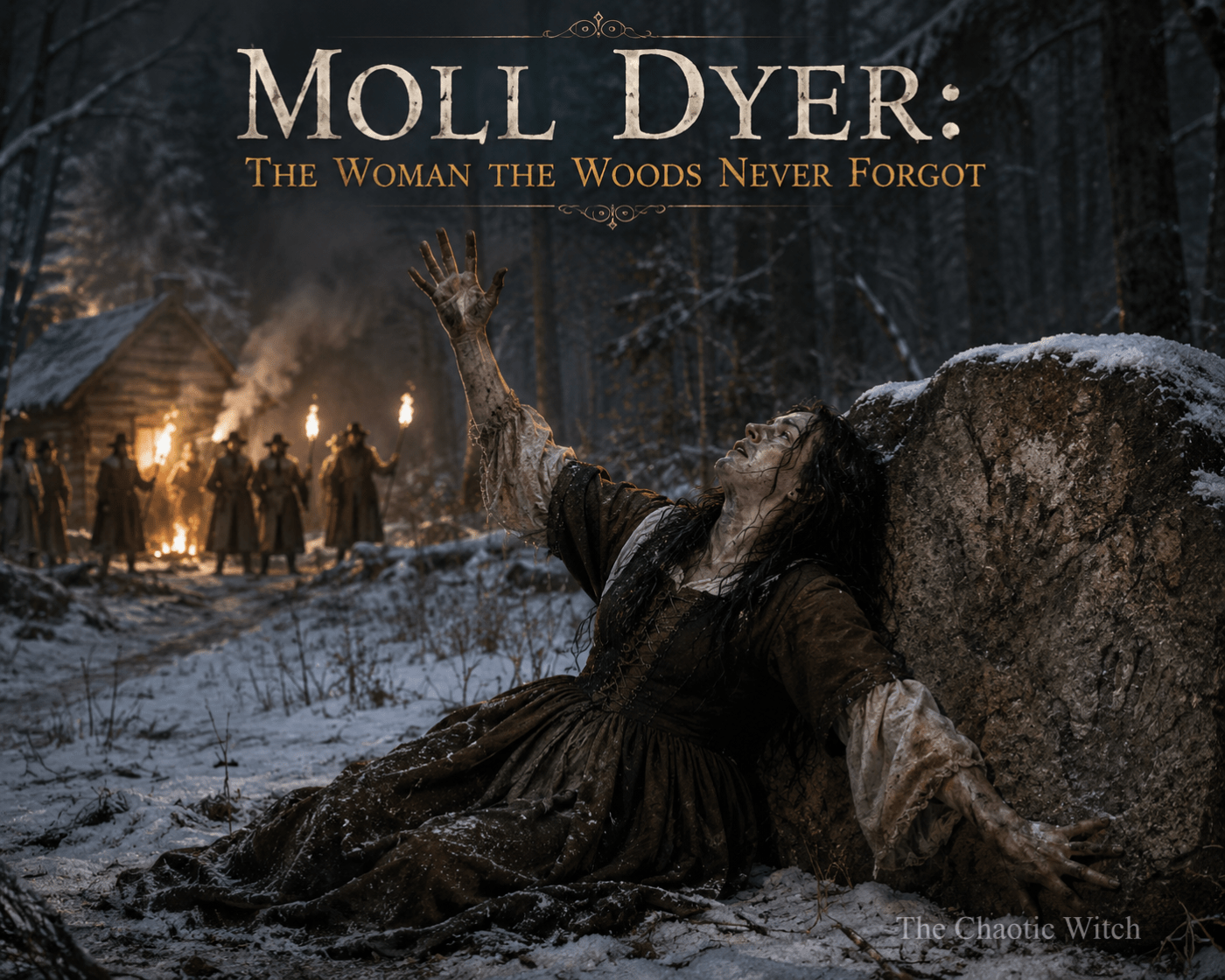
Long before the roads and buildings of modern Leonardtown, Maryland, there were thick forests, scattered farms and small settlements where life could be difficult and uncertainty was often frightening. It was in this landscape, sometime around the late seventeenth century, that legend places a mysterious woman named Moll Dyer. She is remembered today as the “Witch of Leonardtown,” although separating the real woman from the centuries of folklore surrounding her is not an easy task.
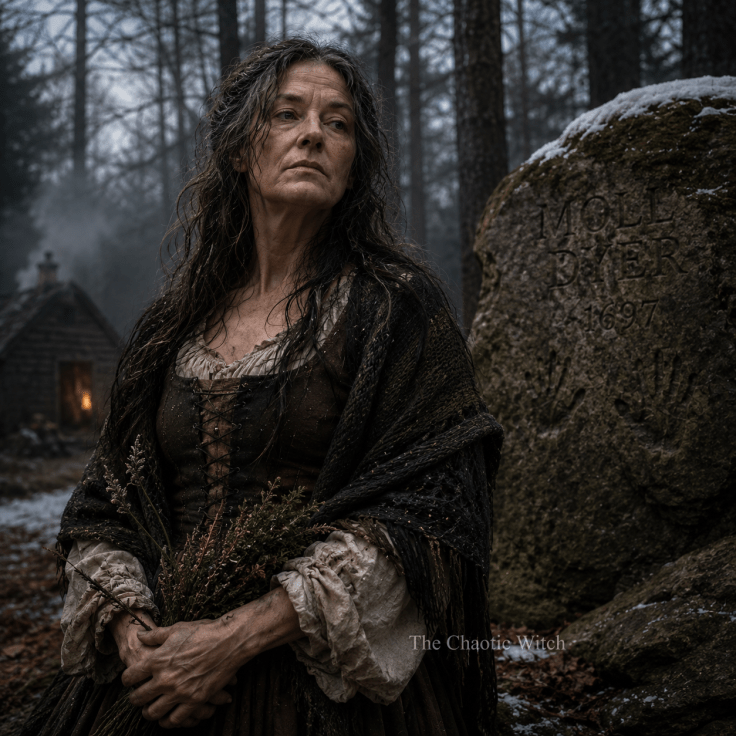
According to the story passed down through generations in St. Mary’s County, Moll lived alone in a small cabin away from most of the settlement. She was said to be an outsider, a woman who preferred the solitude of the woods to the company of her neighbours. Some versions of the legend describe her as knowledgeable about herbs and natural remedies, while others suggest she followed spiritual or cultural traditions that were unfamiliar to the European settlers around her. Whatever the truth may have been, Moll was different enough to attract suspicion.
Then the community began experiencing trouble. An illness reportedly swept through the settlement. People became sick, crops struggled and livestock were said to have died. In a time when disease and crop failures were poorly understood, frightened people sometimes searched for someone to blame. Before long, according to the legend, suspicion settled on the solitary woman living beyond the edge of town.
People began whispering that Moll Dyer was a witch.
There was no scientific investigation and no evidence that Moll had caused the community’s problems. Fear was enough. As the stories spread, ordinary misfortunes became proof of something sinister. If a cow became sick, Moll could be blamed. If someone developed a fever, perhaps Moll had cursed them. The more frightened the community became, the more dangerous the accusations became for the woman living alone in the woods.
Then came the night that would make Moll Dyer a legend.
It was reportedly one of the coldest nights of the winter. Snow covered the ground, and bitter winds moved through the Maryland forest. According to the traditional account, a group of angry townspeople gathered and made their way toward Moll’s cabin.
Some versions of the story say they demanded that she leave the community. Others say the mob surrounded her home and set the cabin on fire.
Either way, Moll realized she had to run. She fled from the cabin and disappeared into the freezing darkness of the forest.
There would have been few places for her to go. The surrounding countryside was wooded and isolated, and the winter conditions were brutal. Without shelter, Moll wandered through the snow while temperatures continued to fall.
The people who had driven her from her home eventually returned to their own houses.
Moll never returned to hers.
The following day, according to the legend, people went looking for her. They followed her path through the snow and deeper into the forest until they came upon a large stone.
There they found Moll and she was dead.
The story says she had collapsed beside the rock after spending the night exposed to the freezing weather. Her body was supposedly positioned strangely. One hand rested against the stone while the other was raised toward the sky, as though she had been reaching toward something, or perhaps calling upon something, in the final moments of her life.
When her body was removed, the legend says something impossible was discovered. Impressions of Moll’s hand and knees had somehow been left in the stone. Then came the darkest part of the story.
Moll was said to have cursed the people who had driven her into the forest. Exactly what she supposedly said varies depending on who tells the story, but the message remained essentially the same: the community responsible for her suffering would never completely escape what it had done.
Soon, stories of strange happenings began circulating. People travelling through the woods claimed to hear unexplained noises or voices when nobody else was nearby. Some reported seeing the figure of an elderly woman moving between the trees, only for her to disappear when approached. Others described mysterious lights appearing in the forest after dark.
And then there was the rock.
The stone where Moll supposedly died became known as Moll Dyer’s Rock. Over generations, people began claiming there was something unusual about it. Some said the stone remained strangely cold even during warm weather. Others claimed touching it caused dizziness, nausea or an overwhelming feeling of uneasiness.
The story became so deeply embedded in local folklore that Moll Dyer’s Rock itself was eventually preserved. Rather than remaining forgotten somewhere in the forest, the stone became a physical reminder of the legend that had been passed from one generation to another.
But there is an important complication to Moll’s story.
Historians have never been able to prove every part of it.
Records indicate that people with the Dyer surname lived in colonial St. Mary’s County, lending at least some historical foundation to the legend. What researchers have struggled to find is contemporary documentation showing that a woman named Moll Dyer was formally accused of witchcraft and died exactly as the story describes.
There is no surviving witchcraft trial comparable to the records left behind by the Salem witch trials. There is no known seventeenth-century document describing a mob chasing Moll from her cabin or discovering her frozen beside the stone.
That means Moll Dyer’s story exists somewhere between history and folklore.
It is possible that there was a real woman whose tragic death became embellished as the story was passed down. Details may have been added, forgotten or changed over generations. It is equally possible that several events or people eventually became combined into the single character remembered as Moll Dyer.
But legends often reveal something important even when every supernatural detail cannot be proven.
Whether or not Moll left her handprint in stone, accusations of witchcraft could be deadly. Women who lived outside accepted social expectations, practiced folk healing, behaved differently from their neighbours or simply found themselves blamed for unexplained misfortune could become targets of suspicion.
That may be the most haunting part of Moll Dyer’s story.
Perhaps there was never a curse.
Perhaps there was never anything supernatural in those woods at all.
Perhaps there was simply a woman living alone who became the convenient explanation for circumstances frightened people could not understand.
And on one bitter winter night, those people decided she was responsible.
They drove her into the forest.
By morning, she was dead.
Centuries later, the community that once supposedly feared Moll Dyer continues to remember her. Her name survived. Her rock survived. And the story of the lonely woman accused of witchcraft still drifts through the folklore of southern Maryland like a whisper through the trees.
Maybe that is Moll Dyer’s real legacy. She didn’t need to place a curse on the people who condemned her.
They made certain her story would haunt them all on its own.
A little magic is always waiting. Subscribe and step inside the circle. 🖤🔮✨


Leave a comment