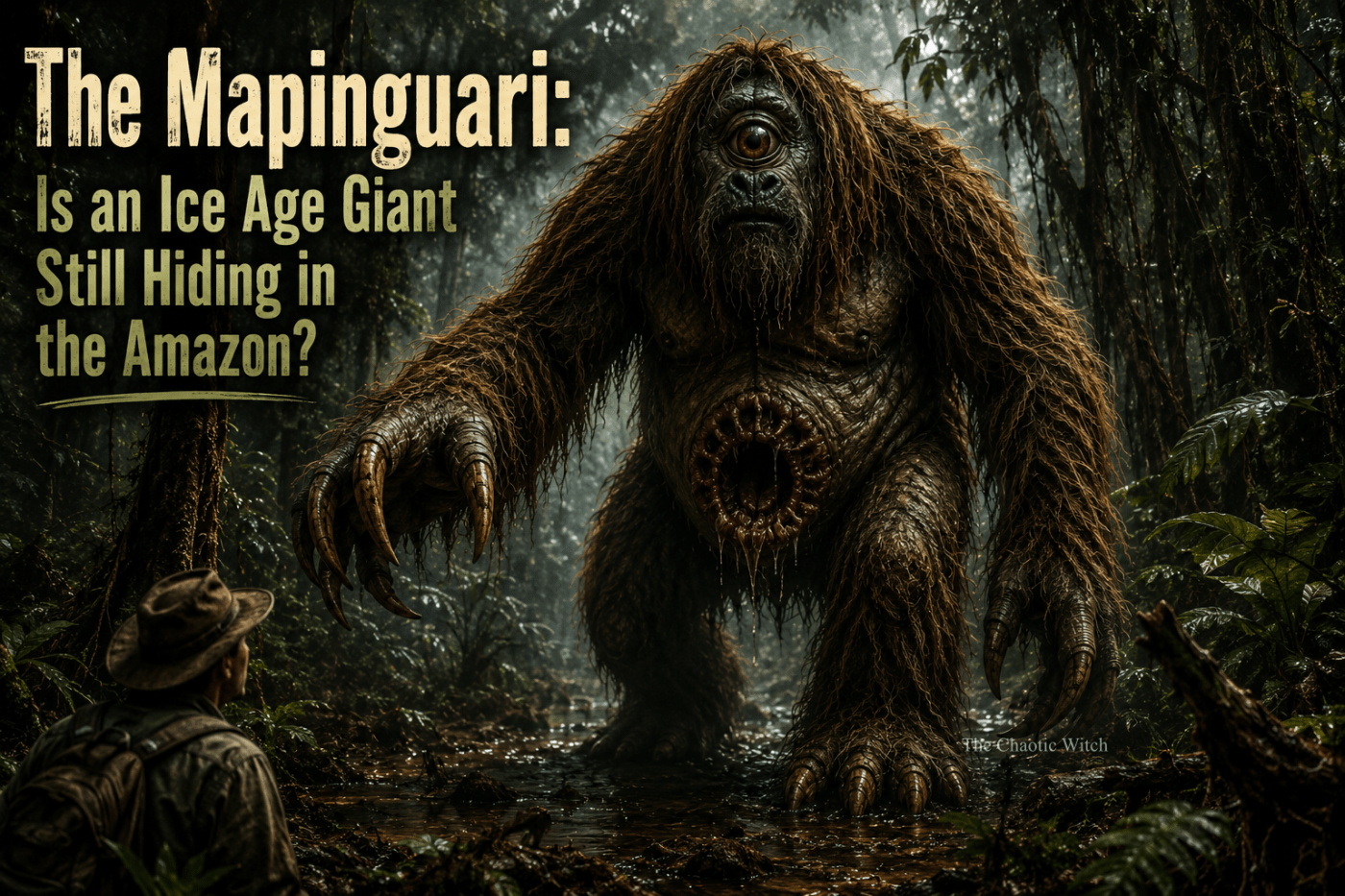
Deep within the Amazon rainforest, there are places where the trees grow so densely that daylight struggles to reach the forest floor. Rivers twist through thousands of kilometres of wilderness, strange cries echo through the canopy, and animals can disappear into the vegetation only a few metres away. It is exactly the kind of place where stories of unknown creatures can survive for generations.
Among the strangest of those stories is the legend of the Mapinguari.
For generations, stories told among Indigenous and rural communities of the Amazon have described a powerful and terrifying being roaming the forest. There is no single description of the Mapinguari, and the stories vary considerably depending on where and by whom they are told. In some traditions, it is much more than an unidentified animal. It is something supernatural, a dangerous presence associated with the wilderness itself.
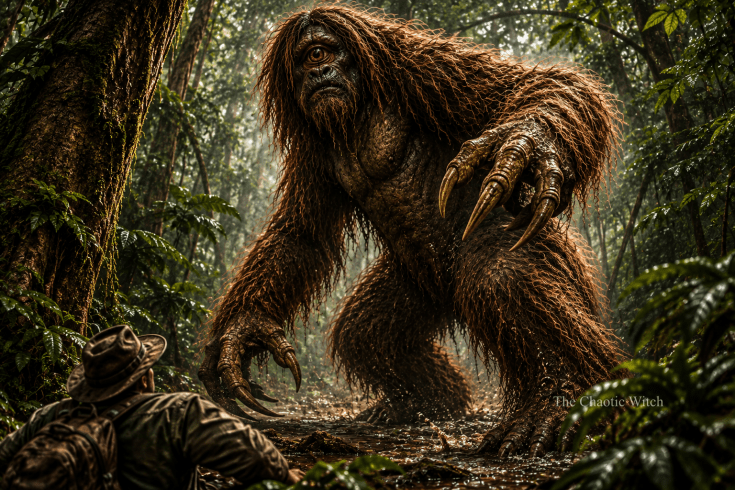
Some versions describe the Mapinguari as an enormous, hairy creature capable of walking upright. Its body is said to be covered in coarse reddish, brown or dark hair, and enormous claws extend from its limbs. It is supposedly incredibly strong and capable of producing frightening cries that carry through the forest.
But according to many stories, you might smell the Mapinguari before you ever see it.
One of the creature’s most frequently repeated characteristics is an unbearable odor. Those who claim to have encountered it have described a stench so powerful that it could supposedly cause nausea, dizziness or even disorientation. In a forest already filled with unfamiliar sounds and smells, the sudden appearance of such an odor became one of the warning signs that something dangerous might be nearby.
The older folkloric descriptions become considerably stranger. Some portray the Mapinguari with only one eye. Others describe a second mouth located somewhere around its abdomen. Its skin is sometimes said to be so thick that arrows or even bullets cannot penetrate it. There are also stories claiming that its feet point backward, confusing anyone attempting to follow its tracks through the forest.
These details make the Mapinguari far more complicated than simply an Amazonian version of Bigfoot. In some traditions, the creature is connected to the idea of protecting the forest. Hunters who take too much, disrespect the wilderness or venture into places where they shouldn’t may find themselves confronted by the Mapinguari. In those stories, the creature isn’t simply hiding in the jungle. It belongs there.
For most outsiders, the Mapinguari could easily have remained another fascinating creature of folklore. But during the twentieth century, something unusual happened. Scientists and cryptozoologists began wondering whether at least some of the stories might have been inspired by a real animal.
And not just any animal.
A prehistoric one.
Thousands of years ago, South America was home to enormous ground sloths. Unlike the small tree-dwelling sloths familiar today, these animals lived primarily on the ground. Some species grew extraordinarily large. The famous Megatherium, for example, could reach elephant-like proportions and was capable of standing upright on its powerful hind legs.
Ground sloths possessed enormous curved claws, heavily built bodies and unusual feet. Covered in hair and standing upright, one would have looked remarkably strange—and probably terrifying—to anyone encountering it unexpectedly.
Most mainland giant ground sloths disappeared around the end of the Pleistocene, roughly 10,000 to 12,000 years ago. Scientists know them from fossils.
But what if a population survived?
That possibility became particularly associated with Brazilian ornithologist David Oren, who became fascinated by stories of the Mapinguari. Oren spent years collecting accounts from people living and working in the Amazon who claimed to have encountered enormous unidentified creatures.
Some of the descriptions caught his attention.
People spoke of a large animal covered with coarse hair. They described powerful claws, an ability to rise upright and a strong, unpleasant smell. Some accounts included unusual footprints that witnesses interpreted as facing backward.
To Oren, certain aspects sounded surprisingly similar to what might be expected from a surviving ground sloth.
Even the strange footprints offered an intriguing possibility. Ground sloths had unusual foot anatomy and did not walk like familiar modern mammals. An unfamiliar track discovered in mud could potentially appear backward to someone who had never seen anything similar.
Suddenly, the legend of the Mapinguari had an extraordinary new interpretation.
Perhaps people weren’t seeing a supernatural monster at all.
Perhaps they were encountering a survivor from the Ice Age.
It was a fascinating idea, but there was—and remains—a major problem.
No scientifically verified evidence has ever demonstrated that giant ground sloths still exist.
There is no confirmed modern skeleton, body, living specimen or scientifically accepted DNA sample. There are no clear photographs or videos capable of establishing that such an animal survives in the Amazon. Despite decades of stories and occasional investigations, the physical evidence required to prove the existence of a surviving ground sloth has never appeared.
There are also more ordinary explanations for some encounters.
The Amazon contains plenty of animals capable of frightening someone who encounters them unexpectedly. Tapirs can grow surprisingly large. Giant anteaters possess enormous claws and can rise onto their hind legs when threatened. Other mammals moving through dense vegetation can appear dramatically different when seen only briefly.
Then there is the rainforest itself.
Visibility can disappear within metres. Heavy rain can erase tracks. Vegetation can conceal enormous animals. Heat and moisture accelerate decomposition, and scavengers can quickly scatter remains. Sounds travel strangely through dense forest, and many animals make cries that seem almost impossible when the source isn’t visible.
It is an environment practically designed to create mysteries.
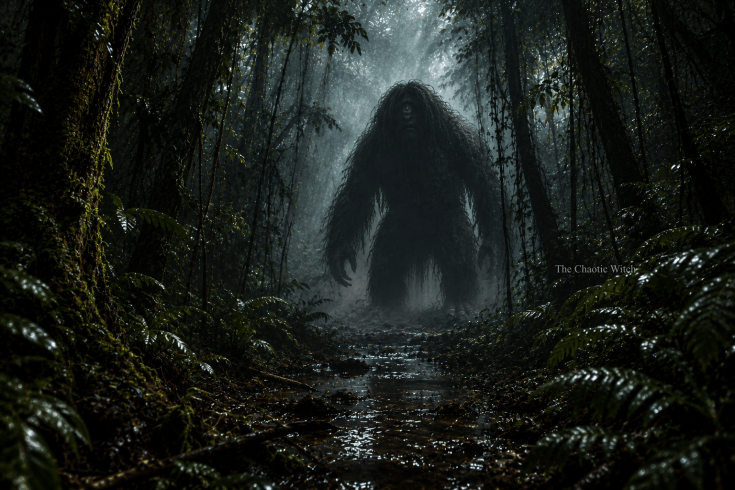
At the same time, scientists really do continue discovering species in the Amazon. Its biodiversity is enormous, and parts of the region remain difficult to study thoroughly. That reality keeps a tiny door open in the imagination whenever stories emerge about something unknown moving among the trees.
But discovering an unknown frog, insect or small mammal is very different from discovering a breeding population of enormous prehistoric mammals. Animals the size of giant ground sloths would require food, territory and enough individuals to maintain a population. Eventually, they should leave behind convincing physical evidence.
So far, they haven’t.
There is another important complication. The Mapinguari should not necessarily be treated as though every story describes a biological animal waiting for science to discover it. Indigenous traditions can carry spiritual, cultural and symbolic meanings that are lost when outsiders attempt to turn every legendary being into a cryptozoological puzzle.
The Mapinguari with one eye, impenetrable skin and a mouth in its abdomen clearly belongs to a very different tradition from accounts describing a large, hairy animal glimpsed moving through the forest. Over generations, folklore, alleged eyewitness encounters and cryptozoological speculation have become intertwined until separating one from another can be difficult.
And perhaps that is exactly why the Mapinguari remains so fascinating.
It exists somewhere between mythology and natural history.
There is no reliable evidence that a giant unknown monster currently stalks the Amazon, and the surviving-ground-sloth hypothesis remains highly speculative. Yet enormous ground sloths were not imaginary creatures. They really existed. They really walked across South America, armed with huge claws and capable of towering over a human when standing upright.
That fact gives the Mapinguari legend an unusual connection to reality.
Perhaps the stories preserve echoes of older traditions that changed as they were passed from one generation to another. Perhaps sightings involved known animals glimpsed under extraordinary circumstances. Perhaps some accounts were exaggerated around fires and hunting camps until an unusual animal became a monster.
Or perhaps somewhere in one of the world’s largest and most complicated wildernesses, people occasionally encountered something they simply couldn’t identify.
For now, the Mapinguari remains exactly where a creature like it seems to belong—in the shadowy space between the known and unknown, somewhere beyond the next wall of trees.
And when you remember that something remarkably similar to the less fantastical descriptions of the Mapinguari really did once roam South America, the legend becomes just a little more unsettling.
Because the question isn’t whether enormous ground sloths ever existed.
We know they did.
The mystery is whether every last one of them truly disappeared.
A little magic is always waiting. Subscribe and step inside the circle. 🖤🔮✨


Leave a comment