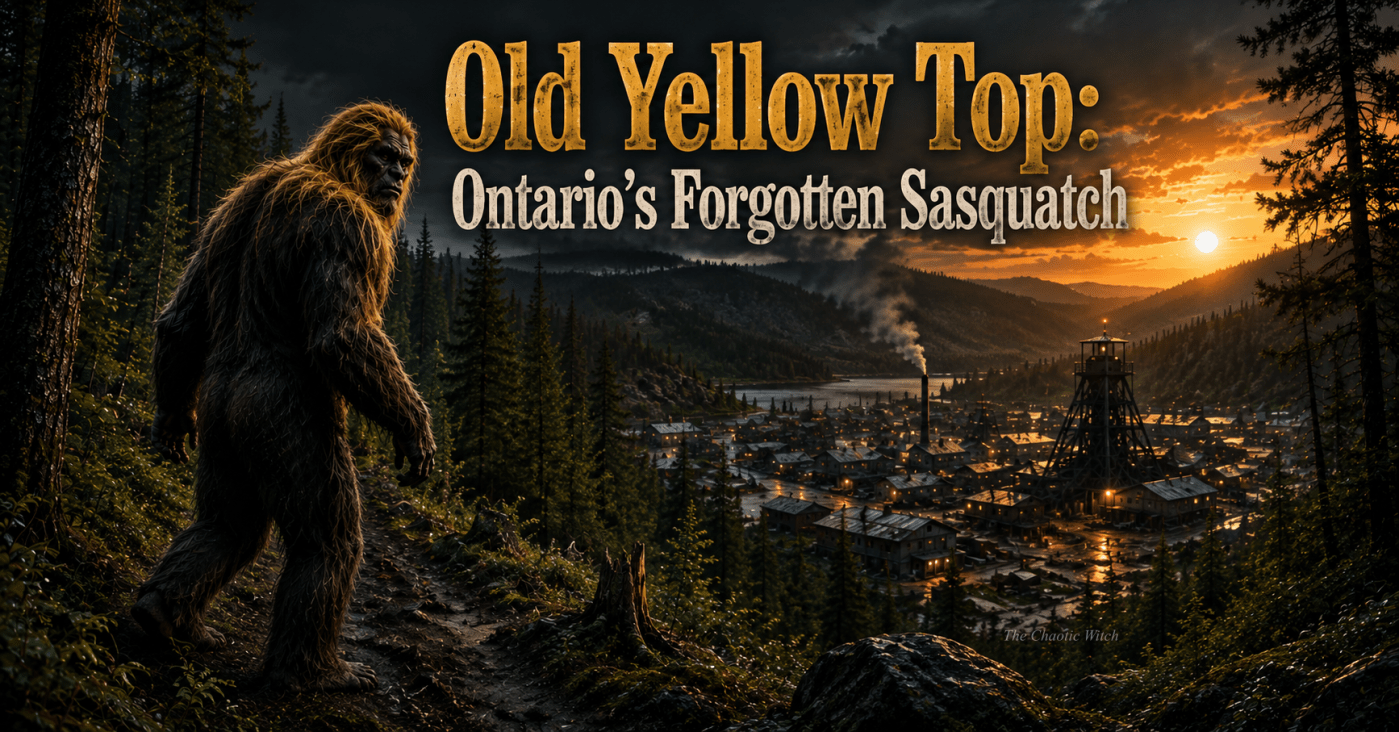
Old Yellow Top is one of Ontario’s strangest – and surprisingly old – Sasquatch legends. Unlike many cryptids that spring from a single dramatic encounter, reports of this creature around Cobalt in northeastern Ontario stretched across more than six decades. What supposedly distinguished it from an ordinary Sasquatch was a very noticeable patch or mane of yellowish-blond hair around its head and shoulders, contrasting with the dark hair covering the rest of its body.
The story appears to begin in September 1906, during Cobalt’s famous silver-mining boom. Workers constructing the headframe at the Violet Mine, east of Cobalt, reportedly saw a large, hairy, humanlike creature near the mine. Unfortunately, the surviving account is sparse and appears to come from newspaper stories published years afterward, so some of the details attached to the encounter may have developed over time. Still, it became regarded as the first Old Yellow Top sighting.
A much more detailed encounter reportedly occurred 17 years later, in July 1923. Prospectors J. A. MacAuley and Lorne Wilson were working mining claims northeast of the Wettlaufer Mine when they noticed something in a blueberry patch. Initially, they thought they were looking at a bear, which would have been completely unsurprising in northern Ontario.
According to the account later published in the North Bay Nugget, Wilson threw a stone toward the animal. The creature then reportedly stood upright, growled at the men and ran away. Wilson described it as covered in dark or black hair but with a distinctly yellowish head. He was adamant that whatever they had encountered did not resemble any bear he had previously seen.
That unusual coloring became the creature’s calling card, eventually earning it the name Old Yellow Top.
Another significant sighting was reported in April 1946. A woman and her son who lived near Gillies Depot were reportedly walking along the railway tracks toward Cobalt when the woman spotted a dark, hairy animal leaving the tracks and entering the bush near Gillies Lake.
She apparently did not get close enough for a detailed examination, but she noticed two unusual characteristics: its head appeared considerably lighter than the rest of its body, and she thought it walked almost like a person. Newspaper coverage reportedly even mentioned the possibility of organizing a search for the mysterious creature.
Some modern retellings date this encounter to 1947. However, a surviving reproduction of the North Bay Nugget article is dated April 16, 1946, making 1946 the better-supported date.
Then came what may be the most dramatic Old Yellow Top encounter.
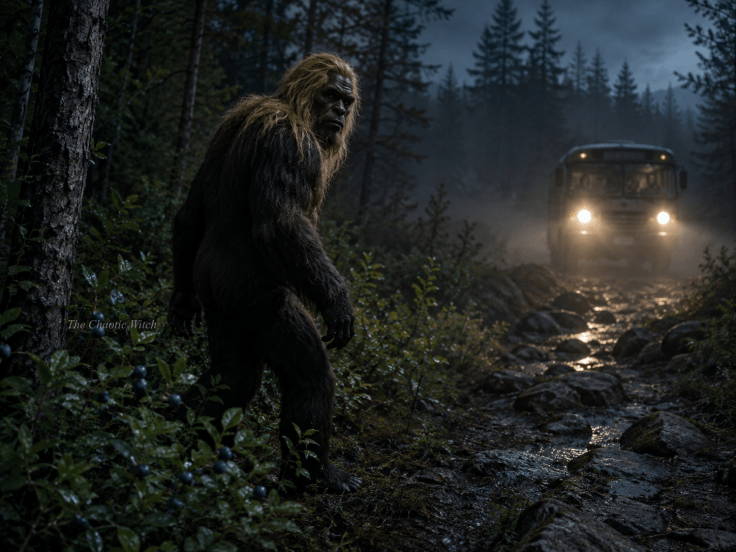
On August 4, 1970, a bus carrying approximately 27 miners was travelling through the Cobalt area when something reportedly appeared on the road ahead. The driver initially thought it was a large bear. As the headlights illuminated the animal, however, witnesses described light-colored or yellowish hair extending around its head and toward its shoulders and an unusual, somewhat stooped way of moving.
The driver swerved to avoid it, and the bus reportedly came dangerously close to going over a rock cut.
Not everyone aboard was convinced that they had encountered a mysterious creature. At least one passenger reportedly acknowledged that it could have been an injured bear. That detail is particularly interesting because it provides a possible ordinary explanation from someone connected to the encounter itself.
The 1970 incident appears to have been the last famous historical sighting specifically attributed to Old Yellow Top.
If every sighting between 1906 and 1970 represented the same individual creature, Old Yellow Top would have been roaming the forests surrounding Cobalt for at least 64 years. It presumably would already have been reasonably large when first encountered, making its actual lifespan even longer.
That raises an obvious problem.
Rather than one extraordinarily long-lived creature, it is possible that witnesses encountered several different animals over the decades. Once the story of a strange yellow-headed creature became part of Cobalt folklore, later unusual encounters may simply have been attributed to the already-famous Old Yellow Top.
There is also a much more conventional suspect: the American black bear.
Black bears are common throughout northern Ontario and are particularly fond of berries. They can stand upright and occasionally move for short distances on their hind legs. Their coloring can also vary considerably between individuals. An unusually colored bear, particularly one with lighter fur around its head or shoulders, could potentially create a surprisingly strange silhouette.
Interestingly, bears repeatedly appear in the Old Yellow Top accounts.
The men in the 1923 encounter initially thought the creature eating blueberries was a bear. Decades later, people involved in the 1970 encounter also initially believed the animal in the road was a bear.
Only after observing its movement, coloring or apparent body shape did witnesses become convinced that they had seen something different.
Believers in Old Yellow Top point to that same fact for a different reason. These were miners, prospectors and residents of northern Ontario—people who lived and worked in bear country. Seeing a black bear would hardly have been remarkable. According to their accounts, there was something sufficiently unusual about this particular animal to convince them that it was not an ordinary bear.
Unfortunately, there has never been physical evidence capable of settling the mystery. No verified body, DNA, photograph, hair sample or scientifically authenticated footprint has established the existence of Old Yellow Top.
What remains is a fascinating piece of northern Ontario folklore with unusually deep historical roots.
Long before social media, viral monster videos or online cryptid communities existed, people around the isolated mining communities surrounding Cobalt were already telling stories about a large, dark-haired creature with a strange yellowish mane wandering through the northern Ontario wilderness.
Whether Old Yellow Top was an unknown animal, several unusually colored bears, misidentification strengthened by decades of storytelling, or simply one of Ontario’s greatest cryptid legends, something about those old reports has allowed the creature to remain part of Cobalt folklore for more than a century.
Sources: North Bay Nugget historical reporting, Sasquatch Canada, Bigfoot Field Researchers Organization, John Green’s Sasquatch: The Apes Among Us, Coleman Township historical and tourism material, Skeptical Inquirer.
A little magic is always waiting. Subscribe and step inside the circle. 🖤🔮✨


Leave a Reply