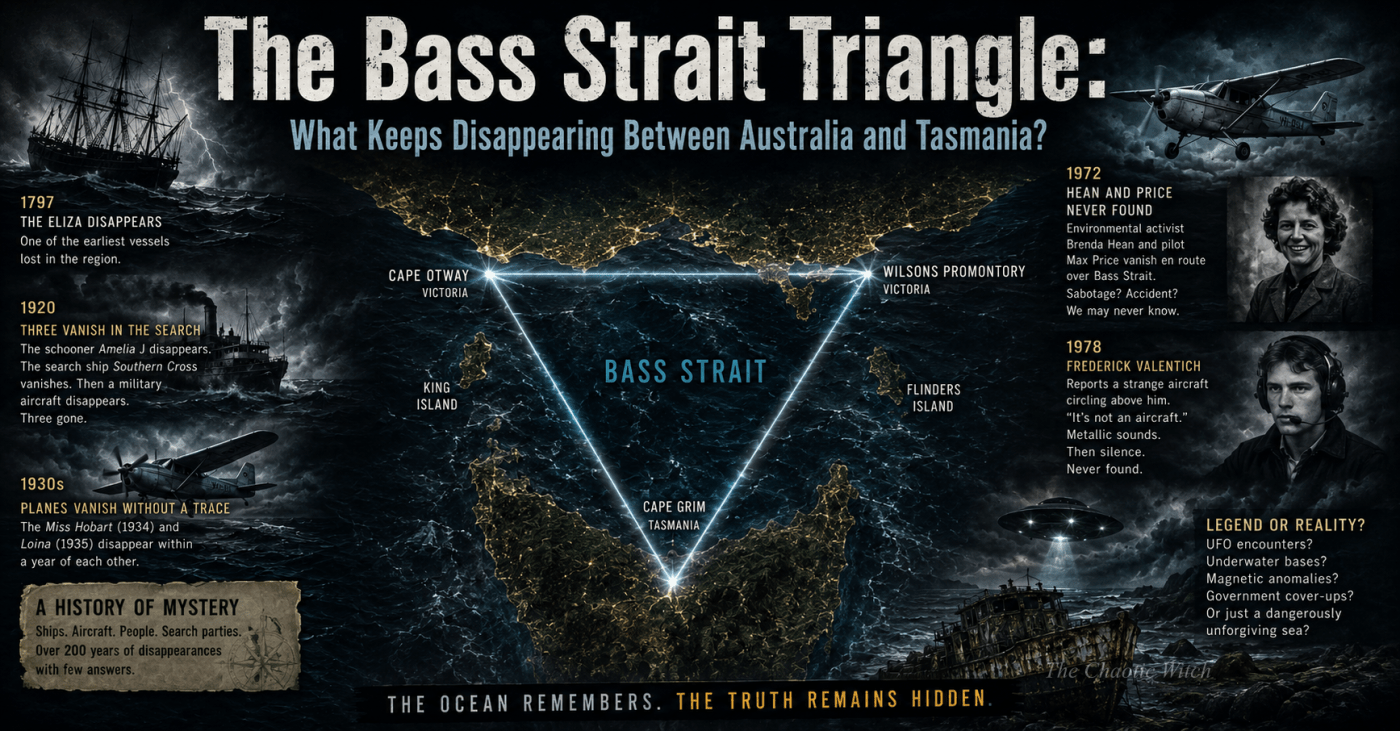
Between mainland Australia and Tasmania lies a stretch of ocean with a reputation that seems almost too strange to be real.
Ships have vanished there. Aircraft have disappeared. Search parties have gone looking for the missing and, in some cases, disappeared themselves. There have been reports of strange lights, unexplained aerial objects and a pilot whose final radio transmission suggested that whatever was circling his aircraft was something he couldn’t identify.
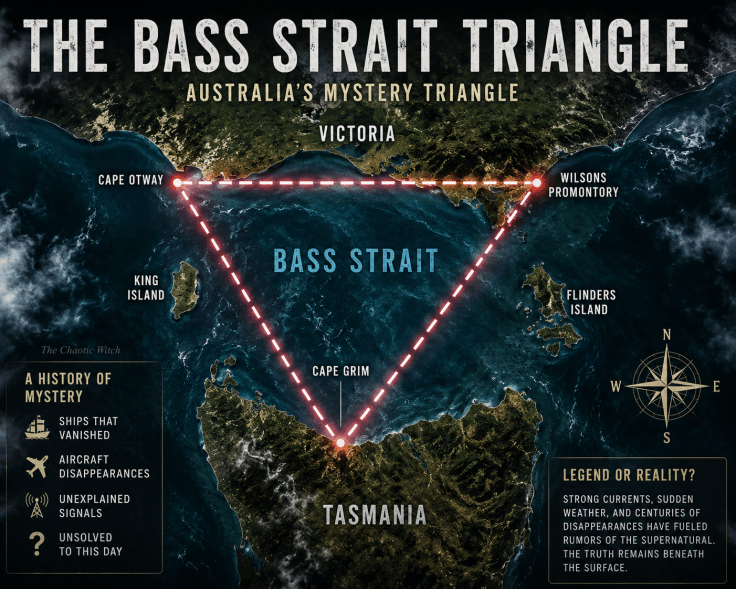
It has become known as the Bass Strait Triangle.
There are no universally accepted boundaries to this supposed triangle, and scientists haven’t identified anything paranormal about Bass Strait. Officially, it is simply a notoriously difficult body of water with dangerous weather, strong currents, reefs, islands and rapidly changing conditions.
But conspiracy theorists would ask a different question.
How many disappearances does it take before coincidence stops feeling like coincidence?
The stories stretch back more than two centuries. Ships disappeared in Bass Strait during the earliest years of European navigation through the region, sometimes leaving remarkably little behind. In those days, disappearing at sea wasn’t particularly mysterious. Navigation was primitive, weather forecasts didn’t exist, charts were incomplete and wooden vessels could be overwhelmed quickly.
Still, as the decades passed, the disappearances continued.
Then came 1920.
The schooner Amelia J vanished while travelling through the region in September of that year.
Authorities launched a search.
Among the vessels participating was the Southern Cross.
It disappeared too.
Then an Australian military aircraft, an Airco DH.9A, was sent to assist with the search.
It also vanished.
Three disappearances connected to a single search operation.
Wreckage associated with the Southern Cross was eventually found on King Island, providing at least part of the answer. But the Amelia J was never recovered, and neither was the missing aircraft.
To skeptics, it was a terrible chain of accidents occurring in dangerous conditions.
To believers, it was the beginning of a pattern.
Whatever had swallowed the Amelia J seemed almost to have taken the people who went looking for it.
The mysteries didn’t stop when aviation improved.
In October 1934, the passenger aircraft Miss Hobart disappeared while crossing Bass Strait. Only limited wreckage was recovered.
Less than a year later, another airliner, Loina, disappeared near Flinders Island. Five people were aboard. No bodies were recovered.
Later examinations of those early aviation disasters produced reasonable explanations involving aircraft design, weather and human error. There is no credible evidence connecting the crashes to anything paranormal.
But by then, Bass Strait had developed an unsettling habit.
People entered it.
Sometimes they didn’t come back.
And sometimes there wasn’t enough left behind to explain why.
One of the strangest disappearances came in 1972.
Environmental activist Brenda Hean was fiercely opposed to the flooding of Tasmania’s Lake Pedder. On September 8, she boarded a Tiger Moth aircraft piloted by Max Price. They were reportedly heading toward Canberra as part of Hean’s environmental campaign.
They disappeared over or near Bass Strait.
No confirmed wreckage was ever recovered.
Because Hean was involved in a bitter political and environmental battle, another possibility quickly entered the story.
Sabotage.
Rumours circulated that someone might have wanted to stop her.
There is no established evidence proving that Hean and Price were murdered or that their aircraft was deliberately sabotaged. An aviation accident remains entirely plausible.
But the absence of an aircraft, bodies or a definitive explanation created exactly the kind of vacuum in which conspiracy theories thrive.
And then, six years later, something happened over Bass Strait that changed the legend completely.
On October 21, 1978, 20-year-old pilot Frederick Valentich departed Moorabbin Airport in a Cessna 182L for a flight toward King Island.
At first, there was nothing extraordinary about the journey.
Then Valentich radioed Melbourne Flight Service.
He wanted to know whether there was another aircraft in his area.
There wasn’t supposed to be.
Valentich reported seeing something above him.
He described lights. He said the object appeared to be travelling at considerable speed. At different points during the encounter, he described four bright lights, a shiny or metallic-looking surface and a green light.
Whatever it was, Valentich believed it was circling or orbiting above his aircraft.
Air traffic control couldn’t identify another aircraft in his vicinity.
Then Valentich reported trouble with his engine.
The conversation became increasingly strange.
Eventually, the controller asked him to identify the aircraft he was observing.
Valentich gave the statement that would turn his disappearance into one of the most famous UFO cases in Australian history.
“It’s not an aircraft.”
Shortly afterward, his transmission ended.
Unusual noises were heard over the radio.
Then there was silence.
Frederick Valentich and his Cessna were gone.
Despite an enormous search of Bass Strait, neither the pilot nor the aircraft was conclusively recovered.
Suddenly the old stories about missing ships and aircraft looked very different.
For UFO researchers, Valentich had essentially provided a live description of an unidentified object immediately before disappearing.
And that’s where the Bass Strait conspiracy theories become considerably stranger.
One theory proposes that the region is some kind of UFO corridor, a location where unidentified craft have repeatedly been observed travelling between the Australian mainland and Tasmania.
An even more extreme variation suggests that something beneath Bass Strait could be responsible.
An underwater base.
There is no physical evidence demonstrating that such a facility exists. But believers point toward the combination of unexplained lights, disappearing aircraft and deep stretches of ocean as circumstantial support for the idea that unidentified objects might be entering or leaving the water.
This overlaps with stories about so-called USOs – unidentified submerged objects – the underwater counterpart to UFOs.
Others believe the answer isn’t extraterrestrial at all.
They propose unusual electromagnetic conditions.
According to versions of this theory, magnetic or atmospheric anomalies over Bass Strait could interfere with compasses, aircraft instruments or human perception. Pilots and sailors could become disoriented without realizing what was happening.
The problem is that no scientifically established “Bass Strait anomaly” capable of explaining the disappearances has been demonstrated.
Another theory goes even further.
Some paranormal enthusiasts have suggested Bass Strait might contain something resembling the phenomenon proposed for the Bermuda Triangle – a geographical area where unusual atmospheric or electromagnetic forces somehow cause navigation failures.
And inevitably, once disappearing ships and aircraft enter the conversation, someone eventually mentions portals.
The most extreme interpretations suggest temporary distortions in space or time could explain why certain vessels apparently vanished without leaving recognizable wreckage.
There is no scientific evidence supporting that idea, but it raises the question conspiracy enthusiasts love most:
What if the reason we never find some of the missing is because they didn’t sink? Then there is the government-cover-up angle.
The Valentich disappearance generated enormous public interest, particularly because authorities possessed recordings and documentation surrounding his final communications. UFO researchers have spent decades examining government files looking for evidence that officials knew more about the mysterious object than they publicly acknowledged.
Documents relating to Valentich were eventually released through Australian archival channels, and nothing publicly available has established that the government discovered an extraterrestrial explanation.
But that rarely satisfies committed conspiracy theorists. To them, the absence of evidence simply becomes evidence of secrecy. There is also a far less exciting explanation for nearly everything associated with the Bass Strait Triangle.
The ocean itself.
Bass Strait is relatively shallow, and shallow seas can become extraordinarily rough. Powerful winds and currents can produce steep, chaotic waves. Weather can deteriorate rapidly. Reefs and islands complicate navigation, and before GPS and modern forecasting, pilots and sailors had far fewer tools available when something went wrong.
Night flying over water introduces another danger.
Without a visible horizon, pilots can experience spatial disorientation. A person can become convinced an aircraft is climbing, descending or turning even when the instruments indicate otherwise.
That has been proposed as one possible explanation for Frederick Valentich.
Some skeptics have suggested the lights he reported could have been celestial objects, distant lights or reflections. Another theory proposes that Valentich became disoriented, entered a descending spiral and mistook aspects of his own aircraft’s movement for another object.
If his Cessna struck Bass Strait at high speed, currents and deep water could explain why it wasn’t readily recovered.
It’s possible. But it doesn’t explain the entire legend. And perhaps nothing has to. The Bass Strait Triangle may simply be a collection of unrelated tragedies gradually woven together into one enormous mystery.
A schooner disappears.
A vessel searching for it disappears.
An aircraft searching for them disappears.
Passenger aircraft vanish.
An environmental activist disappears during a controversial political campaign.
And finally, a young pilot reports something circling his airplane, tells air traffic control that whatever he is seeing is “not an aircraft”…
…and is never seen again.
Individually, nearly every event can be approached rationally.
Put them together, however, and Bass Strait begins to feel different.
Maybe there is no triangle.
Maybe there are no portals, electromagnetic vortices, secret underwater installations or unidentified craft hiding beneath the waves.
Maybe Bass Strait is simply an unforgiving stretch of ocean that has had more than two centuries to accumulate tragedies and legends.
But the conspiracy surrounding the Bass Strait Triangle survives because of the cases that refuse to provide a satisfying ending.
Somewhere beneath those waters are aircraft and ships that have never been found.
Somewhere in the historical records are questions investigators were never able to answer.
And somewhere over Bass Strait on an October evening in 1978, Frederick Valentich saw something that frightened and confused him enough to contact air traffic control.
Whatever he saw, his final description of it has haunted the mystery ever since.
“It’s not an aircraft.”
Then he vanished.
And more than four decades later, nobody can say with certainty what happened next.
Sources: National Archives of Australia, Australian Department of Transport, Australian Broadcasting Corporation, NASA Earth Observatory, historical Tasmanian maritime records and contemporary Australian newspaper archives.
A little magic is always waiting. Subscribe and step inside the circle. 🖤🔮✨
 The Cool Beans
Leave a comment