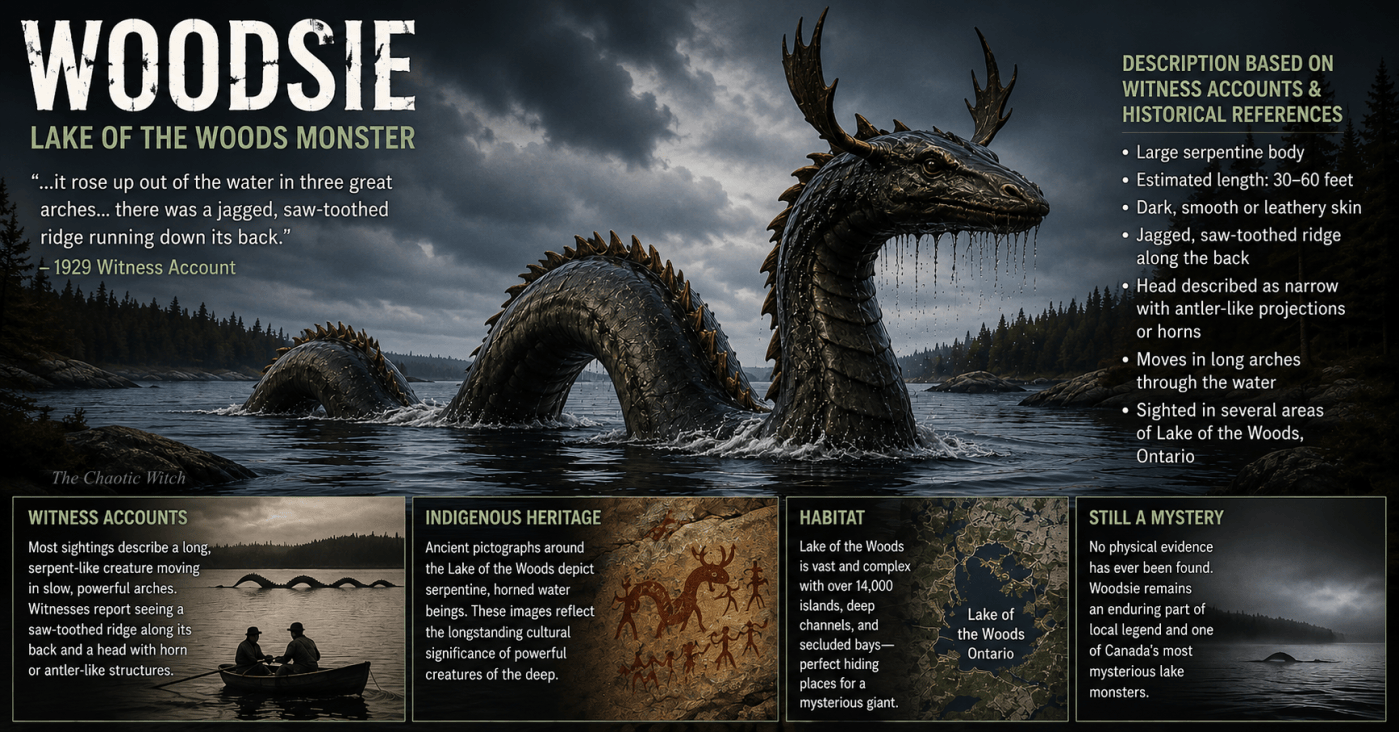
Lake of the Woods is enormous. Spreading across northwestern Ontario and into Manitoba and Minnesota, the lake is a sprawling labyrinth of islands, narrow channels, rocky shorelines and secluded bays. Much of it feels remarkably remote even today. Somewhere within those waters, according to Canadian cryptid lore, is said to live a mysterious serpent-like creature sometimes called Woodsie.
Woodsie is one of Canada’s most obscure lake monsters. Unlike Ogopogo in British Columbia or Manipogo in Manitoba, there isn’t a long, easily traceable collection of twentieth-century sightings attached to the creature. Instead, Woodsie appears in Canadian cryptid catalogues simply as an enormous serpent-like animal associated with Lake of the Woods.
Exactly when people began calling the creature Woodsie is surprisingly difficult to determine. There doesn’t appear to be a well-established first sighting, famous witness or newspaper report announcing the appearance of a monster by that name.
But stories and imagery involving extraordinary creatures associated with water existed in this region long before the name Woodsie appeared.
Lake of the Woods contains numerous Indigenous pictograph sites, some of which are believed to be hundreds of years old. Painted onto steep rock faces overlooking the water, the surviving images include people, animals, spiritual figures and mysterious shapes whose meanings aren’t always known today.
Throughout the broader Anishinaabe rock-art tradition of the Canadian Shield, one particularly striking figure appears: the horned serpent.
These beings are generally depicted as long, snake-like creatures, sometimes with horns extending from the head. Some representations include unusual ridges, projections or other features along the body. Horned serpents also appear within Anishinaabe traditions concerning powerful beings connected with water.
These weren’t simply “monsters” in the modern cryptozoological sense. They could have spiritual significance and belonged to a much deeper understanding of the natural and supernatural world. Their stories shouldn’t automatically be interpreted as ancient reports of unidentified animals.
But when looking at the modern legend of Woodsie, the resemblance is difficult not to notice.
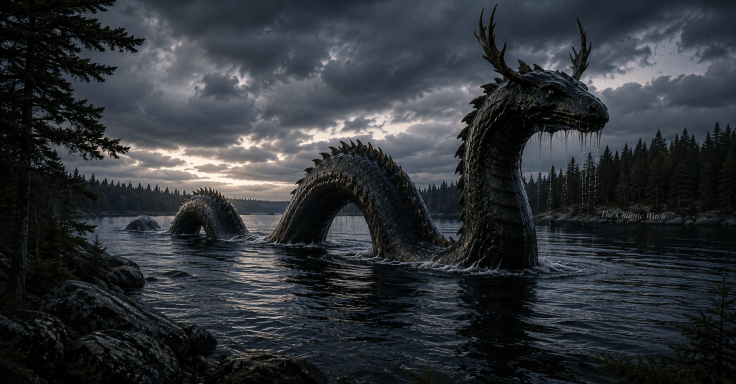
Cryptozoological literature has associated Lake of the Woods with an unusual creature described as an antlered or horned serpentine animal with a jagged or saw-toothed back. Later Canadian cryptid catalogues describe the Lake of the Woods monster much more simply: a large serpent-like creature inhabiting the lake.
Whether those descriptions developed independently or whether later cryptid writers borrowed from the much older serpent imagery is difficult to establish.
And that is where Woodsie’s story becomes particularly mysterious.
There doesn’t seem to be a surviving collection of detailed eyewitness encounters explaining how the modern legend began. Instead, there are pieces of a story scattered across different periods of history.
There is an enormous wilderness lake.
There are centuries-old images associated with extraordinary water beings.
There are traditional accounts involving powerful serpentine beings connected with lakes and waterways.
And much later, there is a cryptid called Woodsie said to inhabit those same waters.
What appears to be missing is the bridge connecting them.
Lake of the Woods itself certainly provides an impressive setting for a lake-monster mystery. The lake contains thousands upon thousands of islands and an extraordinary amount of shoreline. There are isolated channels, deep stretches of water and areas that see relatively little human traffic.
It also contains some genuinely enormous fish.
Lake sturgeon can reach remarkable sizes, while Lake of the Woods is famous for large muskellunge and northern pike. A huge sturgeon unexpectedly breaking the surface beside a canoe could certainly leave someone wondering what they had just encountered.
But the creature described in the Woodsie legend isn’t generally portrayed as an enormous fish.
It is described as serpentine.
And the older creature associated with the lake in cryptozoological references is stranger still – a long aquatic being with horn or antler-like projections and a jagged ridge along its back.
Unfortunately, there is no official photograph of Woodsie.
There is no known specimen.
There is no widely documented film.
And perhaps most frustratingly, there doesn’t appear to be a reliable collection of named witnesses describing exactly when and where they encountered the creature.
That doesn’t necessarily mean nobody ever reported something unusual in Lake of the Woods. Local stories can circulate orally for generations without appearing in newspapers, particularly in remote communities. But without the original accounts, it becomes impossible to know which stories contributed to the modern Woodsie legend and which details were added later.
It also leaves open another intriguing possibility.
Perhaps Woodsie wasn’t originally a separate cryptid at all.
Later writers encountering older references to mysterious serpentine beings associated with Lake of the Woods may have transformed those traditions into the modern idea of a flesh-and-blood lake monster. Somewhere along the way, the creature may have acquired the friendly cryptid nickname Woodsie.
Or perhaps there really were unexplained sightings that helped create the legend, and those original accounts simply haven’t survived in easily accessible records.
There is something wonderfully appropriate about that uncertainty.
Lake of the Woods is a place filled with hidden passages and islands where the shoreline seems to disappear endlessly into the distance. For centuries, unusual and powerful water beings have appeared in the cultural traditions and imagery of the wider region. Much later, stories emerged of something enormous and serpentine supposedly inhabiting the lake itself.
Today, that creature is called Woodsie.
Whether Woodsie represents a modern reinterpretation of much older traditions, forgotten encounters with unusually large animals, an unidentified creature—or simply a legend that grew around one of Canada’s most mysterious lakes—is impossible to say.
Perhaps somewhere beneath the dark waters of Lake of the Woods, there really is something occasionally moving between those thousands of islands.
Or perhaps Woodsie’s greatest mystery isn’t what the creature is.
It’s where the legend began.
Sources: Selwyn Dewdney and Kenneth E. Kidd, Indian Rock Paintings of the Great Lakes; University of Toronto Press; Ontario Archaeological Society; The Canadian Encyclopedia; Lake of the Woods Township historical records; Canadian Shield rock-art research; and Canadian cryptid and lake-monster catalogues.
A little magic is always waiting. Subscribe and step inside the circle. 🖤🔮✨


Leave a Reply