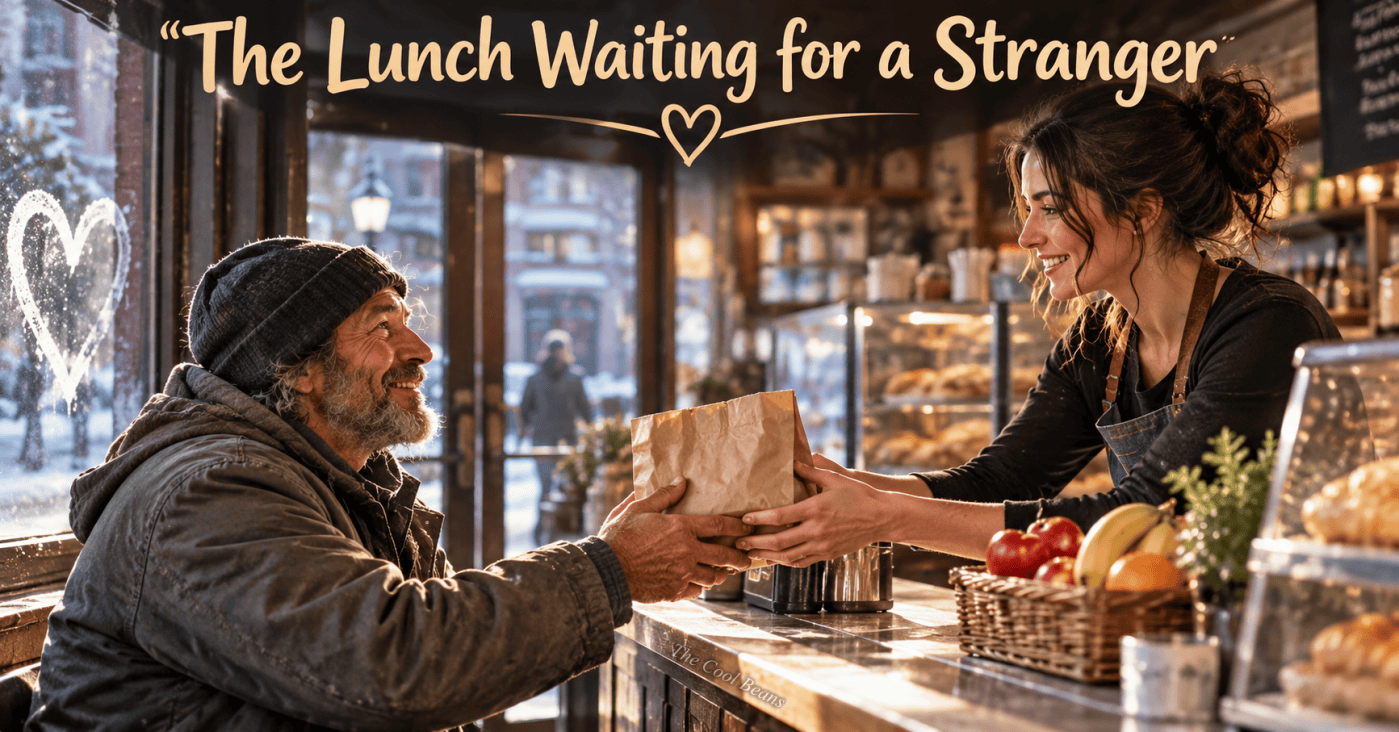
Every morning before work, Daniel stopped at the same little deli. He ordered the same thing almost every time: a turkey sandwich, an apple, and a coffee large enough to convince him that being awake was a reasonable idea.
And almost every morning, he passed the same man sitting near the entrance to the subway station.
His name was Marcus.
Daniel knew this because Marcus had introduced himself one bitterly cold morning after Daniel accidentally dropped one of his gloves.
“Hey, friend,” Marcus called after him. “You’re losing things.”
Daniel turned around to see Marcus holding up his glove.
“You’re going to want this in about five minutes.”
It was minus twelve degrees.
Daniel laughed. “You’re probably right.”
After that, the two began saying hello whenever Daniel passed.
Nothing complicated. Sometimes they talked about the weather. Sometimes they talked about hockey. Once they spent ten minutes debating whether pineapple belonged on pizza. Marcus was strongly opposed. Daniel believed Marcus was wrong.
Their friendship survived.
One morning, Daniel walked into the deli and ordered his usual lunch. Then, without really planning to, he looked at the person behind the counter and said, “Actually, make that two.”
He carried the second paper bag outside.
“Pineapple pizza wasn’t available,” he told Marcus as he handed it over. “So you’ll have to settle for a sandwich.”
Marcus smiled.
“Tragic.”
The next morning, Daniel bought two lunches again.
Soon it became something of a routine.
Daniel never asked Marcus why he was houseless. He never demanded to know his story in exchange for helping him. If Marcus wanted to talk about his life, Daniel listened. If he didn’t, they talked about hockey, bad movies, the weather, or their ongoing pineapple-pizza disagreement.
To Daniel, Marcus wasn’t “the houseless man outside the subway station.”
He was Marcus.
One particularly cold morning, Daniel arrived at the station and Marcus wasn’t there.
The next morning, his usual spot was empty again.
Then again.
By the fourth day, Daniel was genuinely worried. Then Marcus returned. He looked tired, but he was smiling.
“Where have you been?” Daniel asked.
“Shelter across town had a bed.”
“That’s good.”
“It was warm.” Daniel nodded and handed him the usual paper bag. Marcus looked inside and frowned. There were two sandwiches.
“You planning on eating both?”
“No. One’s yours.”
Marcus shook his head. “I already ate.”
“Then save it.” Marcus tucked the extra sandwich into his backpack.
Later that afternoon, he was walking several blocks away when he noticed a young woman sitting against a building. She was bundled inside a thin coat and looked miserably cold.
Marcus walked past her, then he stopped. He thought about the sandwich in his backpack so he turned around.
“Hey.” The woman looked up cautiously.
Marcus pulled out the sandwich. “You hungry?”
She hesitated before quietly answering, “A little.”
He held it out. She looked surprised.
“You don’t want it?”
“I already ate.”
She accepted it and thanked him.
Marcus shrugged.
“Somebody gave it to me.”
The following morning, Marcus told Daniel what he’d done.
Daniel smiled.
“You gave away your sandwich?”
“I didn’t need it.”
Then Marcus said something Daniel never forgot.
“People think because you don’t have much, you’ve got nothing to give.”
Daniel didn’t really know how to answer that.
So he simply nodded.
A few weeks later, Daniel walked into the deli and noticed a handwritten sign beside the register that hadn’t been there before.
SUSPENDED LUNCHES
Underneath was a simple explanation.
Anyone purchasing food could also pay in advance for a lunch for a person experiencing houselessness. The deli would keep a running tally of the prepaid meals behind the counter. Anyone who needed something to eat could walk inside and simply ask whether a suspended lunch was available.
No money required.
No explanation required.
No questions asked.
Just, “Do you have a lunch available?”
If the answer was yes, they could choose a sandwich, a piece of fruit and a drink. They could take it with them or sit somewhere warm and eat it.
Daniel stared at the sign.
Then he looked at the deli owner.
“When did you start this?”
The owner pointed toward the window.
“Your friend.”
Apparently Marcus had been talking with him one morning. He’d mentioned the extra lunches Daniel had been buying and how much they’d meant during days when he wasn’t certain where his next meal would come from. Then he’d told him about giving one of those sandwiches to the young woman he’d met on the street.
The deli owner had thought about it for a moment.
“What if everybody could do that?” he’d asked.
And the idea was born.
Daniel immediately paid for one suspended lunch.
The woman standing behind him overheard the conversation and paid for two more.
A man waiting for his coffee added another.
Someone else prepaid for three coffees.
By lunchtime, seven meals were waiting behind the counter for people none of those customers had ever met.
Before long, word began to spread.
People experiencing houselessness learned that they could walk into the little deli and simply ask whether a lunch was available. They didn’t have to stand outside hoping someone would notice them. They didn’t have to explain their circumstances. They didn’t have to prove that they were hungry enough to deserve a sandwich.
They simply walked in as customers.
Meanwhile, regular customers began adding something to their orders.
“Coffee, please. And add a lunch for somebody who needs one.”
Some people bought one.
Some bought five.
Others couldn’t afford an entire lunch but prepaid for a coffee or a piece of fruit.
It didn’t matter.
Little by little, strangers were feeding strangers.
The people receiving the meals usually never knew who had paid for them.
The people buying the meals usually never knew who ate them.
Kindness didn’t require an introduction.
It was simply waiting behind the counter when somebody needed it.
Months passed.
Winter slowly loosened its grip on the city, and one morning Daniel arrived at the subway station to find Marcus standing instead of sitting.
He was grinning.
Daniel immediately knew something had happened.
“What?”
Marcus held up a key.
Daniel stared at it.
“What is that?”
“My front door.”
After months on a housing waiting list, Marcus had finally been offered a small apartment.
It wasn’t fancy.
Marcus described it as having one window, questionable plumbing, and the world’s ugliest kitchen cabinets.
Daniel thought it sounded magnificent.
A few days later, Marcus moved in.
The morning after his first night in his new home, he returned to the deli.
Daniel was already inside ordering his usual meal when Marcus walked up beside him.
“Two turkey sandwiches,” Marcus said.
Daniel turned.
“Two?”
Marcus nodded.
“One for me.”
Then he pointed at Daniel.
“One for this guy.”
Daniel laughed.
“I can buy my own lunch.”
“I know.”
Marcus handed over the money.
“That’s not the point.”
Then he glanced at the suspended-lunch tally behind the counter.
“And put another one up there.”
Three sandwiches.
One for Marcus.
One for Daniel.
And one for a stranger neither of them would ever meet.
They sat together that afternoon and ate lunch.
Two friends who had met because of a dropped glove.
Behind the counter was a little board covered with marks representing meals already purchased for people who might walk through the door tomorrow, next week, or perhaps later that very afternoon.
It had all started with one extra lunch.
Not because Daniel believed he could solve every problem Marcus faced.
Not because Marcus needed to prove that he deserved kindness.
But because one morning, one person looked at another and thought:
I’m getting lunch.
Maybe my friend would like one too.
And somewhere along the way, one sandwich became two.
Two became seven.
Seven became dozens.
And eventually, a little deli became a place where anyone who was hungry could walk inside and discover that a stranger had already thought of them.
Sometimes kindness doesn’t need to be enormous to change something.
Sometimes it just needs to be paid for in advance and left waiting for whoever needs it next. ❤️


Leave a Reply