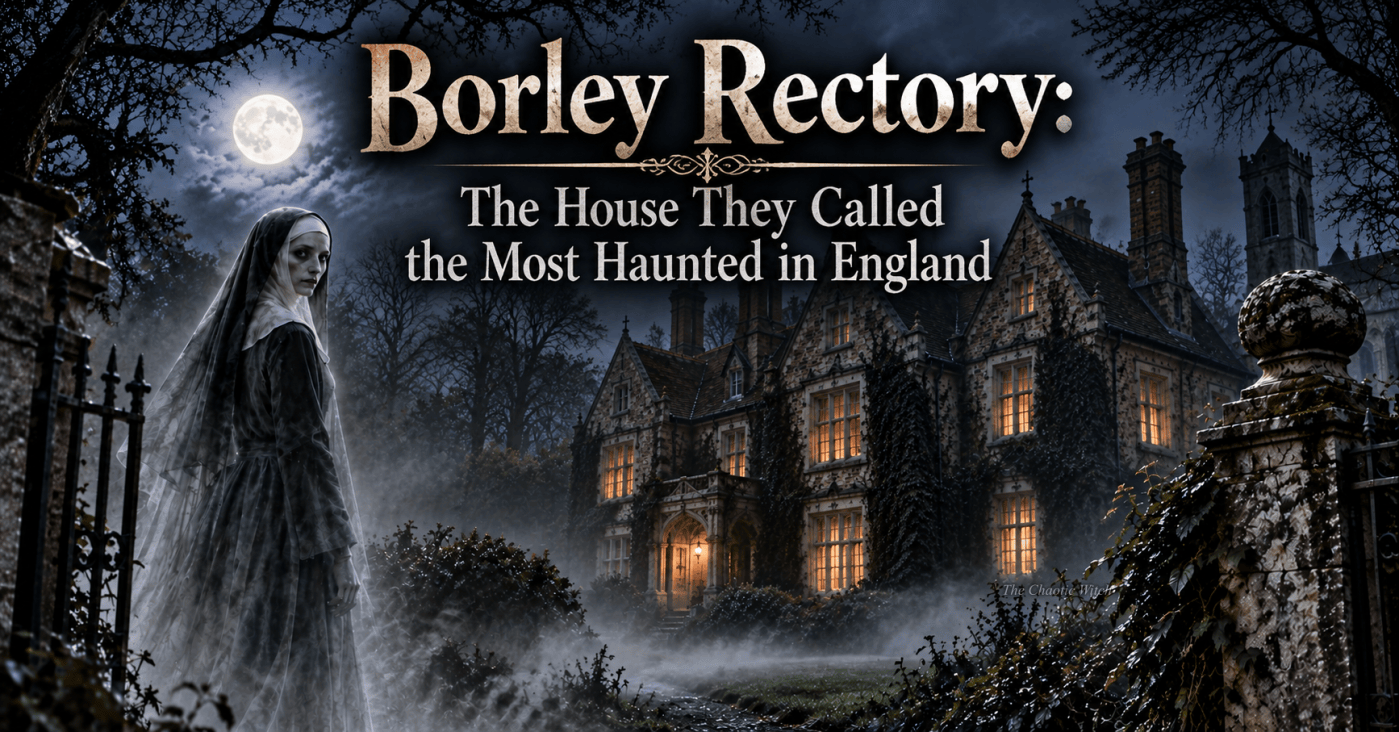
Borley Rectory stood in the quiet village of Borley in Essex, England, an imposing Victorian home that would eventually earn a chilling nickname: “the most haunted house in England.” Long before paranormal investigators arrived with notebooks and cameras, however, the people who lived within its walls were already telling strange stories.
The rectory was built in the 1860s for the rector of Borley and his family. Over the years, residents and visitors began describing things they could not easily explain. Footsteps were reportedly heard moving through empty rooms and corridors. Strange noises seemed to come from areas where no one was present. Objects were said to move unexpectedly, and some witnesses claimed to have seen a mysterious figure wandering near the house.
The most famous apparition associated with Borley was that of a nun.
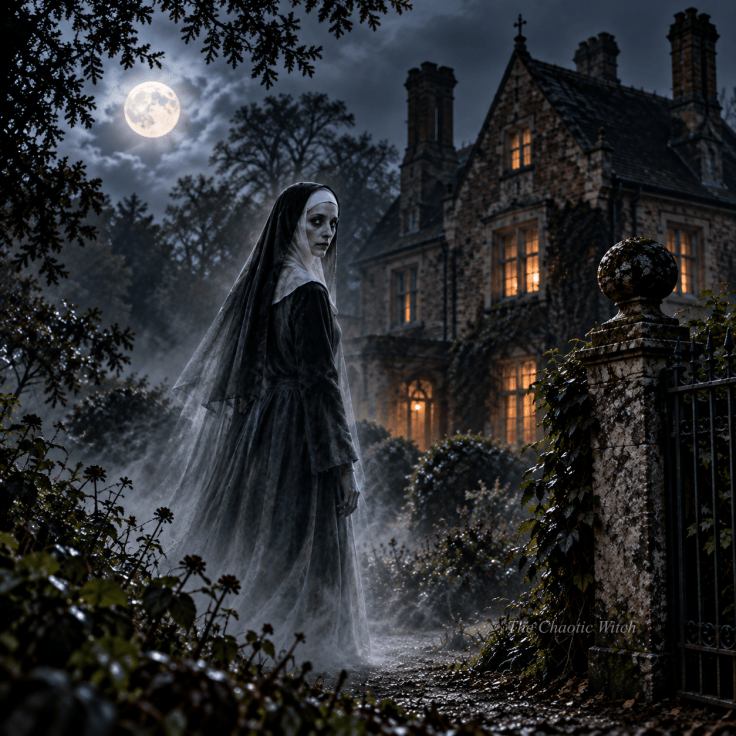
One frequently repeated account dates to July 28, 1900, when several daughters of Reverend Henry Bull reportedly saw what appeared to be a nun walking near the rectory. According to later retellings, the girls attempted to approach the mysterious woman, only for the figure to disappear. Over time, other people would claim to have encountered a similarly dressed figure around the property.
A legend eventually developed to explain her presence. According to the story, centuries earlier a monk from a nearby monastery had fallen in love with a nun from a convent. The two supposedly attempted to run away together but were discovered. Depending on which version of the legend is told, the monk was executed and the nun was killed or imprisoned within the convent walls.
Things became considerably more public in 1929, when Reverend Guy Eric Smith and his wife were living at the rectory. The couple experienced enough unusual occurrences that the story attracted the attention of the press. Newspapers began reporting tales of unexplained footsteps, bells ringing without anyone touching them, mysterious lights and the ghostly nun.
Then Harry Price arrived.
Price was already a well-known psychical researcher, and Borley Rectory quickly captured his imagination. During his visits, the reported activity became increasingly dramatic. Stones and pieces of brick seemed to appear or fly through rooms. Keys and other objects were allegedly thrown. Strange noises echoed through the building, sometimes without an obvious source.
Whether Price had stumbled into an extraordinarily active haunting or something considerably more earthly was happening would eventually become one of the great arguments surrounding Borley.
The rectory’s strangest period may have come during the years Reverend Lionel Foyster lived there with his wife, Marianne. Between 1930 and 1935, the Foysters reported an astonishing variety of phenomena. Bells supposedly rang by themselves. Windows reportedly shattered. Objects disappeared and reappeared. Footsteps were heard. Marianne claimed she was sometimes physically affected by an unseen presence.
Then writing began appearing on the walls.
Some of the markings appeared to address Marianne directly. Fragmented messages seemed to plead for assistance, including words interpreted as appeals for “help.”
For believers, the writing became one of the most unsettling pieces of the Borley mystery. For skeptics, however, it raised serious questions. Marianne herself became the subject of suspicion, and investigators later proposed that at least some of the strange activity during the Foyster years could have been caused deliberately.
By 1937, Harry Price had the opportunity to investigate Borley in a much more ambitious way. He rented the largely abandoned rectory and recruited dozens of volunteers to spend time inside the building, carefully recording anything unusual they experienced.
It was essentially an early organized ghost investigation.
The observers came from different backgrounds and included educated professionals who were instructed to document unusual events rather than simply trade ghost stories. Reports accumulated of footsteps, mysterious sounds, moving objects, strange lights and occasional apparitions.
Price also experimented with séances and automatic writing in an attempt to discover who—or what—might supposedly be haunting the house.
One spirit became particularly famous.
During experiments, investigators claimed to make contact with a woman named Marie Lairre, who was said to have been a French nun murdered centuries earlier. Her story fit almost perfectly with Borley’s existing legend of the phantom nun.
Perhaps a little too perfectly.
Despite considerable interest in the story, researchers have never established that Marie Lairre was a real historical woman who lived or died at Borley. Her identity therefore remains part of the paranormal narrative rather than verified history.
Then came one of the strangest coincidences in the entire story.
During a séance in March 1938, investigators claimed to receive communication from another supposed entity, sometimes identified as “Sunex Amures.” The message allegedly predicted that Borley Rectory would burn and that evidence of a person who had died there would eventually be discovered.
The rectory did not burn on the predicted night.
But less than a year later, it did.
On February 27, 1939, the building caught fire. The owner at the time, Captain William Gregson, said the blaze began accidentally after an oil lamp was overturned. The fire spread through the old house, badly damaging the structure.
As flames consumed the building, another story entered Borley folklore.
Some witnesses reportedly claimed that they saw the figure of a woman looking from an upstairs window of the burning rectory.
No woman was known to have been standing there.
The ruins remained for several years before the rectory was finally demolished in 1944. Even then, Borley refused to surrender its mysteries completely. Reports of strange sights and sounds continued around the ruins, the nearby church and the surrounding area.
Harry Price published books about his investigations, and Borley Rectory became internationally famous. His work helped transform what might otherwise have remained a local ghost story into one of the most discussed hauntings of the twentieth century.
But after Price died in 1948, his investigation itself came under scrutiny.
Researchers associated with the Society for Psychical Research re-examined the case in detail. Their highly critical investigation, published in the 1950s, argued that many of Borley’s famous phenomena could be explained by natural causes, mistakes, exaggeration, practical jokes or deliberate deception. Price himself was accused of having manipulated or manufactured some incidents.
Even some people who had lived at Borley questioned parts of the haunting. Reverend Smith and his wife became suspicious after noticing that particularly dramatic activity seemed to occur around Price. Mrs. Smith eventually believed that many of the supposedly supernatural events had ordinary explanations.
That should have been enough to kill the legend.
It wasn’t.
Other researchers later argued that the skeptical investigation had problems of its own. They pointed out that questionable incidents did not necessarily explain every report made by independent witnesses across several decades. Even if someone had staged certain phenomena, they argued, it did not automatically follow that every strange experience reported at Borley had been fabricated.
And that is what makes Borley Rectory so fascinating.
There probably isn’t one simple explanation for everything that happened there.
Some incidents may have been exaggerated. Some may have been practical jokes. Old houses produce strange noises, moving shadows and unexplained drafts. Newspaper coverage undoubtedly helped turn local stories into sensational legends. Some witnesses may have interpreted ordinary events through the expectation that they were standing inside a haunted house.
There may even have been deliberate deception.
But scattered among those explanations are the experiences of people who insisted they encountered something they could not understand.
Today, Borley Rectory no longer exists. There is no sprawling Victorian house waiting in the darkness for another team of ghost hunters to arrive.
What remains instead is something almost as intriguing: decades of witness accounts, newspaper reports, photographs, investigation notes, séances, arguments and accusations surrounding a house that became legendary while it was still standing.
Perhaps Borley Rectory was never haunted at all.
Perhaps it became the perfect storm of folklore, coincidence, human imagination, practical jokes and sensational journalism.
Or perhaps, beneath all the exaggeration and controversy, something genuinely strange once wandered the corridors of that old rectory and the grounds surrounding it.
More than a century after the first stories began circulating, the argument continues.
And somewhere within all those conflicting accounts remains the image that started much of it: a silent woman dressed as a nun, walking through the grounds of Borley before simply disappearing.
Sources: Society for Psychical Research/Psi Encyclopedia, Journal of the Society for Psychical Research, Harry Price’s Borley Rectory investigations and published works, contemporary British newspaper archives, the Garrett Collection at the University of Maryland Baltimore County, and historical Borley Rectory archival materials.
A little magic is always waiting. Subscribe and step inside the circle. 🖤🔮✨


Leave a Reply