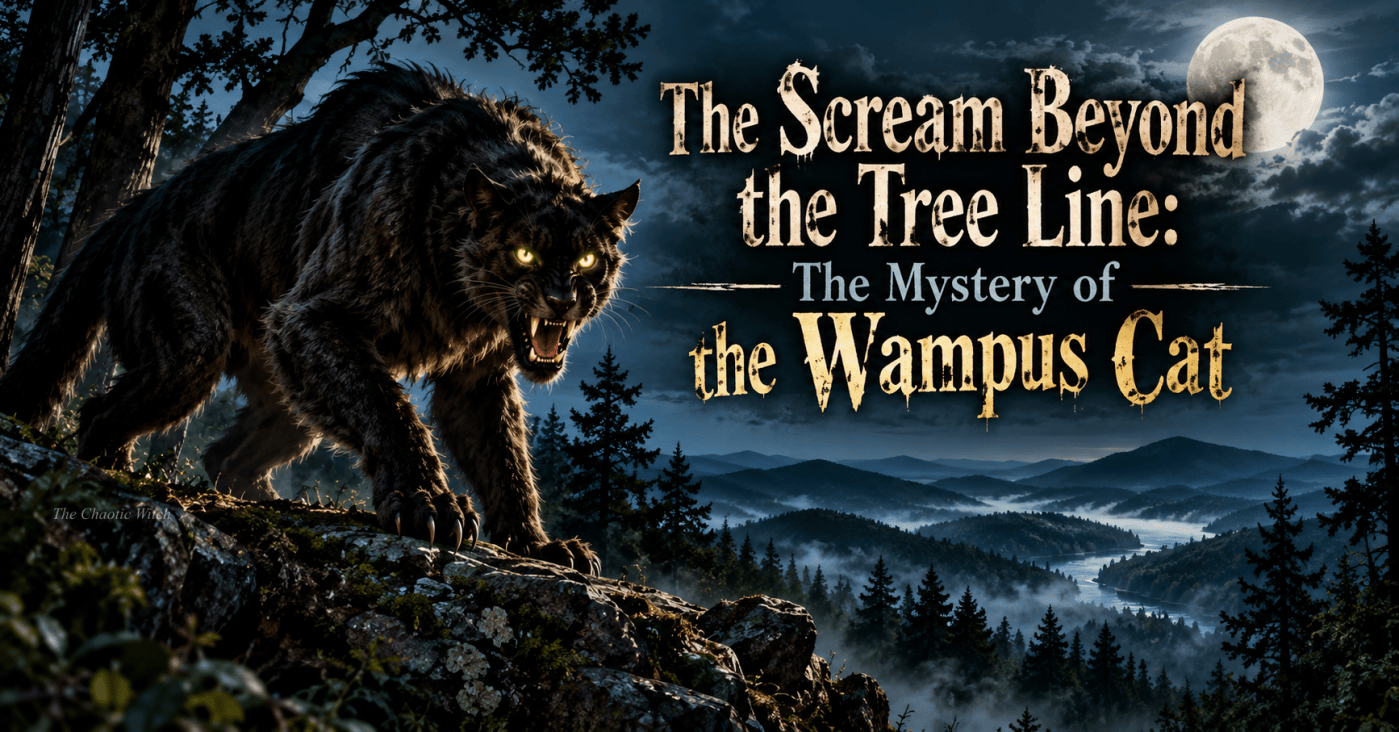
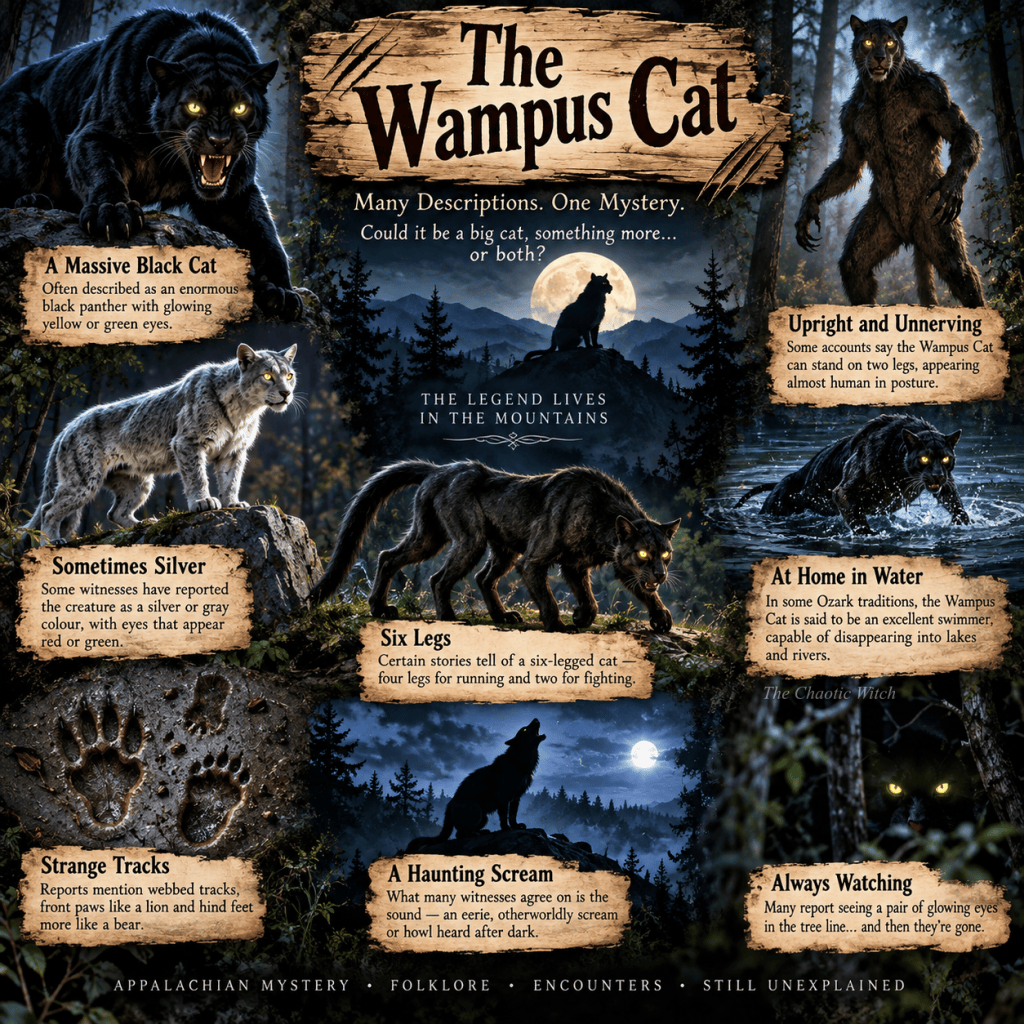
The Wampus Cat is one of those Appalachian creatures whose story seems to change depending on which mountain, hollow, or small town you happen to be standing in. Sometimes it is described as an enormous black panther with glowing yellow or green eyes. Other accounts give it an almost human posture, capable of rising onto two legs. Stranger versions describe a six-legged cat, while still others speak of something that seems to be neither entirely animal nor entirely spirit.
What remains remarkably consistent is the sound.
An eerie scream or howl heard after dark, followed by the unsettling feeling that something is moving through the trees just beyond sight.
Stories of the Wampus stretch across Appalachia and into the Ozarks, where the creature has collected different names along the way. In Missouri, it has been called the Gallywampus, while Ozark stories sometimes refer to the Whistling Wampus. Old descriptions collected in American dialect records spoke of a strange creature heard whining around camps at night and, in another variation, a mysterious green-eyed cat possessing supernatural powers.
One of the most frequently repeated origin stories connects the Wampus Cat with Cherokee tradition. In the familiar version, a woman secretly wrapped herself in the skin of a mountain lion so she could follow the men of her community and observe a ceremony from which she was forbidden. When her presence was discovered, she was transformed into a creature that was part woman and part mountain cat, condemned to wander the mountains.
Another version tells a very different story. A woman called Running Deer takes on the spirit of a mountain cat to confront a terrifying entity that had harmed her husband. After defeating it, she becomes a protector whose spirit continues to watch over the land.
These stories have been retold and altered many times, however, so they are better described as Appalachian stories attributed to Cherokee tradition rather than presented as one definitive Cherokee account of the Wampus Cat.
But the Wampus did not remain confined to fireside stories.
In North Carolina’s Piedmont, particularly around Iredell County and what is now the Lake Norman area, stories circulated about a mysterious animal prowling farms. Historical accounts describe livestock deaths and sightings of an animal whose appearance seemed to change from witness to witness.
Some described it as silver, others said it was black.
Sometimes it was approximately the size of a large dog, while other witnesses compared it to a colt. There were reports of enormous red eyes and peculiar tracks. Some tracks were described as webbed, while another description gave the animal front paws resembling those of a lion and hind feet more like those of a bear.
Stories of a strange cat-like predator killing livestock in Iredell County reportedly stretch back into the 1890s. By the early 1930s, the Wampus had become enough of a local mystery that reports of people seeing or hearing the creature were circulating throughout the area.
Tennessee had its own Wampus stories.
On December 17, 1918, the Greeneville Sun reported that a creature being called a “Wampus” was roaming a ridge near Gethsemane in Greene County. The creature apparently became frightening enough in local imagination that stories about it were reportedly used to discourage children from wandering outside after dark.
Another old Wampus tale tells of a hunter who entered the woods at night accompanied by his dogs.
At first, nothing seemed unusual.
Then the dogs suddenly became frightened.
Instead of following the trail, they abandoned it.
The hunter reportedly noticed an overpowering smell before hearing a terrible howl somewhere behind him.
He turned around.
In the darkness were two enormous glowing yellow eyes.
Whatever possessed those eyes looked something like a mountain lion.
Except it was standing upright.
The hunter ran.
According to the story, the Wampus followed him through the darkness until he reached a friend’s house. The men slammed the door while the creature reportedly battered against it from outside.
Eventually, everything became quiet.
The animal was gone.
When the hunter returned home after daylight, he reportedly discovered his dogs hiding in the barn.
After that night, the story says, he never hunted after dark again.
Other Appalachian encounters were less dramatic but perhaps even more unsettling.
Farmers told of hearing screams drifting from distant ridges during the night. Dogs sometimes refused to leave porches or venture into the woods. Livestock would occasionally be discovered dead the following morning, and some people reported seeing pairs of glowing eyes watching silently from the tree line.
Then the eyes would disappear.
And whatever had been standing there would seemingly disappear with them.
Over time, descriptions of the Wampus became increasingly strange.
A Tennessee newspaper account from 1936 described the legendary animal as extraordinarily long, with enormous eyes. Other versions gave the Wampus six legs—four supposedly used for running and another two for fighting.
Some stories even granted it abilities that seemed to move beyond those of an ordinary animal.
It could disappear.
It could seemingly appear somewhere else.
And in some Ozark traditions, the creature was said to be perfectly comfortable in water. Folklorist Vance Randolph recorded a version in which the mysterious animal behaved almost like an enormous amphibious panther, capable of plunging into the water and swimming away.
Perhaps that inconsistency is part of what has allowed the Wampus Cat to survive for so long.
There is no single creature to look for.
You might be watching for an enormous black cat.
Someone else might describe something silver.
Another witness might swear it stood upright.
Someone farther down the mountain might tell you it had six legs.
And another person may never have seen anything at all.
They simply heard the scream.
A strange, unfamiliar cry rolling across an Appalachian ridge in the middle of the night, coming from somewhere deep among the trees.
For generations, stories have continued to circulate about something prowling those mountains after sunset. The descriptions change. The creature changes. Even its name changes.
But the warning at the heart of the stories remains remarkably similar.
When darkness settles over the mountains and an unfamiliar scream echoes from somewhere beyond the tree line, perhaps it is better not to go looking for whatever made it.
Because according to the old stories, sometimes the Wampus Cat is already looking back.
Sources: NCpedia, Appalachian History, Appalachian Historian, American Folklore, Vance Randolph’s collected Ozark folklore, historical accounts from the Greeneville Sun, Dictionary of American Regional English material, and other historical and folkloric records concerning the Wampus Cat tradition
A little magic is always waiting. Subscribe and step inside the circle. 🖤🔮✨
 The Cool Beans
Leave a comment