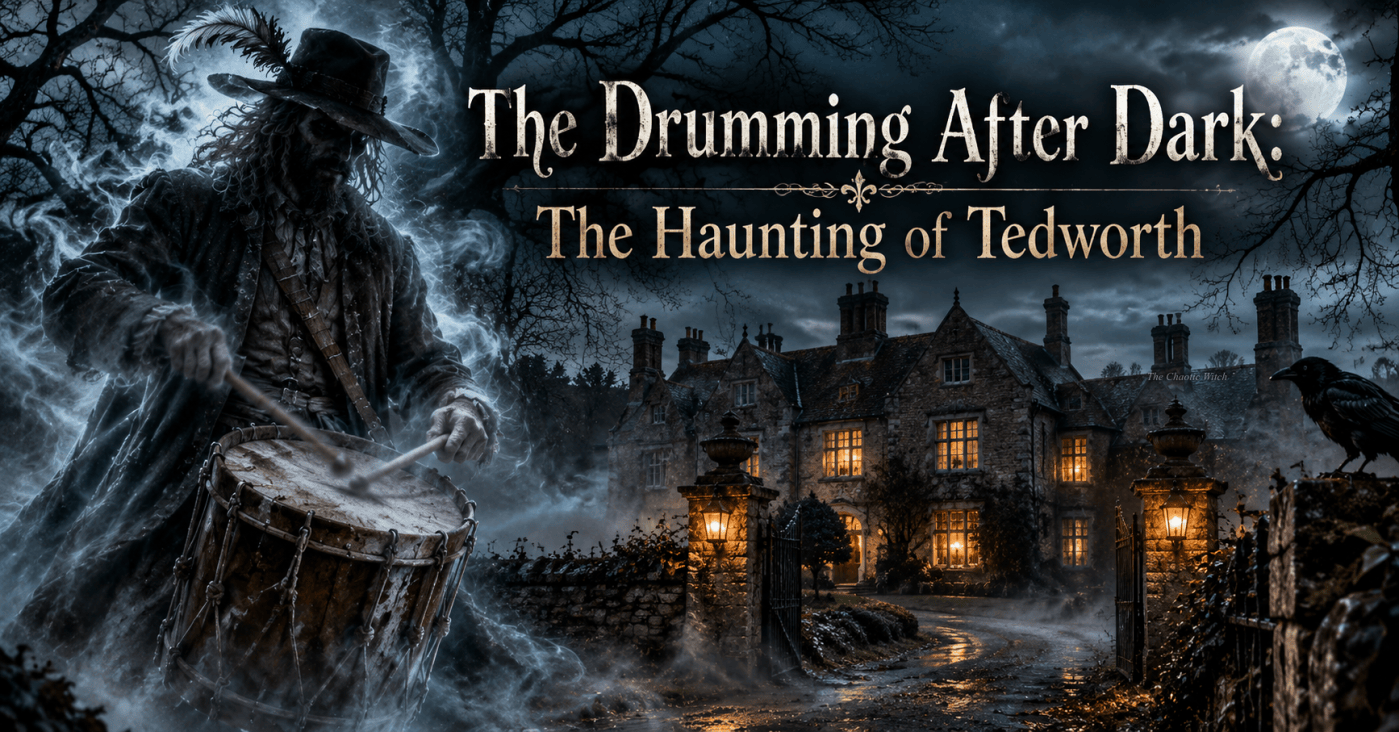
In the spring of 1662, in the quiet Wiltshire countryside of England, John Mompesson could hardly have imagined that confiscating a wandering man’s drum would lead to one of the most famous haunting stories of the seventeenth century.
Mompesson was a landowner, magistrate and local official living with his family at Zouch Manor in Tedworth, the village now known as Tidworth. In March of that year, while dealing with business in nearby Ludgershall, he became involved in the case of a travelling drummer named William Drury. Drury had been moving through the countryside beating his drum and seeking money while carrying a pass that supposedly gave him permission to do so.
There was a problem with the document.
Mompesson recognized the names of men whose signatures appeared on it and determined that the signatures had been forged. Drury was arrested, although he was later released, and his drum was confiscated. The instrument eventually found its way to Mompesson’s home.
Not long afterward, something strange began happening at Zouch Manor.
Mompesson was away from home when his wife first heard violent noises outside the house at night. She feared someone was trying to break in. The family searched for an intruder, but no one could be found.
When Mompesson returned, the disturbance happened again.
There was a tremendous pounding at the door.
Mompesson armed himself and went downstairs to investigate.
Again, there was nobody there.
Then the noises began to change.
What had sounded like someone hammering against the house began to resemble the unmistakable beating of a drum.
Night after night, the mysterious drumming returned. Sometimes it seemed to come from outside. At other times, it appeared to move through the house itself. The family could hear it in different rooms, yet whenever they searched for the source, there was nothing to find.
And soon, the drumming was no longer the strangest thing happening inside the manor.
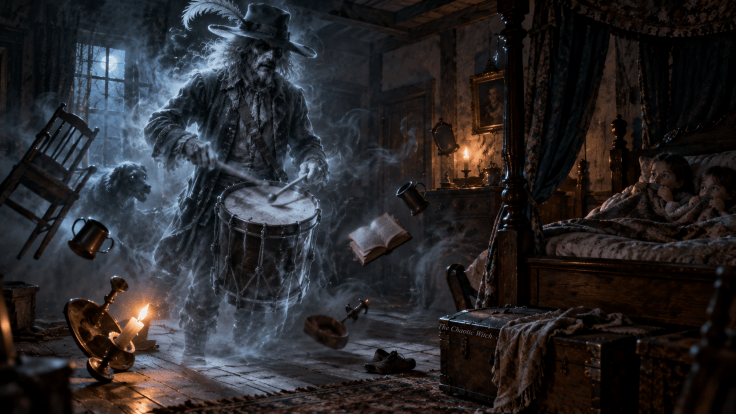
Scratching noises began beneath the children’s beds. There were thumps, strange lights, unpleasant smells and sounds described as something panting like a dog. Objects were reportedly thrown across rooms without anyone touching them.
The children’s beds were said to move.
At times, the bedsteads supposedly shook or even lifted.
Whatever was disturbing the Mompesson household also seemed strangely aware of the people living there.
In December 1662, Mompesson wrote about an incident involving his mother. During a conversation with a neighbor, she heard stories about fairies supposedly leaving money behind for people. Tired of the strange activity tormenting the family, she joked that if their unseen visitor insisted upon staying, perhaps it could at least leave them some money to compensate for all the trouble it had caused.
That night, the house filled with the sound of coins.
The jingling seemed to come from everywhere.
The family reportedly thought they might wake the following morning to find the floors covered with money.
There wasn’t a single coin.
It was almost as though something inside the house had heard the conversation and decided to answer.
Other incidents seemed equally playful, and considerably more unsettling.
People staying at the manor reported unexplained movement around their rooms. Hats and other objects were supposedly thrown. One visitor reportedly experienced something repeatedly pinching or troubling his nose during the night, almost as though invisible pincers were being used against him.
On another occasion, boards in the children’s room appeared to move. A servant reportedly challenged the unseen force to give him one.
One of the boards supposedly moved toward him.
Then there were the sounds beneath the beds.
When clergyman and writer Joseph Glanvill heard about the extraordinary events at Tedworth, he became fascinated. Glanvill was deeply interested in supernatural phenomena and believed that credible evidence for spirits and witchcraft could be investigated rather than simply dismissed.
He visited the Mompesson home in January 1663.
While sitting in the children’s room, Glanvill reported hearing scratching beneath their bed.
He could find no visible explanation for it.
That visit would become enormously important because Glanvill eventually published the Tedworth story, helping transform a strange disturbance in a Wiltshire manor into one of England’s most famous supernatural cases.
Meanwhile, suspicion continued to fall upon William Drury.
The connection seemed almost too obvious.
Mompesson had taken away his drum.
Then an invisible drum apparently began beating inside Mompesson’s house.
Stories circulated that Drury had threatened Mompesson or somehow caused the disturbances through witchcraft. One particularly eerie story emerged while Drury was imprisoned at Gloucester on an unrelated theft charge.
According to the later account, a Wiltshire man visited Drury in prison. Drury asked what news there was from Wiltshire. When the visitor said there was nothing particularly interesting, Drury supposedly asked whether he had heard about the drumming occurring at a gentleman’s house in Tedworth.
The implication was disturbing.
Drury was miles away.
Yet somehow he apparently knew about the mysterious drum.
For people living in seventeenth-century England, that raised a frightening possibility. Perhaps Drury did not have to physically enter the Mompesson house to torment the family.
Perhaps he had sent something there.
The disturbances continued even while Drury was imprisoned, which only added to the supernatural interpretation of events. If he truly was responsible, whatever he had supposedly unleashed at Tedworth did not require him to be nearby.
And the activity apparently continued escalating.
There were reports of horses being mysteriously injured or found in bizarre positions. Strange lights appeared. Sulphurous and other unpleasant smells were reported around the property.
Then came one of the strangest claims associated with the entire haunting.
Mompesson reportedly wrote that on several nights the house appeared to be surrounded by seven or eight figures shaped like men.
Someone eventually fired a gun.
The figures supposedly moved away together toward an arbour and disappeared.
Who, or what they were was never established.
By then, Tedworth had become something of a seventeenth-century paranormal attraction. People travelled to Mompesson’s home hoping to experience the disturbances for themselves. Reports appeared in newspapers, and a ballad about the mysterious drummer circulated in 1663.
The haunting was becoming famous.
Eventually, however, the disturbances faded.
William Drury faced legal trouble, including proceedings connected with theft and allegations surrounding the events at Tedworth. Later versions of the story sometimes present his fate very differently, and this is where separating contemporary records from later folklore becomes important. Even during the seventeenth century, competing versions of the story were already circulating.
The same is true of the haunting itself.
Some believed the Mompesson family had genuinely encountered something supernatural. Others suspected members of the household – particularly servants or children – might have been responsible for at least some of the phenomena. Still others thought imagination, fear and religious beliefs had transformed ordinary noises and coincidences into something much more frightening.
But there is something unusual about the Drummer of Tedworth compared with many old ghost stories.
The story wasn’t first written down generations later.
Mompesson was writing letters describing strange events while the disturbances were supposedly taking place. Newspaper reports appeared in 1663. Visitors went to the house. Joseph Glanvill investigated and later published his own account. By Christmas Day 1667, Samuel Pepys recorded in his famous diary that his wife had been reading the story to him.
Within only a few years, the Drummer of Tedworth had become part of English supernatural folklore.
Glanvill’s published version eventually became particularly influential. He regarded Tedworth as evidence that the supernatural world was real, and the story became intertwined with seventeenth-century debates over ghosts, spirits, demons and witchcraft.
Centuries later, historian Michael Hunter returned to the case and examined early documents associated with the haunting, including surviving copies of Mompesson’s correspondence. His research showed something fascinating: the story evolved almost from the moment it happened. Mompesson’s frightened descriptions, Glanvill’s supernatural interpretation and later accusations of trickery all created different versions of the same mysterious events.
The original Zouch Manor is gone today. The seventeenth-century building no longer survives, although some of its stone may have been reused when a later manor was constructed.
Whatever walked, or didn’t walk, through those rooms disappeared with it.
And perhaps that is what makes the Drummer of Tedworth such an enduring story.
It began with something completely ordinary: a wandering drummer carrying questionable papers and a magistrate who confiscated his drum.
Then the drum arrived at the magistrate’s house.
Soon afterward, something began pounding on the doors.
Then came the drumming.
Then the scratching beneath the children’s beds.
Then objects began moving.
Coins that didn’t exist jingled through the darkness.
Something panted like an animal.
Strange figures reportedly gathered outside the house.
And all the while, the man whose drum had started the entire story was sometimes miles away.
More than 360 years later, there is still no way to know exactly what happened inside Zouch Manor during those strange months of 1662 and 1663.
But somewhere in the surviving records is the voice of John Mompesson himself, writing while the events were supposedly unfolding and trying to explain something he believed was inside his home.
And whatever it was, according to him, it wouldn’t stop making itself heard.
Sources: Michael Hunter’s “New Light on the ‘Drummer of Tedworth’: Conflicting Narratives of Witchcraft in Restoration England” in Historical Research, Joseph Glanvill’s accounts of the Tedworth disturbances, Wiltshire Council’s Community History resources, contemporary state papers and newspaper accounts discussed in Hunter’s research, and Samuel Pepys’ diary.
A little magic is always waiting. Subscribe and step inside the circle. 🖤🔮✨
 The Cool Beans
Leave a comment