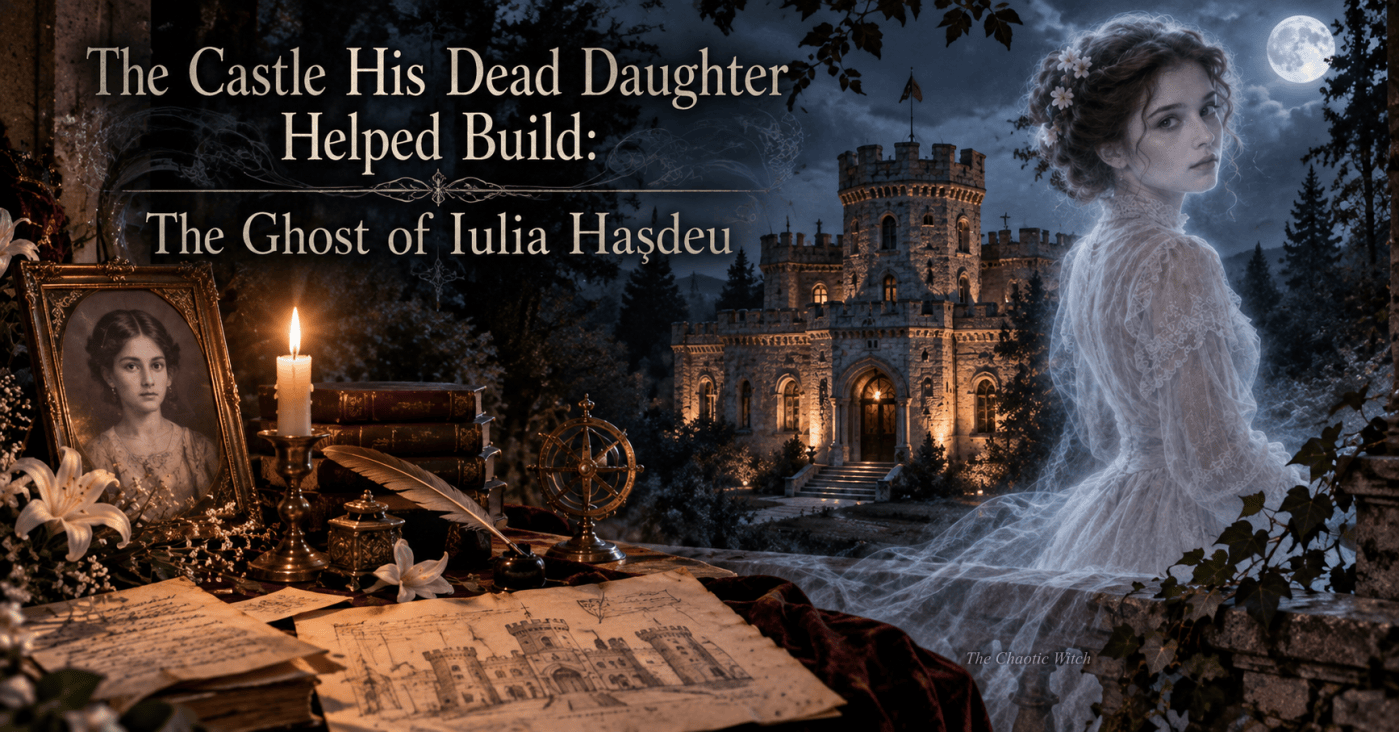
In the Romanian town of Câmpina stands a strange little castle built from grief.
It has towers, hidden symbolism, rooms designed for séances and spaces that seem intended to blur the boundary between the physical and spiritual worlds. But perhaps the strangest thing about Iulia Hașdeu Castle is the reason it exists at all.
Its creator, celebrated Romanian scholar Bogdan Petriceicu Hașdeu, maintained that he did not design it entirely by himself.
He believed his dead daughter helped him.
Iulia Hașdeu was born in Bucharest in 1869, the only child of Bogdan and his wife, also named Iulia. From an extraordinarily young age, she showed remarkable academic and artistic ability. She studied languages, literature, music and philosophy, wrote poetry and prose, and eventually continued her education in Paris.
Her future appeared enormous.
It was also terribly short.
While still a teenager, Iulia became ill with tuberculosis. Despite attempts to restore her health, she deteriorated and died in 1888, only 18 years old.
Her father was devastated.
Hașdeu had spent much of his life immersed in scholarship, history, language and intellectual inquiry. After Iulia’s death, however, his attention increasingly turned toward a question scholarship could not easily answer.
Was his daughter really gone?
About six months after her death, Hașdeu said something happened while he was sitting at his desk that changed the remainder of his life.
According to the account he later published, he picked up a pencil and his hand suddenly began moving without his conscious direction. For several seconds, it wrote rapidly across the paper.
When it stopped, Hașdeu looked down.
There was a short message written in French.
It said, in essence, that Iulia was happy, that she loved him, and that they would see one another again.
Most astonishing to Hașdeu was the handwriting.
He believed it was his daughter’s.
That moment became the beginning of something much larger.
Hașdeu began experimenting seriously with Spiritualism, particularly automatic writing and séances. He held sessions with mediums and with members of his intellectual circle, attempting to communicate not only with Iulia but eventually with other deceased members of his family.
And unlike many nineteenth-century ghost stories, traces of these experiments did not simply disappear into folklore.
Records survive.
Romania’s archival collections contain manuscripts, notes and summaries associated with Hașdeu’s Spiritualist sessions. Historical collections also preserve photographs connected with those experiments. His interest became substantial enough that he wrote about Spiritualism publicly, including in Sic Cogito, first published serially beginning in 1891 and later as a book.
But Hașdeu wanted something more permanent than séances.
First came Iulia’s elaborate tomb at Bellu Cemetery in Bucharest, constructed after her death and filled with layers of spiritual and religious symbolism.
Then came the castle.
Between 1894 and 1896, Hașdeu constructed the extraordinary building at Câmpina that would eventually become known as Iulia Hașdeu Castle.
According to Hașdeu, at least some of its design had been communicated from beyond the grave.
By Iulia.
A surviving Spiritualist manuscript contains an early sketch associated with the castle, and museum records state that Hașdeu himself drew the plans while claiming inspiration from his daughter’s immortal spirit. Architect Toma Dobrescu helped translate Hașdeu’s ideas into workable architectural form.
This wasn’t simply a memorial containing Iulia’s belongings.
Hașdeu appears to have conceived the building as something closer to a spiritual instrument—a place where the living and the dead might somehow meet.
The castle is filled with symbolism.
Its unusual arrangement, towers, religious imagery and geometrical elements have inspired interpretation ever since. Hașdeu incorporated recurring numbers and symbols into the building, particularly the number three.
Inside was something even more remarkable.
A room specifically associated with his Spiritualist experiments.
Today the museum identifies the darkened chamber as the place where séances were conducted. Historical descriptions and surviving museum objects include unusual furniture, manuscripts and photographs associated with Hașdeu’s attempts to communicate with spirits.
Automatic writing remained central to those experiments.
Messages supposedly came from Iulia and other dead relatives through mediums. Some concerned deeply personal matters. Others dealt with philosophical and spiritual questions.
And some, Hașdeu believed, concerned the castle itself.
To Hașdeu, Iulia hadn’t vanished.
She had simply moved somewhere he could no longer reach through ordinary means.
The castle became his attempt to build a doorway.
That alone would have made Iulia Hașdeu Castle one of Romania’s strangest historical buildings.
But then came the stories.
One of the most enduring involves music.
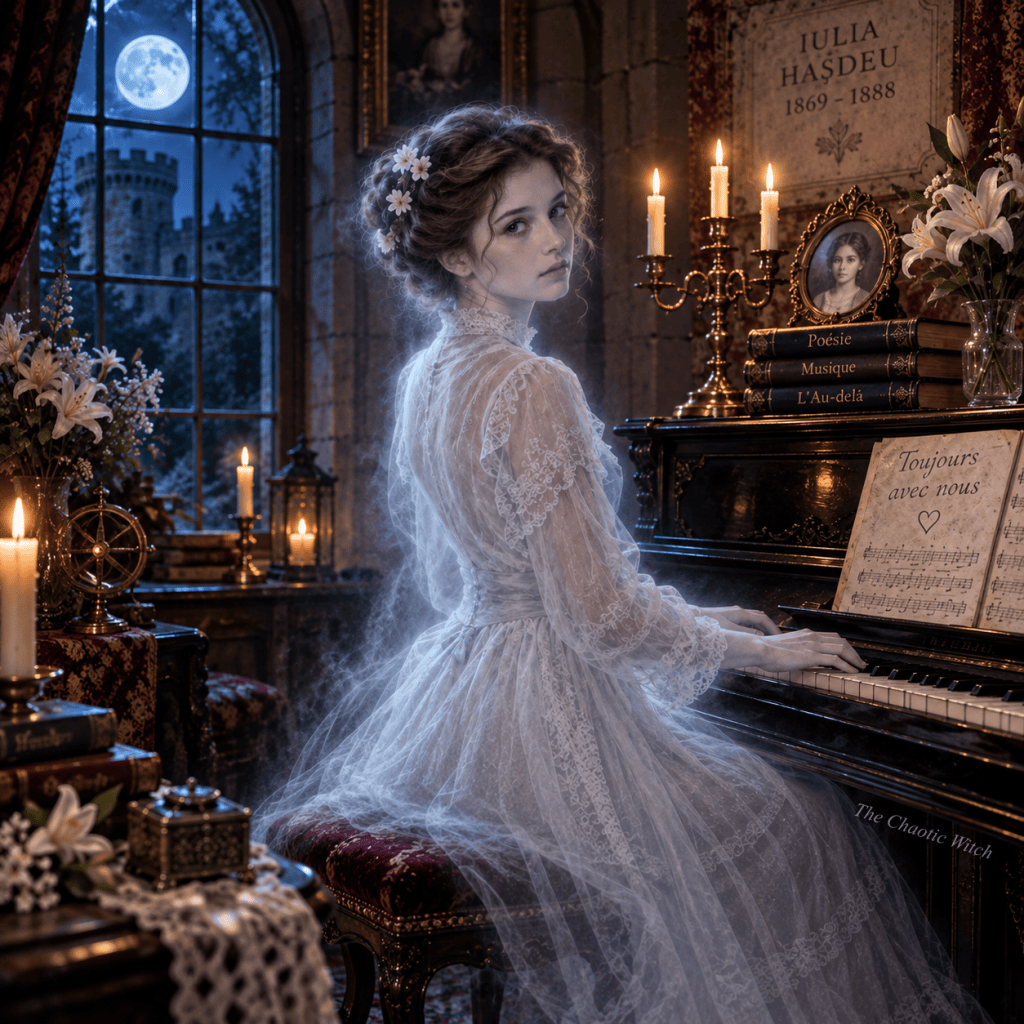
Iulia had been musically talented, and a piano associated with her is part of the castle’s story. According to the legend that developed around the property, music was sometimes heard when nobody was apparently playing.
The piano, people whispered, could play by itself.
And naturally, there was an explanation.
Iulia had returned.
This particular claim is repeated in Romanian accounts of the castle, but unlike Hașdeu’s documented séances and surviving manuscripts, evidence tying the mysterious piano music to specific contemporary witnesses is much thinner. It belongs to the ghost lore surrounding the castle rather than something we can confidently reconstruct as a verified event.
There are apparition stories too.
Over the years, visitors and local legends have described a young female presence associated with the property. Some versions describe Iulia appearing in white. Others speak more vaguely of a woman’s figure, an unexplained presence or strange sensations within the castle.
Again, those stories become difficult to trace the farther they move away from Hașdeu’s own records.
Yet there is something particularly haunting about this case even without the later embellishments.
Because we don’t need folklore to invent the séance room.
It exists.
We don’t need legend to invent the manuscripts.
They survive.
We don’t need someone generations later to claim that Hașdeu believed his daughter communicated with him.
He said so himself.
And we don’t need a ghost story to explain why the castle bears Iulia’s name.
A father who had lost his only daughter built it.
Hașdeu eventually moved into the castle and spent the final years of his life there, continuing his intellectual and Spiritualist pursuits. He died in 1907.
The building remained.
So did Iulia’s belongings.
So did the strange architecture.
And so did the records of the conversations her father believed he had conducted across the boundary of death.
Today, the building is the B.P. Hașdeu Memorial Museum. Visitors can see objects associated with the family, Iulia’s writings and possessions, the unusual architecture and the room connected with Hașdeu’s séances.
Whether anything supernatural ever occurred there is a question history cannot answer.
Perhaps Hașdeu’s automatic writing came entirely from his own grieving mind. Perhaps the séances reflected the powerful Spiritualist movement sweeping through Europe during the nineteenth century. Perhaps a brilliant scholar desperate to speak with his daughter found a way for his subconscious to give him the words he desperately needed to hear.
Or perhaps Hașdeu would have told us that we’re looking at the question entirely the wrong way.
To him, Iulia answered.
She told him she was happy.
She told him she loved him.
She told him they would meet again.
And then, according to the father who refused to believe death had silenced his daughter, she helped him build a castle where the distance between their two worlds became just a little bit smaller.
More than a century later, that castle is still standing.
And the room where Hașdeu waited for Iulia is still there.
Sources: B.P. Hașdeu Memorial Museum, Romanian National Archives, Radio Romania International, CIMEC – Institute of Cultural Memory, Igloo, Revista Arhivelor, and Cuvântul Liber.
A little magic is always waiting. Subscribe and step inside the circle. 🖤🔮✨
 The Cool Beans
Leave a comment