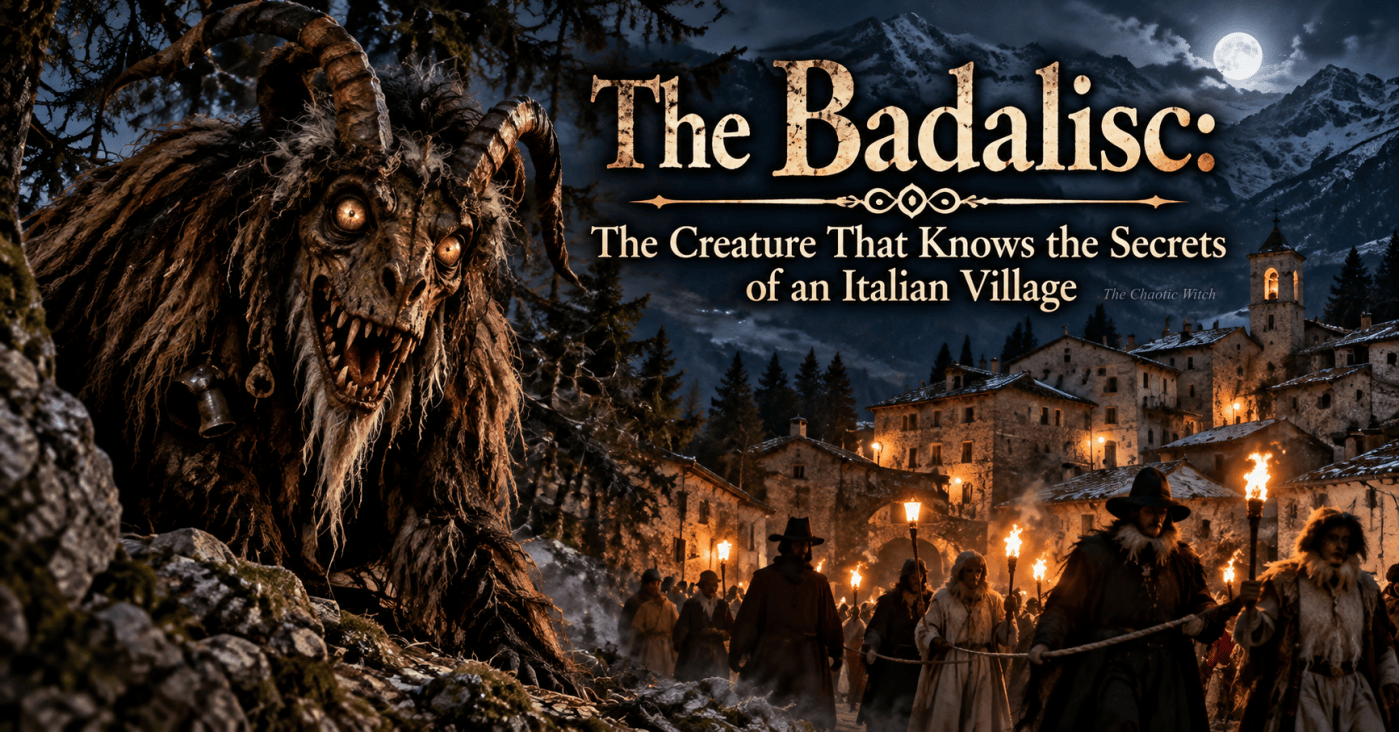
Deep in the mountains of northern Italy, where old stone villages cling to the slopes and thick forests stretch into the Italian Alps, there is said to live a creature that spends most of the year hidden among the trees.
Its name is the Badalisc.
The legend belongs particularly to Andrista, a small village in the municipality of Cevo in Lombardy’s Valle Camonica. According to local tradition, the Badalisc lives in the forests of the surrounding Valsaviore, emerging – or more accurately, being dragged from hiding – around Epiphany each year.
Describing exactly what the Badalisc looks like isn’t easy, because it doesn’t neatly resemble any ordinary animal. Traditional representations give it an imposing, almost shapeless body covered in animal hide, horns resembling those of a goat, an enormous mouth and glowing or illuminated eyes. Other descriptions associate aspects of the creature with a goat, serpent, owl and lynx.
It is strange, wild and decidedly not something you’d expect to meet while taking a peaceful walk through an Alpine forest.
But the most fascinating part of the Badalisc legend isn’t what the creature looks like.
It’s what the creature supposedly knows.
Every year on the night between January 5 and 6, villagers traditionally set out in search of the Badalisc. The hunt is deliberately theatrical. Masked figures carrying torches race through the village and surrounding area, shouting to one another in dialect as they search for the monster’s hiding place.
Eventually, the Badalisc is discovered.
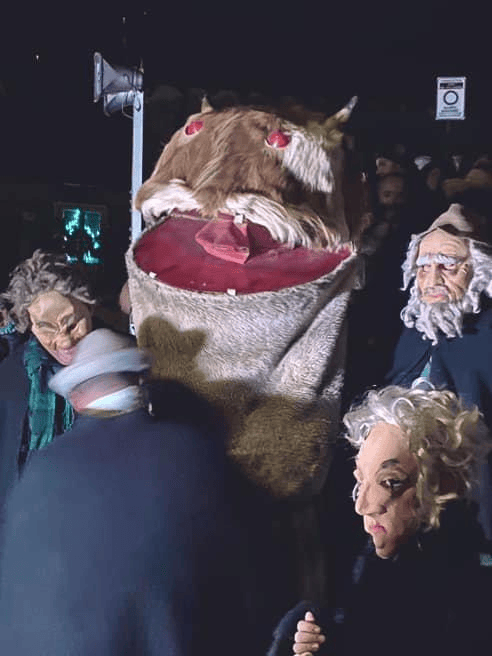
The creature is captured, tied with a rope and brought back toward Andrista in a procession. Various traditional characters accompany it, including elderly figures, shepherds and a young woman traditionally known as the signorina.
The procession winds through the village until the Badalisc reaches the place where the community has gathered.
And that’s when the creature’s real purpose becomes clear.
The Badalisc has been watching.
According to the tradition, while hidden in the surrounding forest during the year, the creature somehow learns about the lives of the villagers – the gossip, disagreements, embarrassing incidents, scandals and other events people might have preferred everyone else to forget.
Once captured, the Badalisc delivers its annual reckoning.
Because the creature doesn’t speak for itself, it hands over a written document containing what is known as the ’ntifunada. An interpreter then reads the Badalisc’s words aloud to the assembled community.
Traditionally written in rhyme and dialect, the speech recounts events from the previous year with humour and satire. Local gossip is exposed, questionable behaviour is mocked and community disputes can become material for the creature’s merciless commentary.
Imagine spending an entire year hoping nobody noticed something embarrassing you did…
…only to have a horned forest monster announce it to your entire village in January.
The tradition wasn’t always regarded as harmless fun.
Historical accounts of the festival describe periods when local religious authorities strongly disapproved of it. Women were once discouraged or even forbidden from witnessing the Badalisc or listening to its speech. Accounts preserved in studies of the tradition describe women who violated the prohibition being denied Communion the following day. Men could also face criticism or penance for participating.
The Church’s historical objections appear to have been connected both to the sometimes provocative nature of the celebration and to the belief that the custom represented remnants of an older pagan tradition.
Exactly how old the Badalisc really is, however, remains one of its mysteries.
The tradition was passed primarily through generations of oral storytelling, making its original beginning extremely difficult to establish. Researchers have noted similarities between the Badalisc and other Alpine traditions involving wild men, horned creatures and frightening seasonal figures.
Some have wondered whether its origins stretch much further into the past, perhaps even connecting symbolically with ancient imagery found among the famous prehistoric rock carvings of Valle Camonica. That possibility is fascinating, but there isn’t enough evidence to establish such an ancient origin as fact.
There is also an obvious similarity between the names Badalisc and basilisk, the legendary serpent-like creature found throughout European folklore. Researchers have considered the possible connection, but the relationship between the two remains uncertain.
What we do know is that the Badalisc tradition survived.
It didn’t simply remain trapped in an old folklore book.
The creature is still ceremonially hunted in Andrista around Epiphany. The community continues to gather for its capture, procession and satirical speech, followed by food, music and dancing. The tradition is recognized within Lombardy’s register of intangible cultural heritage.
And after the Badalisc has revealed what it knows, embarrassed a few villagers and provided everyone with something to talk about, the danger apparently passes.
Traditionally, the creature is eventually released.
Back toward the mountains.
Back toward the trees.
Back into the forests surrounding Andrista, where it will supposedly remain until the following winter.
Perhaps simply waiting.
Perhaps watching.
And perhaps collecting an entirely new year’s worth of secrets to bring back with it the next time the villagers come looking.
Sources: Regione Lombardia Archive of Ethnography and Social History; Adamello Regional Park; Atlante Demologico Lombardo; Turismo Valle Camonica; Giornale di Brescia.
 The Cool Beans
Leave a comment