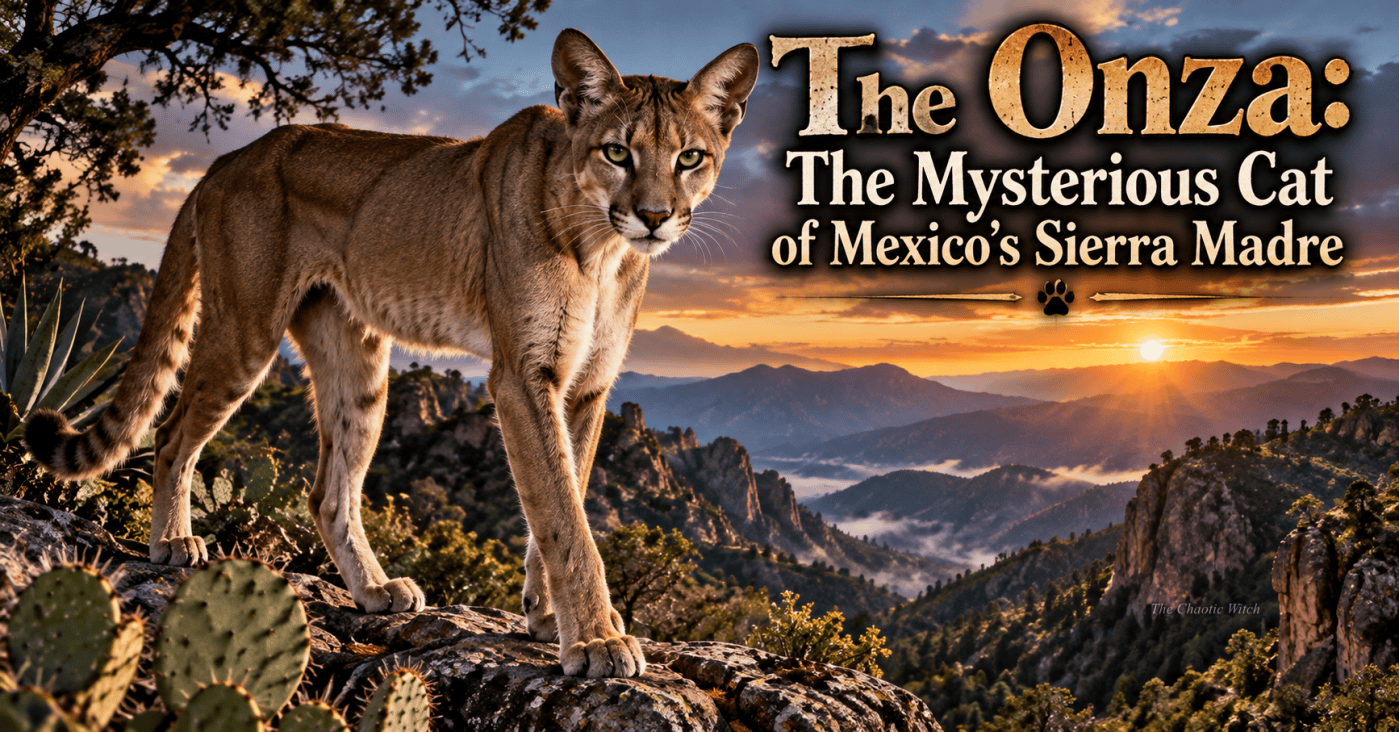
For generations, people living among the rugged mountains and remote ranches of northwestern Mexico told stories about a cat that didn’t quite fit with the animals they already knew.
They knew the jaguar.
They knew the puma.
And they knew the onza.
The creature was said to roam the mountains of Sinaloa and the surrounding Sierra Madre Occidental. At first glance, it supposedly resembled a puma, but people familiar with the animal insisted there were differences. The onza was described as unusually slender, with a long body, narrow build and disproportionately long legs. Its ears could appear larger and its overall appearance more delicate than the muscular, compact build normally associated with a cougar.
Yet despite its almost fragile appearance, the onza had a reputation for being formidable.
Stories about strange cats in Mexico stretch back centuries. Early Spanish accounts contain references to several kinds of large feline, and later naturalists attempted to determine exactly what people meant when they spoke about the onza. The name itself became confusing because it was sometimes applied to different cats in different places and periods.
But in parts of northwestern Mexico, the distinction reportedly remained remarkably specific.
Local ranchers and hunters spoke separately of tigres, meaning jaguars, leones, meaning pumas, and onzas.
To them, the onza wasn’t simply another name for an animal they already knew.
It was something different.
For outsiders, however, proving that difference was another matter entirely.
Occasional sightings and stories continued through the twentieth century. Animals resembling exceptionally thin, long-legged pumas were reportedly encountered in the mountains, but without a specimen available for scientific examination, the onza remained suspended somewhere between zoology and folklore.
Then came January 1, 1986.
Near San Ignacio in the Mexican state of Sinaloa, rancher Andrés Rodríguez Murillo encountered an unusual large cat.
The animal was killed.
At first, Murillo reportedly believed he had encountered a jaguar. But when he examined the animal more closely, something didn’t seem right.
This wasn’t a jaguar.
And it didn’t look quite like the pumas he knew either.
The cat was female and remarkably slender. Its body was elongated, its legs appeared unusually long and its proportions closely resembled the descriptions people had been giving of the mysterious onza.
A neighbouring rancher familiar with the area’s wildlife reportedly looked at the animal and identified it as exactly that.
An onza.
Suddenly, a creature that had existed largely through stories, sightings and local knowledge was lying there in the flesh.
And unlike so many cryptid encounters, the evidence didn’t disappear.
The body was preserved long enough to attract serious attention.
Cryptozoologist J. Richard Greenwell became involved in investigating the animal, along with mammalogist Troy Best. The specimen was photographed and examined, measurements were taken and biological material was preserved.
The photographs were particularly striking.
The animal unquestionably resembled a puma, but its proportions were unusual. Its torso appeared extraordinarily narrow. Its limbs seemed long. The entire animal had the lean, almost greyhound-like appearance traditionally associated with descriptions of the onza.
For cryptozoologists, this was an extraordinary opportunity.
There were no blurry photographs taken from hundreds of metres away.
No footprints slowly disappearing beneath the rain.
No fleeting glimpse through the trees.
There was an actual animal.
If the onza represented an unknown species or subspecies of Mexican cat, scientists finally had something they could test.
Years later, advances in molecular genetics made that possible.
Tissue from the 1986 specimen was subjected to DNA analysis.
And the results produced a fascinating twist.
Genetically, the mysterious animal could not be distinguished from a puma.
The cat killed in Sinaloa appeared to belong to Puma concolor — the cougar, mountain lion or puma found throughout much of the Americas.
For many people, that answered the mystery.
The famous 1986 onza wasn’t an undiscovered species.
It was a puma.
But there was still an uncomfortable little question hiding beneath that answer.
Why did it look the way it did?
And why had people living in this region apparently been describing similarly unusual cats for generations?
The 1986 animal wasn’t merely thin. Its proportions were sufficiently unusual to attract the attention of experienced researchers. The traditional description of the onza — elongated, slender and long-legged — also bore a striking resemblance to the animal that was eventually examined.
One possibility is that the onza represents nothing more mysterious than an uncommon physical variation of the puma.
Another is that certain populations of pumas living in northwestern Mexico historically developed a distinctive appearance because of genetics, environment, diet or some combination of factors.
And there is another possibility that makes the story particularly intriguing.
Perhaps the scientific identification of one onza doesn’t necessarily explain every animal behind centuries of stories.
The specimen tested in 1986 was a puma.
That fact is difficult to argue with.
But folklore doesn’t develop in laboratories.
It develops through generations of people observing the animals living around them. Ranchers, hunters and Indigenous communities often accumulated remarkably detailed knowledge of local wildlife long before scientists arrived to classify it.
Somewhere along the way, people in the mountains of northwestern Mexico became convinced that there were three different large cats sharing their landscape.
The jaguar.
The puma.
And the onza.
Maybe they were wrong.
Maybe they were seeing unusually slender pumas and giving those animals a separate name.
Or perhaps the onza was never meant to describe an entirely separate species at all. It may have represented a recognizable local form of an animal that science would ultimately place under the much broader umbrella of Puma concolor.
Whatever the explanation, the story of the onza occupies an unusual place in cryptozoology.
Most cryptids leave behind stories.
The onza left behind a body.
Scientists examined it. Researchers photographed it. Tissue was preserved. DNA was eventually tested.
And instead of completely destroying the legend, the investigation transformed the mystery.
Because the question is no longer simply:
Does the onza exist?
An animal matching its traditional description certainly did.
The more intriguing question may be:
What exactly were generations of people in Mexico calling the onza?
Somewhere in the rugged mountains of the Sierra Madre Occidental, perhaps other unusually slender cats still move quietly through the brush.
And if another one ever emerges from those mountains, there will be a century-old question waiting for it.
Is it simply another unusual puma?
Or has the complete story of Mexico’s mysterious onza still not been told?
Sources: International Society of Cryptozoology, Cryptozoology; Troy L. Best and colleagues, molecular genetic research concerning the Onza specimen; J. Richard Greenwell’s investigation of the 1986 Sinaloa specimen; George M. Eberhart, Mysterious Creatures: A Guide to Cryptozoology.
A little magic is always waiting. Subscribe and step inside the circle. 🖤🔮✨
 The Cool Beans
Leave a comment