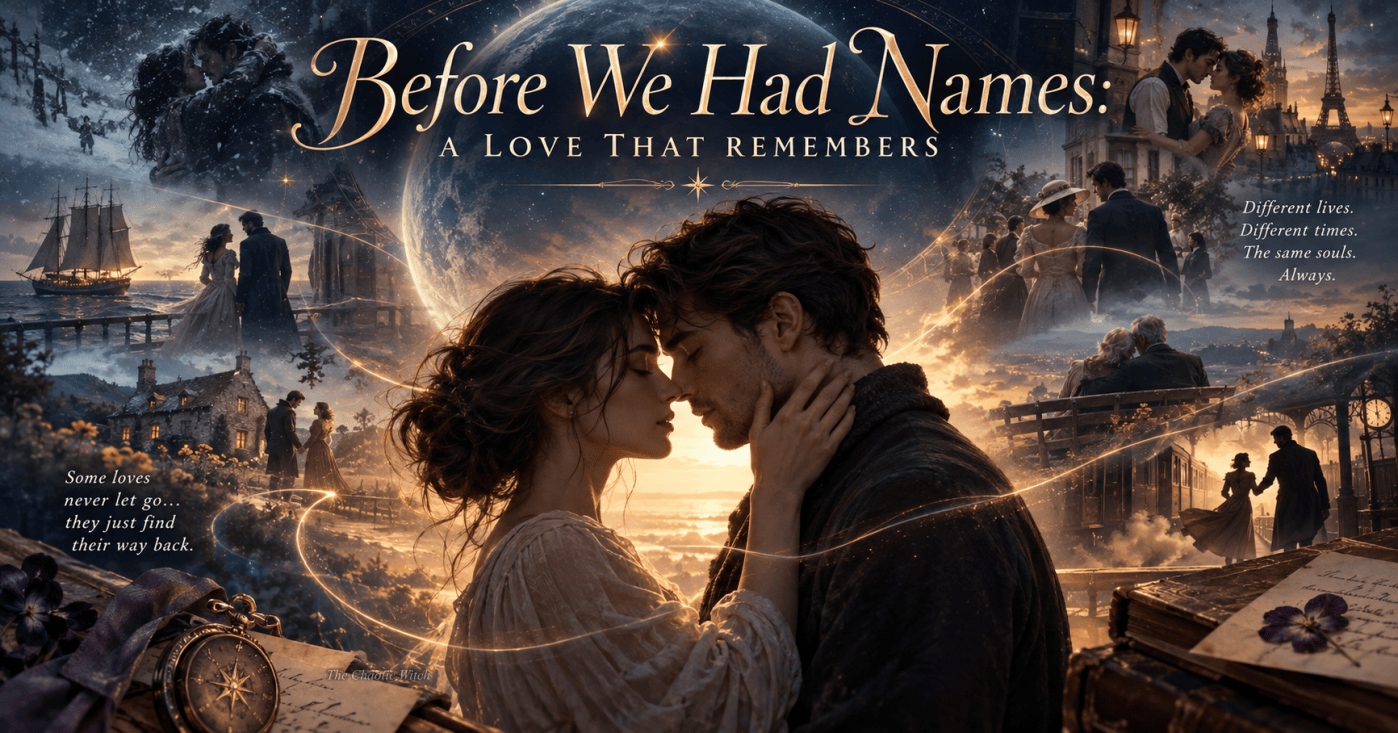
The first time Mara saw him, she remembered watching him die. It lasted less than a second. She was standing in a crowded little bookstore on a rainy Saturday afternoon, reaching for a battered collection of poetry on the highest shelf, when another hand closed around the same book.
“Sorry,” the man said.
Mara looked up, and the bookstore disappeared.
There was snow. So much snow. It fell heavily around her, collecting on her hair and eyelashes, but she couldn’t feel the cold. She was kneeling in it, wearing a dark wool dress that belonged to another century, holding a man’s face between her hands. Blood stained the collar of his coat. His breathing was shallow. His eyes were closing.
“No,” she heard herself whisper. “You promised.”
The man lifted one trembling hand and touched her cheek. “I’ll find you.”
“How?”
“I always do.”
Then the bookstore came rushing back. Mara stumbled backward into the shelf, sending several books tumbling to the floor. The stranger caught her arm.
“Are you all right?”
She stared at him. Same eyes. Not similar. The same. Dark brown with a small fleck of gold near the left pupil. She knew that fleck. Somehow, impossibly, she knew it.
“I’m fine.”
“You don’t look fine.”
“I stood up too quickly.”
“You were already standing.”
Mara stared at him. “Then apparently I stood too quickly twenty minutes ago.”
The corner of his mouth lifted, and she knew that smile too. He released her slowly. Neither of them reached for the poetry book again.
His name was Elias. They talked for eleven minutes. Mara knew because she checked the clock afterward, although it felt as though they had been standing there for hours. They talked about ordinary things – books, rain, the terrible coffee shop across the street, the fact that Elias bought books faster than he could read them and Mara refused to throw away a book even if she hated it. None of it mattered. Underneath every sentence was something neither of them said.
Recognition.
When Elias finally turned to leave, he stopped at the door and looked back at her. For one strange moment, his expression changed. It wasn’t surprise. It was grief. Deep, terrible grief. As though he had already lost her. Then he was gone.
Mara stood beside the poetry shelf for several minutes after the door closed behind him. She finally picked up the book they had both reached for. When she opened it, she found a poem about two lovers separated by the sea. She bought the book. She wasn’t entirely sure why.
That night, Mara dreamed of the ocean. She stood barefoot on the deck of a wooden ship beneath a sky crowded with stars. Lanterns swung overhead. Sailcloth snapped in the wind. Somewhere below deck, men were singing. Elias stood beside her, except his name wasn’t Elias. She knew that. His name was Thomas, and hers wasn’t Mara. She was Anne.
“You’ll come back?” she asked him.
Thomas smiled. “Always.”
“Don’t say always.”
“Why?”
“Because always is a promise nobody can keep.”
He reached for her hand. “I can.”
Then the dream changed. She stood on a rocky shore. The sea was empty. She was older. There was a letter clutched in her hand. The ship had gone down. There were no survivors.
Mara woke crying.
Across the city, Elias woke at exactly the same moment. He had dreamed of a woman named Anne standing on a shore waiting for a ship that would never return. He didn’t know her name in this life, but he knew her face. It belonged to the woman from the bookstore.
They met again three weeks later. Neither admitted they’d been hoping it would happen. This time it was raining. Mara was standing beneath the awning of a café, waiting for the downpour to ease, when Elias appeared beside her.
He laughed when he saw her. “You’re following me.”
“You were here second.”
“That’s exactly what someone following me would say.”
She laughed, and suddenly she remembered another laugh.
Paris. 1923. Music spilled from an open window. She was dancing barefoot in a tiny apartment while a dark-haired man attempted to cook something on a stove.
“You’re burning it!” she shouted.
“I’m improving it.”
“It’s on fire!”
“That’s how you know it’s nearly done.”
She threw a dish towel at him. He caught it and bowed dramatically.
Mara blinked. Paris vanished. There was only rain, traffic and Elias standing beside her.
He was staring at her.
“What?”
“You said that before.”
Her stomach tightened. “Said what?”
He looked frightened now. “‘You’re burning it.'”
“I didn’t say anything.”
“Not now.”
Mara stopped breathing.
Elias stepped closer. “I dreamed about you.”
The rain suddenly seemed very loud.
Mara whispered, “Paris?”
His face went pale.
Neither of them laughed after that. They went inside the café and stayed until closing. Elias told her about his dreams. He had been having them since childhood – places he’d never visited, people he’d never known. Sometimes he was himself. Sometimes he was someone else. And there was always a woman.
Her face changed. Her name changed. Sometimes she had dark hair. Sometimes fair. Sometimes she was young when he met her. Sometimes old. But her eyes were always the same.
Mara’s eyes.
“I thought everyone dreamed like that when I was a kid,” he admitted.
“So did I.”
“When did yours start?”
“I don’t remember. They’ve always been there.”
“Mine too.”
Mara looked at him across the table. “Why didn’t you say anything in the bookstore?”
Elias hesitated. “Because when you looked at me, I remembered you dying.”
Mara’s hand tightened around her cup.
“Where?”
“A house.”
“What kind of house?”
“Stone. There were flowers outside. Yellow ones.”
Mara’s eyes filled with tears. “I know that house.”
They spent the next several months trying to convince themselves there was a reasonable explanation. Coincidence. Déjà vu. Cryptomnesia. Overactive imaginations. Anything except the impossible.
They made rules. They would write down memories separately before comparing them. No leading questions. No finishing each other’s descriptions. No filling in details afterward. They bought identical notebooks. Mara’s was blue. Elias’s was black.
The first test frightened them both.
Mara wrote: Stone cottage. Yellow flowers. Green door. Mountains in distance. Elias sick in bed. I am older. His name begins with J.
Elias wrote: Small stone house. Yellow flowers beneath window. Door painted dark green. Mountains. I’m dying. Her hair is grey. I think my name is James.
Neither spoke for several minutes.
Finally Elias closed both notebooks. “Well.”
“Well what?”
“I was hoping one of us was crazy.”
Mara laughed nervously. “Maybe we’re both crazy.”
“That’s actually less comforting.”
The memories kept coming.
In Ireland sometime in the 1700s, she was the daughter of an apothecary and he was a carpenter. They met when he came to repair a cabinet in her father’s shop and accidentally knocked over an entire shelf of dried herbs.
“You blamed me,” Elias remembered.
“You were the one who knocked it over.”
“You distracted me.”
“How?”
“You smiled at me.”
“That sounds like a YOU problem.”
They married beneath an enormous oak tree. Mara remembered wearing tiny white flowers in her hair. Elias remembered being so nervous he dropped the ring. They had eleven months together. Then fever swept through the village. He died before their first child was born.
Mara remembered standing beneath the oak tree afterward with one hand resting on her swollen stomach, furious at him for leaving even though she knew he hadn’t chosen to.
For several days after remembering that life, Elias became unusually quiet. One night he finally said, “Did the baby live?”
Mara smiled. “A girl.”
“What did you name her?”
“Eliza.”
His eyes filled with tears. “Was she happy?”
“Very.”
That was the first time they realized something else. The memories weren’t returning merely to remind them of each other. They were healing things that had been left unfinished.
Then came Rome. They didn’t know the year. Only the marketplace. Sunlight. Red awnings. Fruit stacked on wooden tables. Mara was walking beside an older woman. Elias passed her carrying a basket. Their shoulders almost touched. They didn’t speak. They didn’t even stop.
But Mara remembered turning around.
So did he.
For a few seconds, across a crowded Roman street, two strangers stared at one another. Then the crowd swallowed them. They never met again in that lifetime.
That memory bothered Elias more than any death.
“We were right there.”
“I know.”
“Ten feet apart.”
“I know.”
“I could have said something.”
“You didn’t know.”
“Neither did you.”
They sat quietly.
Finally Mara reached for his hand. “Maybe finding each other isn’t guaranteed.”
Elias looked at her. “Then what is?”
“Trying.”
In England in 1891, they met again. This time, both were already married to other people. Nothing happened between them. Nothing could. They met at a garden party. Mara remembered him standing beneath a tree. Elias remembered her wearing blue.
They talked for perhaps twenty minutes. Then years passed. They occasionally encountered one another at social gatherings. They never touched. Never confessed anything. Never crossed the boundaries of the lives they’d already built.
But forty years later, when Elias died as an old man, there was a pressed violet tucked inside his Bible.
Mara remembered giving it to him.
He had kept it for four decades.
That memory made Mara cry.
Elias didn’t understand why. “We weren’t together.”
“That’s why.”
He understood then.
Not every love story needed possession to be real.
Then came the lifetime in which they hated each other. That one made them laugh. They couldn’t determine the exact year, only that it was somewhere in the late nineteenth century. They owned neighboring businesses. Mara ran a bakery. Elias owned a tailor shop. Apparently they spent approximately fifteen years arguing about everything.
“You threw a cup at me,” Elias said.
“You deserved it.”
“It was ceramic.”
“You really deserved it.”
“You also called my moustache an insult to masculinity.”
“It was enormous.”
“It was fashionable.”
“It had its own postal code.”
They laughed until Elias nearly fell off the sofa.
Eventually another memory surfaced.
They had married at fifty-three.
Mara stared at him. “You’re joking.”
“No.”
“After fifteen years of fighting?”
“Apparently.”
“Why?”
Elias grinned. “You threw another cup at me.”
“Romantic.”
“Then I kissed you.”
Mara shook her head. “We were idiots.”
“We’re still idiots.”
“Fair.”
But there were darker memories too. Wars. Illness. Ships that never returned. Babies buried beneath small stones. Letters that arrived too late. Promises broken by circumstances neither could control.
Once, Elias remembered dying on a battlefield without knowing whether Mara had survived the bombing of their town.
She had.
She had waited for him for twenty-seven years.
Another time, Mara died young during an epidemic. Elias never remarried.
In one life, they met as children and grew old together. In another, they found each other when Mara was seventy-two and Elias was seventy-five. They had six years.
“Was that enough?” Elias asked.
Mara remembered sitting beside him on a porch, both of them old, watching fireflies rise from the grass.
“Yes.”
“Only six years?”
She looked at him. “We’d waited seventy-two.”
Sometimes they found each other for decades. Sometimes for months.
Once, for only a single day.
They met at a railway station during wartime. They talked for three hours while waiting for different trains. They never exchanged addresses. Neither understood why saying goodbye hurt so much.
Mara’s train left first. Elias remembered running alongside it. She remembered leaning out the window. Neither could remember what they’d shouted.
Perhaps it didn’t matter.
Then there were the lifetimes when they never found each other at all.
Those frightened Mara most.
Because gradually they began to understand something. They weren’t destined to stay together.
They were destined to search for each other.
There was a difference.
Fate might bring them close, but recognition required something else.
A choice.
A glance held a second too long. Turning around in a marketplace. Speaking to the stranger on the train. Reaching for the same book.
One evening, nearly a year after they met, they returned to the bookstore.
The owner recognized Mara. “Back for more books you don’t have room for?”
“That’s the plan.”
Elias wandered toward the poetry section.
Then he stopped.
The battered collection was still there. Neither had realized Mara had bought a different copy that first afternoon. The one they’d originally reached for had remained on the shelf.
Elias pulled it down.
“You know what’s strange?”
“Everything about us?”
“Besides that.”
He opened the book.
Something slipped from between the pages.
A dried violet.
Neither moved.
Mara stared at it.
“No.”
Elias picked it up carefully. “That’s not possible.”
“It could have been there the whole time.”
“Probably.”
“Someone could have used it as a bookmark.”
“Probably.”
“It doesn’t mean anything.”
“Probably.”
They stared at each other.
Mara began laughing.
Elias did too.
Soon they were sitting on the floor between the shelves, laughing until Mara had tears running down her cheeks. The bookstore owner walked past, looked at them, and wisely kept going.
Eventually Elias became quiet.
“Do you think we’ve done this forever?”
Mara looked at the tiny flower resting in his palm. “I don’t know.”
“Do you think there was a first time?”
“Maybe.”
“What do you think happened?”
She smiled. “You probably annoyed me.”
“Historically, that seems likely.”
“Maybe we met somewhere thousands of years ago.”
“Maybe you threw pottery at me.”
“Also historically likely.”
He smiled.
Then his expression became serious. “And what happens next time?”
She understood what he meant.
Another lifetime. Another beginning. Another search. Perhaps another bookstore. Perhaps a battlefield. Perhaps two strangers passing on a street.
“Maybe I won’t remember you,” he said.
Mara’s heart tightened. “You usually don’t.”
“Neither do you.”
“Eventually I do.”
“What if we don’t?”
Mara looked down at their hands. Elias’s little finger was touching hers. Exactly the way Thomas’s had on the ship. Exactly the way James’s had in the stone cottage. Exactly the way a boy at a railway station had touched hers before she boarded a train.
She suddenly understood.
“Maybe remembering isn’t the important part.”
“What is?”
“Recognizing.”
Elias looked at her. “What if we miss each other?”
Mara thought about Rome. About the marketplace. Two people turning around without understanding why. She thought about Paris. The ship. The oak tree. The railway station. The stone cottage. The snow. Every goodbye. Every beginning. Every impossible road that had somehow brought them back together.
Then she took his hand.
“We’ve missed each other before.”
“And?”
“We kept looking.”
They grew old together in that lifetime.
Not dramatically. Not perfectly.
They argued about groceries. Elias snored. Mara stole the blankets. He left cupboard doors open. She left half-finished cups of tea everywhere. They forgot anniversaries and remembered ridiculous things instead.
Every year on the anniversary of their first meeting, Elias bought her a book.
Every year, Mara placed a dried violet inside it.
They burned dinners. They travelled. They fought. They apologized. They occasionally went to bed angry and usually woke up unable to remember why.
Sometimes memories from other lives continued to surface. Eventually they stopped being frightened by them.
“Paris,” one would say.
And the other would understand.
“Oak tree.”
“I remember.”
“Train station.”
“I know.”
There was no grand spell keeping them together. No invisible force preventing them from leaving. No cosmic rule guaranteeing happiness.
They simply chose each other.
Again and again.
Perhaps that was the real magic.
Elias died first.
Mara was eighty-seven. She sat beside him holding the same hand she’d first touched over a poetry book sixty years earlier. Outside the window, snow had begun to fall.
Mara noticed and laughed softly.
“Of course.”
Elias opened his eyes. “What?”
“Snow.”
He smiled. “Again?”
“Apparently we lack imagination.”
His breathing had grown quiet.
Mara leaned closer.
For once, she wasn’t afraid.
She had spent an entire lifetime fearing the moment she’d lose him. Now that it had arrived, she understood something she hadn’t understood in the snow centuries earlier.
This wasn’t the end.
Maybe she was wrong. Maybe there were no more lives. Maybe all their memories had some explanation they had simply never discovered.
But even if this was truly goodbye, they’d had this life.
That was enough.
“Go ahead,” she whispered.
His eyes opened. There was still a trace of the young man from the bookstore inside them.
“What if I forget?”
“You will.”
He smiled faintly. “So will you.”
“Probably.”
“Then how will I know?”
Mara kissed his forehead.
“The same way you always do.”
He waited.
She smiled through her tears.
“Something in you will recognize something in me.”
Elias closed his eyes. His fingers tightened around hers once.
Then relaxed.
Mara lived another four years.
On her final night, her granddaughter sat beside her. There was a book on Mara’s bedside table. Inside it were dozens of pressed violets.
Her granddaughter had asked about them many times. Mara always gave a different answer.
Tonight, she gave the true one.
“They help someone find me.”
Her granddaughter smiled, assuming it was another one of Mara’s stories.
“Who?”
Mara looked toward the window.
For just a moment, she thought she could smell snow.
“Someone who’s been looking for a very long time.”
She closed her eyes.
And somewhere far beyond memory, she heard laughter.
Paris.
A ship.
A railway station.
An oak tree.
A bookstore.
Then silence.
Seventy-three years later, a young man stepped onto a train in a city neither Mara nor Elias had ever known. He was running late. The doors were about to close when a woman came racing down the platform.
“Hold it!”
Without thinking, he put his arm between the doors. They opened, and she hurried aboard.
“Thank you.”
“No problem.”
Their eyes met.
Something moved through both of them.
Not a memory.
Not quite.
The strange sensation of arriving somewhere familiar.
Neither remembered the bookstore. Neither remembered Paris, Ireland, Rome, the snow, the ships or the violets. They didn’t remember promises whispered beneath oak trees or lives spent wondering why someone they barely knew felt impossible to forget.
They didn’t remember a railway station where they’d had only three hours. They didn’t remember the lifetime they wasted arguing across neighboring shops. They didn’t remember the six precious years they found each other in old age.
They didn’t remember any of it.
They were strangers.
Completely.
The woman turned toward an empty seat.
Then stopped.
Something told her to look back.
She did.
The young man was already looking at her.
“Have we met?” he asked.
She almost said no.
Instead, she studied his face.
There was something about his eyes.
Dark brown.
And near the left pupil, almost impossible to notice unless you were looking closely, was a tiny fleck of gold.
Her heart stumbled.
“I don’t think so.”
“Neither do I.”
Neither moved.
The train began rolling out of the station.
The woman smiled. “This is going to sound strange.”
“Try me.”
“I feel like I know you.”
He laughed.
The sound hit her somewhere deep inside. Somewhere older than her name. Older than this body. Older than anything she could remember.
She laughed too.
And suddenly, inexplicably, there were tears in her eyes.
The young man’s smile faded.
“Are you okay?”
She nodded. “I have absolutely no idea.”
He hesitated, then gestured toward the empty seat beside him.
“Sit with me?”
She looked at the seat.
She had planned to sit somewhere else. She had planned to put on her headphones. She had planned to spend the journey alone.
For one strange second, she had the overwhelming feeling that the smallest decision mattered enormously.
Somewhere, once, she had walked past him in a marketplace.
She didn’t know that.
Somewhere, once, she had boarded a train without asking his name.
She didn’t know that either.
Somewhere, across countless lives, two people had repeatedly come within inches of losing each other forever.
She knew none of it.
But something inside her did.
She sat down.
“I’m Eliana.”
The young man smiled.
“Thomas.”
Neither understood why his name made her heart ache.
Outside, the city slipped away.
They began talking.
Books. Music. Rain. A terrible coffee shop near the station.
Ordinary things.
The sort of conversation two strangers might have anywhere.
Yet underneath every sentence was something neither of them could name.
Recognition.
An hour later, Thomas made a joke about his inability to cook.
Eliana laughed.
“Let me guess. You think setting something on fire means it’s nearly done?”
Thomas stopped smiling.
For a moment, neither breathed.
“That’s exactly what I say.”
Eliana stared at him.
She had no idea why she’d said it.
Thomas had no idea why hearing it made him want to cry.
The train continued forward.
Neither noticed that outside the window, the first snow of winter had begun to fall.
Thomas looked at Eliana.
Eliana looked at Thomas.
And somewhere deeper than memory, older than names, stronger than time and patient enough to wait through centuries, something quietly whispered to both of them:
There you are.
A little magic is always waiting. Subscribe and step inside the circle. 🖤🔮✨


Leave a comment