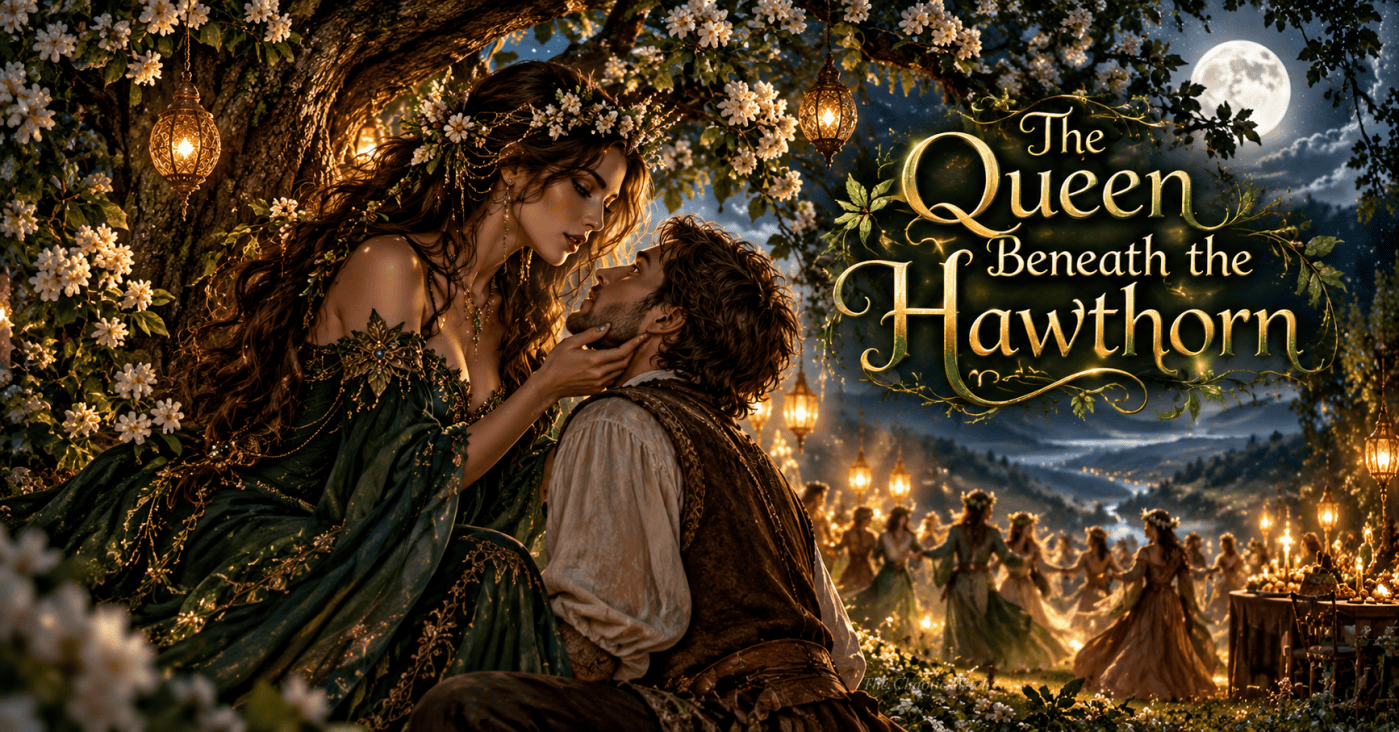
Everyone in the village knew not to follow music into the hills. Children were taught it before they were old enough to understand why. Never step inside a ring of mushrooms after sunset. Never eat food offered beneath a hawthorn tree. Never answer when someone calls your name from an empty field. And above all, if a beautiful stranger appeared on Midsummer Eve and asked you to dance, you were supposed to refuse.
Thomas Gray knew every warning. He simply didn’t believe any of them.
Thomas was twenty-eight when he first saw the woman beneath the hawthorn. He had been walking home from the neighboring village late one June evening when music drifted across the fields. It sounded like fiddles at first, although no celebration was being held nearby. Then came bells, laughter and something resembling a woman’s voice singing without words.
Thomas stopped. On the hillside stood an enormous hawthorn tree covered in white blossoms, and beneath it was a woman waiting for him. She wore a green gown so dark it appeared almost black whenever she stepped into shadow. Her hair fell nearly to her waist, and around her throat hung a silver chain bearing a small white stone.
Thomas would later struggle to describe her face. He could remember that she was beautiful. He could remember wanting desperately to look at her. But whenever he tried to recall her individual features, his memory seemed to slip away.
“You took your time,” she said.
Thomas laughed nervously. “Have we met?”
“Not yet.”
She held out her hand. Behind her, Thomas suddenly noticed dozens of people dancing beneath the trees. He hadn’t seen them moments before. Lanterns hung from branches, tables overflowed with fruit, cakes and shining goblets, and musicians played instruments Thomas didn’t recognize.
The woman smiled. “Dance with me.”
Every childhood warning returned at once, and Thomas stepped backward. “No.”
Her smile widened. “Good.”
That surprised him. “Good?”
“I dislike men who are too easily persuaded.”
She walked around him slowly, and Thomas felt strangely examined. When he asked her name, she told him that names were expensive things. Thomas, apparently forgetting every rule his grandmother had ever taught him, immediately offered his own.
“Mine’s Thomas.”
“I know.”
That should have frightened him. Instead, it fascinated him.
The woman leaned close enough that Thomas could smell hawthorn blossoms. “Come back tomorrow night, Thomas Gray.”
Then she kissed his cheek.
In an instant, the hillside went dark. Thomas found himself standing alone beside an empty field. There was no music, no lanterns and no dancers. There was only the hawthorn tree.
He went home.
And the following night, he returned.
The woman was waiting for him. This time she called herself Maeve, although Thomas somehow understood that it wasn’t her true name. They walked beneath the moon while she asked him about the human world. Thomas told her about ordinary things—the mill, the harvest, arguments in the village tavern and his mother’s terrible blackberry wine. Maeve listened as though these mundane details were treasures.
Before dawn, she kissed him again and asked, “Tomorrow?”
Thomas nodded.
Soon he was visiting every night. Maeve never begged him to come. She didn’t need to. She made Thomas feel as though no conversation he’d ever had before meeting her had mattered. She knew when he lied, she knew what frightened him, and she somehow knew ambitions he’d never confessed to another person. Yet whenever Thomas tried asking about her world, Maeve answered with another question.
Weeks passed. His mother noticed he was sleeping through mornings. His friends complained that he no longer visited. Thomas didn’t care. Nothing compared with midnight beneath the hawthorn.
Then Maeve finally invited him to her court.
“You may stay until sunrise,” she warned.
Thomas remembered the old stories. He told her he wouldn’t eat anything, and Maeve laughed and called him wise. He said he wouldn’t drink anything either, which she considered even wiser. When Thomas announced that he certainly wasn’t dancing inside any fairy ring, Maeve looked thoroughly amused.
“Someone frightened you properly as a child.”
“My grandmother.”
“I think I would have liked her.”
The fairy court was more magnificent than Thomas had imagined. Silver lanterns floated without chains. Musicians played beneath trees whose leaves glittered like glass. Men and women danced barefoot across the grass, and everywhere Thomas looked there seemed to be something impossible.
At the centre of it all stood two thrones.
One was occupied by Maeve.
The other was empty.
Thomas stared at it, and Maeve watched him notice. That was when he finally understood. She wasn’t merely one of the fair folk.
She was their queen.
Thomas turned toward her. “What is that throne for?”
“My consort.”
A chill moved through him. “Where is he?”
“I haven’t chosen him yet.”
Thomas suddenly remembered something else his grandmother used to say. Fairies rarely lied. They simply allowed humans to misunderstand.
“Why me?” he asked.
For the first time since meeting her, Maeve didn’t immediately answer. Finally, she told him it was because he had refused her.
Thomas laughed uneasily. “That’s all?”
“No.”
Maeve stepped down from her throne and approached him. Others had wanted beauty, wealth or immortality, she explained. Some wanted her simply because possessing a fairy queen would make them feel powerful.
She touched Thomas’s face.
“You wanted to know me.”
Thomas’s heart hammered. He looked toward the empty throne. “And what happens if I sit there?”
“You remain.”
“For how long?”
Maeve’s expression changed.
That was his answer.
Thomas stepped away. “No.”
The entire court became silent. Hundreds of faces turned toward him. Thomas wondered whether refusing a fairy queen twice was courageous or simply an unusually elaborate method of dying.
Then Maeve laughed.
The court relaxed.
“You continue to surprise me.”
She approached him again and told him to go home. Thomas hesitated before asking whether he would ever see her again.
“If you wish,” she replied.
That answer frightened him more than anything else.
Thomas returned to the village before sunrise and stayed home for three nights. On the fourth night, he dreamed about Maeve. On the fifth, he heard music drifting across the fields. On the sixth, hawthorn blossoms appeared on his windowsill even though the tree was miles away.
On the seventh night, Thomas returned to the hill.
Maeve was there.
“You came back.”
“You knew I would.”
“No,” she said softly. “I hoped.”
Thomas studied her. “You’re still trying to seduce me.”
“Obviously.”
He laughed, but it was at that moment Thomas finally understood the true danger. It wasn’t enchantment. It wasn’t fairy dust. It wasn’t some spell forcing him toward the hill.
Maeve didn’t need magic.
She was patient.
She had eternity.
Thomas had perhaps sixty more years.
She could afford to wait.
And every time Thomas returned voluntarily, the boundary between their worlds became a little thinner.
Their strange courtship continued. Thomas grew older, but Maeve did not. Villagers eventually stopped asking why he disappeared into the hills at night. Some believed he had a secret lover. Others knew better.
Thomas never sat upon the empty throne. He never ate fairy food. He never accepted Maeve’s promises of youth.
But he never stopped visiting her either.
Then, one autumn evening many decades later, an old Thomas Gray walked slowly toward the hawthorn tree. Maeve was waiting exactly as she’d looked the first night they met.
Thomas smiled. “You’ve been remarkably stubborn.”
“So have you.”
She held out her hand.
This time, Thomas took it.
“One dance,” he said.
Maeve smiled. “One.”
The music began, and Thomas danced with the fairy queen beneath the hawthorn until both disappeared into the mist.
The following morning, villagers found Thomas’s walking stick beneath the tree.
Nothing else.
For generations afterward, people claimed that on Midsummer Eve an elderly man’s laughter could sometimes be heard among the fairy music. But there was one peculiar detail. Those who claimed to glimpse the dancers never described an old man.
They described a young one.
And beside him danced a beautiful woman dressed in green.
Some said Thomas had finally been enchanted. Others believed Maeve had spent a lifetime waiting until he chose her freely.
But the oldest people in the village always ended the story differently.
They said that was precisely why the fairy queen was so dangerous.
She never needed to drag anyone beneath the hill.
Eventually, they walked there themselves.
A little magic is always waiting. Subscribe and step inside the circle. 🖤🔮✨


Leave a comment