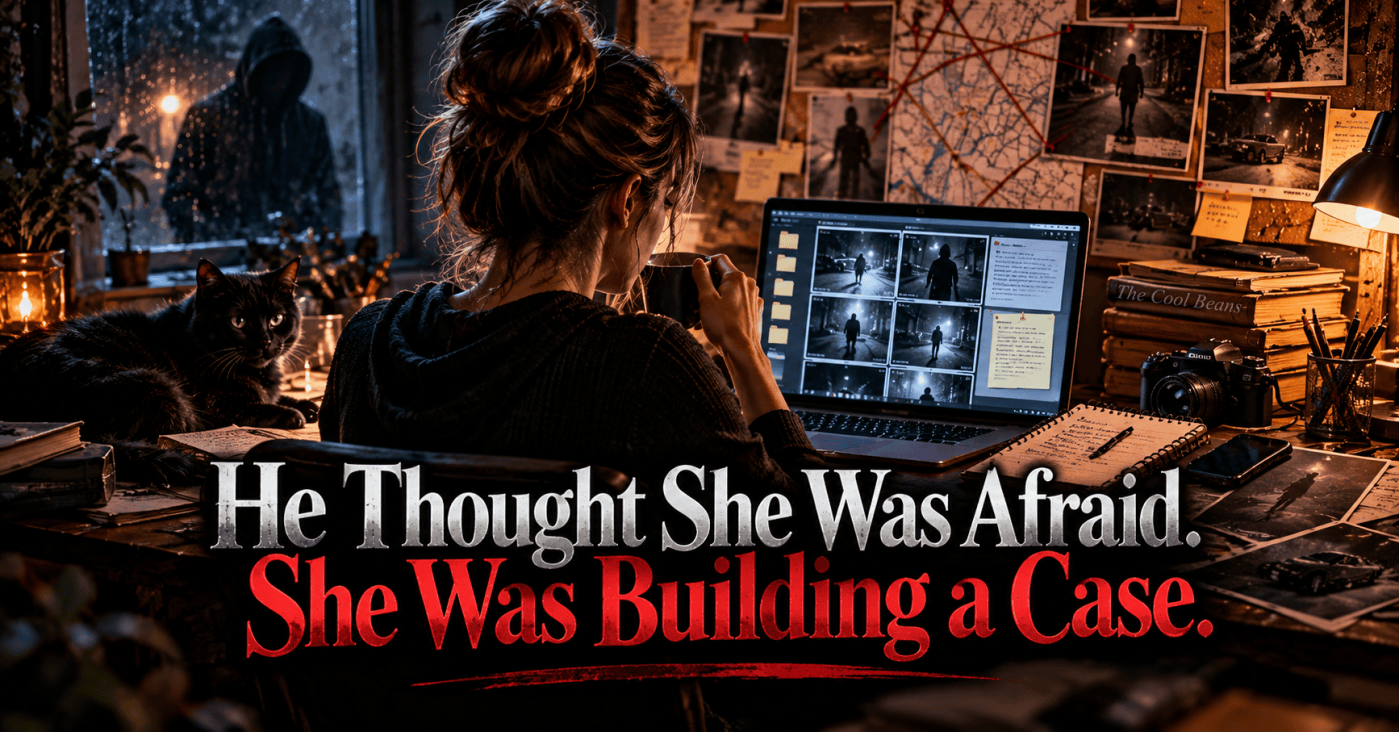
Claire Morgan had spent years studying crime. She had a degree in criminology, shelves filled with books about criminal investigations, and an almost embarrassing ability to identify obscure murder cases within three clues. Her friends joked that if they ever disappeared, Claire was the person they wanted looking for them. At five-foot-two and barely over a hundred pounds, Claire had also spent most of her life being underestimated. She didn’t mind. Sometimes being underestimated was useful.
What Claire never expected was that one day she would need everything she’d learned to investigate a crime being committed against her.
His name was Adrian. When they first met, he was charming in that effortless way that makes everyone else in the room feel temporarily less interesting. He remembered tiny details. He sent thoughtful messages. He wanted to know everything about Claire. What were her favourite restaurants, her childhood, her friends, her schedule, where she went running and what time she usually left work. At first, it felt like attention. Later, Claire would understand that he had been collecting information.
The relationship changed slowly enough that she kept explaining each incident away. Adrian criticized her friends because they were “bad influences.” He became angry when she didn’t answer messages immediately. He wanted passwords because couples “shouldn’t have secrets.” Arguments somehow always ended with Claire apologizing for something Adrian had done.
When she finally ended the relationship, Adrian didn’t yell or threaten her. He simply smiled. Somehow, that frightened her more.
“You’ll come back,” he said.
Claire didn’t.
Three days later, flowers arrived at her home with no card. The following week, someone left a coffee on the roof of her car – made exactly the way she ordered it. Then came the text messages from unfamiliar numbers. At first they were almost innocent. “I miss you.” Then they became unsettling. “You looked nice today.” Finally came one that made the hair on the back of Claire’s neck stand up: “Blue suits you.”
Claire had worn a blue sweater that afternoon.
She blocked the number. Another appeared. Then another.
Adrian insisted it wasn’t him. In fact, he seemed almost offended by the accusation. During the last conversation Claire willingly had with him, he dismissed her concerns completely. “You’re obsessed with crime,” he told her. “You’re seeing things that aren’t there.”
That sentence stayed with Claire because she knew something about patterns. One strange incident could be coincidence. Twenty-seven weren’t.
So Claire stopped arguing with him.
And started documenting him.
She created a chronological log containing dates, times, locations and descriptions. She took screenshots of every message and photographs of anything unusual. She wrote down the names of anyone who had witnessed an incident. Instead of deleting disturbing voicemails because she didn’t want to hear his voice again, she preserved them. Everything was backed up somewhere Adrian couldn’t access.
Then Claire noticed something else. Adrian had patterns too. He was intelligent, but he desperately needed other people to know he was intelligent. He wanted Claire to understand that he could reach her whenever he wanted. That need to frighten her, and receive credit for frightening her, made him careless.
Whenever something happened, Adrian eventually found some indirect way to demonstrate that he knew about it. A note appeared beneath Claire’s windshield wiper after she had dinner with a male colleague. A message arrived minutes after she visited her sister. One evening, Claire took an unusual route home and noticed a familiar black SUV several cars behind her. She didn’t confront the driver or try to determine whether it was Adrian. She drove somewhere public instead. Eventually, the SUV disappeared.
Claire recorded the time and location.
The following morning, Adrian sent her a message.
“Taking the scenic route these days?”
Claire stared at the screen, and then she smiled. Not because it was funny, but because Adrian had just documented himself.
The stalking escalated. Someone began appearing outside Claire’s apartment late at night. Her building’s security camera captured a hooded figure entering the parking area on several occasions. Adrian continued denying everything.
Claire did something Adrian hadn’t anticipated. She told people.
She told her friends, her family and her coworkers what was happening. She gave trusted people his name and photograph. She made sure others knew about the unwanted messages and appearances. She stopped protecting the privacy of a situation that was becoming increasingly frightening.
That mattered because Adrian had depended on isolation.
Claire gave him witnesses.
Then came the mistake that changed everything.
One afternoon, Claire received a photograph from another anonymous account. It showed her sitting beside the window of a café. The photograph had clearly been taken from outside the building. Whoever sent it apparently wanted Claire focused on its frightening implication: I can see you.
Instead, Claire studied the photograph.
The criminology graduate took over.
She enlarged the image and examined everything visible in it. Reflected in the café window was part of the street behind whoever had taken the photograph. Claire could see a storefront, part of a traffic signal and the unmistakable rear quarter of a black SUV.
She knew exactly where the photograph had been taken.
More importantly, Claire remembered that a neighbouring business had exterior security cameras.
She didn’t go searching through the business’s footage herself. She didn’t confront Adrian, follow him or attempt to set some elaborate trap. She gave what she’d noticed to police.
Investigators obtained surveillance footage.
There was Adrian.
His vehicle arrived shortly before Claire entered the café. He parked across the street. He got out. He photographed Claire through the window. Then he returned to his vehicle and drove away.
Suddenly, it wasn’t Claire’s word against his.
But Adrian still believed he was smarter than everyone else.
So he kept going.
That was his next mistake.
He contacted Claire through an anonymous email account while simultaneously insisting that he hadn’t communicated with her for months. He appeared near her workplace. More messages arrived. Each time Adrian tried to frighten Claire, he created another piece of the pattern she had been carefully documenting.
That was the fundamental mistake he had made from the beginning. Adrian assumed every incident would stand alone. A flower delivery meant nothing. A car driving past meant nothing. One anonymous message meant nothing. A person standing outside an apartment building might mean nothing.
Claire understood something he didn’t.
Put them together.
The messages weren’t random anymore. Neither were the drive-bys. Neither were the photographs, the appearances outside her apartment, the anonymous accounts or Adrian’s strangely specific knowledge of places Claire had been.
One incident might have been explained away.
Together, they told a story.
And Claire had preserved it.
When Adrian was eventually confronted with the accumulated evidence, his response was almost predictable. Claire was vindictive. Claire was imagining things. Claire had misunderstood innocent behaviour. Then came the claim that she had orchestrated everything because she couldn’t get over him.
But there was a problem. The evidence didn’t care about Adrian’s explanation. Cameras didn’t care. Timestamps didn’t care. Phone records didn’t care and witnesses didn’t care.
That was what Claire had understood before he did. She didn’t need to outfight him. She didn’t need to intimidate him. She didn’t even need Adrian to admit what he’d done.
She simply needed to stop playing the game he had designed.
Months later, after the legal proceedings were over, a friend asked Claire a question she would come to hate.
“With everything you know about crime, how didn’t you see what he was?”
Claire thought about it before answering.
“Because knowing what stalking looks like in a textbook isn’t the same as realizing someone you once loved is doing it to you.”
That was perhaps the hardest lesson of all.
Claire hadn’t been foolish. She hadn’t failed some imaginary test that people with criminology degrees were supposed to pass. Adrian had known her personally. He knew which boundaries to push gradually, which explanations she was likely to accept and how to make unreasonable behaviour appear almost reasonable when viewed one incident at a time.
He had also made one enormous miscalculation.
He believed frightening Claire would make her easier to control.
Instead, once Claire understood what was happening, she became methodical. She stopped trying to convince Adrian to leave her alone. She stopped trying to understand why he was doing it. She stopped responding to provocations designed to pull her back into conversation.
And she documented everything.
Years later, Claire still loved true crime. But she listened differently whenever people asked why a victim hadn’t recognized the danger sooner. She knew now how easily a frightening story could begin inside an ordinary relationship and how different abuse could look when you were standing inside it instead of studying it from the outside.
She also understood something Adrian never had.
Being physically smaller didn’t make Claire powerless. Being frightened didn’t make her weak and becoming a victim didn’t suddenly make an intelligent woman stupid.
Adrian had spent months trying to prove that he knew everything about Claire.
In the end, there was one thing he hadn’t known at all.
What she was capable of when he finally gave her a reason to stop underestimating herself.
🔎 Love true crime, unsolved mysteries, missing-person cases, and stories that deserve to be remembered? Your subscription helps keep these stories visible and sometimes visibility is exactly what a case needs.


Leave a comment