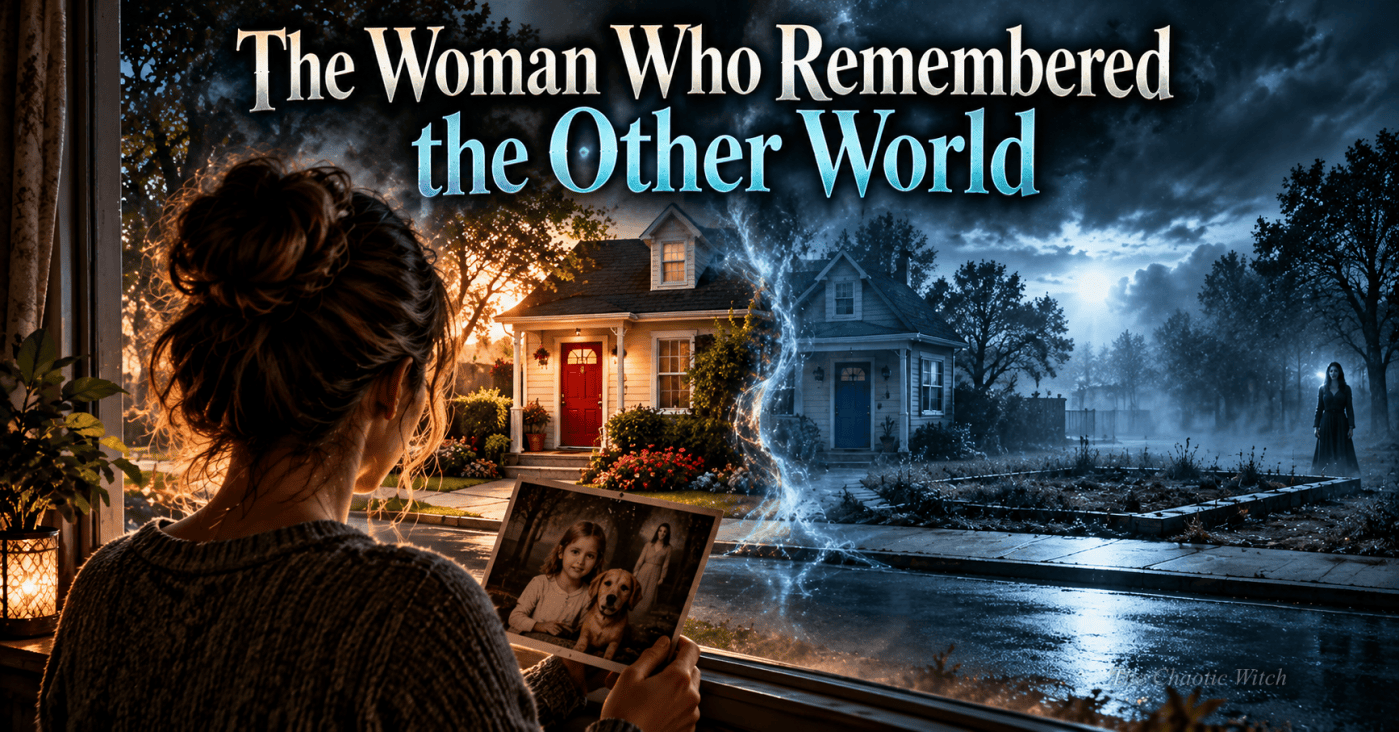
The first thing Melinda noticed was the blue door. It shouldn’t have been blue. She had lived across from Mrs. Bell’s house for eleven years, and the front door had always been red. Not burgundy. Not faded crimson. Red. Mrs. Bell had once joked that she kept it that colour so she could find her house if she ever became senile.
But on Tuesday morning, Melinda stepped outside with her coffee and found herself staring across the street at a perfectly ordinary navy-blue door. She assumed Mrs. Bell had painted it. Then Mrs. Bell came outside.
“Love the new colour,” Melinda called.
Mrs. Bell looked puzzled. “What new colour?”
“Your door.”
The woman glanced behind herself. “It’s always been blue.”
Melinda laughed because that was easier than explaining why those four words made her stomach tighten.
By Wednesday, she had mostly forgotten about it. Then she stopped at Miller’s Bakery on her way to work and discovered it was called Miller & Sons. There had never been any sons. Mr. Miller had three daughters. Melinda knew because she’d gone to school with one of them. Yet framed photographs behind the counter showed Mr. Miller standing proudly beside two grown men Melinda had never seen before.
When she asked about his daughters, the cashier stared at her. “Mr. Miller doesn’t have daughters.”
This time, Melinda didn’t laugh.
She began writing things down. Mrs. Bell’s door – red. Mr. Miller – three daughters. The pharmacy on King Street – beside the bank. Her childhood dog – Pepper. Her sister’s middle name – Rose. She kept the list folded inside her purse.
For three days, nothing changed. Then on Saturday morning, the pharmacy was on Queen Street. Her sister’s middle name was Anne. And Pepper had apparently never existed.
Melinda found photographs of herself as a child sitting on the porch where Pepper should have been curled beside her. There was only empty space. She called her mother and asked, “Did we ever have a dog?”
“No, sweetheart. Your father was allergic.”
Her father wasn’t allergic to dogs. At least he hadn’t been yesterday.
That night, Melinda stopped sleeping. She searched the internet for explanations: false memories, stress, neurological conditions, the Mandela Effect. Every reasonable explanation made sense until she looked at the list in her purse.
Because the list didn’t change.
Reality did.
On Monday, she noticed something worse. People were changing too. Her coworker Daniel suddenly drank tea instead of coffee. Her neighbour drove a silver car instead of a black one. Her mother remembered a family vacation to Florida that Melinda was certain had never happened.
The changes were tiny. Almost polite. As though something were editing the world carefully enough that nobody would notice.
Nobody except her.
Then Melinda found the photograph. It was inside an old album in her mother’s basement. Her eighth birthday. Balloons. Cake. Her parents. Her sister. And Pepper.
Melinda nearly cried when she saw him. There he was, sprawled beneath the kitchen table with his ridiculous floppy ears.
But someone else was in the photograph.
A woman stood behind Melinda. Tall. Pale. Smiling.
Melinda didn’t recognize her.
She turned the photograph over. Her mother’s handwriting listed everyone pictured: Mom. Dad. Melinda. Sarah. Pepper.
And beneath those names were three words: The woman watching.
Melinda dropped the photograph.
That evening, someone knocked on her door. Three slow knocks. She looked through the peephole. The woman from the photograph stood outside and she looked exactly the same.
Melinda had been eight years old in that picture. She was thirty-six now.
The woman smiled toward the peephole. “You’re noticing.”
Melinda didn’t open the door. “What is happening?”
The woman’s smile disappeared. “You keep remembering the previous versions.”
“Versions of what?”
“Everything.” Melinda backed away.
The woman explained that reality wasn’t one permanent thing. It shifted constantly – tiny adjustments, corrections, possibilities replacing other possibilities. Most people shifted with it. Their memories changed alongside the world. They never knew anything had happened.
“But mine don’t,” Melinda said.
“No.”
“Why?”
The woman tilted her head. “We don’t know.”
Melinda looked toward the table where her handwritten list waited. “How many times has this happened?”
The woman was silent.
“How many?”
“Since you’ve been alive?”
“Yes.”
“Thousands.”
Melinda felt the room sway. Then she asked the question she immediately wished she hadn’t.
“What’s the biggest thing that’s ever changed?”
For the first time, the woman looked uncomfortable.
“You had a brother once.”
Melinda couldn’t breathe. “No.”
“Yes.”
“I don’t remember a brother.”
“I know.”
That frightened her more than anything else. Because if she could forget him, what else had disappeared without leaving even a memory behind?
The woman stepped closer to the door. “Melinda, tomorrow morning there will be another shift. A large one.”
“What changes?”
“I can’t tell you.”
“Why are you warning me?”
A long silence followed.
Then the woman whispered, “Because this time, you’re the thing that changes.”
Melinda didn’t sleep. She covered her walls with photographs, notes and memories. She wrote her name hundreds of times.
MELINDA CARTER EXISTS.
She emailed herself. Scheduled messages. Hid letters around the house.
Before sunrise, she sat at the kitchen table clutching the photograph of her eighth birthday. At exactly 6:17am, every light in the house flickered.
For perhaps half a second, there was no sound. No traffic. No refrigerator humming. No birds.
Nothing.
Then the world returned.
Melinda opened her eyes. Her kitchen looked the same. Her notes remained. Her photographs remained.
She laughed.
Whatever was supposed to happen hadn’t worked.
Across the street, Mrs. Bell stepped outside.
Her door was red again.
Melinda ran to the window.
Mrs. Bell looked toward Melinda’s house.
Her smile vanished.
Because there was no house there.
Only an empty lot.
Melinda looked down at herself. She was still there. Her kitchen was still there. Everything inside the house remained exactly as it had been.
But outside the windows, the world continued without her.
People walked past the empty lot. Cars drove through the space where her driveway should have been. Nobody looked toward her windows.
Nobody could see them.
Then Melinda noticed someone standing across the street.
The pale woman. She could see her. Slowly, the woman raised one hand. Not waving, but pointing. Behind Melinda.
Three slow knocks came from the front door. Melinda stared at it because whatever had knocked couldn’t have come from outside. There was no outside anymore.
And somewhere beyond the walls of a house the world had forgotten, something knocked again.
Three times.
As though asking to be let into a reality where it had never existed.
A little magic is always waiting. Subscribe and step inside the circle. 🖤🔮✨


Leave a comment