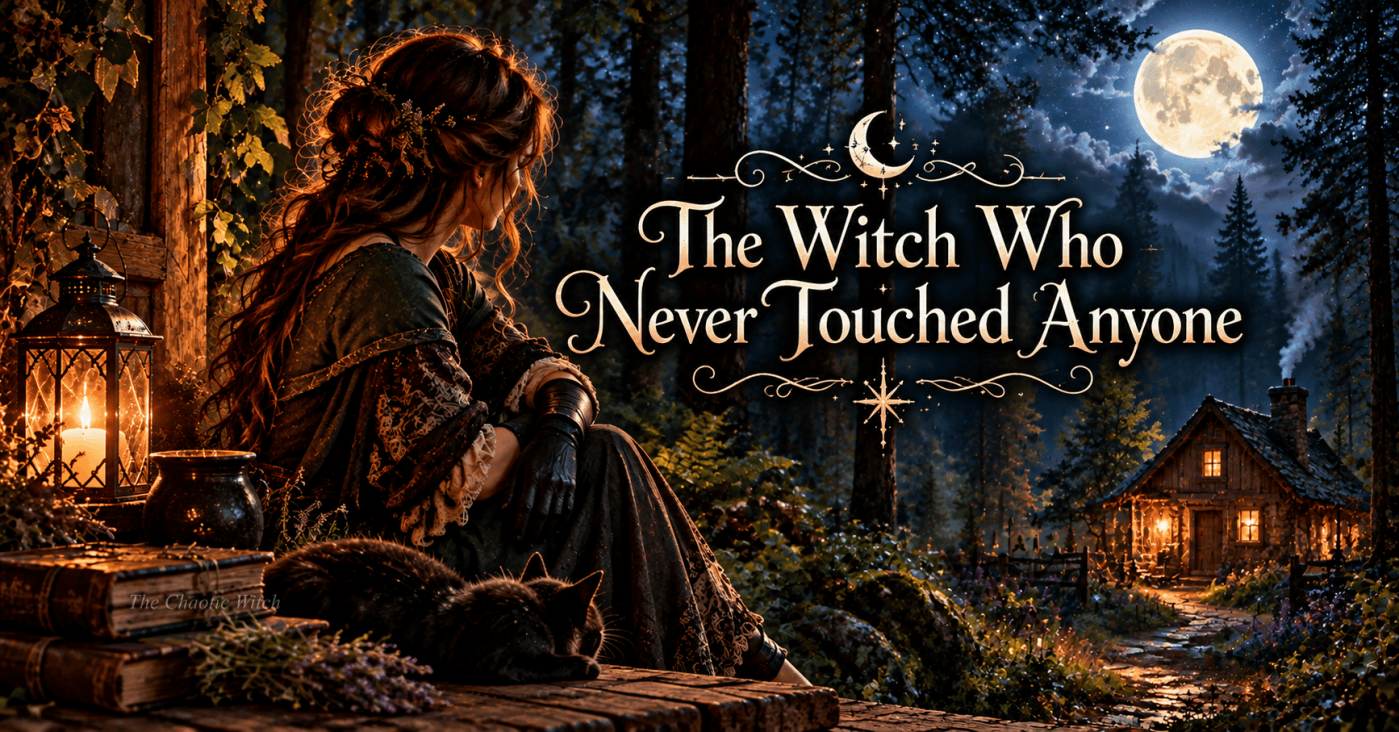
Everyone in Briar Hollow knew that Isobel Leach wore gloves. She wore them in summer, when the heat made the roads shimmer and everyone else rolled their sleeves above their elbows. She wore them while buying bread, while gathering herbs beside the river, and even while standing alone beneath the rain. What no one knew was why.
The rumours were considerably more entertaining than the truth. Some said Isobel’s hands were horribly scarred. Others claimed anything she touched died before sunset. Children whispered that she had claws instead of fingernails. Old Mrs. Bell insisted Isobel had murdered three husbands, despite the inconvenient fact that Isobel had never married anyone. Isobel encouraged every rumour because they were easier to live with than the truth.
Isobel’s touch did not kill. It revealed.
Skin against skin was enough – a fingertip brushing another hand, an accidental bump of bare shoulders, someone reaching for her wrist. The moment it happened, Isobel would see the deepest fear that person carried, the one buried beneath ordinary fears of death, sickness, loneliness, or loss. She saw the humiliating ones, the secret ones, the fears people would rather die than admit belonged to them.
The baker feared that everyone secretly hated his bread and had been politely choking it down for twenty-three years. The mayor feared that he was astonishingly stupid and that every person in town had somehow agreed not to tell him. A celebrated soldier who had survived three wars feared darkness because, at forty-eight years old, some part of him remained convinced there was something underneath his bed.
Isobel never merely learned these things, she experienced them. When she touched someone, the world disappeared and, for a few terrible moments, she became them. She felt their shame crawling beneath her skin. She heard every cruel voice they had ever imagined. She stood inside nightmares constructed from memories, insecurities, childhood wounds, and private embarrassments. Then she returned to herself, usually within seconds and sometimes screaming.
The curse had begun when Isobel was seventeen. Before that, she had been affectionate to an almost irritating degree. She hugged people when she greeted them, linked arms with friends, and kissed her mother goodnight.
Then, one autumn afternoon, Isobel found an injured woman beside the forest road. The stranger was old, bleeding, and dressed entirely in black. Isobel knelt beside her and reached out.
“Let me help you.”
The woman looked at Isobel strangely. “People rarely touch what frightens them.”
“You don’t frighten me.”
“You should learn to be more careful.”
Isobel reached for her hand. The world shattered. She saw hundreds of faces and hundreds of fears, tumbling through her mind faster than she could understand them. Then, somewhere inside the chaos, she heard the old woman whisper something Isobel would remember for the rest of her life.
“Then carry what they hide.”
When Isobel awoke, the stranger was gone.
The curse remained.
At first, Isobel tried to continue living normally. She lasted three days. Her mother touched her cheek, and Isobel saw her mother’s secret terror that she had wasted her entire life. Her brother grabbed her hand, and Isobel discovered he feared everyone would eventually realize he wasn’t nearly as brave as he pretended to be.
Then her closest friend hugged her.
Isobel saw herself.
Not Isobel exactly, but the terrifying version her friend secretly imagined: beautiful, clever, effortlessly captivating – the woman everyone would eventually choose instead of her. Isobel pulled away, and her friend saw the horror on her face. Neither of them ever spoke about it.
Within a year, Isobel stopped touching people entirely. She moved into an abandoned cottage beyond Briar Hollow, where the village road disappeared into the pine forest. She grew medicinal herbs, made tinctures and teas, repaired her own roof, and learned to cut her own hair badly.
Most importantly, she wore gloves. Always.
Years passed, then decades. Eventually, people stopped trying to know her.
Until Elias Rowan knocked on her door.
He arrived during a thunderstorm carrying a dead chicken. Isobel stared at him. Elias stared back. Rain poured from his hair.
“This yours?” he asked.
“No.”
“Oh.” He looked at the chicken. Isobel looked at the chicken.
“Why did you bring it here?”
“I found it near your gate.”
“So naturally you assumed I wanted it?”
“I panicked.”
Despite herself, Isobel laughed. It was the first time she had laughed with another person in years.
Elias became an inconvenience almost immediately. He lived in a farmhouse beyond the eastern hill and apparently possessed no instinct whatsoever for leaving Isobel alone. He brought eggs, books, and mushrooms he wanted her to identify. Once, inexplicably, he brought her a chair.
“I noticed yours was broken.”
“You were looking through my window?”
“I was standing outside.”
“That is generally where windows are observed from.”
He considered this. “Fair point.”
Isobel liked him.
That terrified her.
So she established rules. He was never to enter without knocking, never stand behind her, and, most importantly, never touch her.
Elias accepted them without asking why.
Months became years. They drank tea on opposite sides of her table and walked through the forest with space between their shoulders. He learned that Isobel hated turnips, loved thunderstorms, cheated shamelessly at cards, and cried whenever she saw injured animals. She learned that Elias sang badly while chopping wood, secretly wrote poetry, hated raisins with an irrational passion, and spoke to his horse as though the animal were an employee whose performance required constant evaluation.
Neither mentioned love. They didn’t need to.
Then, Elias became ill. It happened quickly. A fever swept through Briar Hollow one winter, and although Isobel’s remedies helped many, Elias worsened. She sat beside his bed for three nights, changing cool cloths with her gloved hands, measuring medicine, and listening as his breathing grew weaker.
On the fourth morning, Elias opened his eyes.
“Isobel.”
“I’m here.” He lifted his hand toward her. She froze.
“Isobel.”
“No.”
“Just once.”
“You don’t understand.”
“Then explain it.” And after thirty-two years, Isobel finally told someone the truth.
Elias listened quietly as she told him everything: the woman beside the road, the curse, the visions, the terrible intimacy of knowing what another person desperately wanted hidden. When she finished, Elias smiled.
“That’s all?”
She stared at him. “That is most certainly not all.”
“So you’ll see my greatest fear.”
“Yes.”
“My most embarrassing one?”
“Yes.”
“The thing I would rather nobody know?”
“Yes.”
He thought about this for a moment. “That could be unfortunate.”
Despite herself, Isobel laughed. Then Elias held out his hand.
“You don’t have to,” Isobel whispered.
“I know.”
Slowly, she removed one glove. Her bare hand hovered above his, every instinct screaming at her to stop.
Then their fingers touched.
The cottage vanished.
Isobel fell into Elias’s fear. She expected monsters. Failure. Death. Perhaps something ridiculous involving public nudity.
Instead, she saw herself.
Isobel stood inside her cottage exactly as she was now, but Elias was gone. Years passed around her. Her hair turned silver. Her hands trembled. The cottage deteriorated. No one knocked at the door. No one brought eggs. No one argued about raisins.
Isobel sat alone beside the window.
Waiting.
And suddenly she understood.
Elias’s deepest fear wasn’t dying, it was leaving her alone again. The vision shattered, and Isobel returned to the room with tears streaming down her face. Elias looked mortified.
“Well,” he whispered, “that’s embarrassing.”
Isobel laughed through her tears. “You absolute idiot.”
“I was hoping it would be something dignified.” She squeezed his hand.
For the first time in thirty-two years, Isobel intentionally touched another human being and nothing terrible happened. She simply saw the part of him he had hidden, and suddenly Isobel understood something the curse had prevented her from seeing all those years.
Fear was not ugliness.
It was intimacy.
The curse had never shown her people’s worst selves. It had shown her their most vulnerable ones. She had spent half her life believing she had been cursed to discover how ridiculous people were, when perhaps she had actually been cursed to discover how human they were.
Elias survived the fever.
Spring returned, and gradually Isobel began removing her gloves.
Not for everyone, of course. She had absolutely no desire to discover what Mayor Holloway was secretly terrified of. Some mysteries deserved to remain mysteries.
But she touched Elias.
She held his hand while they walked through the forest. She rested her head against his shoulder. Whenever his skin met hers, sometimes another fear appeared. She learned that he feared he wasn’t good enough for her, that someday she would regret choosing him, and that his poetry was genuinely terrible.
That last one, Isobel privately suspected, was less a fear and more an accurate literary assessment.
Years later, people in Briar Hollow began noticing something strange. The witch beyond the pines still wore gloves whenever she came into town, but now there was usually a man walking beside her.
And their hands were always intertwined.
People invented new rumours. They said Elias Rowan had broken the witch’s curse.
They were wrong. The curse never disappeared.
Isobel simply stopped being afraid of it.
Because there are things about ourselves we hide beneath pride, laughter, anger, and carefully constructed versions of who we want the world to believe we are. There are fears we consider too foolish, too humiliating, or too vulnerable to ever place in another person’s hands.
And sometimes the deepest form of love is not being spared those hidden things.
It is allowing someone to see them – and discovering their hand is still holding yours.
A little magic is always waiting. Subscribe and step inside the circle. 🖤🔮✨


Leave a comment