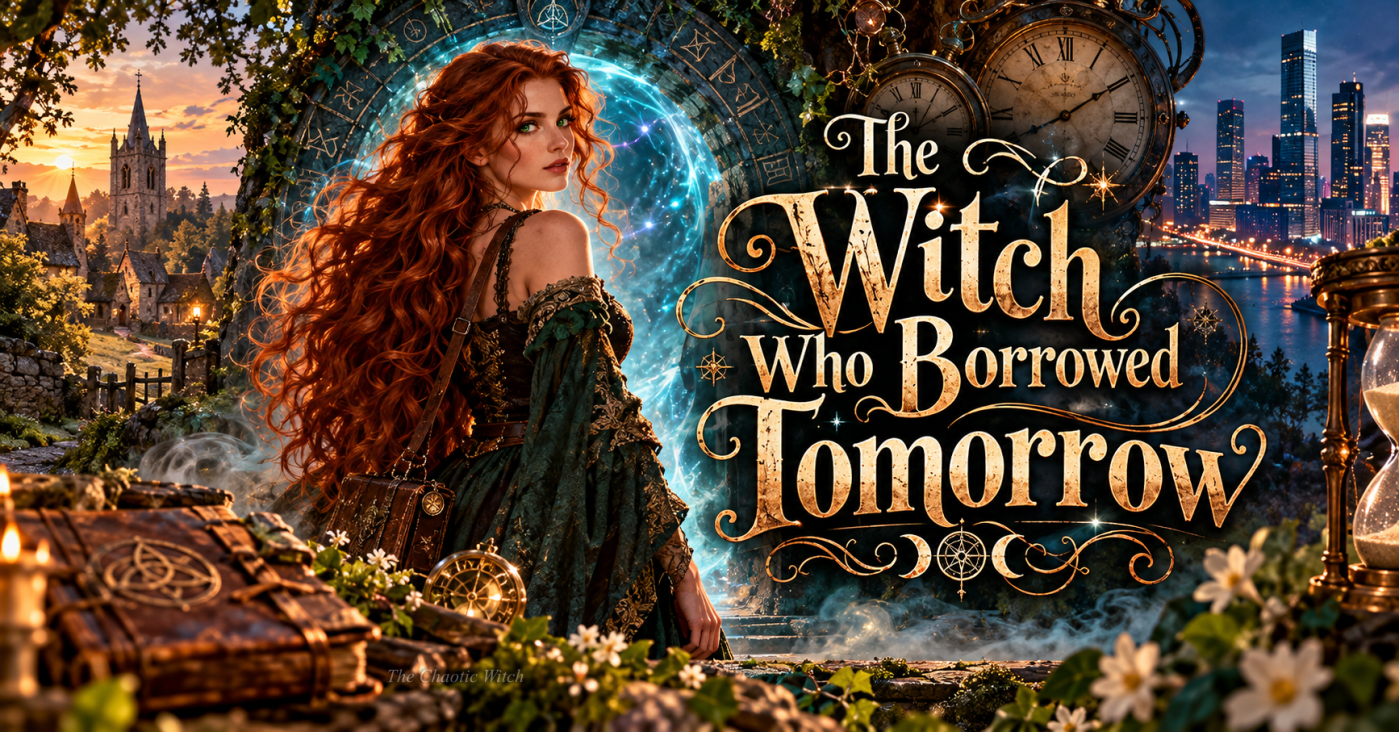
Part One
The first time Isolde Ashbourne travelled through time, she was twenty-seven years old, standing barefoot in a circle of salt beneath a blood-red moon, and absolutely certain she was about to die. She had been born in 1590, in a small English village surrounded by ancient woodland, where the trees grew so close together that sunlight rarely touched the forest floor. Her mother had been a healer, her grandmother a witch, and her great-grandmother something considerably older and more mysterious. The women of her family had passed down their knowledge through whispered lessons, handwritten books, and warnings that were never fully explained.
Isolde had inherited more than their magic. She was unusually tall for a woman of her time, with a curvy figure, striking green eyes, and magnificent waves of deep red hair that fell to her waist. Her complexion was smooth and pale, without a single freckle, and her features were so distinctive that villagers often recognized her long before she reached the marketplace. Some admired her beauty. Others crossed themselves when she passed. Isolde cared very little for either reaction.
By the age of twenty-seven, she had learned to mend broken bones, coax stubborn crops from exhausted soil, and communicate with spirits that lingered in the spaces between the living and the dead. She could summon rain with a whispered incantation, identify poisonous plants by touch, and occasionally hear the thoughts of people who believed themselves particularly clever. What she could not do was stop time. And time, she had recently discovered, was coming for her.
It began with a warning delivered by a dying woman. Her grandmother, Elspeth, had summoned Isolde to her bedside one bitter November evening. The old woman’s breathing was shallow, her hands cold, and her eyes fixed upon something beyond the ceiling. “There is a door,” Elspeth whispered. Isolde leaned closer and asked what door she meant. “The one beneath the roots. The one our mothers were forbidden to open.”
Isolde urged her grandmother to rest, but Elspeth seized her wrist with surprising strength. “Listen to me. The years are not arranged as you believe. Yesterday does not lie behind you, nor tomorrow ahead. They are rooms in the same house, child. And our blood carries the key.” Isolde stared at her, struggling to understand. Elspeth’s grip tightened as she delivered one final warning. There was a price for opening the door, she explained, and there was always a price. She begged Isolde to promise that she would never attempt it. But before Isolde could answer, her grandmother’s fingers loosened, and the last breath escaped her lips.
Three nights later, soldiers arrived in the village. Someone had accused Isolde of witchcraft. By morning, her cottage had been searched, her books confiscated, and her neighbours questioned. A magistrate had ordered her arrest, and although Isolde possessed enough magic to defend herself, she understood that doing so would endanger everyone who had ever shown her kindness. She fled into the forest carrying only a leather satchel, her grandmother’s silver pendant, and a small book bound in dark green leather.
The book contained a single instruction written in Elspeth’s hand: When the world leaves you nowhere to go, seek the place where time forgets to move. Beneath those words was a drawing of seven interlocking circles. Isolde recognized the symbol immediately. She had seen it carved into an ancient standing stone deep within the forest, a place her grandmother had forbidden her to visit. Naturally, that was precisely where she went.
The stone stood in a clearing surrounded by enormous oak trees. Its surface was covered in symbols worn smooth by centuries of rain, and its base disappeared beneath a tangled network of roots. As Isolde approached, the silver pendant around her neck began to grow warm. Then the ground trembled, the roots parted, and beneath them appeared a staircase descending into darkness. Isolde hesitated only long enough to mutter, “Well, this seems like an exceptionally terrible idea.” Then she went down.
At the bottom of the staircase stood a door made of black wood, its surface shimmering as though submerged beneath water. Seven silver circles had been carved into its centre, matching the drawing in her grandmother’s book. Beyond the door, she heard thousands of voices. Some spoke languages she recognized, while others spoke words that had not yet been invented. Isolde placed her palm against the wood, the door opened, and time broke.
She felt herself falling through darkness filled with stars, through memories that were not hers, through the laughter of children not yet born and the screams of people long dead. She saw cities rise from fields, ships crossing impossible oceans, towers reaching toward the clouds, and great machines carrying people through the sky. Then she struck solid ground with enough force to knock the breath from her lungs.
“Bloody hell!” she exclaimed, struggling to her feet. A horn blared nearby, and Isolde looked up just as a large metal carriage roared past her, followed by another and another. The street was covered in black stone, strange lights glowed above the buildings, and people hurried past wearing clothing unlike anything she had ever seen.
A young man stopped beside her and asked whether she was all right. He wore trousers made from an unfamiliar blue material and held a small glowing rectangle in his hand. Isolde stared at him before demanding to know what year it was. The man blinked in confusion and told her it was 2026. Isolde closed her eyes as she calculated the difference. Four hundred and nine years. She had travelled four hundred and nine years into the future. “Oh,” she whispered. Then, after a moment, she added, “Grandmother is going to be absolutely furious.”
Her first week in the twenty-first century was a catastrophe of magnificent proportions. She attempted to pay for bread with a silver coin from the reign of James I, accidentally activated a supermarket’s automatic doors seventeen times, and nearly attacked a vacuum cleaner because she believed it was a possessed household spirit. Electric lights fascinated her, elevators terrified her, and coffee delighted her so thoroughly that she briefly considered abandoning witchcraft to devote herself entirely to its consumption.
The internet, however, was another matter. When a librarian explained that a computer could access much of humanity’s collected knowledge, Isolde was astonished. She became considerably less impressed upon discovering that people used this extraordinary invention to argue about whether the earth was flat. She shook her head in disbelief. Four centuries of progress, she observed, and humanity remained committed to being ridiculous.
Despite her confusion, Isolde adapted quickly. She found temporary accommodation above a small bookshop, learned to dress without attracting unwanted attention, and discovered that her magic had become stronger in the modern world. There were fewer people who believed in witches, but belief, she soon realized, had never been the source of magic. Magic existed whether anyone acknowledged it or not. It lived in the roots of trees pushing through pavement, in the movement of the moon above glass skyscrapers, and in the quiet wishes people made when they believed nobody was listening.
But something was wrong. Every night at precisely 3:17am, Isolde heard a clock ticking. It was not an ordinary clock, for the sound seemed to come from inside her bones. Every morning, she discovered something missing from her memory. At first, the losses were insignificant. She forgot the name of a childhood friend, the scent of her mother’s favourite flowers, and the exact colour of the curtains in her grandmother’s cottage. Then, one morning, she could no longer remember her father’s face.
Terrified, Isolde returned to her grandmother’s book and discovered that the pages had changed. Where once there had been blank parchment, new words appeared in dark red ink. The message explained that time permitted passage, but never without payment. For every year travelled, something belonging to the traveller had to remain behind. Isolde understood immediately. Her memories were the price. If she remained in 2026, she would eventually forget everything about the woman she had once been. Her family, her childhood, her magic, and perhaps even her own name would disappear.
She needed to return to 1617, but the door beneath the roots had vanished. For weeks, Isolde searched for another way through time. She visited libraries, museums, archives, and ancient places of worship. She examined medieval manuscripts and studied legends of disappearing travellers, enchanted forests, and mysterious strangers who appeared centuries out of place. Then she discovered something extraordinary.
In a museum exhibition devoted to unexplained historical objects, she found a portrait painted in 1743. It depicted a tall, red-haired woman standing beside a stone doorway. The woman had green eyes, waist-length wavy hair, and a silver pendant hanging at her throat. It was Isolde. She stared at the painting until a museum attendant asked whether she was feeling unwell.
According to the information displayed beneath the portrait, the woman had been known as the Red Witch of Ravensmere. She had appeared in the village during the winter of 1743, healed several children during an outbreak of illness, and disappeared three days later. But Isolde had never visited 1743. Not yet. She examined the painting more closely and noticed that the woman held a folded piece of parchment. Upon it were written three words: Find the Watchmaker.
That evening, Isolde returned to the bookshop and searched every reference she could find to the Red Witch of Ravensmere. Eventually, she discovered a peculiar nineteenth-century account of a watchmaker named Elias Tremblay, a man who allegedly possessed clocks capable of showing not merely the hour, but moments that had not yet occurred. His workshop had stood in London, and its address was recorded in an old newspaper. Impossibly, the building still existed.
The following morning, Isolde travelled there. The shop was wedged between a modern café and a narrow alleyway. Its windows were dusty, its wooden sign crooked, and dozens of clocks ticked behind the glass. Above the door were three words painted in fading gold: TREMBLAY & SON. Isolde entered, and a small bell rang. Instantly, every clock stopped.
From the back of the shop emerged a man with silver hair, dark eyes, and a face that appeared to belong to someone in his late thirties. He looked at Isolde and smiled. “About time,” he remarked. Isolde narrowed her eyes and demanded to know whether they had met. “Not yet,” he replied. She folded her arms and informed him that she was growing exceptionally tired of that answer.
The man laughed softly and introduced himself as Elias Tremblay. Isolde protested that this was impossible because Elias Tremblay had lived in the nineteenth century. He agreed that he had, among others. Then he gestured toward a chair and studied the silver pendant around her neck. He recognized it immediately and called her Elspeth’s granddaughter, adding that he had wondered when she would arrive.
Isolde demanded to know how he knew her grandmother. Elias explained that they had known each other very well, but when she asked him how to return home, his expression changed. He told her that she could not return. Isolde felt the blood drain from her face and demanded an explanation. Elias regarded her sadly before telling her that she had already returned home many times. She simply had not reached those moments yet.
He reached beneath the counter and withdrew a thick leather journal. Its cover bore the seven interlocking circles. Inside were hundreds of pages written in a familiar hand. Her hand. Isolde turned the pages in disbelief. There were entries dated 1743, 1812, 1888, 1945, 2026, and 2097. Some described wars, while others described discoveries, people she had loved, places she had visited, and tragedies she had tried to prevent.
One page contained a sketch of a small cottage beneath enormous oak trees. Another described a child born during a thunderstorm. Near the centre of the journal, Isolde found a sentence that made her heart stop. It declared that she had been born in 1590, had lived more than a thousand years, and would meet herself for the first time the following day. She looked up slowly and demanded to know what she was holding. Elias pulled out the chair opposite her and told her it was the truth.
He explained that the women of Isolde’s family had never been ordinary witches. They were Keepers, born with the ability to move through the corridors of time. Their purpose was not to change history but to protect certain moments upon which countless other lives depended. A child saved from drowning might one day become a physician who saved thousands. A letter delivered at precisely the right moment might prevent a war. A stranger offered kindness might go on to change the world. The Keepers moved quietly through the centuries, nudging events when necessary and ensuring that the fragile threads of existence did not unravel.
Isolde listened in astonishment, but one question troubled her more than all the others. Why were her memories disappearing? Elias explained that she had entered the corridor without knowing how to anchor herself. When she asked how that was done, he told her that she must remember why she travelled. He opened the journal to its final page, where seven words had been written in Isolde’s own handwriting: Love is the only thing time cannot steal.
For a moment, something stirred deep within Isolde’s memory. She heard a voice, then laughter, and suddenly remembered a pair of hands holding hers. A name rose from somewhere she could not explain. Lucian. The memory struck her with such force that she gripped the edge of the table. She saw a man standing beneath a tree in a field of wildflowers. He had dark hair, gentle eyes, and a smile that made her feel as though she had finally found the place she belonged.
She remembered loving him. She remembered losing him. But she could not remember when. Isolde whispered his name and asked Elias who he was. The watchmaker looked away before telling her that Lucian was someone she had not met yet. When Isolde demanded to know why she remembered him, Elias quietly explained that her heart did not experience time in the same order as the rest of her.
Before she could demand a further explanation, every clock in the shop began ringing. The windows darkened, the floor trembled, and a crack appeared in the air between them, spilling silver light across the room. Elias stood abruptly and announced that they had found her. Isolde demanded to know who he meant, but the answer arrived before he could speak.
From the crack emerged a long, pale hand, followed by another. A figure unfolded from the darkness, impossibly tall and thin, with a face that seemed to shift between the features of a child, an old woman, and a skull. Its voice sounded like hundreds of clocks ticking at once as it spoke Isolde’s name. She stepped backward and demanded to know what in the name of all the gods she was looking at.
Elias called the creature a Collector and explained that such beings hunted those who travelled through time without permission. When Isolde asked whose permission was required, he gave an answer that chilled her. Time itself. The creature moved toward her, and Isolde instinctively raised both hands. Green fire erupted from her palms, striking the Collector and sending its body twisting like smoke caught in a violent wind.
Elias seized her wrist and urged her toward the silver crack. Isolde resisted, demanding to know what would happen to him. He promised that he would find her again. When she asked when, he smiled sadly and answered with a single word. “Yesterday.” Then he shoved her through the opening.
The world shattered into a thousand pieces. Isolde fell through centuries, past cities that had not yet been built and kingdoms that had long since crumbled. She saw the ocean swallow coastlines, stars shifting in unfamiliar skies, and faces she somehow knew she would one day love. Then she landed in a field of wildflowers.
The air smelled of summer rain, and a church bell rang in the distance. Beside a narrow stream stood a young man holding a basket of apples. He turned at the sound of her arrival. He had dark hair, gentle eyes, and a familiar smile. When he asked whether she was all right, Isolde stared at him, her heart pounding so fiercely that she could barely breathe.
“Lucian?” she whispered.
The young man looked startled and apologized, asking whether they had met before. Isolde opened her mouth, then closed it again. For the first time since stepping through the door beneath the roots, she understood that time was not simply carrying her away from the life she had known. It was carrying her toward a life she had yet to live. She smiled and answered, “Not yet.”
Lucian laughed and remarked that it was a curious answer. Isolde assured him that he had no idea just how curious it was. He offered her an apple, which she accepted, and the two began walking together beneath the afternoon sun. Somewhere beyond the reach of ordinary clocks, a page turned in a book that had not yet been written.
The year was 1743. Isolde Ashbourne had been born 153 years earlier. She had travelled through centuries, forgotten pieces of herself, and narrowly escaped a creature that existed outside time. But as she walked beside Lucian beneath the warm afternoon sun, she realized that her greatest adventure was only beginning.
Somewhere in the future, a woman with waist-length red hair had written a warning in a leather-bound journal. Somewhere in the past, a grandmother had died trying to keep her granddaughter from opening a forbidden door. Neither had told Isolde the whole truth. The Collectors were not hunting her simply because she had travelled through time. They were hunting her because, one day, she would discover how to stop it.
And when that day came, every century that had ever existed would depend upon the choice she made.
For now, however, Isolde took another bite of her apple, glanced at the handsome stranger walking beside her, and decided that perhaps the universe could wait until tomorrow. After all, she had rather more tomorrows than most people, and she intended to enjoy every single one.
To be continued…
A little magic is always waiting. Subscribe and step inside the circle. 🖤🔮✨


Leave a Reply