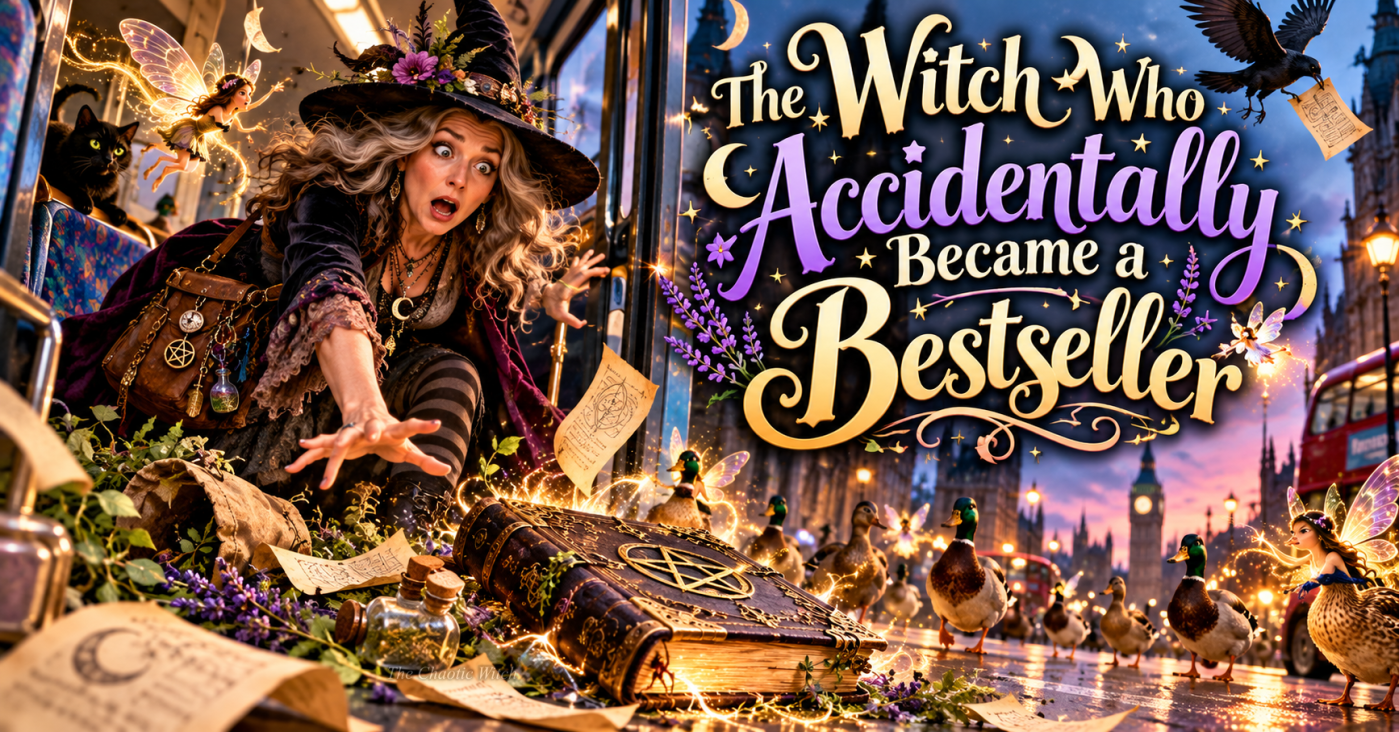
Matilda Thistlewick had survived one hundred and forty-three years without causing a major magical catastrophe, which was impressive considering she had once accidentally turned her landlord into a decorative garden fountain.
In her defence, he had been standing rather close to the begonias. She had also transformed an entire wedding cake into a flock of pigeons, enchanted her washing machine to develop romantic feelings for the refrigerator, and summoned a minor thunderstorm inside a public library because someone had refused to lower their voice.
But these were, in Matilda’s opinion, relatively small incidents.
Nothing that required intervention from the International Council of Witches.
Well, except the fountain.
And possibly the pigeons.
The washing machine had technically been a private matter.
Matilda lived in a crooked little house squeezed between two perfectly ordinary buildings on a quiet street in London. To mortal eyes, her home appeared to be a narrow Victorian terrace with peeling green paint and an alarming number of cats. In reality, it contained seventeen rooms, three enchanted gardens, a staircase that occasionally led to 1842, and a pantry that had declared independence in 1997.
Her neighbours believed she was a retired librarian.
This suited Matilda perfectly.
Nobody questioned the peculiar smells drifting from her kitchen, the strange lights in her windows, or the fact that she occasionally shouted things like, “GET BACK IN YOUR JAR, YOU UNGRATEFUL LITTLE DEMON!”
Retired librarians, apparently, were allowed their eccentricities.
Matilda’s most treasured possession was her private grimoire, a thick, leather-bound volume containing generations of Thistlewick family magic. Its pages held everything from simple household charms to ancient enchantments capable of altering weather patterns, manipulating probability, and briefly convincing the moon to move three inches to the left.
It also contained several deeply personal entries, including a spell for removing stubborn chin hairs, a recipe for enchanted digestive biscuits, and an extremely unflattering drawing of her ex-husband.
She carried the book everywhere.
This was her first mistake.
Her second mistake was taking the number 47 bus on a Tuesday.
Her third mistake involved a sausage roll.
Matilda had boarded the bus with her grimoire tucked beneath one arm, a shopping bag full of moonwort under the other, and a warm sausage roll balanced precariously between her teeth.
The bus lurched.
The sausage roll escaped.
Matilda lunged.
Her shopping bag split open.
Moonwort scattered across the floor, causing three passengers to briefly remember lives they had never lived.
A man in a business suit suddenly announced that he had once been a pirate.
A teenage girl began speaking fluent medieval French.
The bus driver developed an overwhelming desire to purchase a goat.
Matilda, meanwhile, retrieved her sausage roll, gathered her herbs, apologized to a confused woman who was now convinced she had invented the wheel, and hurried off at her stop.
She did not notice that her grimoire remained on the seat.
By the time she realized what had happened, the bus was halfway across London.
“OH, FOR THE LOVE OF HECATE’S BLOOMERS!”
Her scream shattered every teacup in a three-house radius.
Across the city, a struggling literary agent named Oliver Finch was having what he considered the worst day of his professional life.
His biggest client had abandoned him for a rival agency. His landlord had increased the rent. His girlfriend had informed him that she needed “space,” which apparently meant moving to Brighton with a yoga instructor named Sebastian.
Oliver had spent the afternoon drinking terrible coffee and wondering whether it was too late to become a lighthouse keeper.
Then he spotted a beautiful leather-bound manuscript abandoned on the bus.
He opened it.
The first page read:
The Thistlewick Grimoire: An Unrestricted Collection of Practical Magic, Forbidden Rituals, Household Enchantments, and Other Things That Should Absolutely Never Be Attempted by Idiots.
Oliver smiled.
“What a fantastic title.”
He turned the page.
WARNING: The following spells are real. They must never be spoken aloud by untrained mortals. Improper use may result in spontaneous combustion, dimensional instability, emotional attachment to furniture, or death.
Oliver laughed.
“Brilliant. Absolutely brilliant.”
He spent the evening reading.
By midnight, he was convinced he had discovered the greatest fantasy manuscript of the decade.
By morning, he had emailed a proposal to twelve publishers.
By Friday, three were fighting over the rights.
And by the following Tuesday, a major publishing house had offered him an advance so large that Oliver briefly considered forgiving Sebastian.
The publisher’s legal department did raise a few questions about the missing author.
Oliver explained that the manuscript had been submitted anonymously.
This was not remotely true, but the publishing industry had survived stranger circumstances.
Six months later, The Thistlewick Grimoire appeared in bookstores around the world.
The cover featured a dramatic silver moon, a glowing cauldron, and the words:
THE SPELLS ARE REAL. THE CONSEQUENCES ARE YOURS.
The marketing department thought it was wonderfully provocative.
Matilda, who discovered the book displayed in a shop window while buying marmalade, nearly swallowed her own dentures.
She stood frozen on the pavement, staring at a towering display of her family’s most dangerous magical secrets.
A cheerful cardboard sign announced:
THE GLOBAL FANTASY SENSATION! OVER TWO MILLION COPIES SOLD!
Matilda’s left eye began twitching.
“No.”
She entered the shop.
A young employee smiled.
“Can I help you?”
Matilda pointed at the display.
“Where did you get that?”
“Oh, it’s amazing, isn’t it? Everyone’s obsessed. We’re having a midnight spellcasting party next weekend.”
Matilda gripped the counter.
“A what?”
“A spellcasting party! Fans are going to dress up as witches and read their favourite incantations together.”
Somewhere inside Matilda’s skull, a tiny imaginary violin snapped in half.
“How many people?”
“Oh, hundreds here. Thousands worldwide. There’s a livestream.”
Matilda closed her eyes.
She considered turning the entire shop into a mushroom.
Instead, she purchased a copy.
She needed to know exactly how much trouble she was in.
The answer, as it turned out, was all of it.
The first incident occurred in Manchester.
A seventeen-year-old girl named Sophie decided to try the book’s Charm of Irresistible Attraction.
She stood in front of her bedroom mirror, lit a scented candle, and recited the incantation while thinking about a boy named Ryan.
Unfortunately, Sophie mispronounced the final syllable.
The spell was supposed to attract romantic affection.
Instead, it attracted ducks.
At precisely 8:43pm, forty-seven ducks appeared in her bedroom.
Another ninety-two gathered on the roof.
By morning, the entire neighbourhood was overrun.
The local news called it an unprecedented migration event.
Matilda called it Wednesday.
She arrived disguised as a council pest-control officer and spent six hours persuading the ducks to return to their original locations.
One refused.
She named him Gerald.
The second incident happened in Toronto, where a woman attempted the Blessing of Endless Prosperity.
The spell was intended to attract modest financial opportunities.
Unfortunately, the woman had substituted cinnamon for ground star anise.
Within twenty-four hours, every object she touched began producing loose change.
Her refrigerator dispensed quarters.
Her shower sprayed nickels.
Her golden retriever sneezed toonies.
The Canadian Mint issued a statement describing the situation as “unusual.”
Matilda flew across the Atlantic, reversed the enchantment, and confiscated fourteen kilograms of magically generated coins.
The retriever was deeply disappointed.
Then came the incident in Sydney.
A university student performed a ritual called The Opening of Hidden Doors.
The spell was designed to reveal concealed opportunities.
Instead, it opened a portal to a small dimension inhabited entirely by judgmental turnips.
The turnips were furious.
They marched through the university library carrying tiny banners that read:
WE DEMAND RESPECT.
Matilda spent three days negotiating a diplomatic settlement.
The turnips eventually agreed to return home in exchange for better soil conditions and an apology from the Australian government.
By the end of the month, Matilda had visited eleven countries, reversed eighty-three spells, repaired four damaged realities, and removed a curse that caused an entire office building in Berlin to communicate exclusively through interpretive dance.
She was exhausted.
And the book had just reached number one on the bestseller list.
Worse, the internet had discovered it.
A young woman in California posted a video titled:
I TRIED THE MIDNIGHT BEAUTY SPELL AND YOU WON’T BELIEVE WHAT HAPPENED!
The video showed her reciting a passage while applying a face mask.
Within seconds, her hair transformed into a magnificent cascade of shimmering silver.
Unfortunately, it continued growing.
By the time Matilda arrived, the hair had escaped through the windows, wrapped around three parked cars, and established a thriving ecosystem of squirrels.
The video received forty-two million views.
The publisher immediately ordered another printing.
Matilda considered moving to Mars.
Unfortunately, she had misplaced the spell for interplanetary travel sometime in 1896.
Then came the truly terrible news.
The International Council of Witches summoned her.
The council chamber was located beneath an abandoned cathedral, accessible only through a door that appeared when someone sneezed three times while holding a black candle.
Matilda arrived late because she had accidentally sneezed twice and opened a broom cupboard instead.
Inside, thirteen senior witches sat around a long stone table.
At its head was High Enchantress Agatha Grimshaw, a woman so stern that mirrors occasionally refused to reflect her.
“Matilda Thistlewick,” Agatha began.
Matilda smiled nervously.
“Lovely to see everyone. Has anyone tried the biscuits?”
“Your private grimoire has been published.”
“Yes. Funny story, actually—”
“Millions of mortals are performing real magic.”
“Well, technically, most of them are performing it rather badly.”
“A man in Ohio has turned his swimming pool into custard.”
“That one’s surprisingly easy to fix.”
“A woman in France has accidentally married a thundercloud.”
Matilda winced.
“Ah.”
“The thundercloud is demanding visitation rights.”
“Oh, dear.”
Agatha leaned forward.
“If you do not contain this catastrophe within thirty days, the council will revoke your magical licence.”
Matilda gasped.
“You can’t do that!”
“We can.”
“But I’ve been a witch for over a century!”
“And in that time, you’ve caused seventeen documented magical incidents.”
“Sixteen. The fountain was the landlord’s fault.”
Agatha slammed her staff against the floor.
“THIRTY DAYS.”
Matilda left the chamber with a headache, a formal warning, and a biscuit she had stolen from the refreshments table.
She needed a plan.
Unfortunately, her plans generally made things worse.
Her first idea was to enchant every copy of the book so the pages appeared blank.
This worked beautifully for approximately seven minutes.
Then the magic spread to every book within a ten-mile radius.
Libraries panicked.
Students celebrated.
A philosophy professor in Oxford declared that the disappearance of all written knowledge was a fascinating metaphor for the human condition.
Matilda reversed the spell.
Her second idea was to erase the book from everyone’s memory.
Unfortunately, the spell required the caster to possess an object connected to every person affected.
With eleven million copies sold, this seemed impractical.
Her third idea involved a very large bonfire.
Gerald the duck objected.
And then, on the twenty-third day, something extraordinary happened.
Matilda received a letter.
It arrived through her kitchen window, carried by a small paper bird.
The letter was written in careful blue ink.
Dear Ms. Thistlewick,
I hope you don’t mind me writing. My name is Emily Harper. I’m twelve years old, and I think your book is wonderful.
I know everyone says it’s fiction, but I don’t think it is.
Last week, my little brother was very sad because our dog died. I found a spell in your book called The Lantern of Gentle Memories.
I tried it because I wanted him to feel better.
Nothing exploded, and no ducks appeared.
But that night, little golden lights filled his bedroom. They showed him happy memories of our dog playing in the garden, chasing butterflies, and sleeping beside his bed.
He smiled for the first time in weeks.
I don’t know if that was real magic, but it felt real to us.
Thank you for writing something beautiful.
Love, Emily.
Matilda read the letter twice.
Then a third time.
She sat quietly at her kitchen table.
For the first time since the catastrophe began, she remembered why her family had written the grimoire in the first place.
Magic had never been intended solely for witches.
It was meant to help.
To heal.
To bring comfort.
To remind people that the world held more wonder than they could see.
The problem wasn’t that mortals had discovered magic.
The problem was that nobody had taught them how to use it.
Matilda looked at Gerald.
Gerald looked back.
“Quack.”
“Exactly,” she said.
And suddenly, she had an idea.
A terrible idea.
A magnificent idea.
An idea so reckless that several of her ancestors probably rolled over in their graves.
Matilda was going to write a sequel.
She contacted Oliver Finch.
The literary agent answered his telephone while sitting in a luxurious office surrounded by awards, flowers, and several framed newspaper articles about his publishing triumph.
“Oliver Finch Literary Agency.”
“Hello, Oliver.”
“Who is this?”
“Matilda Thistlewick.”
There was a pause.
Then Oliver laughed.
“Oh, very funny. We’ve had hundreds of fans pretending to be the author.”
“I am the author.”
“Of course you are.”
“Oliver, your left sock has a hole in the heel, your coffee has gone cold, and there’s a small green creature living inside your filing cabinet.”
Oliver glanced down at his sock.
Then at his coffee.
Then at the filing cabinet.
Something inside it sneezed.
He screamed.
Matilda sighed.
“Now, shall we discuss my royalties?”
Three days later, Matilda sat across from Oliver in his office.
He looked pale.
She looked irritated.
Gerald sat on the desk wearing a tiny bow tie.
Oliver stared at the duck.
“Is that necessary?”
“He’s my legal adviser.”
The duck quacked.
Matilda placed a manuscript on the desk.
Its title was The Thistlewick Grimoire: The Second Volume — A Beginner’s Guide to Not Destroying the Universe.
Oliver opened it.
The first page read:
Rule One: Never attempt a spell you do not understand.
Rule Two: Never substitute ingredients unless you enjoy unexpected livestock.
Rule Three: Never summon anything you cannot politely ask to leave.
Rule Four: If your furniture begins expressing romantic interest, stop immediately.
Rule Five: When in doubt, do absolutely nothing and have a biscuit.
Oliver looked up.
“This is brilliant.”
“It’s also legally binding.”
“What?”
“Nothing.”
The sequel was published three weeks later.
It became an even bigger bestseller than the first.
But Matilda had included something special.
Hidden within the book’s opening pages was a gentle enchantment that activated whenever someone read it.
It didn’t remove anyone’s ability to perform magic.
Instead, it made every spell respond only to genuine understanding, careful intention, and a willingness to accept responsibility.
The dangerous incantations became harmless nonsense when spoken recklessly.
The helpful ones remained accessible to those who approached them with patience and kindness.
And the truly powerful magic required years of study.
The world gradually returned to normal.
The ducks disappeared from Manchester.
The turnips withdrew their diplomatic complaints.
The French thundercloud agreed to an amicable separation.
The man in Ohio finally got his swimming pool back, though it continued smelling faintly of vanilla.
The International Council of Witches reluctantly restored Matilda’s licence.
Agatha Grimshaw even admitted that the solution had been “marginally competent.”
Coming from Agatha, this was practically a standing ovation.
Matilda returned home, brewed herself a pot of tea, and settled into her favourite armchair.
For the first time in months, there were no emergencies.
No portals.
No magical disasters.
No calls from foreign governments requesting assistance with enchanted vegetables.
Just peace.
She opened the newspaper.
On the front page was a photograph of Oliver Finch standing beside a smiling television producer.
The headline read:
GLOBAL BESTSELLING FANTASY SERIES TO BECOME MAJOR TELEVISION FRANCHISE.
Matilda blinked.
Beneath the headline, the article continued:
Producers promise an immersive experience featuring interactive spells, live audience participation, and a revolutionary augmented-reality magical system.
Matilda slowly lowered the newspaper.
Gerald looked up from his cushion.
“Quack?”
She stared at the ceiling.
Then she screamed.
“OLIVER, YOU ABSOLUTE WALNUT!”
Somewhere in Los Angeles, a television executive announced that the pilot episode would feature ten thousand fans chanting the same spell simultaneously.
The spell was titled The Awakening of the Ancient Ones.
Matilda knew that spell.
She knew it very well.
It was on page 347.
It had been forbidden since the fall of Atlantis.
And it was most definitely not suitable for television.
She grabbed her broom, her emergency spell kit, and Gerald.
“Come along,” she told the duck. “We’re going to Hollywood.”
Gerald quacked enthusiastically.
Matilda paused at the front door.
Then she turned around, marched back into the kitchen, and retrieved her grimoire.
This time, she chained it to her wrist.
She was not making that mistake again.
Outside, thunder rolled across an otherwise cloudless sky.
Somewhere deep beneath the Pacific Ocean, something ancient opened one enormous eye.
And in a television studio thousands of miles away, a producer cheerfully announced:
“Don’t worry, folks! It’s only fiction!”
Matilda, hurtling through the sky on her broomstick, heard those words through a magical broadcast and nearly flew into a church steeple.
“FICTION, MY BLOOMING BACKSIDE!”
Gerald flapped his wings.
And the world, which had only just recovered from its first encounter with amateur witchcraft, was about to discover that the most dangerous force in the universe wasn’t ancient magic.
It was a television producer with a budget.
Matilda would soon discover, the beginning of an entirely new catastrophe…
A little magic is always waiting. Subscribe and step inside the circle. 🖤🔮✨


Leave a Reply