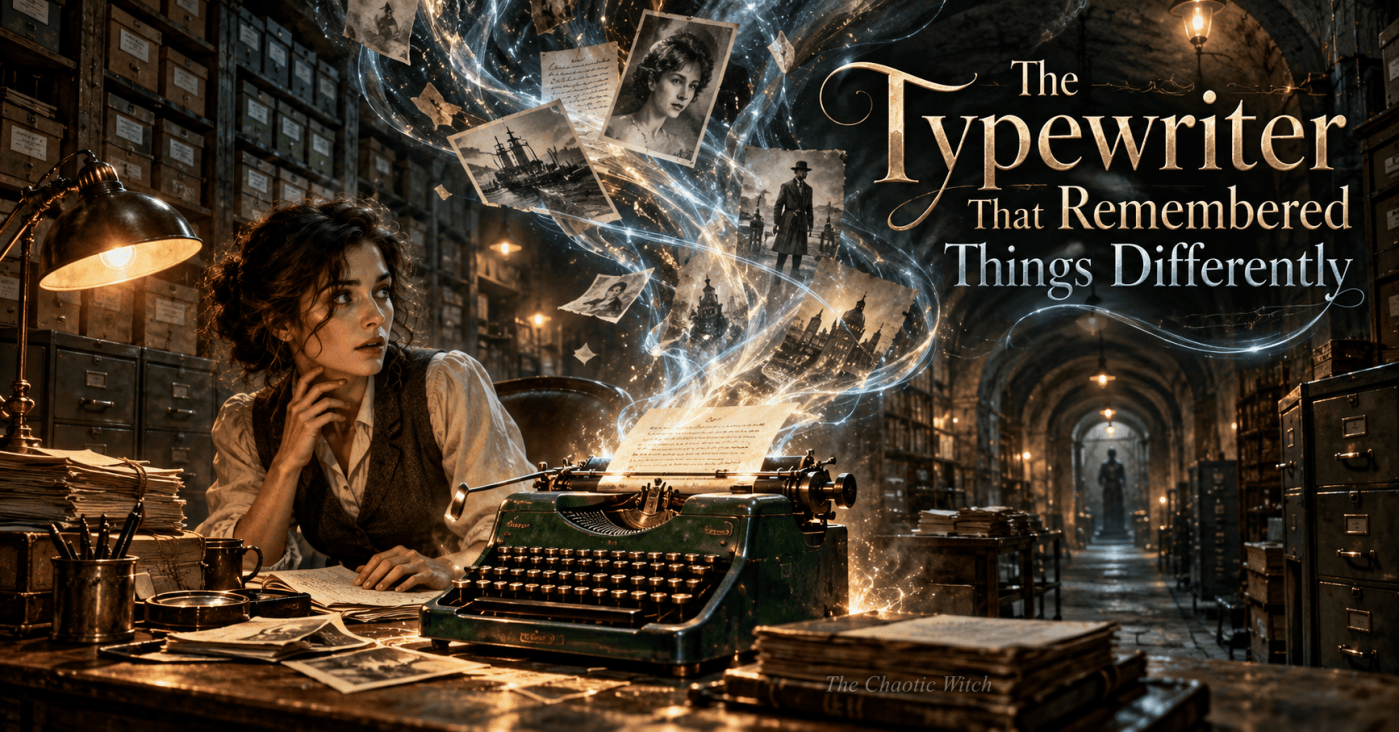
There were three things Evelyn Hart knew with absolute certainty. The government had too many secrets, coffee was not nearly strong enough to compensate for a twelve-hour shift, and anyone who voluntarily worked in an underground archive probably had something fundamentally wrong with them. Unfortunately, Evelyn had been working in one for eleven years.
Officially, she was a senior archival specialist for the Department of Historical Preservation, a government organization so dull that even its employees struggled to explain what it did. Unofficially, she worked seven floors beneath an abandoned municipal library, cataloguing objects that the government had decided the general public should never know existed. There were hundreds of thousands of them, and some were so peculiar that Evelyn occasionally wondered whether she had wandered into an elaborate practical joke that nobody had bothered to end.
There was a pocket watch recovered from a ship that had disappeared in 1892, although the watch itself had been manufactured in 1947. A Victorian mourning brooch contained a photograph of a woman who appeared in every family album it was placed beside. A brass telescope showed constellations nobody had ever charted, including several that moved when the observer blinked. And, of course, there was the singing teapot. Evelyn particularly hated the singing teapot. Every Tuesday at precisely 3:17 in the afternoon, it performed a dreadful rendition of Greensleeves, regardless of whether it contained water. Someone had once tried to silence it by removing the lid, but that only made it sing louder.
After eleven years, Evelyn had stopped asking questions. She assigned numbers, documented unusual properties, photographed objects, and placed them in appropriate containment units. Sometimes she signed paperwork confirming that an object had been destroyed, even though she could hear it scratching against the inside of its storage cabinet. Her supervisor, Mr. Bellamy, had once told her that curiosity was the leading cause of workplace fatalities in their department. Evelyn suspected he was joking, although she had learned that certainty was a dangerous luxury in her line of work.
On a wet Thursday morning in November, an ordinary-looking wooden crate arrived at her workstation. It bore no warning symbols, no containment classification, and none of the bright red labels that usually accompanied anything capable of causing an existential crisis. The attached paperwork described its contents as a Royal Quiet De Luxe typewriter, manufactured in 1938, recovered during the demolition of a private residence in Ottawa. Nothing remarkable, at least according to the accompanying documentation.
Evelyn signed the intake form, opened the crate, and lifted the machine onto her desk. It was beautiful in the tired, dignified way old things sometimes were. The enamel was a deep forest green, the chrome keys had been polished smooth by decades of use, and a faint smell of dust and old paper rose from beneath the carriage. A single sheet of yellowed paper had been rolled into the platen, and on it, someone had typed four words: Please remember me correctly.
Evelyn frowned at the message. “Well, that’s unsettling,” she muttered, checking the accession paperwork again. There was no mention of the note, but that wasn’t especially unusual. Half the objects arriving at the facility came with incomplete documentation, and the other half arrived with explanations so absurd that Evelyn sometimes suspected the paperwork was deliberately designed to discourage further investigation.
She photographed the machine, examined its ribbon, and tested the keys. The typewriter worked perfectly. There was something soothing about the mechanical clatter. After years of computer databases, malfunctioning scanners, and electronic forms that refused to save, Evelyn found the simple certainty of metal striking paper strangely satisfying.
Without thinking, she typed a sentence about her supervisor’s mother. On Tuesday, November 12, 1996, Margaret Bellamy baked an apple pie for her son Thomas. She had no idea why she chose those particular words. Perhaps because she’d overheard Mr. Bellamy discussing his mother earlier that morning, perhaps because she was hungry, or perhaps because the typewriter had been waiting for her to put her fingers on its keys. Evelyn removed the page, added it to the preliminary documentation, and went downstairs for coffee.
At 11:42am, Mr. Bellamy appeared in her doorway carrying a plastic container. “Apple pie,” he announced cheerfully, setting it on her desk. Evelyn looked up, confused, as he explained that his mother used to make the best apple pie in the world. He had found her old recipe the previous evening and decided to try it himself. Then he mentioned something peculiar. He had suddenly remembered his mother making him an apple pie for his birthday in 1996, a memory that had apparently returned to him in extraordinary detail that very morning. He could recall the smell of cinnamon, the yellow curtains in the kitchen, and the exact date.
Evelyn slowly lowered her pen. “Tuesday, November twelfth?” she asked. Bellamy stared at her in astonishment and demanded to know how she knew that. For several seconds, the only sound in the room was the distant mechanical whine of the ventilation system. Evelyn looked at the typewriter, then at Bellamy, then back at the typewriter before forcing herself to smile. “Lucky guess,” she said.
Bellamy gave her a suspicious look, shrugged, and left. Evelyn waited until his footsteps disappeared before pulling the typed page from her folder. Her hands had begun to tremble. She read the sentence again, trying to convince herself that what had happened was impossible. It was a coincidence, surely. A peculiar, slightly disturbing coincidence. Still, she couldn’t resist testing it.
She inserted another sheet of paper and, after a moment’s thought, typed that on the morning of October 3, 2004, James Williamson had won a large stuffed purple dinosaur at the county fair. James was a security officer on Level Three whom Evelyn had known for nearly a decade. He was an enormous man with a shaved head, a collection of terrible neckties, and the emotional temperament of a disappointed rhinoceros. He also hated amusement parks, which made him the perfect subject for her experiment.
An hour later, Evelyn visited Level Three and found James sitting behind the security desk, eating a sandwich. She greeted him, and he immediately corrected her observation that it was morning by pointing out that it was, in fact, afternoon. Undeterred, Evelyn asked whether he’d ever won anything at a fair. James’s expression changed, and for a moment, he seemed almost embarrassed. Then he admitted that he had once won a purple dinosaur. It had taken him about fifteen attempts at a carnival game, and he’d eventually given the enormous stuffed animal to his little sister, who had dragged it everywhere for years.
Evelyn felt her stomach turn. When she asked whether he remembered when it happened, James answered without hesitation. It had been October 3, 2004. He then studied her face and observed that she looked terrible, prompting Evelyn to thank him for his enormously comforting assessment. She returned to the archive without another word.
That evening, Evelyn conducted seven more experiments. She typed that a maintenance worker remembered receiving a silver watch from his grandfather, and the following morning, the man described the watch in loving detail. She typed that a cafeteria employee remembered seeing snow fall during a summer holiday in 2011, and the woman laughed while recounting the bizarre weather, even though meteorological records showed no such event. Evelyn even typed that Mr. Bellamy had once performed a tap-dancing routine at a school talent show. The next day, Bellamy spent forty minutes demonstrating a series of surprisingly competent dance steps in the staff lounge. That particular experiment, Evelyn admitted privately, had been worth the risk.
But the amusement faded as she noticed something disturbing. The memories were not simply appearing in people’s minds. They were becoming part of who those people believed themselves to be. James spoke about the purple dinosaur with genuine affection. The maintenance worker became emotional when describing his grandfather. Bellamy insisted his mother had taught him the steps to his school routine. The experiences had never happened, yet the feelings attached to them were real.
Evelyn began to wonder whether a person’s memories were merely stories they carried or whether those stories were the very substance of identity. She wondered what would happen if she typed something terrible, and then she wondered why the thought had occurred to her at all.
Three days later, she discovered the first warning hidden beneath the typewriter’s ribbon spool. It was written in tiny letters on a strip of paper folded so tightly that it resembled a piece of lint. The message explained that the machine did not change what had happened. It changed what living people remembered, and every memory had to come from somewhere. Evelyn read the note three times, finding the final sentence particularly troubling.
She returned to her desk and opened the archive’s internal database. According to the records, the typewriter had originally belonged to Alice Wren, a stenographer employed by the Ministry of Public Information during the Second World War. Alice had disappeared in 1944. There was no death certificate, no burial record, and no evidence that she’d emigrated or changed her name. Her personnel file contained only one handwritten notation: Subject removed from collective recollection. Operation successful.
Evelyn stared at the words before opening the attached documents. Most were heavily redacted, but one page contained a short explanation of a project called MNEMOSYNE. Its objective was chillingly simple: to develop a means of altering public memory without altering historical events. The government had apparently wanted to erase the recollection of military mistakes, political scandals, and covert operations. If nobody remembered something, they reasoned, the consequences might eventually disappear.
But the project had gone wrong. People began remembering childhoods they had never lived. Entire families forgot relatives who were still alive. A village in northern Scotland collectively remembered a church fire that had never occurred, while a woman in London insisted she had buried a daughter whose birth had never been registered. And Alice Wren, the woman operating the typewriter, had vanished from every surviving personal account of her life.
Her husband could no longer remember marrying her. Her sister denied ever having had a sibling, and her closest friend looked at photographs of Alice and saw a stranger. The records confirmed Alice’s existence, but the world had forgotten her. Evelyn leaned back in her chair, listening to the typewriter hum softly. She hadn’t noticed it humming before.
Over the following week, strange things began happening. James Williamson stopped speaking about the purple dinosaur, and when Evelyn asked why, he looked confused and insisted he had no idea what she was talking about. Mr. Bellamy no longer remembered his mother’s apple pie. But the most disturbing incident occurred on a Wednesday afternoon when Evelyn went to visit her neighbour, Mrs. Lopez.
Mrs. Lopez was eighty-two years old, lived alone, and had a habit of leaving homemade biscuits outside Evelyn’s door. She was also the only person Evelyn knew who could complain about the weather for twenty minutes without repeating herself. That afternoon, however, Mrs. Lopez opened the door and stared blankly at Evelyn. When Evelyn greeted her, the elderly woman politely apologized and explained that she didn’t know anyone by that name.
Evelyn’s smile vanished. They had known each other for eight years, shared Christmas dinners, birthday cakes, and countless cups of tea. Mrs. Lopez had once sat beside Evelyn for six hours after her father died, saying very little but refusing to leave her alone. Now she looked at Evelyn with polite uncertainty and asked whether she had the right apartment.
Evelyn stumbled backward, unable to finish her explanation. Back in her own apartment, she began examining photographs. In one, she stood beside Mrs. Lopez at a neighbourhood barbecue, but where Evelyn should have been standing, there was empty space. She opened another photograph and found the same thing. A Christmas picture showed Mrs. Lopez holding two mugs of hot chocolate, one extended toward someone who wasn’t there. Evelyn dropped her phone as the horrifying realization settled over her. The typewriter hadn’t merely added memories. It was taking them away, and somehow, it had begun taking memories of her.
The next morning, Evelyn confronted Mr. Bellamy. He listened to her account in silence before closing his office door and admitting that he had wondered how long it would take her to discover what was happening. Evelyn demanded to know how much he knew, and Bellamy reluctantly explained that the machine should never have been removed from containment. The department had spent decades attempting to reactivate MNEMOSYNE, but the mechanism would only respond to certain people.
According to Bellamy, the machine required a particular kind of mind, someone who understood the importance of remembering and spent their life preserving the past. Evelyn immediately understood. An archivist. Someone like her. Bellamy admitted that he’d deliberately arranged for the typewriter to arrive at her workstation because he knew she would never have used it if she’d been warned about its properties.
The room went very quiet. Evelyn had known Bellamy for eleven years. She’d endured his terrible jokes, attended his retirement party twice because he kept postponing retirement, and once driven him to the hospital when he swallowed a paper clip while attempting to demonstrate a magic trick. Now she looked at him and realized she barely knew the man.
When she asked what would happen to her, Bellamy’s expression tightened. He explained that every alteration required a memory to be displaced, and the stronger the new memory, the greater the cost. The machine drew from the person operating it first. Eventually, the operator would become someone nobody remembered. When Evelyn demanded to know what had happened to Alice Wren, Bellamy admitted that she had been their first successful operator, but nobody knew where she had gone.
Evelyn’s anger rose as she realized that Bellamy had knowingly exposed her to the same fate. He defended himself by arguing that the facility contained objects capable of rewriting physics, consuming entire rooms, and making people disappear. If the public discovered them, he insisted, there would be panic. The department was simply preserving order. Evelyn almost laughed at the familiar justification, pointing out that people always seemed to claim they were preserving order when they were doing something monstrous.
Bellamy reached into his desk drawer and removed a small black folder. Inside was a photograph showing a group of people standing outside a brick building in 1944. At the centre stood a young woman with dark hair, a sensible coat, and an expression of quiet determination. It was Alice Wren. Beside her stood another woman, and Evelyn felt the room tilt as she recognized her own face.
It wasn’t a resemblance or a distant family similarity. The woman in the photograph looked exactly like Evelyn. She demanded to know who it was, but Bellamy admitted that the department had been trying to determine that very thing. Evelyn turned the photograph over and found six words written in faded blue ink: Alice and Evelyn. Before the first correction.
Her own name stared back at her. Evelyn reminded Bellamy that she hadn’t been born until 1989, making it impossible for her to appear in a photograph from 1944. His silence was worse than any answer.
That night, Evelyn returned to the archive. The building was nearly empty as she passed through three security doors, descended seven floors, and entered her workstation. The typewriter waited beneath a cloth. She removed the cover and stared at it for a long time before inserting a sheet of paper and typing that Evelyn Hart remembered who she had been before the first correction.
The machine shuddered, every light in the room flickered, and Evelyn remembered. Not one memory, but thousands. She remembered sitting in a kitchen in 1944, laughing with Alice Wren over burnt toast. She remembered working at the Ministry of Public Information, recording testimonies from soldiers whose memories had been altered after experimental operations. She remembered discovering that the typewriter had not been invented by the government at all. It had been found, buried beneath the ruins of a monastery in northern France, wrapped in cloth that had not decayed for centuries.
Its earliest documented appearance was in 1642, but the machine itself was far older. It had no true beginning. Every generation, it appeared in a different form: a quill that wrote memories into existence, a printing press that convinced entire towns they had always known certain truths, or a book whose blank pages filled with recollections nobody had lived. Every time it was used, it consumed the past of its operator.
Evelyn remembered how Alice had tried to stop it, and she remembered their desperate plan. They had discovered that the machine could not destroy memories. It could only move them, like water poured from one vessel into another. Every forgotten birthday, erased childhood, invented friendship, and stolen identity remained somewhere inside it. The machine was a reservoir of human memory, a vast and impossible library of everything people had been made to forget.
Alice had proposed releasing those memories, but restoring everything at once would overwhelm millions of minds, leaving people unable to distinguish their own experiences from those that had been forced upon them. They needed someone to act as a filter, someone who could hold the displaced memories long enough to return them to their rightful owners. Evelyn had volunteered, and the machine had taken her first.
It erased her from the memories of everyone she’d ever known, including Alice, before folding her life into another time, another century, and another childhood. She had been born again in 1989, with an invented history and no recollection of the life she’d lived before. Somehow, the government had found her again.
Evelyn staggered backward beneath the weight of her recovered past. She could remember two childhoods, two mothers, two sets of friends, and two entirely different lives. Both felt real, and both belonged to her. She placed a hand against the typewriter and whispered that it had found her. The machine began typing without anyone touching the keys, answering that she had found herself. Another line appeared, reminding her that the past did not disappear simply because it was forgotten. Then the machine informed her that she could return what had been taken.
The lights went out, and somewhere in the distance, an alarm began to sound. Evelyn knew Bellamy would come, and security would follow. She also knew that if the department regained control of the typewriter, it would continue using it, perhaps for decades or even centuries. She rolled a fresh sheet of paper into the machine, her fingers hovering above the keys.
She could type that Bellamy had forgotten where the archive was located, or that the government had never discovered MNEMOSYNE. She could even make the entire facility disappear from public consciousness. But doing so would only create more stolen memories, more false histories, and more people wondering why pieces of their lives no longer fitted together. There had to be another way.
Then she remembered something Alice had told her in 1944, a sentence spoken over burnt toast in a kitchen filled with morning sunlight. Alice had warned that the trouble with people who controlled stories was that they eventually forgot stories belonged to the people who lived them.
Evelyn began to type. She instructed the machine to return every memory it had taken to the person from whom it was stolen. The typewriter trembled beneath her hands, but she continued, commanding that every memory invented by the machine be recognized as an invention without erasing the feelings attached to it. As the keys grew hot beneath her fingers, footsteps thundered down the corridor. Evelyn typed one final command: No person shall be forgotten because another person wishes it.
The machine began to shake violently, and white light spilled from beneath its keys. Evelyn heard voices, millions of them, rising together in an extraordinary chorus. Children called for their mothers, lovers whispered promises, old men laughed, and women sang lullabies in languages Evelyn had never heard. People remembered first kisses, lost homes, forgotten friendships, terrible grief, and moments of joy so small that nobody else had ever thought to record them.
The sound filled the archive, poured through the corridors, climbed the elevator shafts, and spread outward into the sleeping city. Across the world, people began to remember. An elderly man in Dublin suddenly recalled the little sister he’d spent seventy years believing was imaginary. A woman in Montreal remembered the name of a friend who had disappeared from every photograph. A retired teacher in London woke from a dream and remembered an entire classroom of children whose records had been destroyed. A former government official sat upright in bed, shaking, as decades of concealed operations returned to his mind.
And somewhere in a small house in rural England, an old woman named Alice Wren opened her eyes. She had not aged a day since 1944. For eighty-two years, she’d lived outside the memories of the world, invisible to everyone who had once known her. But now she remembered Evelyn, and she whispered her name into the darkness.
Back in the archive, the typewriter’s keys struck one final time, leaving behind two sentences: What is remembered may be changed. What is true must be carried. Then the machine caught fire, although it was no ordinary fire. Its flames were silver and blue, and instead of heat, they released the smell of old books, birthday candles, sea air, childhood bedrooms, and every familiar place a person had ever loved.
Evelyn watched as the machine folded inward, becoming smaller and smaller until it was no larger than a matchbox. Then it vanished. The alarms stopped, the lights returned, and the archive fell silent. Evelyn collapsed.
When she woke, she was in a hospital with a police officer sitting beside her bed. He asked whether she knew what had happened, and Evelyn considered the question for a moment before smiling. “That depends,” she said. “How much time do you have?”
The investigation lasted eleven months. The Department of Historical Preservation was dismantled, and thousands of classified records were released, although the public remained understandably skeptical about reports of objects that sang, moved independently, or occasionally swallowed government employees. The singing teapot became a minor celebrity after performing Greensleeves during a televised parliamentary hearing, receiving considerably more media attention than Evelyn thought it deserved.
Mr. Bellamy resigned, and his testimony exposed decades of concealed experiments. He continued insisting that he had acted to protect national security, but Evelyn never entirely forgave him. There were some things, she’d learned, that could be understood without being excused.
As for the memories, the world adjusted slowly. People discovered strange new pieces of their histories. Some recovered painful experiences they had never known were missing, while others remembered beloved relatives, childhood friendships, and moments of happiness stolen so long ago that they had stopped noticing the empty spaces. Not every restored memory brought comfort. Truth rarely did. But it allowed people to understand their lives as they had actually been lived.
Six months after leaving the hospital, Evelyn received a letter with no return address. Inside was a photograph of two young women standing outside a brick building in 1944. It showed Alice and Evelyn, and this time, the photograph was perfectly clear. On the back, someone had written: You were always worth remembering. Love, Alice.
Evelyn cried for a long time before laughing softly at the extraordinary irony of it all. She’d spent her entire career believing that history belonged in boxes, folders, and carefully numbered storage rooms. But history, she now understood, lived in people, in the things they remembered, the stories they told, the voices of those who had come before them, and the extraordinary, fragile miracle of being known.
One year later, Evelyn opened a little bookshop called The Second Chapter. It stood on a quiet street between a bakery and a florist, with green-painted windows and a bell above the door that rang every time someone entered. There were no underground levels, no security clearances, and no objects requiring magical containment. Apart from a rather temperamental grandfather clock that occasionally ran backward, everything in the shop was perfectly ordinary.
Evelyn was happy, genuinely happy. She sold books, made tea, and listened to customers tell stories about the novels they’d loved as children. Sometimes Mrs. Lopez stopped by with biscuits. She remembered Evelyn now, including every Christmas dinner, every birthday cake, and the night she’d sat beside her after her father’s death. Sometimes, when the shop was quiet, Alice visited too. She looked exactly as she had in 1944, although Evelyn had stopped asking how that was possible. Some mysteries, she’d decided, could remain mysteries without doing anyone harm.
One rainy afternoon, a little girl entered the shop with her grandfather. She couldn’t have been more than eight years old, and while her grandfather browsed the history section, she wandered toward Evelyn’s desk and asked whether there were any books about magic. Evelyn assured her that there were several hundred, prompting the little girl to ask whether she meant real magic. Evelyn smiled and admitted that it was a complicated question.
The girl considered this for a moment before pointing toward an old green typewriter sitting on a shelf behind the counter. She wanted to know whether it worked, but when Evelyn turned to look at it, her breath caught. The machine was identical to the one that had vanished in the archive, with deep forest-green enamel, chrome keys, and a sheet of yellowed paper rolled into its carriage. Evelyn hadn’t placed it there.
She approached slowly and read the four words typed on the paper: Please remember me correctly. For a moment, the entire world seemed to hold its breath. Then the little girl mentioned that her grandfather said old things always had stories. Evelyn looked at the typewriter and thought about everything it had done, the memories it had stolen, the lives it had altered, and the terrible power of allowing one person to decide what another should remember.
She reached forward and gently lifted the sheet of paper, agreeing that the girl’s grandfather was right. When the little girl asked whether the typewriter was magical, Evelyn considered her answer carefully. “Yes,” she said at last. “But not the kind people should use carelessly.”
She removed the ribbon, closed the carrying case, and placed the machine in a locked cabinet behind her desk. For the first time, she fully understood something Alice had tried to tell her almost a century earlier. Magic did not become good simply because it was powerful, and the ability to change someone’s story did not give you the right to do so.
The little girl wandered back to her grandfather, and outside, the rain softened. Evelyn returned to her desk, where an ordinary notebook lay open beside her tea. She picked up a pen and wrote a reminder on its first page: There are some stories we must never allow to be forgotten, and others we must never presume to write for someone else.
She closed the notebook and looked toward the window. Across the street, two children were splashing through puddles, a young couple stood beneath a shared umbrella laughing, and an elderly woman paused outside the bakery to smell the fresh bread drifting through its open door. They were ordinary people, living ordinary moments and creating memories that belonged entirely to them.
Evelyn smiled as she watched them. For eleven years, she had spent her days cataloguing impossible things, but the greatest magic she’d ever encountered had never been locked in a government vault. It was the simple, extraordinary fact that every person carried an entire world inside them, a world made of memories that nobody, no matter how powerful, had the right to steal.
Behind her, the locked cabinet gave a faint metallic click. Evelyn didn’t turn around as she warned the machine not to even think about it. For several seconds, there was silence, and then, from somewhere inside the cabinet, came the soft, unmistakable sound of a typewriter striking four keys, followed by the cheerful ring of its carriage bell.
Evelyn sighed, picked up her tea, and shook her head. “Honestly,” she muttered, “I should have opened a flower shop.”
And outside, the rain continued falling on a world that, at last, was remembering itself.
The most powerful magic is not the ability to rewrite the past, but the courage to remember it truthfully. Every life is a story, and every person deserves to be its rightful author.
A little magic is always waiting. Subscribe and step inside the circle. 🖤🔮✨


Leave a Reply