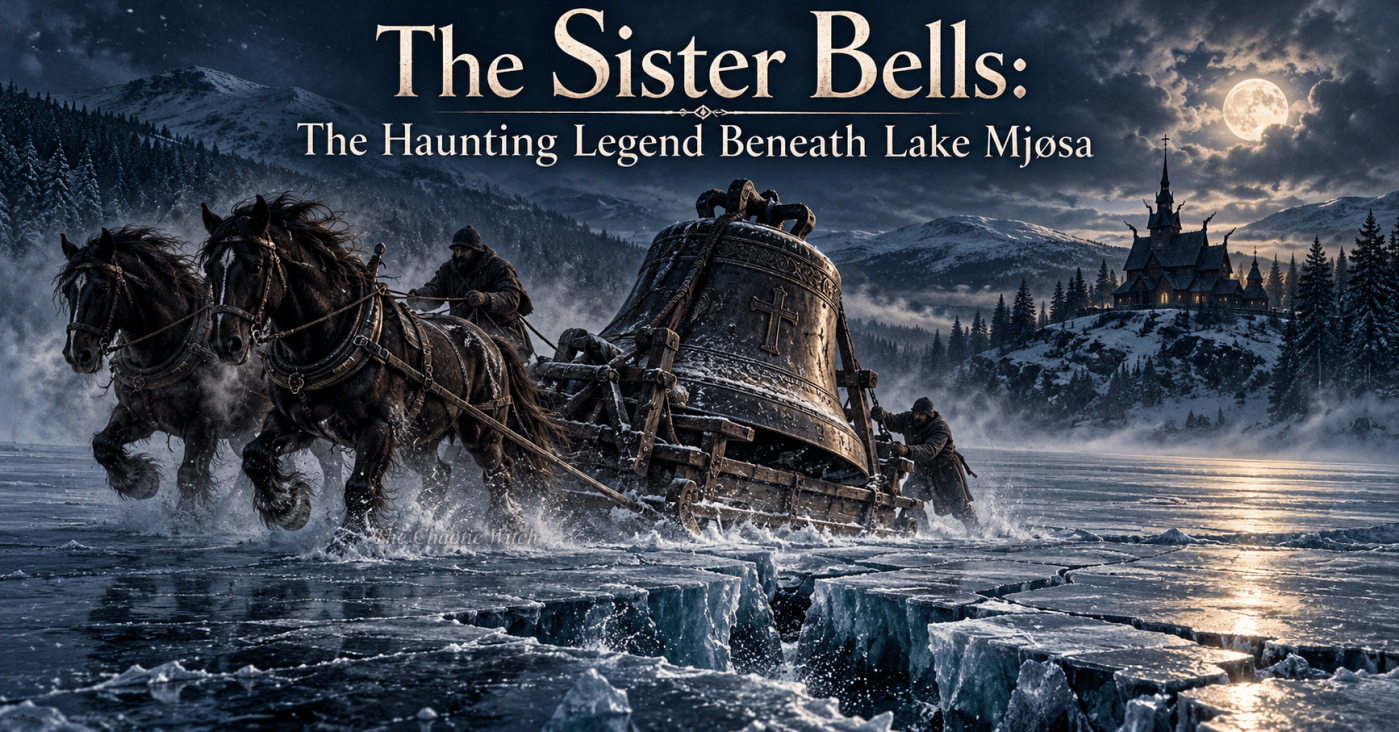
Deep in the heart of Norway, surrounded by mountains, forests, and picturesque villages, lies Lake Mjøsa, the country’s largest lake. Its waters have witnessed centuries of history, from the journeys of medieval travellers to the changing fortunes of Norwegian communities. But beneath its peaceful surface, according to an old and haunting legend, rests a church bell that was never meant to be separated from its twin.
The story begins centuries ago in the beautiful valley of Gudbrandsdalen, near the village of Ringebu. There, on a farm known as Vestad, a family welcomed the birth of two daughters whose arrival was considered extraordinary. The girls were conjoined twins, physically connected from birth, and although their unusual circumstances attracted considerable attention, they were deeply loved by their parents.
The sisters grew up together, sharing a bond that went beyond ordinary sisterhood. They were inseparable not simply because of the circumstances of their birth, but because their lives were intertwined in ways few others could understand. Their parents cherished them, and according to the legend, the family lived with both gratitude and the constant fear that illness might take one child and leave the other behind.
That fear became a terrifying reality when one of the sisters fell gravely ill. Her condition worsened, and her parents feared they were about to lose her. Desperate and helpless, they turned to prayer, pleading for their daughter’s recovery. They made a solemn promise that if the sick child survived, they would commission two magnificent bells for the local church, one to honour each daughter.
Their prayers also carried another heartbreaking request. When the sisters’ lives eventually came to an end, the parents wished that neither would be forced to endure the loss of the other. They prayed that the girls would remain together, even in death.
Whether through coincidence, medicine, or what the family believed to be divine intervention, the sick sister recovered. Overwhelmed with relief, the parents fulfilled their promise and arranged for two beautiful church bells to be cast.
The bells were unlike ordinary bells. According to local tradition, they possessed an extraordinarily beautiful and harmonious sound, so clear and pure that some believed silver had been mixed into the molten metal during their creation. When they rang together, their voices carried across the countryside, filling the valley with music that villagers would remember for generations.
They became known as the Sister Bells.
For years, the two bells hung together at Ringebu Stave Church, a remarkable wooden church whose origins reach back to the thirteenth century. Their ringing marked important moments in village life, from celebrations and religious gatherings to funerals and solemn occasions. To the people of Ringebu, the bells were more than instruments. They were reminders of two sisters, their parents’ devotion, and a promise that had been made in a moment of desperate hope.
But as the years passed, the reputation of the bells spread beyond the valley. Their exceptional sound attracted the attention of people far away, eventually reaching Christiania, the city now known as Oslo.
According to the legend, authorities decided that one of the bells should be removed from Ringebu and transported south. The magnificent bell would be taken to another church, where its extraordinary voice could be appreciated by a larger congregation.
The decision meant separating the Sister Bells.
For the villagers, the thought was deeply unsettling. The bells had been created together, dedicated to two sisters whose lives had been inseparably joined. Removing one seemed to violate the very promise that had brought them into existence.
Nevertheless, arrangements were made for the journey.
It was winter when the bell was taken down from its place in the church. Snow covered the countryside, and the rivers and lakes had frozen beneath the bitter Norwegian cold. A horse-drawn sleigh was prepared to carry the enormous bell toward Christiania, travelling along routes made accessible by the frozen landscape.
The journey began without incident. The horse pulled steadily through the snow, and the heavy bell rested securely on the sleigh. Eventually, the travellers reached Lake Mjøsa, whose frozen surface stretched out before them beneath the pale winter sky.
Crossing the lake would shorten the journey considerably, and the ice appeared strong enough to support the weight.
The driver urged his horse forward.
At first, everything seemed perfectly ordinary. The runners of the sleigh glided across the frozen surface, and the horse continued its steady progress. The surrounding countryside was quiet, broken only by the sound of hooves and the occasional creak of the loaded sleigh.
Then came a noise from beneath the ice.
A sharp crack echoed across the frozen lake.
The driver stopped and listened.
Another crack followed, louder than the first. Then another, spreading outward beneath the enormous weight of the bell.
Fear gripped him. The ice that had appeared so solid suddenly seemed dangerously fragile, and the dark waters beneath it were unimaginably deep.
The driver remembered the story of the two sisters and the promise that they should never be separated. He wondered whether the strange cracking beneath the sleigh was something more than an ordinary winter hazard.
Perhaps the bells were resisting their separation.
Perhaps the lake itself was warning him to turn back.
Whatever the reason, the driver decided he had gone far enough. He turned the horse around and began making his way back toward the shore, determined to return the bell to Ringebu.
As he travelled away from the dangerous stretch of ice, the cracking appeared to stop. The lake grew quiet again, and his fear slowly began to subside.
But with the return of his courage came another thought.
What would people say when he returned without completing his journey? Would they laugh at him for being frightened by a few cracks in the ice? Would those who had ordered the bell’s removal accuse him of failing in his duty?
He imagined the embarrassment of explaining that he had turned back because he feared the bells did not wish to be separated.
Eventually, pride overcame caution.
The driver stopped the sleigh once more, turned his horse around, and resumed the journey across Lake Mjøsa.
This time, according to the legend, the warning was not repeated.
Without any further opportunity to escape, the ice gave way.
The enormous bell crashed through the frozen surface and plunged into the black water below. The weight of the metal dragged it downward, and within moments it disappeared beneath the ice, sinking toward the depths of the lake.
The bell that had once filled the valley with music was gone.
News of the disaster eventually reached Ringebu, where the loss was met with grief and unease. To those who believed in the story of the sisters, the disappearance seemed far too meaningful to dismiss as an ordinary accident.
The bells had been created to honour two lives that were never meant to be separated, and now one of them had vanished rather than be carried away from its companion.
But the story did not end there.
When winter loosened its grip and the ice finally disappeared, efforts were reportedly made to recover the lost bell. According to the legend, the searchers eventually located it beneath the water and managed to secure a rope around it.
Slowly and carefully, they began hauling the enormous weight toward the surface.
It was difficult work. The bell was heavy, the water deep, and the men understood that one mistake might send their prize back to the bottom. They pulled with determination, watching as the dark shape gradually emerged from the depths.
At last, the bell reached the surface.
For a moment, it appeared that the recovery had succeeded. The men had accomplished what many believed impossible, and the magnificent bell was almost within their grasp.
Then one of the rescuers made a declaration.
According to the traditional telling, he announced triumphantly that they had finally captured the bell and that it would now be taken to Christiania, exactly as originally intended.
At that instant, the rope snapped.
The enormous bell slipped free, plunged back into the water, and disappeared beneath the surface once again.
The lake swallowed it as completely as before.
Whether another recovery attempt was made is unclear in the surviving versions of the legend. What matters to the story is that the bell was never successfully removed from Lake Mjøsa.
And there, according to local tradition, it remains.
Some versions of the tale suggest that the lost bell rests silently in the darkness, waiting for the day when it might finally be reunited with its twin. Others focus on the strange coincidence of its disappearance, interpreting the repeated failures to transport it as evidence that the sisters’ promise could not be broken.
The legend is especially moving because the bells represent something profoundly human: the fear of separation and the enduring power of love. The parents who commissioned them had hoped to preserve the bond between their daughters, and generations of storytellers transformed that wish into a tale in which even objects made of metal seemed capable of loyalty.
The historical Ringebu Stave Church still stands in Norway today, a remarkable reminder of the region’s medieval past. The story of the Sister Bells has survived through local folklore and historical writing, although the supernatural details and the reported events on Lake Mjøsa have not been independently established as historical fact.
Norwegian author Lars Mytting later drew inspiration from the legend for his acclaimed novel The Sister Bells, helping introduce the haunting story to readers far beyond Norway.
But perhaps the most fascinating part of the legend is not the dramatic moment when the ice cracked or even the mysterious failure to retrieve the bell.
It is the thought of what might still lie beneath the water.
Lake Mjøsa reaches extraordinary depths, and its dark waters have inspired generations of folklore. Somewhere beneath the shifting currents and layers of sediment, the imagination can easily picture an enormous church bell resting where it fell centuries ago.
A bell whose voice was once said to be so beautiful that people travelled great distances to hear it.
A bell created to honour a bond that death itself was not supposed to separate.
And a bell that, according to legend, refused to be taken away from its sister.
On a quiet winter evening, when the snow settles across the Norwegian countryside and Lake Mjøsa begins to freeze, it is easy to imagine the old story returning to life. The landscape grows still, the shoreline disappears into darkness, and the vast frozen surface conceals everything resting beneath it.
No one can say with certainty whether the lost Sister Bell truly lies at the bottom of the lake. But its story has endured through the centuries, passed from one generation to the next as a reminder that some promises are believed to reach far beyond the people who made them.
And somewhere in the depths of Lake Mjøsa, if the legend is to be believed, one half of a magnificent pair of bells still waits to be reunited with the other.
Perhaps it has been waiting all along.
Sources: The legend of the Sister Bells is preserved in Norwegian local folklore associated with Ringebu Stave Church and Vestad farm, including historical traditions recorded by Ivar Kleiven. Information about the church and the legend is available through the official Ringebu Stave Church website. The story also inspired Lars Mytting’s historical novel The Sister Bells, which draws upon traditional accounts of the conjoined sisters and the bells commissioned in their honour.
A little magic is always waiting. Subscribe and step inside the circle. 🖤🔮✨


Leave a Reply