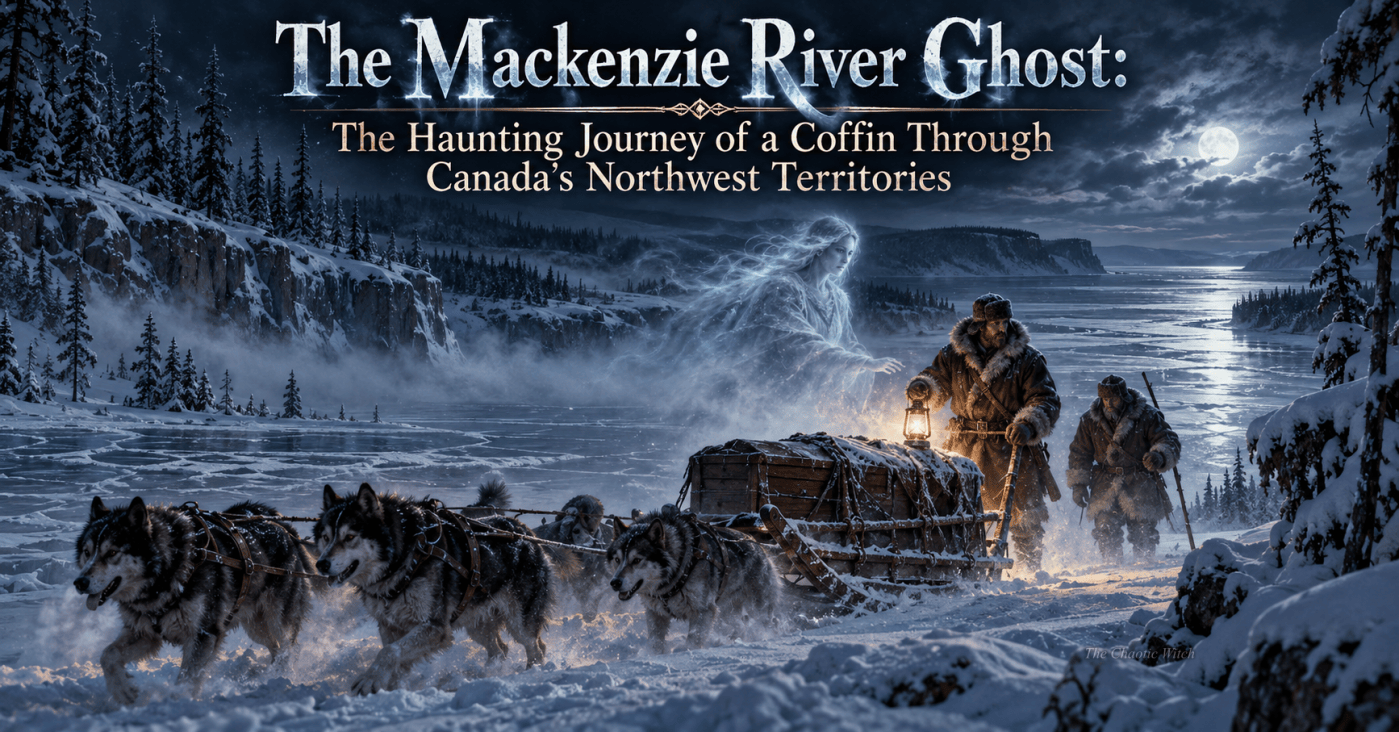
Deep in Canada’s Northwest Territories, where the mighty Mackenzie River winds through an unforgiving landscape of dense forests, frozen waterways, and seemingly endless wilderness, an extraordinary ghost story has survived for more than 160 years. It is a tale of death, an unusual final journey, and a mysterious presence that appeared determined to protect the remains of a man who had died years earlier.
Unlike many ghost stories that have been passed down solely through generations of storytelling, this haunting has connections to historical accounts recorded by people who lived and worked in the Canadian North during the nineteenth century. At the centre of the mystery is Augustus Richard Peers, a Hudson’s Bay Company employee whose death in 1853 would eventually lead to one of the region’s most unsettling supernatural legends.
Peers was just 33 years old when he died at Fort McPherson on March 15, 1853. During his lifetime, he had reportedly made it known that he did not wish to remain buried at the remote northern settlement. His reasons are not entirely clear in the surviving retellings, but his wishes would eventually set in motion a journey that became the subject of a haunting tale.
Fort McPherson was an isolated Hudson’s Bay Company trading post in what is now the Northwest Territories. Life there was shaped by extreme weather, difficult travel, and the vast distances separating northern communities. During the nineteenth century, moving supplies, messages, and people between trading posts could require lengthy journeys by canoe, boat, snowshoe, or dogsled, depending on the season.
Transporting human remains under such conditions presented an especially difficult challenge. There were no modern roads connecting these remote settlements, and winter journeys demanded preparation, experienced travellers, and teams of dogs capable of crossing immense stretches of frozen terrain.
For several years following his death, Peers remained at Fort McPherson. Then, in March 1860, nearly seven years after his passing, arrangements were made to move his remains to Fort Simpson, another important Hudson’s Bay Company settlement farther south along the Mackenzie River system.
The responsibility for this unusual undertaking fell to Roderick Macfarlane, a Hudson’s Bay Company official who reportedly volunteered to accompany the coffin on its long journey through the northern wilderness.
The expedition was far from ordinary. Travelling with the remains of a man who had been dead for years was a sombre responsibility, made more difficult by the isolation and hazards of the route. The men faced bitter cold, frozen waterways, and the constant possibility of encountering wild animals.
Yet according to Macfarlane’s account, the most disturbing part of the journey would not be the weather or the terrain.
It would be the strange events that seemed to accompany the coffin.
As the travelling party made its way through the wilderness, the sled dogs began displaying unusual behaviour. On more than one occasion, they reportedly became extremely agitated, barking and gathering around the sled carrying Peers’s remains.
The dogs appeared particularly disturbed when wild animals threatened the coffin. Their reactions were so intense that the men took notice, especially when the animals seemed to respond to something beyond the ordinary dangers of the journey.
One incident involved a wolverine, an animal well known throughout the northern wilderness for its strength, persistence, and ability to scavenge food under difficult conditions. According to later retellings of Macfarlane’s account, the presence of the animal appeared to provoke extraordinary activity among the dogs.
Then came something far more difficult to explain.
A voice was reportedly heard issuing commands to the sled dogs, urging them to begin running.
The words seemed clear enough to be understood as an instruction, yet no one present could identify who had spoken.
The men were travelling through an isolated landscape where an unfamiliar human voice would have been remarkable. There were few settlements nearby, and the sound did not appear to come from anyone within the travelling party.
The incident left an unsettling impression, but the journey had to continue.
The men pressed onward, guiding their dogs through the frozen landscape while keeping watch over the coffin entrusted to their care. Whatever strange sounds or unexplained disturbances they encountered, their responsibility remained the same: to bring Peers’s remains safely to their intended destination.
Macfarlane reportedly began to suspect that the mysterious occurrences were connected to the deceased man himself. He considered the possibility that Peers’s spirit was accompanying the expedition, perhaps guarding his earthly remains against the animals that might disturb them.
To someone unfamiliar with the beliefs and experiences of nineteenth-century travellers, such an explanation might seem extraordinary. But in isolated regions where weather, darkness, exhaustion, and unfamiliar sounds could create deeply unsettling experiences, supernatural interpretations were not uncommon.
Still, the strange incidents reportedly continued.
As the party travelled, the dogs occasionally reacted with sudden agitation, seemingly alert to threats the men could not immediately identify. The possibility that something unseen was travelling alongside them became increasingly difficult for Macfarlane to dismiss.
Eventually, the expedition reached Fort Simpson, where Peers’s remains were brought to their final destination.
One might imagine that the arrival would have ended the strange experiences. After all, the purpose of the journey had been fulfilled. The coffin had reached the settlement, and the difficult responsibility of transporting the remains was complete.
But according to the haunting’s most unsettling account, the mysterious presence had not yet disappeared.
Following the journey, Macfarlane and a companion were reportedly resting when they experienced an overwhelming sensation that something unseen had entered their surroundings.
There was no ordinary explanation immediately apparent to them, yet both men apparently became deeply frightened.
Macfarlane later described being so overcome by fear that he pulled his blanket over his face and found himself unable to speak. The sensation was powerful enough to remain fixed in his memory, and he associated it with the same mysterious presence that he believed had accompanied Peers’s coffin.
For a man accustomed to the harsh conditions of northern travel, the intensity of his reaction was striking.
The experience was not described as a violent attack. There was no account of an apparition physically harming the travellers or attempting to prevent them from completing their mission. Instead, the haunting appeared to involve an unexplained presence, a mysterious voice, and an overwhelming sense that the deceased man’s spirit had remained close to his remains.
This interpretation gave the legend an unusual character.
The ghost, if one truly existed, did not seem to be seeking revenge or attempting to lure the living into danger. Rather, Macfarlane believed it was protecting the body of a man who had already been dead for nearly seven years.
Perhaps, according to the supernatural interpretation of the story, Peers had been waiting for someone to honour his wishes.
Perhaps he had accompanied the coffin to ensure that nothing interrupted its journey.
And perhaps the frightening presence felt by the men after arriving at Fort Simpson was connected to the completion of that final obligation.
Of course, there are other possible explanations for the events.
Sled dogs are highly sensitive to sounds, scents, and the movements of wild animals. Their sudden agitation might have been caused by predators or scavengers approaching the travelling party, even when the men could not immediately see them.
The mysterious voice is more difficult to assess, particularly because the surviving accounts do not provide enough independently verifiable detail to establish precisely what was heard. In the extreme cold and isolation of the northern wilderness, sounds can carry in unusual ways, and exhausted travellers may sometimes misinterpret unfamiliar noises.
The overwhelming sensation of a presence could also have been influenced by fatigue, stress, grief, or the psychological effects of completing such an unusual and emotionally charged journey.
None of these possibilities proves what happened, and none can establish that the men encountered anything supernatural.
What remains particularly interesting is that the story was associated with an identifiable historical figure, a documented death, and a Hudson’s Bay Company official who reportedly recorded the experience.
Augustus Richard Peers was a real man who died at Fort McPherson in 1853. Roderick Macfarlane was also a real historical figure whose career took him into the Canadian North during the era of the fur trade. The reported movement of Peers’s remains in 1860 provides the historical setting around which the ghost story developed.
The supernatural details, however, remain part of the account as remembered and retold, rather than independently confirmed events.
Over time, the legend became known through Canadian ghost-story collections and historical retellings, preserving an eerie episode from a period when travelling across the Northwest Territories required extraordinary endurance.
The setting itself contributes much to the story’s enduring fascination.
Imagine the northern wilderness in the middle of March, with snow covering the ground and frozen waterways stretching into the distance. A small party of men guides a dogsled carrying a coffin through miles of isolated terrain. The cold is relentless, the forests are quiet, and the only regular sounds come from the runners of the sled and the movements of the dogs.
Then, without warning, the animals begin barking.
They gather around the coffin, restless and alert, as though something nearby has caught their attention.
A voice suddenly orders them forward.
The men turn toward the sound, expecting to see one of their companions issuing instructions.
But nobody admits to speaking.
The journey continues, and the unanswered questions travel with them.
It is easy to understand why an experience like that might remain in a traveller’s memory long after the expedition had ended.
The legend of the Mackenzie River Ghost is also unusual because it offers a more compassionate interpretation of a haunting. Rather than presenting the dead as something to fear, it suggests that devotion, determination, and the desire for a proper resting place might continue beyond death.
In this story, the ghost was not necessarily the threat.
It may have been the protector.
More than a century and a half has passed since the events reportedly took place. The trading posts, settlements, and routes of the old fur trade have changed, but the Mackenzie River still flows through the Northwest Territories, connecting communities across one of Canada’s most remarkable landscapes.
The wilderness that once surrounded Macfarlane and his companions remains capable of inspiring awe, uncertainty, and imagination.
Whether the mysterious voice belonged to an unseen traveller, was a sound misunderstood in the frozen landscape, or represented something that could never be explained, the story has endured because of the questions it leaves behind.
Why did the dogs react so strongly around the coffin? Who, if anyone, issued the commands that the travellers believed they heard? What caused Macfarlane and his companion to experience such overwhelming fear after reaching their destination?
And why did Macfarlane become convinced that Augustus Richard Peers was somehow accompanying his own remains?
Perhaps the most haunting possibility is also the simplest.
A man had died far from the place where he wished to rest. Seven years later, his coffin began a difficult journey through the frozen wilderness, accompanied by men who were determined to see that his wishes were honoured.
According to the legend, something else travelled with them.
Something the dogs seemed to recognize.
Something the men could sense but never clearly see.
And something that may have remained close until the journey was finally complete.
Whether that presence was real or imagined, the Mackenzie River Ghost remains a chilling reminder of the stories hidden within Canada’s northern history.
For if the legend is to be believed, Augustus Richard Peers did not make his final journey alone.
He may have been there every step of the way.
Sources: Information about Augustus Richard Peers, Roderick Macfarlane, and the reported haunting appears in Canada’s History Society’s September 2019 issue of Kayak, which explored Canadian ghost stories. Additional historical material concerning Peers’s death and the transportation of his remains can be found in Natural Cold Storage, preserved through Dartmouth College’s Encyclopedia Arctica collection. The account has also been discussed in Chilling Tales of Arctic Undertakers by Mysteries of Canada and in Craig Baird’s Canada’s Spooky Mysteries, published through Canadian History Ehx in October 2024.
A little magic is always waiting. Subscribe and step inside the circle. 🖤🔮✨


Leave a Reply