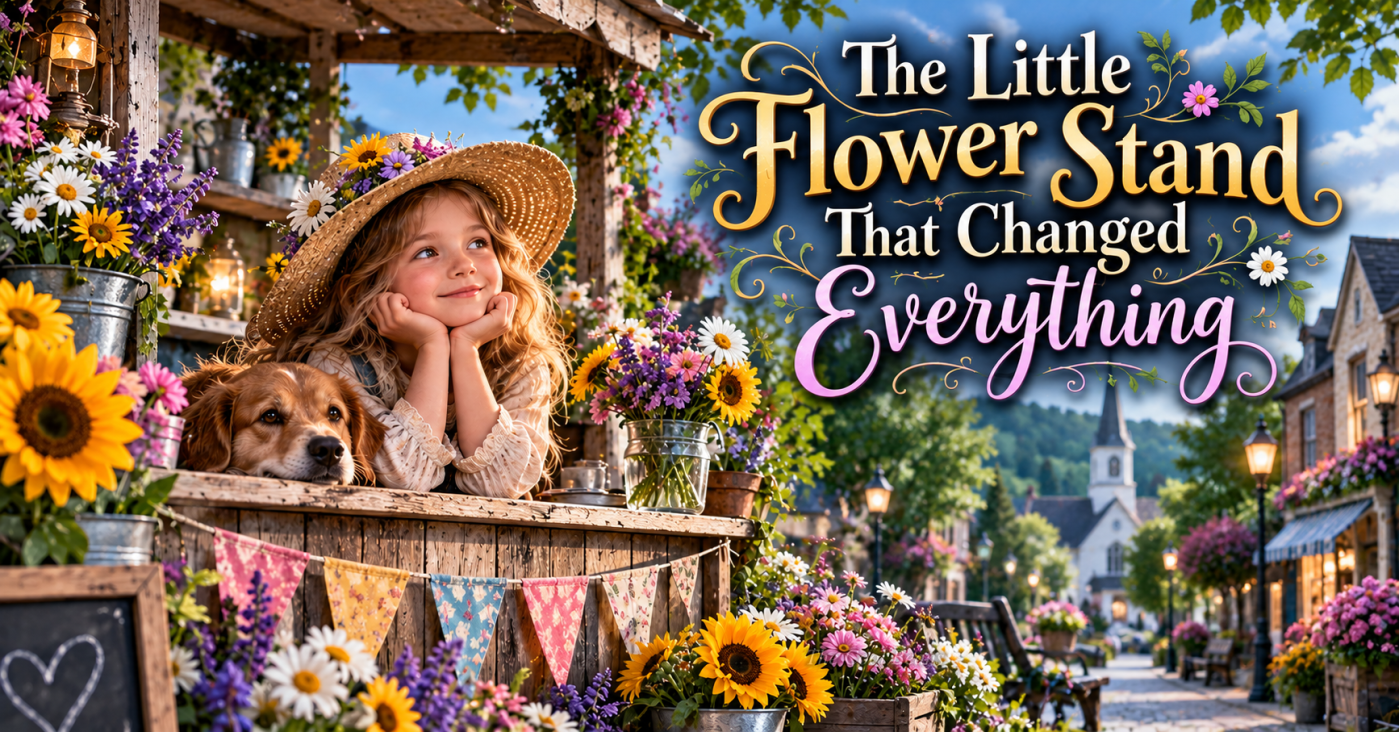
There were two things everyone in the little town of Willow Creek seemed to agree on. The first was that nothing much ever happened there. The second was that if you wanted something badly enough, you had better figure out how to get it yourself.
Willow Creek had once been a bustling place, with busy shops, a thriving lumber mill, and a Main Street where people gathered on Saturday afternoons. But the mill had closed years earlier, taking hundreds of jobs with it. Storefronts stood empty, houses needed repairs, and families had learned to stretch every dollar until it practically begged for mercy. Still, the town had its charms. There were mountains in the distance, a river that sparkled in the summer sunshine, and neighbours who would shovel your driveway without being asked. People might not have had much money, but they had an extraordinary talent for showing up when someone needed them.
And then there was six-year-old Ellie Bennett, who had a dream so enormous that it barely fit inside her little body. Ellie wanted to fly. Not in an airplane, which she considered perfectly ordinary, but through the open air, with the wind rushing past her face and nothing between her and the clouds except a pair of wings.
She had discovered hang gliding in a documentary her grandfather had been watching one rainy afternoon. The moment she saw a woman soaring above a mountain valley, Ellie climbed onto the sofa, spread her arms, and announced that she was going to do that someday. Her grandfather, Walter Bennett, looked over his glasses and told her that she would probably need to learn how to land first.
For the next three weeks, Ellie talked about flying at breakfast, lunch, and dinner. She drew pictures of herself soaring over mountains, made wings out of cardboard, and even tried to convince the family dog, Biscuit, to participate in a flight simulation involving a laundry basket. Biscuit, who had never shown the slightest interest in aviation, declined.
Then, one evening, Ellie’s parents told her that they would be visiting the mountains during their summer vacation. There was a place nearby that offered tandem hang-gliding experiences with professional instructors. Ellie nearly fell off her chair. She begged to go, but her mother explained that the experience cost one hundred dollars, and they would also have to check whether Ellie was old enough to participate.
Ellie went quiet. A hundred dollars might as well have been a million. She had seven dollars and thirty-five cents in a jar, most of which had come from finding coins in the sofa. For several days, she carried the disappointment around like a stone in her pocket. Then she went to see her grandfather.
Walter was seventy-two, retired from the mill, and a man who believed almost every problem could be improved with a hammer, a cup of coffee, or a little patience. He was sitting in his workshop when Ellie appeared in the doorway and asked how people got a hundred dollars. Walter explained that some people worked for it, others saved for it, and a few lucky souls occasionally discovered forgotten money in an old coat.
Ellie informed him that she had already checked every coat she owned. Her efforts had produced seventeen cents and a peppermint. Walter nodded solemnly and assured her that it was a start.
Ellie climbed onto the stool beside him and explained that she wanted to earn the money herself, but she was only six, and nobody would hire her. Walter looked out the workshop window toward the little garden his late wife, June, had planted years earlier. Despite his best efforts to neglect it, the garden still bloomed every spring and summer. There were daisies, zinnias, marigolds, and cheerful little cosmos flowers that seemed determined to grow wherever they pleased.
An idea began to take shape. Walter suggested that Ellie might try selling flowers, and her disappointment immediately turned into excitement. She wanted to know whether she would be a real florist and whether businesswomen were allowed to wear fancy hats. Walter assured her that successful businesswomen could wear whatever hats they liked, and Ellie declared that she would need to find one immediately.
Three days later, Walter built a tiny wooden flower stand from leftover lumber. He painted it pale yellow, added a little shelf for bouquets, and attached a hand-lettered sign across the top that read, “ELLIE’S LITTLE BLOOMS — Flowers to Make Your Day Brighter.” Ellie insisted on adding a picture of a smiling sunflower, although her grandfather privately thought it looked more like a fried egg with eyelashes.
On Saturday morning, she arranged six small bouquets in recycled glass jars, put on her fanciest straw hat, and sat behind the stand at the end of her grandparents’ driveway. Each bouquet cost two dollars. For the first forty minutes, nobody stopped. Ellie watched cars pass and began to wonder whether she had made a terrible mistake.
Then an elderly woman named Mrs. Peterson pulled over. She admired the flowers and asked whether Ellie had arranged them herself. Ellie proudly explained that she had, although her grandfather said she still needed to stop hiding the short flowers behind the tall ones. Mrs. Peterson laughed and purchased two bouquets.
Ellie carefully wrapped the flowers in brown paper and accepted four dollars. She stared at the money for a moment, hardly believing it. Then she ran up the driveway shouting that she was officially a businesswoman. Walter appeared at the workshop door and congratulated her on what he predicted would soon become a flourishing company.
By the end of the morning, every bouquet had sold. Ellie had earned twelve dollars. She counted the money three times, placed it in her savings jar, and went to bed that night convinced she was well on her way to becoming the richest person in Willow Creek. What she didn’t know was that something much bigger than her dream of flying had just begun.
The following weekend, Mrs. Peterson returned with two friends. A teacher from the elementary school bought flowers for her kitchen. The local mechanic stopped for a bouquet for his wife, explaining that he had forgotten their anniversary and was hoping the flowers might save his marriage. Ellie gave him an extra daisy for emergencies.
Word spread. People began slowing down when they passed the Bennett house, looking for the little yellow stand and the girl in the oversized straw hat. Walter expanded the garden. Ellie’s mother taught her how to keep track of her earnings in a notebook, while her father showed her how to calculate expenses. Ellie found the idea of subtracting money considerably less exciting than adding it.
Sometimes customers paid more than the asking price. Ellie always tried to give them change, but they usually told her to keep it. She never quite understood why someone would pay five dollars for two dollars’ worth of flowers. Walter understood perfectly. He watched the way people smiled when they approached the stand, how Ellie’s enthusiasm made strangers linger and talk, and how neighbours who hadn’t spoken in years suddenly found themselves standing together, admiring bouquets and discussing the weather.
The flowers were beautiful, but they weren’t the only reason people came.
By the middle of summer, Ellie had saved one hundred and thirty-eight dollars. She ran into the kitchen with her notebook, shouting that she had finally done it. Her parents hugged her, and Walter lifted her into the air despite his protesting knees. They celebrated with homemade chocolate cake, and Ellie announced that the first thing she wanted to do was call the hang-gliding company.
Unfortunately, the answer wasn’t what she hoped. Ellie was too young. The instructor explained kindly that she would have to wait until she met the minimum age and size requirements. Ellie listened quietly, thanked him, and hung up. For the rest of the afternoon, she sat on the porch steps staring at the mountains.
Walter eventually joined her. He knew she was disappointed, especially after working so hard to reach her goal. Ellie wondered what the point of all that effort had been if she still couldn’t fly. Walter reminded her that she had learned how to grow something, how to sell something, how to save money, and how to make an extraordinary number of people happy along the way.
Ellie thought about Mrs. Peterson, who had recently told her that the flowers made her house feel less lonely. She looked toward the little yellow stand and asked whether she could keep selling flowers even though she already had the money. Walter smiled and asked why she would ever need to stop doing something that brought her so much happiness.
And so she continued.
The following spring, Ellie opened her flower stand again. She was seven now, which she considered a considerable improvement over being six. Her bouquets were neater, her handwriting had improved, and she had developed a surprisingly firm opinion about customers who wanted to negotiate prices. When one gentleman suggested that two dollars was rather expensive for a handful of flowers, Ellie informed him that he couldn’t even buy a decent sandwich for that amount. The gentleman purchased three bouquets.
By the time Ellie turned eight, she was growing flowers in several raised garden beds. Walter had taught her how to start seeds indoors, how to protect delicate seedlings from late frost, and why watering plants in the middle of a blazing afternoon wasn’t always the best idea.
Their weekends developed a comfortable rhythm. Walter worked in the garden while Ellie arranged flowers at the old wooden table. Sometimes they talked about school or the weather. Sometimes they worked quietly, listening to birds in the trees. Walter told stories about June, the grandmother Ellie barely remembered, and how she had loved yellow roses because she said they looked like sunshine that had decided to stay awhile.
Ellie often wondered whether her grandmother would have liked the flower stand. Walter assured her that June would have adored it, although she probably would have taken over the entire operation within a week. Ellie laughed and declared that she would have been happy to have her grandmother as the boss.
By the time Ellie was ten, the little flower stand had become a familiar part of Willow Creek. People stopped by on birthdays, anniversaries, and ordinary Tuesdays when they needed something cheerful. A retired schoolteacher donated extra flowerpots. The hardware store began giving Ellie a discount on gardening supplies. A neighbouring farmer offered her a small patch of land for growing sunflowers.
Someone suggested that she raise her prices, but Ellie refused. She knew some people didn’t have much money, and she believed everyone deserved to enjoy flowers occasionally. She did introduce larger bouquets for customers who wanted them, and she began setting aside a portion of her earnings for a purpose she hadn’t quite figured out yet.
Then, one December afternoon, everything changed.
Ellie was eleven when she accompanied her mother to the local community centre to drop off some winter coats. Inside, volunteers were sorting food donations and preparing holiday hampers for families who needed extra support. Near the entrance stood a small Christmas tree decorated with paper stars. Each star had a child’s age and a few gift wishes written on it.
A seven-year-old wanted a dinosaur. A nine-year-old wanted art supplies. A little girl wanted a doll with curly hair. Then Ellie noticed a star that simply read, “Boy, age 12. Warm gloves. A book. Anything.”
She stared at that last word. Anything. She asked her mother why someone would write that instead of asking for a special present. Her mother explained that sometimes children didn’t want to ask for too much, especially when their families were having a difficult year.
Ellie wanted to know whether every child on the tree would receive a present. Her mother told her that the volunteers would do their best, but sometimes there simply weren’t enough donations to fulfill every wish. Ellie didn’t say much on the drive home.
That evening, she took out the notebook where she recorded her flower sales and counted the money she had saved. There was enough for several gifts. She went into the living room, where Walter was reading the newspaper, and told him she finally knew what she wanted to do with her flower money.
Walter listened as she explained the Christmas tree, the paper stars, and the boy who had asked for anything. When she finished, he reminded her that buying presents for other children was a big undertaking. It would take work, and she might have to spend most of what she had saved.
Ellie nodded. She understood all of that, but she couldn’t stop thinking about the children whose wishes might go unanswered. She told Walter that she knew what it felt like to want something badly, but she had been fortunate enough to have a grandfather who believed in her. What troubled her was the thought that some children might not have anyone who could help make their dreams come true.
Walter folded his newspaper and looked at his granddaughter with enormous pride. Perhaps, he suggested, those children now had Ellie.
That Christmas, Ellie purchased twenty-three gifts. She wrapped every one herself, although several looked as though they had been attacked by a particularly enthusiastic raccoon. Walter drove her to the community centre, where she carried the packages inside in three trips.
The volunteer coordinator, a woman named Denise, stared at the mountain of presents and asked where they had all come from. Ellie explained that she had bought them with the money she earned selling flowers. Denise looked at the little girl standing before her, cheeks pink from the cold, holding a roll of tape that had somehow become stuck to her sleeve. Then she hugged her.
For the first time, Ellie understood that making someone happy could feel even better than earning money.
The next spring, she put a new sign beside her flower stand explaining that every bouquet helped bring a little joy to a child at Christmas. People noticed. Customers began buying flowers not just for themselves but for neighbours, friends, and complete strangers.
The owner of the grocery store offered to display Ellie’s bouquets near the checkout counter. A local café began selling small arrangements on its tables. The elementary school invited Ellie to speak about her project, which terrified her considerably more than the thought of flying off a mountain.
But Walter sat in the back row and gave her a thumbs-up. Ellie took a deep breath and explained that she had started selling flowers because she wanted to do something special for herself. Along the way, she had discovered that helping someone else experience something special felt even better.
One little boy raised his hand and asked what he could do if he didn’t have flowers. Ellie thought about the question before telling him that he could do something else. Anything kind.
Those two words became the unofficial motto of Ellie’s Little Blooms.
Over the next few years, the project grew in ways nobody had expected. People donated seeds, soil, ribbons, and gardening tools. Retired neighbours volunteered to help prepare the flower beds. Teenagers who needed community-service hours spent Saturday mornings pulling weeds and arranging bouquets.
Walter built two more stands, then three. Eventually, the town council gave Ellie permission to hold a summer flower market in the little park beside Main Street. The first market featured flowers, homemade lemonade, baked goods, and a children’s craft table. By the second year, it had become a community tradition.
People who had spent years feeling discouraged about Willow Creek began finding reasons to gather again. The empty storefronts were still there, jobs were still difficult to find, and some families continued to struggle. Ellie’s flowers couldn’t solve those problems, but they reminded people that they still had something valuable to offer one another.
And sometimes, that reminder made all the difference.
When Ellie turned fourteen, Walter’s health began to decline. His knees had troubled him for years, but now he tired more easily. Some mornings, he could no longer manage the walk to the far end of the garden. Ellie noticed, even though he tried to hide it.
One afternoon, she found him sitting beside the original flower stand, running his fingers along the faded yellow paint. He told her he was simply admiring his handiwork, and Ellie sat beside him, remembering how he had built it when she was six.
She asked whether he ever wished she had stopped selling flowers after earning her hundred dollars. Walter looked genuinely surprised. Ellie explained that the project had become so much work, and she sometimes worried that she had asked too much of him.
Walter looked across the garden. The raised beds were overflowing with flowers. A pair of teenagers were tying ribbons around bouquets. Mrs. Peterson, now in her eighties, was sitting beneath a tree sorting seed packets. Beyond the fence, neighbours were arriving to help prepare for the summer market.
He reminded Ellie that he had built her a little wooden stand because she wanted to fly. But somehow, through her determination and generosity, she had given an entire town something to grow. He squeezed her hand and told her it was the best thing he had ever built.
That Christmas, Ellie’s Little Blooms helped provide more than a hundred gifts for local children. The following year, when Ellie turned fifteen, the project reached a milestone nobody had imagined. Since its beginning, the flower stand and its community supporters had helped purchase and donate more than five hundred and fifty Christmas gifts.
Denise invited Ellie to the community centre for a small celebration. When Ellie arrived, she found the room filled with volunteers, customers, teachers, neighbours, and children. Photographs covered the walls, documenting the years that had passed since she first opened her little roadside business.
There was Ellie at six, wearing her oversized straw hat. Ellie at eight, standing proudly beside a wheelbarrow of flowers. Ellie at eleven, delivering her first Christmas gifts. Ellie at thirteen, speaking at the summer flower market.
And in the centre of it all was a photograph of Walter, kneeling beside the original little yellow stand, holding a hammer while Ellie painted a very questionable-looking sunflower on the sign.
Ellie stopped in front of it. Her grandfather had died earlier that autumn. For weeks, she had struggled to work in the garden without him. Every flower reminded her of something he had taught her, and every empty chair seemed to emphasize how much she missed him. She had even wondered whether she could continue.
Now, standing in front of the photograph, she felt the familiar ache in her chest. Denise approached quietly and told Ellie that Walter would have loved seeing how much the project had accomplished.
Then Denise handed her a small envelope. She explained that they had found something while sorting through the things Walter had donated to the community centre. Inside was a photograph of the original flower stand.
On the back, in Walter’s familiar handwriting, were the words, “She thinks she’s growing flowers. Just wait until she realizes she’s growing hope.”
Ellie pressed the photograph against her chest. For a moment, the entire room blurred through her tears.
Then a little girl approached. She couldn’t have been more than six. She asked whether Ellie was the girl who sold flowers, and Ellie knelt to speak with her. The child explained that her family had received gifts through the Christmas program the previous year. She had been given the art set she wanted, and she had used it to make Ellie a picture.
The little girl handed over a folded piece of paper. Inside was a drawing of a little yellow flower stand, surrounded by enormous flowers and smiling people. Above it, in uneven purple letters, were four words.
“Thank you for remembering us.”
Ellie stared at the picture before hugging the little girl. And suddenly, she knew exactly what she wanted to do next.
The following spring, Ellie announced a new project. The flower business would continue supporting the Christmas gift program, but she wanted to expand its purpose. She called it The Little Blooms Kindness Fund.
The idea was simple. Whenever possible, the community would help provide small things that could make a big difference in a child’s life. A new backpack for someone starting school, art supplies for a young painter, a pair of soccer cleats, a birthday cake for a child whose family couldn’t afford one, or a musical instrument borrowed or donated to someone who wanted to learn.
Ellie didn’t want children to feel embarrassed about needing help. She worked with teachers, community organizations, and families to make sure assistance was offered quietly and respectfully. She also invited other children to participate. Some grew flowers, others made greeting cards, helped at markets, or organized book exchanges. No one had to donate money. Everyone had something they could contribute.
And slowly, Willow Creek began changing.
Not in the dramatic way that made newspaper headlines. The mill didn’t reopen, the empty shops didn’t magically fill overnight, and the town still faced difficult days. But children began seeing possibilities where they had once seen limitations. Neighbours who had barely known one another started working together, and every spring, when the first flowers pushed through the soil, people knew the little yellow stand would soon be open again.
On the tenth anniversary of Ellie’s Little Blooms, the town held a celebration in the park. Ellie was sixteen now, taller, more confident, and preparing to finish high school. The little girl who once struggled to arrange six bouquets had become a young woman who could organize an entire community event.
During the celebration, the mayor invited her to speak. Ellie stood before the crowd, holding the original wooden sign her grandfather had made. Its paint was chipped, and the sunflower still looked like a fried egg with eyelashes.
She began by telling everyone that when she was six, she had wanted to fly. She thought the greatest thing in the world would be to save a hundred dollars and experience something incredible. Her grandfather had believed in her enough to build a little flower stand, and she had believed that reaching her goal would be the end of the adventure.
But somewhere along the way, Ellie explained, she had discovered that her dream wasn’t simply about getting something for herself. It had taught her how much happiness could come from helping other people reach their dreams.
She spoke about the things Walter had taught her and how he believed little things mattered. A bouquet of flowers, a birthday present, a pair of shoes, or a person who remembered your name could mean more than anyone realized. Sometimes, she told the crowd, the smallest gestures were the ones that reminded people they mattered.
Ellie lifted the old sign and explained that everything had started because one person believed a little girl’s dream was worth helping. Then she asked the crowd to imagine what might happen if everyone chose to do that for somebody else.
The applause lasted so long that Ellie began laughing through her tears.
Later that evening, after the market stalls had been packed away and the last families had gone home, Ellie walked to the old Bennett house. The garden was quiet, and the little yellow flower stand stood beneath the maple tree, freshly painted but otherwise unchanged.
Ellie sat on the stool behind it, just as she had ten years earlier. For a while, she listened to the crickets and watched the last sunlight disappear behind the mountains. Then she reached into her pocket and took out a photograph of Walter standing beside the flower stand, grinning proudly at the camera.
She placed it on the counter and whispered that they had done pretty well together.
A gentle breeze moved through the garden, stirring the flowers. Ellie smiled, and then she noticed something tucked beneath the edge of the stand. It was a tiny bouquet of yellow roses. Beside it was a handwritten note that read, “For the girl who reminded us how to grow.”
There was no name. Ellie looked toward the quiet street, wondering who had left it. Then she laughed softly, because she finally understood something her grandfather had known all along.
Kindness doesn’t always need a name attached to it. Sometimes it simply needs somewhere to begin.
And in Willow Creek, it had begun with a little girl, a hundred-dollar dream, and a grandfather who believed that even the smallest pair of hands could grow something extraordinary.
Ellie never forgot her dream of flying. Years later, when she was old enough and the conditions were right, she finally took that tandem hang-gliding flight over the mountains. As the ground fell away beneath her, she thought about the little yellow stand, her grandfather’s patient hands, and all the people who had helped her along the way.
She had imagined this moment for most of her life. But as she soared above the valley, she realized that flying wasn’t quite the greatest feeling in the world after all.
The greatest feeling was knowing how many other people had been lifted up because one little dream had been given the chance to grow.
And far below, in a small town nestled between the mountains, the flowers kept blooming.
Enjoying what you find here? 💜 Consider subscribing and becoming part of our little community. It’s a simple way to stay connected, support what we do, and make sure you don’t miss what’s coming next. We’d truly love to have you here. 🌿✨


Leave a Reply