When twenty-two-year-old Oliver Bennett moved into Apartment 3B at 47 Willow Street, he expected three things: unreliable plumbing, questionable neighbours, and a landlord who would pretend not to hear him whenever something broke.
What he didn’t expect was to discover sixty years of other people’s unfinished conversations.
Oliver was a computer science student who believed almost every problem could be solved with the right technology. He had three monitors, two laptops, a smartwatch that reminded him to drink water, and an impressive collection of charging cables that somehow never included the one he actually needed. His friends joked that if the internet ever disappeared, Oliver would probably wander into traffic looking for a Wi-Fi signal.
He considered himself a practical person. He didn’t believe in fate, destiny, or meaningful coincidences. He believed in algorithms, reliable data, and the comforting certainty that most things made sense once you understood how they worked.
His new apartment, however, seemed determined to challenge that philosophy.
The building was an aging brick structure on a quiet street in a city that had spent the past several decades replacing its history with parking garages and glass condominiums. Willow Street had somehow survived. Its narrow sidewalks were lined with enormous maple trees, and the houses leaned toward one another like elderly neighbours sharing gossip.
The apartment itself had crooked floors, tall windows, and radiators that hissed dramatically whenever the temperature dropped. Oliver loved it immediately, mostly because the rent was affordable and the internet connection was surprisingly good.
On his third evening there, while attempting to install a wall-mounted desk, Oliver noticed something peculiar about the closet in his bedroom. The back panel sounded hollow when he knocked against it, and a narrow gap ran along one edge. Assuming it concealed an old plumbing access, he fetched a screwdriver and carefully loosened the panel.
Behind it was a shallow storage space filled with dust, cobwebs, and cardboard boxes.
There were fourteen boxes altogether, stacked from floor to ceiling. Each was tied with faded string, and several had handwritten labels that were almost impossible to read. Oliver dragged the nearest one into the bedroom, sneezed three times, and lifted the lid.
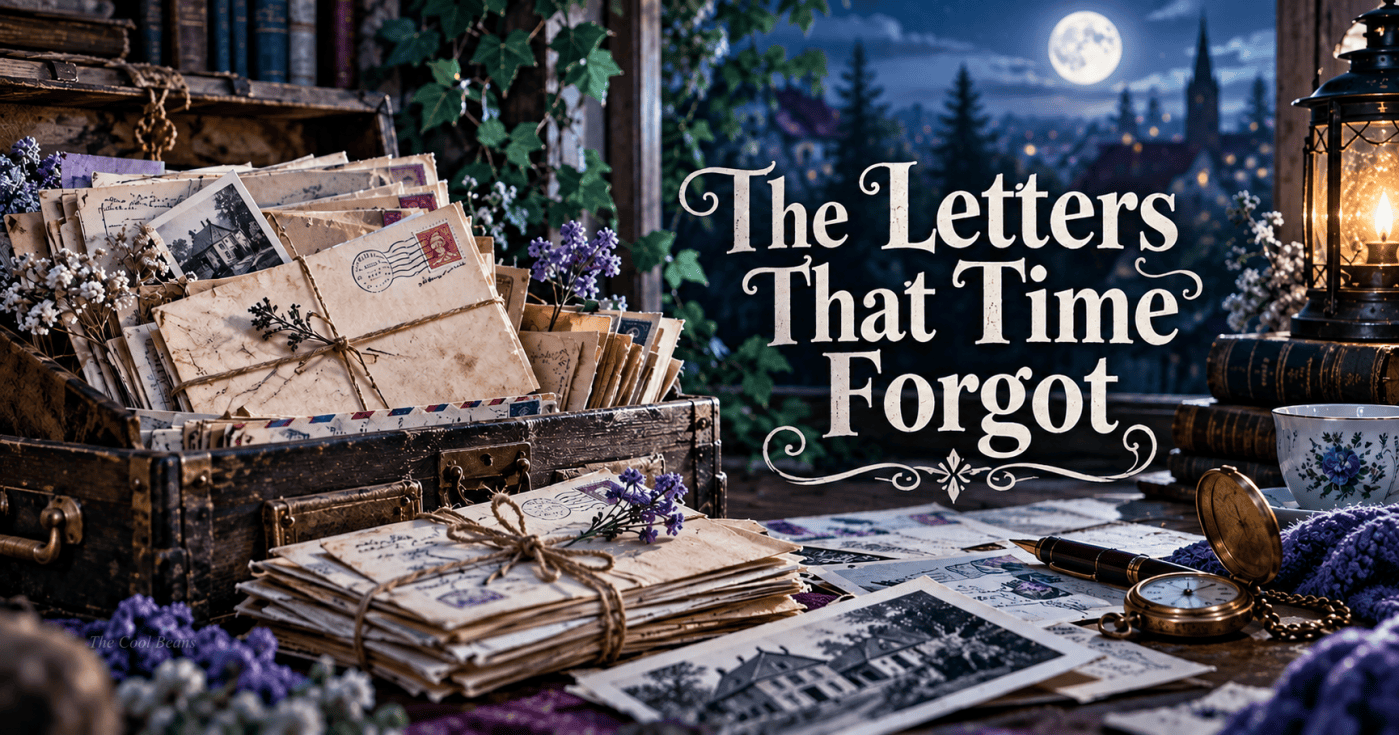
Inside were hundreds of envelopes.
Some were pale blue, others yellowed with age. A few had delicate floral borders, while others bore the bold lettering of businesses that had long since disappeared. There were birthday cards, postcards, official notices, and letters written in careful handwriting. Most were addressed to people who had lived on Willow Street or in the surrounding neighbourhoods during the 1960s.
Oliver picked up an envelope postmarked June 14, 1964. It was addressed to a woman named Margaret Ellis at 12 Hawthorne Avenue. The return address belonged to someone named Eleanor Price in Vancouver.
He turned it over. The seal was intact.
He examined another envelope, then another. None appeared to have been opened, and many bore handwritten delivery notes, forwarding instructions, or marks indicating they had never reached their intended recipients.
“What on earth?” Oliver muttered.
He spent the next hour examining the boxes without opening the letters. There were hundreds of them, perhaps thousands, spanning nearly a decade. A small notebook tucked beneath the final stack offered the first clue. Its cover read Willow Street Postal Substation, 1961-1969.
The building, Oliver discovered after a late-night internet search, had once housed a small postal sorting office on the ground floor. During renovations in 1970, the office had closed, and the building had eventually been converted into apartments.
Somehow, a collection of undelivered correspondence had been forgotten behind a wall.
Oliver sat cross-legged on his bedroom floor, surrounded by envelopes older than his parents. He could have called the landlord, handed everything over, and returned to his programming assignment. That would have been the sensible thing to do.
Instead, he picked up the notebook and began reading the names.
By midnight, he had created a spreadsheet.
By two in the morning, he had built a searchable database.
And by sunrise, he had forgotten entirely about his programming assignment.
Over the following week, Oliver catalogued every envelope without breaking its seal. He recorded names, dates, addresses, postmarks, and whatever forwarding information appeared on the outside. He photographed each envelope, created a digital map of the neighbourhood as it had existed in the 1960s, and compared old street directories with modern property records.
He also contacted the postal service and the building’s owner to explain what he had found. After some discussion, the collection was placed in the care of a local historical society while its origins and proper handling could be established. Oliver was permitted to help research the intended recipients and arrange the return of correspondence where possible.
The historical society’s archivist, a cheerful woman named Judith Bell, was delighted by his discovery.
“Do you understand what you’ve found?” she asked, examining the boxes.
“A spectacular amount of paperwork?”
Judith laughed. “You’ve found a neighbourhood’s missing history.”
Oliver wasn’t entirely convinced. To him, the letters were fascinating pieces of data, but he couldn’t imagine that anything written sixty years earlier could still matter very much.
Judith gave him a knowing smile.
“You might be surprised how long people carry things they never got to say.”
The first person Oliver managed to locate was Margaret Ellis, the woman whose name appeared on the envelope postmarked June 14, 1964.
Margaret was eighty-four years old and lived in a small retirement community forty minutes away. Her husband had died several years earlier, and her daughter lived across the country. When Oliver telephoned and explained that he might have a letter addressed to her from the 1960s, she was understandably suspicious.
“Young man, if you’re trying to sell me something, I already have enough insurance.”
Oliver assured her that he wasn’t selling anything. He explained the discovery, the historical society’s involvement, and the name on the envelope.
When he mentioned Eleanor Price, the telephone went silent.
“Did you say Eleanor?” Margaret finally whispered.
“Yes. Eleanor Price, from Vancouver.”
There was another long silence.
“That was my sister.”
Oliver arranged to visit Margaret the following Saturday, accompanied by Judith, who carried the letter in a protective sleeve. Margaret welcomed them into a bright sitting room filled with family photographs, crocheted blankets, and a remarkable number of ceramic birds.
She held the envelope for several minutes before opening it. Her hands trembled as she unfolded the delicate paper.
Oliver watched her eyes move across the page. At first, her expression was unreadable. Then her lips began to quiver, and tears slipped down her cheeks.
Margaret and Eleanor had stopped speaking in 1963 after a bitter disagreement over their mother’s care. Both sisters had said things they regretted, and neither had known how to take the first step toward reconciliation. Eleanor had moved west shortly afterward, and Margaret had convinced herself that her sister wanted nothing more to do with her.
The letter told a different story.
Eleanor had written to apologize. She had admitted her own mistakes, explained how deeply she missed Margaret, and begged her sister not to let one terrible argument erase a lifetime of shared memories. She had included her new telephone number and an invitation to visit.
Margaret pressed the paper against her chest.
“All these years,” she whispered. “I thought she hated me.”
Oliver gently asked whether Eleanor was still alive.
Margaret nodded. “She’s ninety-one. She lives with her granddaughter in British Columbia. We send Christmas cards now, but we’ve never really talked about what happened.”
She looked down at the letter again.
“I think it’s time.”
Oliver helped her arrange a video call that afternoon. When Eleanor’s face appeared on the screen, Margaret held up the letter, and both women began crying before either could speak.
For nearly two hours, the sisters talked about their childhood, their mother, the years they had lost, and the stubborn pride that had kept them apart. By the end of the call, they were laughing about the time Eleanor had accidentally dyed Margaret’s hair green before a school dance.
Oliver sat quietly in the corner, watching two elderly women rediscover the friendship they had once shared.
As he left, Margaret took his hand.
“You have no idea what you’ve given me,” she said.
Oliver glanced at the old envelope resting on her lap.
“I didn’t write it.”
“No,” Margaret replied. “But you made sure it finally arrived.”
That night, Oliver returned to his apartment and stared at the database on his computer. For the first time, the names and addresses didn’t look like information waiting to be organized.
They looked like people waiting to be found.
He began spending his weekends tracing the recipients, carefully working with Judith and the historical society to protect their privacy and return the letters appropriately. Some people had died, and their correspondence was offered to surviving family members when it was suitable to do so. Others had moved across the country or changed their names. A few were impossible to locate, but Oliver refused to consider the effort wasted.
Every letter, he reasoned, had once been important enough for someone to sit down, choose their words, address an envelope, and send it into the world.
Surely that deserved a little effort.
His second remarkable discovery involved a letter addressed to Thomas Whitaker, who had lived at 8 Willow Street in 1966. Thomas, now eighty-three, was a retired mechanic living in a modest bungalow with his wife, Helen.
The envelope had been sent by a man named Samuel Brooks.
When Oliver arrived with the letter, Thomas took one look at the handwriting and laughed in disbelief.
“Well, I’ll be damned. Sammy Brooks.”
Thomas explained that Samuel had been his closest friend throughout childhood. They had grown up two houses apart, built questionable inventions in Thomas’s father’s garage, and once attempted to construct a homemade submarine using a discarded bathtub.
“It sank before we even climbed in,” Thomas recalled proudly. “Which, looking back, was probably for the best.”
In 1965, Samuel had joined the military and eventually settled overseas. The two friends had exchanged letters for a while, but communication had gradually stopped. Thomas had always assumed Samuel had simply moved on with his life.
The letter revealed that Samuel had written from Germany, inviting Thomas to join him on a long-planned motorcycle trip through Europe. He had included several pages of enthusiastic plans, complete with a hand-drawn map and a promise that they would finally see the world together.
Thomas read the letter twice before shaking his head.
“That fool,” he murmured affectionately. “I would have gone.”
Oliver asked whether he knew what had become of Samuel.
Thomas admitted that he had tried looking for him years earlier but hadn’t known where to begin. Oliver offered to help, and within a week, after several phone calls and some determined research, he located Samuel living in a seaside town in England.
Samuel was eighty-two, recently widowed, and delighted to learn that Thomas was still alive.
Their first telephone conversation lasted three hours.
Their second lasted four.
Within a month, the two men had arranged to meet in person for the first time in nearly sixty years. Thomas’s wife accompanied him to England, where Samuel greeted his old friend at the airport wearing a motorcycle helmet and holding a sign that read, YOUR RIDE IS FINALLY HERE.
The photograph of the two elderly men embracing made Oliver laugh so hard that he nearly spilled coffee across his keyboard.
A week later, Thomas sent him another picture. It showed the two friends sitting on a pair of stationary motorcycles at a local museum, grinning like teenagers.
The caption read, We decided to start with something our knees could handle.
By then, Oliver’s project had become something of a local curiosity. Judith had helped him create a small exhibition at the historical society, displaying photographs of the envelopes and telling the stories of those who had agreed to share their experiences. A local newspaper published an article about the discovery, and people began contacting Oliver with information about former Willow Street residents.
His apartment became a peculiar combination of technology laboratory and historical research centre. Old maps covered the walls, his computer screens displayed family trees and digitized street directories, and a large corkboard held photographs of people whose lives had crossed paths decades earlier.
His friends found the entire situation hilarious.
“You’ve become a twenty-two-year-old detective specializing in ancient gossip,” his roommate from university, Marcus, informed him.
Oliver grinned. “Technically, I’m a historical correspondence recovery specialist.”
“You’re a mailman with three monitors.”
Oliver couldn’t argue with that.
The third letter that changed everything was addressed to a woman named Evelyn Carter.
It had been mailed in September 1968 by a young man named Daniel Foster, who was serving overseas. Unlike most of the other envelopes, this one had a small drawing of a sunflower in the corner, along with the words For my favourite girl.
Oliver found Evelyn living in a retirement residence not far from the city. She was eighty, with silver hair, bright blue eyes, and a mischievous smile. When he explained the letter, she stared at him in astonishment.
“Daniel Foster?” she repeated.
Oliver nodded.
“Oh, my goodness.”
She invited him to sit down and brought out an old photograph album. Inside were pictures of a handsome young man with dark hair and an enormous grin, standing beside a younger Evelyn in a summer dress.
Daniel had been her first love.
They had met at a dance in 1966, fallen hopelessly in love, and spent the next two years planning a future together. When Daniel was posted overseas, they promised to write every week. For a while, they did, but then his letters stopped arriving.
Evelyn had written several times without receiving a reply. Eventually, she assumed Daniel had changed his mind about their relationship. Heartbroken, she moved away, married someone else, and built a happy life with her husband, who had died five years earlier.
She had never forgotten Daniel, though she rarely spoke of him.
With trembling hands, Evelyn opened the envelope. Inside was a letter filled with affectionate stories, plans for the future, and a heartfelt explanation that Daniel’s assignment had changed unexpectedly. He worried that some of his correspondence had gone missing, and he wanted Evelyn to know that his feelings hadn’t changed.
At the bottom of the page, he had written that he hoped to marry her when he came home.
Evelyn sat silently for a long time.
“All those years,” she whispered. “I thought he stopped loving me.”
Oliver felt a familiar ache in his chest. He had begun to understand that the most painful misunderstandings weren’t always caused by cruelty or betrayal. Sometimes they were simply the result of words that never reached the people who needed to hear them.
He asked whether she would like him to try finding Daniel.
Evelyn hesitated. “What if he doesn’t want to be found?”
“Then we’ll respect that,” Oliver promised. “But perhaps he’d like to know you received his letter.”
It took nearly three weeks to locate Daniel. He was eighty-one, living in a small coastal community, and had been widowed for several years. When Oliver explained why he was calling, Daniel went completely silent.
Then he asked a question that made Oliver’s throat tighten.
“Did she ever know I came home looking for her?”
Oliver explained that Evelyn had never received the letter.
Daniel sighed. He had returned to find her gone, and after several unsuccessful attempts to locate her, he had assumed she wanted a different life. He had eventually married, raised a family, and found happiness, but he had always wondered what had happened to the girl who loved sunflowers.
Oliver asked whether he would like to speak with Evelyn.
Daniel answered without hesitation.
“More than anything.”
Their first conversation was awkward, emotional, and filled with nervous laughter. They talked about the dance where they met, the summer evenings they spent walking beside the river, and the dreams they had shared when they were young. They also spoke warmly about the lives they had built apart, the spouses they had loved, and the children and grandchildren who had brought them joy.
Neither wanted to erase the years between them. They simply wanted to understand them.
Several months later, Daniel travelled to visit Evelyn. Oliver accompanied him to the retirement residence, where Evelyn waited in the garden wearing a pale yellow cardigan.
Daniel carried a bouquet of sunflowers.
When Evelyn saw him, she laughed and began crying at the same time. Daniel approached slowly, looking almost as nervous as he must have been on the night they first met.
“Hello, Evie,” he said.
“Hello, Danny.”
For a moment, they simply looked at one another. Then Evelyn reached for his hand, and Daniel held it as though he had been waiting sixty years for the opportunity.
They spent the afternoon walking through the garden, sharing stories and discovering that, despite everything, their friendship had survived the passage of time.
By autumn, they had begun meeting regularly for lunch, attending concerts together, and taking long drives through the countryside. Their families were delighted, particularly when Evelyn announced that she and Daniel had decided they were far too old to waste time pretending they weren’t enjoying each other’s company.
Oliver received a photograph of them sitting beneath a sunflower arch at a local garden festival.
On the back, Evelyn had written, Some letters take the scenic route.
As the months passed, the project continued growing. Oliver delivered birthday cards that had never reached their recipients, postcards from long-forgotten holidays, and letters filled with ordinary details that had become extraordinary simply because so much time had passed.
One elderly man received a note from his father praising him for his courage during a difficult childhood. A woman discovered that her grandmother had once dreamed of opening a bakery, inspiring her to gather old family recipes and finally start the small business she had always wanted. Two cousins who had lost touch after a family disagreement began speaking again after discovering that their mothers had continued exchanging affectionate letters long after the rest of the family had drifted apart.
Not every letter brought dramatic revelations. Some contained grocery lists, invitations to parties, or reminders about appointments that had long since passed. Others brought sadness, particularly when the intended recipients had died before the letters could be delivered.
Yet even those letters sometimes offered comfort.
A daughter received a letter her late mother had written to an old friend, describing how proud she was of her children. A grandson discovered a postcard from his grandfather, who had died before he was born, filled with jokes and observations that made the family laugh. Small pieces of forgotten correspondence became unexpected treasures, connecting generations through handwriting, humour, and memories.
Oliver began to realize that history wasn’t simply a collection of dates, wars, inventions, and famous names. It was made of ordinary people loving one another, making mistakes, forgiving, dreaming, and trying to find their way through life.
And sometimes, it was made of a single envelope that had waited sixty years to be opened.
By the following spring, Oliver had returned more than three hundred letters to their intended recipients or families. The historical society had carefully preserved the remaining collection, and several volunteers had joined the effort to continue researching addresses and family connections.
His university professors were impressed by the technology he had developed, particularly the mapping system that connected historical addresses with modern records. One suggested he turn the project into his final-year research paper.
Oliver agreed, but he had a bigger idea.
He wanted to create a nonprofit organization dedicated to helping families reconnect with lost correspondence, photographs, and personal histories. With Judith’s guidance, he began developing a secure digital archive that could help people identify forgotten documents while respecting the privacy of those involved.
He called it The Letter Project.
The name was simple, but the mission meant everything to him.
A year after discovering the boxes, Oliver organized a gathering at the historical society to celebrate the people whose stories had been reunited with their owners. He expected perhaps twenty guests. More than a hundred arrived.
Margaret came with her sister Eleanor, who had travelled from British Columbia for the occasion. The two women sat together, holding hands and laughing over stories from their childhood. Thomas and Samuel arrived wearing matching motorcycle jackets, much to the amusement of their families. Evelyn and Daniel appeared arm in arm, carrying a bouquet of sunflowers for Judith.
There were children, grandchildren, old friends, neighbours, and people who had never met but somehow felt connected through the extraordinary collection of letters.
Oliver stood at the front of the room, suddenly nervous. He was comfortable giving presentations about software, databases, and complex programming systems, but speaking about emotions in front of a room full of people was an entirely different challenge.
He cleared his throat and glanced at the faces watching him.
“When I found those boxes, I thought I’d discovered a really interesting technical problem,” he began. “There were names, addresses, dates, and thousands of pieces of information that needed organizing. I figured I could build a database, create a map, and maybe solve a few mysteries.”
The audience smiled.
“What I didn’t understand was that every name belonged to a person, and every envelope represented something someone had wanted to say. Some of those messages were funny. Some were ordinary. Some were apologies, promises, or words of love. But every one of them mattered to the person who wrote it.”
Oliver paused, looking toward Margaret and Eleanor.
“I used to think technology was the most important thing I could create. Now I think its greatest value is what it allows us to do for one another. A computer helped me find these people, but it was kindness, forgiveness, and love that brought them back together.”
He smiled as his voice grew steadier.
“Those letters were lost for sixty years, but the feelings inside them weren’t. They were simply waiting for another chance to be heard.”
The room erupted in applause, and Oliver found himself surrounded by people offering hugs, handshakes, and heartfelt thanks. He had never felt so overwhelmed or so certain that he was doing something worthwhile.
Later that evening, after the guests had gone home, Judith found him standing beside the display of old envelopes.
“You know,” she said, “when you first brought these boxes to me, I thought you were just another student looking for an interesting project.”
Oliver laughed. “I thought the same thing.”
Judith smiled. “Turns out you found something much bigger.”
He looked around the quiet room, remembering Margaret’s tears, Thomas’s laughter, Evelyn’s sunflowers, and all the other moments that had unfolded because someone had taken the time to deliver a forgotten letter.
“Yeah,” he said softly. “I think I did.”
Several weeks later, Oliver returned to Apartment 3B after a long day at university. The apartment looked much the same as it had when he first moved in, although the crooked floors and hissing radiators had become strangely comforting. His monitors still glowed on the desk, his charging cables remained hopelessly tangled, and his smartwatch continued reminding him to drink water.
But something about his life had changed.
He no longer spent every spare moment staring at a screen. He visited neighbours, volunteered at the historical society, and made time to call his parents simply to ask how their day had been. He had even begun writing letters of his own, discovering that there was something wonderfully satisfying about putting pen to paper and choosing words carefully.
That evening, he sat at his desk with a blank sheet of stationery.
He thought about all the people he had met, the friendships he had witnessed being restored, and the extraordinary journeys that had begun with ordinary envelopes. Then he picked up his pen and began writing to his grandmother, who lived several hours away.
He told her about university, his friends, and the strange apartment that had changed his life. He thanked her for the stories she had told him when he was little, for the birthday cards she never forgot to send, and for always believing that he could accomplish something meaningful.
At the bottom of the page, he wrote that he loved her and hoped they could spend more time together.
He folded the letter, slipped it into an envelope, and carefully wrote her address across the front.
The next morning, Oliver walked to the post office instead of sending a text message.
As he dropped the envelope into the mailbox, he smiled at the thought of his grandmother opening it, recognizing his handwriting, and discovering that her grandson had taken the time to write something just for her.
It was such a small thing.
And yet, after everything he had experienced, Oliver understood that small things often mattered most.
Years later, The Letter Project would grow into a remarkable organization, helping thousands of families preserve memories, recover forgotten correspondence, and reconnect with pieces of their personal histories. Oliver would continue developing technology, but he would always insist that the people behind the information were more important than the systems used to find them.
He would also keep one particular photograph on his desk.
It showed Margaret and Eleanor laughing together, Thomas and Samuel wearing their ridiculous motorcycle jackets, and Evelyn and Daniel standing beneath a bright yellow arch of sunflowers. In the middle stood Oliver, looking slightly embarrassed as everyone crowded around him.
On the back, Judith had written a message that became his favourite reminder of why the project mattered.
Sometimes the most important messages aren’t the ones that arrive quickly. They’re the ones that arrive when someone finally needs to hear them.
Oliver never forgot those words.
And whenever someone asked how a college student obsessed with technology had ended up dedicating his life to delivering old-fashioned letters, he would smile and tell them about the fourteen dusty boxes hidden behind a bedroom wall.
He would explain how a forgotten apology had reunited two sisters, how a lost invitation had restored a lifelong friendship, and how a letter decorated with a tiny sunflower had brought two people together after decades apart.
But his favourite part of the story was always the same.
He had moved into that apartment believing that the future was something people built with computers, inventions, and extraordinary new ideas. What he discovered was that the future could also be changed by remembering the past, listening to one another, and finding the courage to say the things that mattered.
Because somewhere in the world, there was always someone who needed to hear that they were loved, someone waiting for an apology, someone hoping an old friendship could be renewed, or someone who simply needed to know they hadn’t been forgotten.
And while not every lost letter could be found, there was always time to write a new one.
That became Oliver’s greatest lesson, and the one he shared whenever he had the chance: never wait for the perfect moment to tell someone how much they mean to you. Send the message, make the call, write the letter, or knock on the door. A few thoughtful words might seem ordinary to the person sending them, but to the person receiving them, they could mean the world.
After all, love, friendship, forgiveness, and kindness never truly go out of date.
Sometimes they just need a little help finding their way home.
Enjoying what you find here? 💜 Consider subscribing and becoming part of our little community. It’s a simple way to stay connected, support what we do, and make sure you don’t miss what’s coming next. We’d truly love to have you here. 🌿✨


Leave a Reply