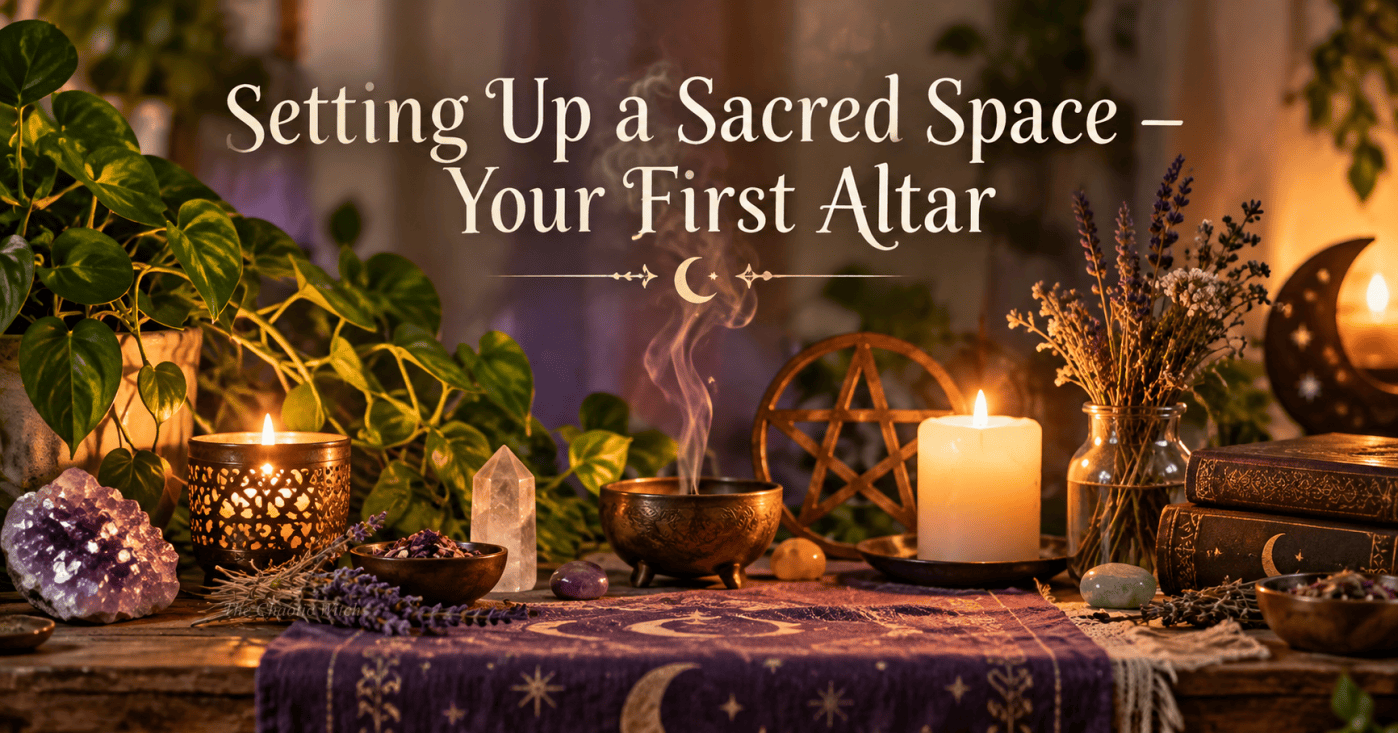
Creating your first altar is one of the most personal and meaningful steps in exploring witchcraft. It is a place where you can connect with your intuition, practise rituals, meditate, honour the natural world, and focus your intentions. Whether you’re drawn to traditional witchcraft, green witchcraft, Pagan spirituality, or simply wish to create a peaceful place for reflection, your altar can become a special part of your spiritual journey.
The wonderful thing about creating an altar is that there are no strict rules about what it must look like. You don’t need expensive crystals, elaborate statues, or an entire collection of magical tools. Your sacred space can be as simple as a candle, a favourite stone, and a small bowl of water. What matters most is the meaning you give it.
Finding the Right Location
The first step is choosing where your altar will live. This could be a small table in your bedroom, a shelf in your living room, a quiet corner near a window, or even a wooden box that can be opened whenever you wish to practise.
Ideally, choose somewhere you feel comfortable and relaxed. Your altar should be a place where you can step away from everyday distractions and spend a few moments focusing on yourself.
Some witches prefer placing their altars near windows to connect with sunlight and moonlight. Others enjoy creating sacred spaces surrounded by houseplants, natural materials, and objects gathered during walks through the forest.
If privacy or space is limited, a portable altar is a wonderful alternative. A small wooden box containing a few meaningful objects can be just as special as a permanent arrangement.
Cleansing Your Sacred Space
Before setting up your altar, many practitioners choose to cleanse the area. Within witchcraft traditions, cleansing is a symbolic practice intended to release unwanted or stagnant energy and prepare a space for spiritual work.
There are several ways to do this. You might gently ring a bell, use a singing bowl, open a window to allow fresh air to circulate, or wipe down the surface with water while focusing on peaceful intentions.
Some witches use incense or herbal smoke, although these methods are entirely optional. Smoke-free cleansing is particularly useful in homes with pets, children, or anyone sensitive to fragrances.
As you cleanse, you can say:
“I clear this space of all that weighs upon it. May peace, harmony, wisdom, and positive intention find a home here. Let this be a place of comfort, protection, and spiritual growth.”
You can also create your own words. The purpose is to establish a meaningful beginning for your sacred space.
Welcoming the Four Elements
Many modern witchcraft traditions incorporate the four classical elements into altar arrangements. Each element represents different qualities of nature and human experience.
Earth symbolizes stability, grounding, fertility, abundance, and growth. It can be represented by a stone, a bowl of salt, soil, crystals, or a small plant. Earth is traditionally associated with the northern direction in many Western magical traditions.
Air represents knowledge, communication, inspiration, thought, and new beginnings. Feathers, bells, and incense are common representations. Air is often associated with the east.
Fire symbolizes transformation, courage, creativity, passion, and personal power. A candle is one of the most familiar representations of this element, although a sun symbol or an LED candle can work just as well. Fire is commonly associated with the south.
Water represents intuition, emotional healing, dreams, compassion, and spiritual renewal. A small bowl of water, seashells, or ocean imagery can represent this element. Water is traditionally associated with the west.
You don’t need to include all four elements, nor must you follow a particular directional arrangement. Different traditions have different correspondences, and you can explore what feels appropriate for your practice.
Choosing Your First Altar Tools
As you begin exploring witchcraft, you’ll encounter many different tools associated with magical practice. Some have long histories within particular traditions, while others are especially popular in contemporary witchcraft.
Candles are commonly used during meditation, intention-setting, and rituals. Their colours may carry symbolic meanings, although a simple white candle is often used as a versatile option.
Crystals are popular for their beauty and traditional spiritual associations. Clear quartz is often linked with clarity, amethyst with intuition, and rose quartz with love and compassion. These are symbolic associations rather than scientifically established properties.
A small bowl can hold water, salt, herbs, or offerings. A chalice may serve a similar purpose, particularly in traditions that incorporate ceremonial tools.
An altar cloth helps define your sacred space and can protect the surface beneath your objects. You might choose colours that reflect the seasons, your intentions, or simply your personal taste.
Some witches include an athame, a ritual blade used symbolically in certain traditions, or a wand to represent the direction of intention and energy. Neither is necessary for beginners.
A Book of Shadows or spiritual journal can be especially useful. It gives you somewhere to record rituals, dreams, magical correspondences, personal reflections, and what you learn along the way.
Remember that you can begin with things you already own. A treasured stone, a handmade bowl, or a flower from your garden can hold more personal significance than an expensive object purchased simply because it appears on a list of altar essentials.
Making Your Altar Truly Yours
One of the most enjoyable parts of creating an altar is decorating it with objects that reflect your personality and spiritual interests.
If you’re drawn to the moon, you might include lunar symbols, silver-coloured decorations, and a calendar showing the moon’s phases. If you feel especially connected to nature, your altar might feature pinecones, dried leaves, stones, flowers, and seasonal greenery.
Some witches dedicate their altars to specific deities, while others create spaces to honour ancestors or loved ones who have passed away. Photographs, inherited jewellery, and meaningful keepsakes can become beautiful additions.
You may also wish to create an altar devoted to a particular intention, such as personal growth, protection, gratitude, creativity, or emotional well-being.
There is no requirement to work with deities, spirits, or any particular belief system. Your altar can simply be a place where you reconnect with yourself and the natural world.
Blessing and Dedicating Your Altar
Once your altar is arranged, you may wish to perform a simple dedication ritual. This is sometimes called consecrating your altar, although the exact meaning and method vary between traditions.
Begin by sitting or standing comfortably before your sacred space. Take several slow breaths, allowing your thoughts to settle.
If you wish, light a candle or switch on a flameless one. Place your hands gently on the altar or hold them above its surface.
Imagine the space becoming filled with warmth, peace, and the intentions you wish to nurture.
Then say:
“By earth beneath and sky above,
By ancient wisdom, light, and love,
I dedicate this sacred place,
To peace, protection, strength, and grace.
May wisdom guide the path I take,
May kindness grow with each new day.
Within this space, my heart is free,
To learn, to grow, and simply be.
With purpose clear and spirit bright,
I bless this altar here tonight.”
Remain quiet for a few moments, reflecting on the meaning of your new sacred space.
Your altar is now ready for whatever spiritual practices you choose to explore.
Your First Simple Altar Ritual
You don’t need to begin with complicated spells or lengthy ceremonies. One of the easiest ways to become comfortable with your altar is through a simple daily intention ritual.
Sit quietly before your altar and take three slow, comfortable breaths. Allow yourself to become aware of the present moment.
Choose an intention for the day. Perhaps you wish to approach challenges with patience, speak more kindly to yourself, remain grounded during stressful situations, or welcome creativity into your life.
You might say:
“Today, I choose patience over frustration, courage over fear, and kindness toward myself and others. May my actions reflect the intentions I set.”
Spend another moment in silence before continuing with your day.
This simple practice can help establish a personal connection with your altar while encouraging mindfulness and self-reflection.
Caring for Your Altar
An altar is not something you create once and then forget. It can evolve as your interests, beliefs, and spiritual practices develop.
Keep the surface clean, replace flowers or offerings before they spoil, and rearrange objects whenever you feel inspired.
Some witches refresh their altars during the new moon or full moon, while others prefer changing their decorations with the seasons or the eight festivals commonly celebrated along the modern Pagan Wheel of the Year.
You might add autumn leaves during Samhain, fresh flowers during Beltane, or evergreen branches during Yule.
If you use candles, always keep flames away from fabric, dried herbs, and other flammable materials. Never leave a burning candle unattended. Keep potentially toxic plants, essential oils, and small altar objects safely away from pets.
Your altar should be a place of peace, not another responsibility that adds stress to your life. There is no need to perform rituals every day or maintain a strict schedule.
Growing Alongside Your Sacred Space
As your understanding of witchcraft grows, your altar may change considerably. You might discover new traditions, develop an interest in herbal magic, explore divination, or begin celebrating seasonal festivals.
Objects that once felt important may eventually be replaced by others that better reflect your spiritual journey.
That is perfectly natural.
Your altar is not meant to remain frozen in time. It is a reflection of your relationship with yourself, your beliefs, and the world around you.
You may eventually have several altars devoted to different purposes, or you may find that one simple sacred space continues to meet all your needs.
Neither approach is more meaningful than the other.
The Magic Begins With You
Creating your first altar is not about proving that you are a witch or demonstrating how much magical knowledge you possess. It is about giving yourself permission to explore, learn, and develop a spiritual practice that feels authentic.
You don’t need a perfect arrangement, a collection of expensive tools, or an elaborate ceremony to begin.
A smooth stone gathered during a peaceful walk, a candle glowing softly on a quiet evening, or a handwritten intention tucked beneath a small bowl can be enough.
Over time, your altar may become a familiar place where you turn for comfort, reflection, inspiration, and connection.
And perhaps that is the most beautiful part of creating a sacred space. In a world that constantly demands our attention, we can choose to set aside one small corner where nothing is expected of us except to be present.
Your first altar is the beginning of a journey, not a test you must pass.
The most powerful part of your sacred space isn’t what you place upon it. It’s the meaning, intention, and care you bring to it.
A little magic is always waiting. Subscribe and step inside the circle. 🖤🔮✨


Leave a Reply