The first thing anyone needed to know about Lucy Bennett was that she had absolutely no business working in a kitchen.
At least, that was what her older brother, Daniel, liked to tell her whenever she dropped a saucepan, knocked over a container of flour, or somehow managed to set off the smoke alarm while making toast. Lucy had once tripped over a stationary mop, accidentally salted a birthday cake instead of sugaring it, and sent an entire tray of freshly baked croissants sailing across a restaurant kitchen like buttery little frisbees.
And yet, at twenty-four years old, Lucy was determined to become a chef.
She worked as a line cook at a busy downtown restaurant, where the head chef regularly referred to her as “Hurricane Lucy.” She wasn’t particularly fast, she wasn’t especially graceful, and her plating skills sometimes resembled the aftermath of a small natural disaster. But she loved food with a passion that bordered on obsession. She loved the smell of fresh bread, the sound of onions sizzling in butter, and the way a single bite of something delicious could make a person’s entire day better.
Most of all, she loved the memories that food carried.
Her grandfather, Arthur Bennett, had taught her that.
Arthur had owned Bennett’s Bakery for nearly fifty years, a small, old-fashioned shop tucked between a bookstore and a florist on a narrow downtown street. The bakery had been a neighbourhood institution long before Lucy was born. People came for the cinnamon buns, the warm bread, and the feeling that stepping through its doors was a little like coming home.
Arthur had been a wonderful baker, although nobody could ever quite explain why his food tasted different from everyone else’s. His bread had a delicate sweetness that lingered on the tongue, his pastries remained impossibly tender, and his cakes seemed to have a richness that no amount of expensive ingredients could reproduce.
Whenever someone asked for his secret, Arthur would wink and say, “The recipe is only half the story.”
Lucy had spent much of her childhood sitting on a flour-dusted stool in his kitchen, watching him work. He let her knead dough, measure ingredients, and taste things straight from the mixing bowl. He never scolded her when she made a mess, even when she once knocked an entire bag of flour over his head.
Instead, he’d stood there looking like a bewildered snowman before declaring that he was finally old enough to have white hair.
When Arthur died at seventy-nine, the bakery lost more than its founder. It lost the man who had kept it alive through recessions, rising rents, changing neighbourhoods, and the arrival of shiny new cafés selling pastries with names nobody could pronounce.
Lucy’s mother, Helen, tried desperately to keep the business running, but the numbers were getting worse every month. The ovens needed repairs, ingredient costs were climbing, and the landlord had begun sending increasingly unpleasant letters about overdue payments.
By the time Lucy came home for Arthur’s funeral, Bennett’s Bakery was barely surviving.
She noticed it immediately. The display cases were half-empty, the paint was peeling near the back door, and the familiar smell of fresh bread had been replaced by the faint, discouraging scent of industrial cleaning solution. Her mother looked exhausted, and Daniel, who handled the accounts, had developed a habit of staring at spreadsheets as though he might frighten them into producing better numbers.
One evening, after the bakery closed, Helen handed Lucy a battered cardboard box.
“Your grandfather wanted you to have these,” she said.
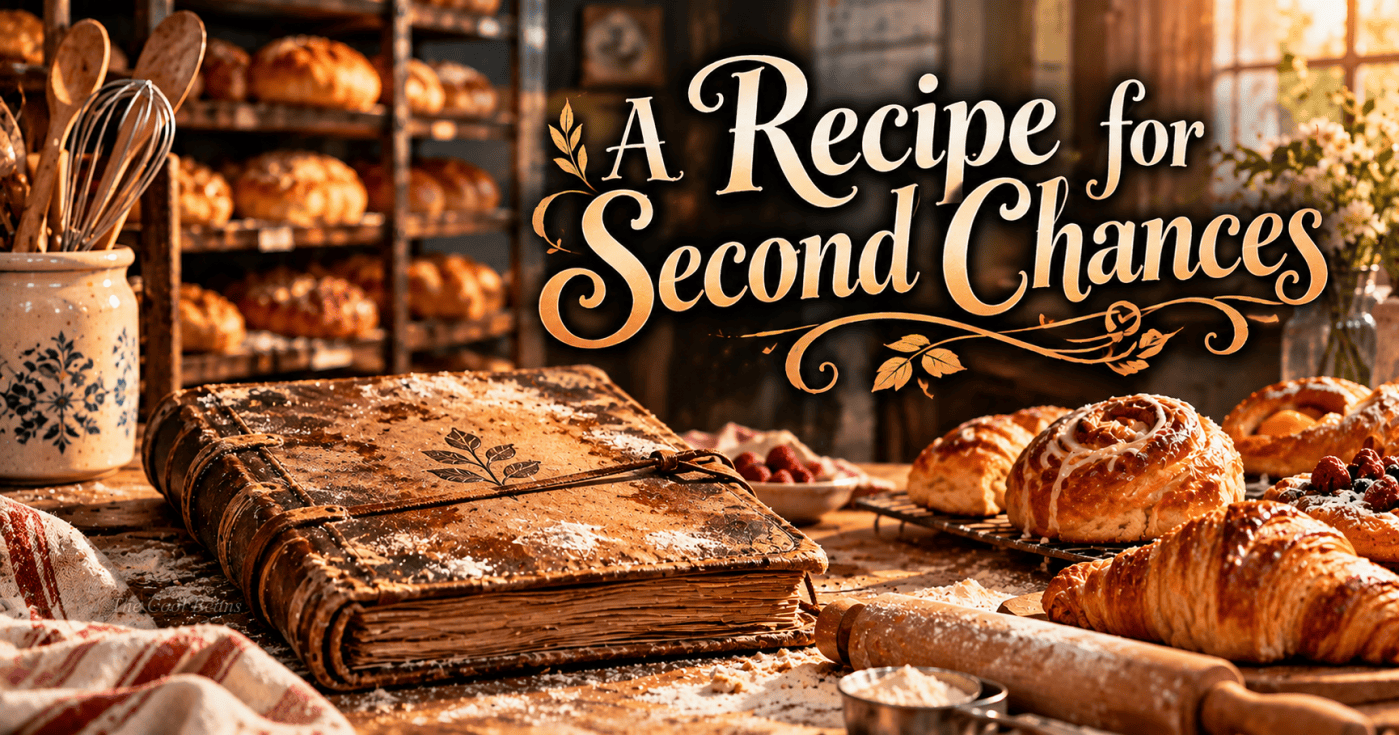
Inside were a few old photographs, a flour-covered apron, a wooden rolling pin, and a cookbook so thoroughly stained that Lucy initially wondered whether someone had used it to mop the kitchen floor.
The cover was cracked and faded. Several pages were stuck together with what appeared to be ancient caramel. Others were marked with splashes of chocolate, butter, and something suspiciously green.
Across the front, written in Arthur’s familiar handwriting, were the words For the One Who Never Stops Trying.
Lucy felt a lump rise in her throat.
She opened the book, expecting to find the recipes she’d grown up loving. Instead, she found what looked like the scribblings of a man who had lost a long and enthusiastic argument with a pencil.
There were circles, arrows, little drawings of birds, strange fractions, and symbols that resembled musical notes. Ingredients were listed in peculiar combinations, with measurements such as “three whispers,” “one sleepy spoon,” and “until the dough remembers.”
On one page, beside a sketch of a crooked teapot, Arthur had written, “When the sun touches the second window, wake the butter.”
Lucy stared at the sentence for a full minute.
“What on earth does that mean?”
Daniel leaned over her shoulder, examined the page, and shook his head.
“Grandpa was either a genius or he’d been sniffing too much vanilla extract.”
Lucy laughed despite herself.
But later that night, sitting alone in her childhood bedroom, she couldn’t stop thinking about the cookbook. Arthur had been meticulous about baking. He believed that every ingredient mattered, every temperature had a purpose, and every minute could change the outcome of a recipe.
He wouldn’t have written nonsense.
There had to be a system.
The following morning, Lucy carried the cookbook into the bakery and announced that she was going to recreate Arthur’s famous honey-apple bread.
Helen looked doubtful. Daniel looked alarmed. The bakery’s longtime assistant, Mrs. Kowalski, crossed herself and quietly moved the fire extinguisher closer to the counter.
Lucy’s first attempt was a catastrophe.
The dough rose beautifully, then collapsed so dramatically that it looked as though someone had sat on it. Her second attempt emerged from the oven with the consistency of a brick. The third had a pleasant aroma but tasted like sweetened cardboard.
By the fourth attempt, Daniel suggested they could sell the loaves as decorative doorstops.
Lucy threw a dish towel at him.
For weeks, she experimented whenever she wasn’t working at the restaurant. She filled notebooks with measurements, copied Arthur’s strange symbols, and tried to identify patterns. She watched baking tutorials, borrowed books from the library, and asked older bakers whether they’d ever encountered recipes written in such an unusual way.
Nobody had.
Her head chef even examined a photograph of one page before suggesting that Arthur might have been writing in code to protect his recipes from competitors.
That idea stayed with Lucy.
Perhaps the cookbook wasn’t merely disorganized. Perhaps it was deliberately encrypted.
She began studying the drawings more carefully. A little bird appeared beside certain ingredients. A spiral showed up near instructions involving dough. A crescent moon was drawn beside several temperature notes.
At first, she thought the symbols represented measurements. Then she wondered whether they referred to timing. Every theory ended in another ruined batch of something.
As autumn arrived, the bakery’s financial situation grew increasingly desperate. Helen began quietly selling pieces of equipment they no longer used. Daniel stopped paying himself. Mrs. Kowalski offered to work fewer hours, although everyone knew she couldn’t afford to.
Then the foreclosure notice arrived.
Unless the family settled its outstanding loan obligations within ninety days, the bakery would be lost.
Lucy found her mother sitting at Arthur’s old desk, holding the letter with trembling hands.
“I don’t know what else to do,” Helen whispered.
Lucy sat beside her and took her hand.
“We’ll figure something out.”
Helen gave a tired smile.
“Sweetheart, I love your optimism. But optimism doesn’t pay the mortgage.”
Lucy knew she was right. Still, the thought of losing the bakery felt unbearable. It wasn’t simply a business. It was where she’d celebrated birthdays, learned to ride her bicycle in the back alley, and watched Arthur dance with her grandmother while bread cooled on the counter.
It was the last place that still smelled like her childhood.
That night, Lucy stayed in the bakery long after everyone had gone home. She sat at the old wooden table, surrounded by failed recipes, notebooks, and cups of increasingly terrible coffee.
At two in the morning, exhausted and frustrated, she opened the cookbook to a page covered in Arthur’s familiar drawings.
There was a little bird, a spiral, and a crooked teapot.
She stared at them.
Then she remembered something.
When she was small, Arthur used to tell her that dough was alive in its own peculiar way. He said it needed warmth, rest, and patience, just like people. He used to call the first rise “the bird waking up,” the second “the spiral turning,” and the final resting period “tea time.”
Lucy sat upright.
“The bird isn’t an ingredient,” she whispered.
She flipped through the pages.
The bird appeared wherever Arthur had written instructions for beginning a fermentation or resting stage. The spiral appeared when the dough needed to be folded or turned. The teapot appeared when it needed to rest again.
Her heart began pounding.
She pulled out an old photograph of Arthur standing in the bakery kitchen. Behind him, sunlight streamed through the east-facing windows.
“When the sun touches the second window, wake the butter.”
Lucy glanced toward the windows.
Arthur hadn’t been describing a mysterious ingredient. He had been describing the time of day and the temperature of the kitchen.
She hurried to the next page.
“Three whispers” wasn’t a quantity. It was a reference to three gentle folds. “One sleepy spoon” meant adding an ingredient after the mixture had rested. “Until the dough remembers” referred to a texture Arthur had taught her to recognize when she was a child.
Lucy laughed so loudly that Mrs. Kowalski, who lived in the apartment upstairs, came down in her dressing gown carrying a rolling pin.
“Is someone breaking in?”
“No!” Lucy cried. “I think Grandpa left us a treasure map!”
Mrs. Kowalski examined the open cookbook, looked at the flour covering Lucy’s face, and decided that whatever was happening could probably wait until morning.
Over the following days, Lucy began translating the cookbook with renewed determination.
What emerged was unlike anything she’d learned in culinary school or at the restaurant.
Arthur had developed an unusual method of baking that combined slow fermentation, carefully timed temperature changes, and repeated resting periods. He used small amounts of naturally fermented mixtures to develop flavour, then incorporated ingredients at different stages rather than mixing everything together at once.
Some techniques resembled established baking traditions, but Arthur had spent decades adapting them into his own distinctive system. He had discovered how to create remarkably tender pastries with less butter, how to coax deep sweetness from fruit without overwhelming it with sugar, and how to produce bread with a delicate, almost custard-like interior beneath a beautifully crisp crust.
The drawings weren’t random. They were his personal shorthand for timing, texture, and temperature, developed through years of experimentation.
The cookbook wasn’t a collection of ordinary recipes.
It was the record of a lifetime spent understanding how ingredients behaved together.
Lucy began testing the translated instructions.
This time, the results were different.
Her first successful loaf of honey-apple bread emerged from the oven on a cold November morning. It was golden, fragrant, and beautifully risen, with a delicate crust that crackled beneath her fingers.
She cut a slice, spread it with a little butter, and took a bite.
For a moment, she couldn’t move.
The taste was exactly as she remembered.
Sweet apples. Warm honey. A soft, rich crumb that seemed to melt on her tongue.
She was seven years old again, sitting on a stool beside Arthur while snow fell outside the bakery windows.
Lucy began to cry.
Daniel found her ten minutes later, sitting on the floor beside the oven with half a loaf in her lap.
He looked at the bread, then at her tear-streaked face.
“Is it terrible?”
Lucy shook her head.
He tore off a piece and tasted it.
His expression changed.
Then he took another bite.
“Oh,” he said quietly.
Lucy nodded.
“Yeah.”
Daniel swallowed.
“That’s Grandpa’s bread.”
For the first time in months, the bakery felt alive again.
Lucy and Helen began working through the translated recipes, testing each one carefully and adapting the process for their equipment. Mrs. Kowalski took charge of the pastries, announcing that she had waited twenty years to discover how Arthur made his impossibly tender cinnamon twists.
There were still disasters, of course. Lucy accidentally overproofed an entire batch of dough, and one experimental pastry expanded so dramatically that Daniel claimed it was attempting to escape the oven.
But slowly, the family found its rhythm.
They introduced a small collection called Arthur’s Forgotten Favourites.
The first morning, they sold twelve loaves of honey-apple bread.
The second morning, they sold thirty.
By the end of the week, customers were arriving before opening time.
An elderly man took one bite of a cinnamon twist and stood silently at the counter for several seconds before explaining that he hadn’t tasted one like it since his wife was alive.
A woman brought her daughter to try the orange-cardamom buns she’d loved as a child.
A local food blogger stopped by after hearing about the unusual pastries and posted a glowing review describing Bennett’s Bakery as a place where old-fashioned comfort met something wonderfully unexpected.
Within days, the review had been shared thousands of times.
People began travelling across the city to taste the bread. Then they came from neighbouring towns. Soon, there were lines stretching down the sidewalk, and Daniel was forced to create a numbering system because customers kept arguing over the last honey-apple loaf.
For the first time in years, Bennett’s Bakery was making a profit.
But Lucy wasn’t satisfied with simply recreating Arthur’s recipes.
She began experimenting with the techniques herself.
She combined his slow-fermentation method with seasonal ingredients, creating pear-and-rosemary breakfast buns, maple-pecan cloud rolls, and delicate lemon pastries that seemed almost impossibly light.
She called the new collection The Second Chance Series.
Every recipe was inspired by something Arthur had taught her, but each carried a little of Lucy’s own imagination.
One afternoon, Clara Mitchell, a respected food writer, visited the bakery after hearing about its unusual baking methods. She spent several hours watching Lucy work, asking questions about the timing, ingredients, and strange symbols in the cookbook.
When Lucy explained how she’d deciphered her grandfather’s notes, Clara was fascinated.
“Your grandfather developed a remarkable system,” she said. “And you’ve managed to bring it back to life.”
Lucy smiled.
“I mostly just burned a lot of things until I figured it out.”
Clara laughed.
“Sometimes that’s what discovery looks like.”
The article appeared two weeks later.
Its headline read, The Grandfather’s Secret: How a Young Cook Revived a Forgotten Baking Method and Saved a Family Legacy.
The response was extraordinary.
Food enthusiasts began sharing photographs of Bennett’s pastries. Professional bakers contacted Lucy to learn about the techniques. A culinary school invited her to demonstrate Arthur’s methods, and a regional television program asked whether she would appear on a morning cooking segment.
Lucy nearly refused that last invitation.
She imagined dropping a bowl on live television or accidentally setting something on fire in front of thousands of viewers.
Daniel reminded her that she’d already done both in front of considerably smaller audiences.
“At least this time,” he said, “you’ll be famous for it.”
Lucy agreed to appear.
The television segment went surprisingly well, although she did knock over a container of flour and accidentally dust the host’s shoes. Fortunately, the host found it hilarious, and the clip became one of the show’s most popular online videos.
By Christmas, the bakery had enough money to settle the overdue loan payments, repair the ovens, and begin rebuilding its financial reserves.
The foreclosure proceedings were halted.
Helen cried when the bank confirmed that the bakery was no longer in immediate danger.
Daniel celebrated by ordering an enormous pizza, explaining that after three months of eating experimental pastries, he desperately needed something that wasn’t made of dough.
Lucy pointed out that pizza was, in fact, made of dough.
Daniel told her not to ruin the moment.
On Christmas Eve, the family closed the bakery early and gathered around Arthur’s old wooden table. The shop smelled of cinnamon, warm bread, and orange peel. Snow drifted past the windows, and the little brass bell above the door jingled whenever the wind caught it.
Helen brought out a bottle of sparkling cider, and Mrs. Kowalski arrived with a tin of homemade biscuits that she insisted were better than anything in the bakery.
For the first time since Arthur’s death, the family celebrated without the heavy shadow of financial worry hanging over them.
Lucy placed the old cookbook in the centre of the table.
Its cover was still cracked. The pages were still stained. Several corners were held together with tape, and there was now a suspicious new smear of chocolate across the introduction.
Daniel lifted his glass.
“To Grandpa,” he said. “The only man I know who could leave behind a cookbook that required a detective.”
Everyone laughed.
Helen reached out and touched the cover gently.
“He always said Lucy would be the one to understand it.”
Lucy looked up.
“What?”
Her mother smiled.
“Your grandfather knew you loved baking, but he also knew you were always afraid of getting things wrong. He used to say you were so busy worrying about the mess that you forgot to notice what you were learning.”
Lucy swallowed hard.
Helen continued, “He told me once that he hoped you’d discover the difference between making mistakes and being a mistake.”
The room fell quiet.
Lucy thought about all the ruined cakes, burnt pans, spilled flour, and moments when she’d convinced herself she wasn’t good enough. She remembered Arthur standing beside her when she was little, laughing as she accidentally dropped a bowl of batter onto the floor.
He’d never called her clumsy.
He’d called her curious.
Later that evening, after everyone had gone home, Lucy stayed behind to clean the kitchen. As she put the cookbook away, a folded piece of paper slipped from the back cover.
It was yellowed with age and covered in Arthur’s familiar handwriting.
Lucy unfolded it carefully.
My dear Lucy,
If you’ve found this, I hope you’ve made a wonderful mess of my kitchen.
I’ve spent most of my life trying to understand the strange and beautiful things that happen when ordinary ingredients come together. I’ve learned that bread needs time, that sweetness sometimes comes from patience, and that the best things rarely turn out exactly as planned.
You have always been afraid of getting things wrong, my girl. But I want you to remember something. A burnt loaf is not a failure if it teaches you how to make the next one better. A crooked cake can still taste wonderful. And sometimes the greatest discoveries begin with a mistake.
Don’t spend your life trying to become someone who never drops anything. Become someone who always picks it up and tries again.
And remember, the recipe is only half the story.
All my love, Grandpa.
Lucy sat down on the nearest stool, holding the letter against her chest.
For a long time, she simply cried.
Not the painful, hollow tears she’d shed after his funeral, but the warm, grateful tears that came when love found a way to reach across an absence.
She understood now why Arthur had left her the cookbook.
He hadn’t expected her to be perfect.
He’d expected her to be persistent.
Months later, Bennett’s Bakery was thriving. The family had hired two additional employees, expanded its morning menu, and begun offering weekend baking classes for beginners.
Lucy insisted that the classes welcome everyone, especially people who believed they weren’t naturally talented.
She started each session by placing a tray of her earliest failed creations on the counter.
There was a photograph of the collapsed honey-apple loaf, a rock-hard cinnamon bun, and a cake that had somehow developed a crater in its centre.
The students always laughed.
Then Lucy explained that every successful recipe in the bakery had begun with mistakes, questions, and the willingness to try again.
One Saturday morning, a nervous teenager named Sophie arrived for her first lesson. She was quiet, awkward, and convinced that everyone else would be better than she was.
Halfway through the class, Sophie knocked over a bowl of flour.
A white cloud exploded across the worktable, covering her apron, the counter, and most of the floor.
The girl froze.
“I’m so sorry,” she whispered. “I ruin everything.”
Lucy looked at the flour-covered kitchen, then at Sophie’s miserable expression.
For a moment, she saw herself at that age, standing beside Arthur after making an equally spectacular mess.
She smiled.
“Well,” she said, picking up a dish towel, “that’s one way to decorate the kitchen.”
Sophie blinked.
“You’re not angry?”
“Of course not. I’ve done much worse. Once, I accidentally launched six croissants across a restaurant kitchen.”
Sophie laughed despite herself.
Lucy handed her a clean bowl.
“Come on. Let’s start again.”
Together, they cleaned up the flour and returned to the recipe.
By the end of the lesson, Sophie had made a beautiful batch of cinnamon twists. They weren’t perfectly shaped, but they were golden, fragrant, and delicious.
As the girl proudly packed them into a box, Lucy felt something settle quietly inside her.
She had spent so long believing that success meant finally becoming someone who never made mistakes. But the bakery hadn’t been saved because she’d suddenly become graceful, organized, or flawless.
It had been saved because she kept trying when things went wrong.
And because someone had loved her enough to teach her that mistakes weren’t the end of the story.
That evening, Lucy stood alone in the bakery as the last sunlight spilled through the front windows. The display cases were empty, the ovens were cooling, and the familiar scent of warm bread lingered in the air.
She looked around at the old wooden counters, the freshly painted walls, and the little photographs of Arthur hanging beside the register.
The bakery was no longer simply surviving.
It was growing, changing, and becoming something new without losing the heart of what it had always been.
Lucy opened the cookbook one last time and turned to a blank page near the back.
She picked up a pencil and began writing a new recipe.
It was for a pastry she’d invented that morning, a soft, golden roll filled with honey, lemon, and a little rosemary. The first batch had been too dense. The second had collapsed. The third had been wonderful.
She wrote down the ingredients, added her own little symbols, and sketched a crooked star beside the instructions.
Then she paused and wrote a name across the top.
Grandpa’s Second Chance Rolls.
She smiled, closed the book, and placed it carefully on the shelf.
Tomorrow there would be more customers, more recipes, more mistakes, and probably another unfortunate incident involving flour.
But Lucy wasn’t afraid of any of it.
She had discovered that the secret ingredient in her grandfather’s recipes had never been something mysterious or impossible to find. It was the patience to learn, the courage to experiment, and the love that made every effort worthwhile.
And as she switched off the kitchen lights and stepped out into the cool evening air, Lucy Bennett finally understood something her grandfather had known all along.
The most beautiful things in life weren’t always made by people who got everything right.
Sometimes they were made by the ones who refused to give up.
And sometimes, when you thought everything was falling apart, you were actually just one good recipe away from a brand-new beginning.
Enjoying what you find here? 💜 Consider subscribing and becoming part of our little community. It’s a simple way to stay connected, support what we do, and make sure you don’t miss what’s coming next. We’d truly love to have you here. 🌿✨


Leave a Reply