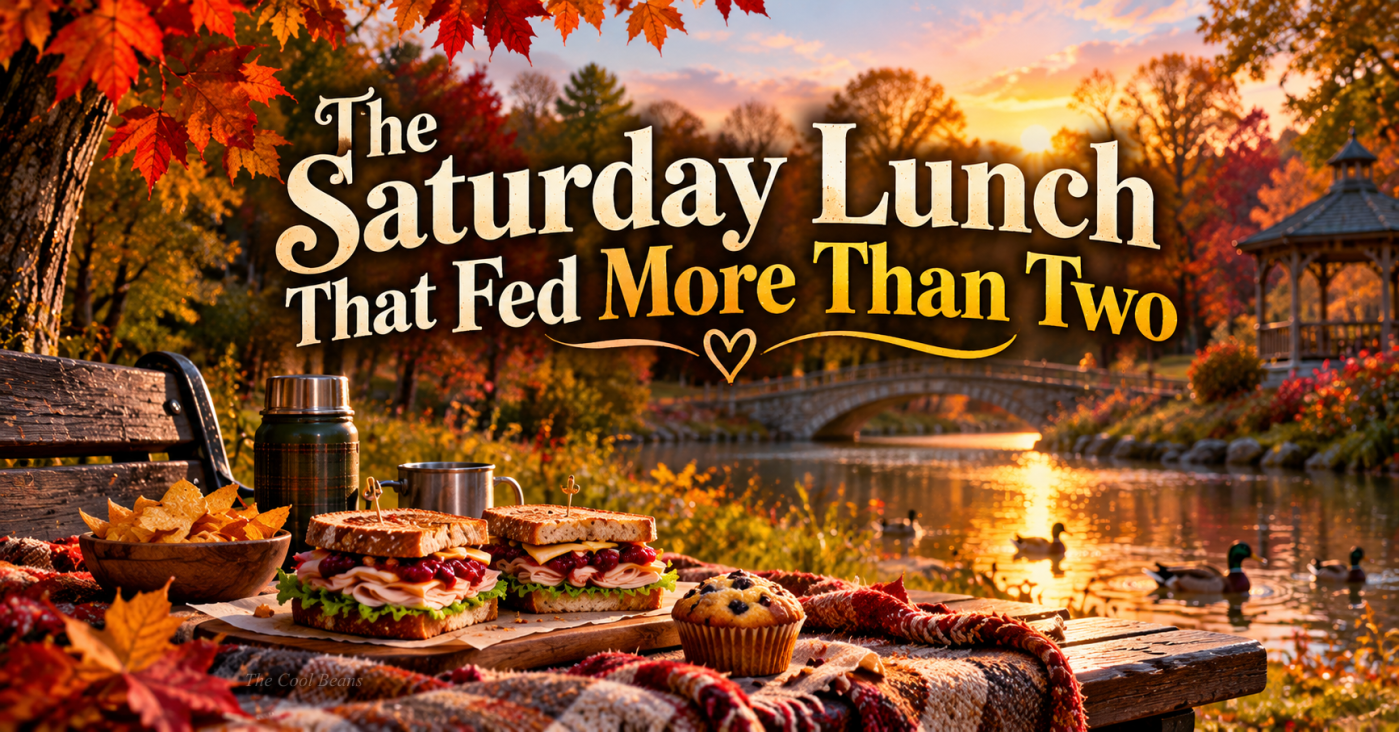
There are some Saturdays that pass without leaving much of a memory. You run a few errands, enjoy a little sunshine, and before you know it, the afternoon has slipped away. But every once in a while, something happens that reminds you how much goodness still exists in the world, and how the smallest act of kindness can change someone’s entire day.
For thirty-four-year-old Hannah Mitchell, that Saturday began with a sandwich, a sunny park bench, and absolutely no intention of changing anyone’s life.
Hannah had been looking forward to her Saturday afternoon all week. After five exhausting days at the veterinary clinic where she worked, she had promised herself a peaceful afternoon with no appointments, no ringing telephones, and nobody asking her to do seventeen things at once. She wanted nothing more than a little fresh air, a good lunch, and perhaps an hour of reading beneath her favourite oak tree.
She stopped at a small bakery on her way to Riverside Park and treated herself to a turkey and cranberry sandwich, a blueberry muffin, and a bottle of lemonade. The woman behind the counter had accidentally made an extra sandwich, and rather than waste it, she offered it to Hannah at half price.
Hannah laughed and accepted. She hadn’t planned on buying two sandwiches, but she figured she could save one for dinner. Besides, it was Saturday, and Saturdays were made for doing things that didn’t necessarily make sense.
By the time she reached the park, the afternoon sunshine had warmed the wooden benches, children were chasing one another across the grass, and a golden retriever was enthusiastically attempting to retrieve a stick approximately three times his own size. Hannah found an empty bench overlooking the pond, settled down with her lunch, and took a deep, satisfied breath.
It was perfect.
At least, it was perfect until she noticed the elderly gentleman sitting on the bench opposite hers.
He wore a faded brown cardigan, neatly pressed trousers, and a flat cap that looked as though it had accompanied him through several decades of adventures. His shoes were polished, his hands rested quietly on his knees, and beside him sat a small paper bag.
Every so often, he glanced toward the families eating picnic lunches nearby. He didn’t look upset or particularly unhappy, but there was something in the way he watched them that made Hannah pause.
After a few minutes, he reached into his paper bag and removed a single apple.
He polished it against his cardigan, took a small bite, and returned his gaze to the pond.
Hannah looked down at her two sandwiches.
Then she looked at the man.
Then she looked at the sandwiches again.
“Oh, for goodness’ sake,” she muttered to herself with a smile. “You know perfectly well you’re not going to eat both of these.”
She gathered her lunch, walked across the path, and stopped beside his bench.
“Excuse me,” she said brightly. “Would you mind terribly if I joined you? I appear to have accidentally purchased enough lunch for a small football team.”
The gentleman looked up, startled, before a warm smile spread across his face.
“Well,” he replied, “I suppose that depends. Are you planning to recruit me?”
“Only if you’re willing to help me defeat an unreasonable number of sandwiches.”
He chuckled and moved his paper bag aside.
“Then by all means, have a seat.”
Hannah introduced herself, and the gentleman told her his name was Walter Bennett. He was eighty-one years old, had lived in the same town for fifty-six years, and came to the park every Saturday afternoon, provided the weather cooperated.
Hannah placed the extra sandwich between them.
“Turkey and cranberry,” she announced. “The bakery accidentally made an extra one, and I think the universe is telling me I should share.”
Walter looked at the sandwich, then at Hannah.
“That’s very kind, but I wouldn’t want to take your lunch.”
“You’re not taking it,” she replied. “You’re helping me avoid carrying it around all afternoon. There’s a difference.”
He laughed again, and this time the sound was so wonderfully genuine that Hannah couldn’t help laughing with him.
They unwrapped their sandwiches and began eating together, watching the ducks paddle across the pond. At first, their conversation was simple. They discussed the beautiful weather, the changing leaves, the bakery on Main Street, and the golden retriever who had finally succeeded in dragging his enormous stick halfway across the grass before becoming hopelessly tangled in his own leash.
But as the afternoon unfolded, Walter began telling Hannah stories.
He had been a carpenter for forty-two years. He had built kitchen cupboards, repaired staircases, restored old furniture, and once constructed an elaborate treehouse for his daughter that had become so popular with the neighbourhood children that his backyard resembled a small amusement park.
He told Hannah about his wife, Margaret, whom he had met at a Saturday afternoon dance in 1964. She had accidentally stepped on his foot during their first dance, and he had jokingly told her that she owed him another one to make up for it.
“She gave me fifty-three years’ worth of dances,” he said softly.
Hannah smiled. “She sounds wonderful.”
“Oh, she was,” Walter replied. “Stubborn as a mule, though. Once decided to paint our kitchen yellow while I was at work. Bright yellow. Looked like we’d moved into the middle of a sunflower.”
“Did you like it?”
“Absolutely not.”
“What did you do?”
Walter grinned. “Bought yellow curtains. Figured if I couldn’t beat her, I might as well coordinate.”
Hannah laughed so hard she nearly dropped her lemonade.
They continued talking, and eventually Walter mentioned that Margaret had passed away four years earlier. Their daughter lived several hours away with her own family, and although they spoke regularly, visits were difficult to arrange.
He didn’t say it sadly or with any expectation of sympathy. He simply explained that Saturdays had once been his and Margaret’s special day. Every week, regardless of how busy life became, they would pack a lunch and sit together in the park.
“After she died,” he said, looking across the pond, “I kept coming. Seemed a shame to stop doing something that had made us both so happy.”
Hannah felt a small ache in her chest.
“And do you still enjoy it?”
Walter considered the question.
“I enjoy the memories,” he said. “But I do miss having someone to tell them to.”
For a moment, neither spoke. The afternoon breeze rustled the leaves overhead, and somewhere nearby, a little boy shrieked with delight as his father lifted him onto his shoulders.
Then Hannah broke the silence.
“Well, Walter, I happen to be an excellent listener. Particularly when there are sandwiches involved.”
He smiled.
“And I happen to have about eighty years’ worth of stories.”
“Perfect,” Hannah replied. “We may need to order dessert.”
She reached into her bag, pulled out the blueberry muffin, and broke it in half.
Walter accepted his portion with exaggerated seriousness.
“I should warn you,” he said, “I’m a very demanding lunch companion. I expect excellent conversation and absolutely no raisins.”
Hannah gasped. “No raisins?”
“Not in muffins. Not in cookies. Not masquerading as chocolate chips. It’s a matter of principle.”
“Walter, I think we’re going to get along beautifully.”
They sat together for nearly two hours.
Walter told her about the time Margaret had accidentally entered their homemade apple pie in the county fair’s vegetable competition and somehow won third place. He described his daughter’s childhood obsession with collecting frogs, the disastrous camping trip when a raccoon stole their breakfast, and the afternoon he had tried to impress Margaret by fixing her bicycle, only to discover he had reassembled the brakes backward.
Hannah told him about the veterinary clinic, the mischievous animals she cared for, and the particularly determined dachshund who had once escaped his examination room and stolen an entire packet of treats from reception.
By the time they finished laughing, the afternoon had begun turning golden.
Hannah glanced at her watch and realized she needed to leave. She gathered the empty wrappers and stood, brushing a few crumbs from her jeans.
“Well, Walter, thank you for helping me with my sandwich emergency.”
He rose slowly, still smiling.
“No, Hannah,” he said. “Thank you.”
Something in his voice made her pause.
Walter looked down at his hands before continuing.
“You know, I almost didn’t come today. I woke up this morning and thought perhaps I should stop bothering. It gets rather quiet, sitting here by myself.”
Hannah listened.
“But then I thought Margaret would give me a proper telling-off if I spent a beautiful Saturday afternoon sitting indoors feeling sorry for myself. So I came anyway.”
He looked toward the bench where they had been sitting.
“And then you appeared with an extra sandwich.”
Hannah smiled, although her eyes had begun to sting.
“Funny how that works, isn’t it?”
Walter nodded.
“Funny indeed.”
She hesitated for a moment, then asked, “Are you coming back next Saturday?”
His face brightened.
“I expect so.”
“Good,” she replied. “Because I think next Saturday I’ll bring chicken salad sandwiches. Unless you have strong feelings about chicken salad.”
Walter pretended to think very carefully.
“Does it contain raisins?”
“Absolutely not.”
“Then I believe we have an arrangement.”
They shook hands with the exaggerated formality of two people sealing an important business agreement, and Hannah walked back toward the parking lot feeling lighter than she had in weeks.
The following Saturday, she returned to the park carrying two chicken salad sandwiches, two bottles of lemonade, and a packet of chocolate chip cookies.
Walter was already waiting.
He had brought a thermos of tea and a small tin of homemade shortbread.
“Margaret’s recipe,” he explained proudly. “I’ve been making it for years, although she always said I used too much butter.”
Hannah took one bite and closed her eyes.
“Walter, with all due respect to Margaret, there is no such thing as too much butter.”
He laughed, and just like that, their Saturday tradition began.
As the weeks passed, their lunches became something both looked forward to. Sometimes Hannah brought sandwiches from the bakery. Sometimes Walter packed soup in his old green thermos. They shared stories, exchanged terrible jokes, and developed a friendly rivalry over who could bring the best dessert.
Then, one chilly November afternoon, something unexpected happened.
A young mother approached their bench with two small children. She looked exhausted, her hair was coming loose from its ponytail, and the youngest child was crying because his mitten had fallen into the pond.
Hannah immediately offered the little boy a spare pair of gloves she kept in her bag, while Walter produced a chocolate chip cookie from his tin.
The child’s tears disappeared almost instantly.
His mother thanked them profusely, explaining that it had been a difficult morning and she had simply wanted to get the children outside for a little while.
Hannah glanced at Walter.
Walter glanced at Hannah.
Without saying a word, they both shifted along the bench.
“Would you care to join us?” Hannah asked. “We appear to have enough lunch for a small army.”
The woman hesitated, then smiled.
And so, three people became six.
The following week, the young mother returned with homemade banana bread. A university student studying alone nearby accepted an invitation to join them. A retired schoolteacher began bringing hot chocolate, and a widower named Frank contributed an enormous container of pasta salad that he insisted was a secret family recipe, although everyone strongly suspected it came from the supermarket.
Before long, the Saturday lunches had become a small gathering of people who might otherwise never have met.
There were no membership fees, no invitations, and no expectations. Anyone who wanted company could pull up a chair, spread out a blanket, or simply sit for a few minutes and talk.
Some brought homemade food. Others brought something from the bakery. A few arrived empty-handed, and nobody minded in the slightest.
Walter became the unofficial host, greeting newcomers with a cheerful wave and asking whether they had heard the story about the raccoon that stole his breakfast.
By December, the weather had grown too cold for outdoor lunches, so the group moved to the community centre, where a volunteer offered them a room every Saturday afternoon.
Someone suggested calling their little gathering the Saturday Lunch Club.
Walter insisted that sounded far too respectable for a group of people who spent half their time arguing about whether pineapple belonged on pizza.
Nevertheless, the name stuck.
One Saturday, shortly before Christmas, Hannah arrived to discover that Walter had brought something special.
It was a small wooden sign, beautifully sanded and polished, with carefully carved lettering.
He placed it on the table and stepped back.
The sign read:
THERE’S ALWAYS ROOM FOR ONE MORE.
Hannah stared at it, smiling.
“Walter, it’s beautiful.”
He shrugged modestly.
“Had some spare wood in the workshop. Thought it might look nice here.”
But when Hannah looked at him, she noticed his eyes were shining.
“You know,” he said quietly, “Margaret used to say something like that whenever we had company. Didn’t matter how many people turned up. She’d just put another potato in the pot and tell everyone to squeeze together.”
Hannah reached over and squeezed his hand.
“She sounds like someone I would have loved.”
Walter smiled.
“Oh, she would have adored you.”
The following spring, the Saturday Lunch Club returned to Riverside Park.
By then, nearly thirty people attended regularly. Some came every week, others whenever they could. There were grandparents, students, parents, children, newcomers to town, and people who simply enjoyed spending an afternoon surrounded by friendly faces.
One warm Saturday, exactly six months after their first lunch together, Hannah arrived carrying a basket of sandwiches.
Walter was sitting beneath their favourite oak tree, watching the children play.
She settled beside him and handed him a sandwich.
“Turkey and cranberry,” she announced. “For old times’ sake.”
Walter accepted it with a grin.
“Ah, the sandwich that started all the trouble.”
They sat quietly for a moment, looking around at the gathering. Children were playing tag, Frank was trying to convince everyone that his pasta salad was homemade, and the retired schoolteacher was teaching a group of teenagers how to play cards.
A young woman who had recently moved to town was laughing with two people she had met only that afternoon. Nearby, the exhausted mother from November was enjoying a cup of tea while her children played with their new friends.
Walter watched it all with an expression Hannah couldn’t quite describe.
“What are you thinking?” she asked.
He looked down at the sandwich in his hands.
“I’m thinking that six months ago, I was sitting on this bench with an apple, wondering whether anybody would notice if I stopped coming.”
Hannah’s smile softened.
“And now?”
Walter looked around the park.
“Now I have thirty people who would probably come knocking on my door if I missed a Saturday.”
“Thirty-two,” Hannah corrected. “You’re forgetting the twins.”
Walter chuckled.
“Thirty-two, then.”
He took a bite of his sandwich and shook his head in amazement.
“All because you had an extra lunch.”
Hannah leaned back against the bench and watched the sunlight dance across the pond.
“Not quite,” she said.
Walter looked at her.
“You see, I only offered you a sandwich. You were the one who offered me a story. And then we both made room for somebody else.”
Walter considered that for a moment before nodding.
“I suppose we did.”
A little boy came running toward them, holding a bright yellow dandelion.
“Mr. Walter!” he shouted. “I picked this for you!”
Walter accepted the flower with the same care he might have given a priceless treasure.
“Why, thank you, young man. That’s a fine specimen.”
The boy grinned and raced away.
Walter tucked the dandelion into his cardigan pocket, right above his heart.
Hannah smiled.
And as the afternoon unfolded around them, she realized something wonderful.
She had set out on an ordinary Saturday hoping to enjoy a quiet lunch by herself. Instead, she had found a friend, helped create a little community, and discovered that kindness had a remarkable way of growing when people were willing to share it.
Sometimes, making someone’s day better doesn’t require a grand gesture, a large donation, or a carefully planned act of generosity. Sometimes, it begins with noticing someone sitting alone, offering them half your sandwich, and taking the time to listen.
Because the most beautiful thing about sharing isn’t always what we give away.
It’s what we make room for.
And somewhere beneath the old oak tree in Riverside Park, a wooden sign continued welcoming anyone who needed a little food, a little friendship, or simply a place to belong.
There’s always room for one more.
Enjoying what you find here? 💜 Consider subscribing and becoming part of our little community. It’s a simple way to stay connected, support what we do, and make sure you don’t miss what’s coming next. We’d truly love to have you here. 🌿✨


Leave a Reply