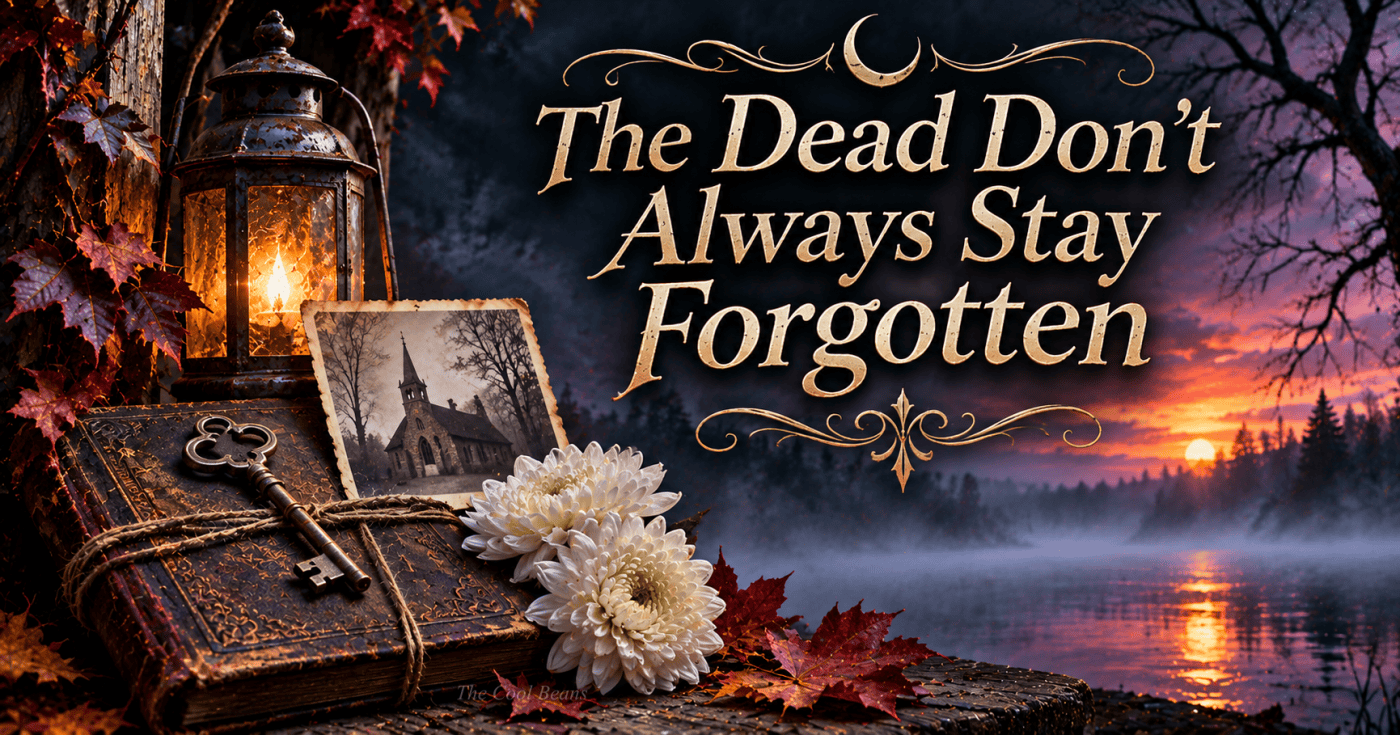
Every year on November 2, the bells of Saint Mary’s Church rang for the dead. They rang once for every soul buried in the village of Ravensmere during the previous twelve months, their mournful echoes drifting across the lake and disappearing into the mist that gathered along its shores. It was an old All Souls’ Day tradition, one that had survived wars, epidemics, and generations of villagers who had long since forgotten how it began. But there was one rule everyone remembered: the bells were never to ring after midnight.
Nobody could explain why. Some claimed the tradition dated back to a terrible winter when the lake froze so completely that thirteen villagers disappeared while crossing it. Others insisted it had something to do with a priest who had been found dead in the bell tower, his hands wrapped around the ropes and his face frozen in an expression of unimaginable terror. The church records offered no explanation, and the oldest villagers simply refused to discuss it.
For thirty-two-year-old Evelyn Hennings, such stories had always been little more than childhood entertainment. She had grown up in Ravensmere listening to her grandmother’s warnings about wandering spirits and the dangers of answering a knock at the door on All Souls’ Night. But Evelyn had spent the last fifteen years living in London, working as an archivist, and learning that almost every frightening legend had a perfectly reasonable explanation. At least, that was what she believed when she returned to Ravensmere to settle her grandmother’s estate.
Madeline Hennings had died three weeks earlier, leaving behind a narrow stone cottage overlooking the lake, a collection of antique clocks, and several hundred handwritten journals. Evelyn had loved her grandmother dearly, but she had never understood her fascination with the dead. Madeline had spent decades recording the names of everyone buried in Ravensmere, carefully noting dates, family connections, and stories that might otherwise have been forgotten.
When Evelyn arrived on the afternoon of November 1, she found the cottage exactly as she remembered it. Dried lavender hung above the kitchen window, the old grandfather clock ticked beside the staircase, and a faded photograph of Madeline as a young woman stood on the mantelpiece. The only unfamiliar object was a small wooden box resting on the dining table. Inside was a silver key, a folded sheet of paper, and a photograph of thirteen people standing outside Saint Mary’s Church.
The photograph was dated November 2, 1947. Evelyn recognized her grandmother immediately. Madeline was standing near the centre, wearing a dark coat and holding the hand of a little girl. Twelve adults surrounded them, their expressions solemn. Yet something about the photograph made Evelyn uneasy. Someone had scratched away the face of the thirteenth person, leaving a pale, damaged oval where a man’s features should have been.
She unfolded the paper and immediately recognized Madeline’s handwriting. The letter began affectionately, but its contents were unlike anything her grandmother had ever written to her.
My darling Evelyn, if you are reading this, then I have gone where you cannot follow. There are things I should have told you, but some truths become more dangerous the longer they remain hidden. On All Souls’ Day, go to the church before the bells begin. Find the thirteenth name. Whatever happens, do not let them ring for him again.
Evelyn read the letter twice, searching for some explanation. There was no signature beyond her grandmother’s familiar initials, and nothing to indicate who the mysterious man might be. She searched the box for another note but found nothing. Finally, she placed the photograph beside the letter and decided that Madeline’s instructions were probably connected to some obscure piece of village history.
That evening, Evelyn walked to the village square to buy groceries. Ravensmere had changed very little since her childhood. The same crooked buildings leaned over the cobbled streets, the same ancient oak stood beside the war memorial, and Saint Mary’s Church still dominated the hill above the lake. Its grey stone tower rose against the darkening sky, while the cemetery stretched behind it beneath a canopy of bare branches.
As Evelyn passed the church gates, she noticed an elderly woman standing beside the entrance. Dressed entirely in black, the woman held a small bunch of white chrysanthemums, and her eyes followed Evelyn as she approached. Without introducing herself, she remarked that Evelyn must be Madeline Hennings’ granddaughter.
“Yes, I’m Evelyn,” she replied, wondering how the stranger recognized her.
The woman nodded slowly. “Your grandmother kept the names. The names of those who were forgotten.” Before Evelyn could ask what she meant, the woman turned toward the cemetery and added, “She promised she would never let him be counted.”
“Who?” Evelyn asked.
The woman paused, her expression suddenly troubled. “The one who came back.”
With that, she walked through the gates and disappeared among the gravestones. Evelyn stood watching her, uncertain whether to follow. A cold wind moved through the trees, carrying the distant sound of the lake against its rocky shore. By the time she reached the cemetery entrance, the woman was nowhere to be seen.
The following morning, All Souls’ Day arrived beneath a blanket of thick white fog. Ravensmere seemed strangely quiet. Shops opened late, curtains remained drawn, and the church bells sounded only once at nine o’clock, announcing the beginning of the day’s remembrance services.
Evelyn spent the morning examining Madeline’s journals. Most contained ordinary genealogical information, but the entries from 1947 were different. Several pages had been torn out, and the surviving notes referred repeatedly to an event called the November Gathering. One passage, dated November 2, 1947, caught her attention.
Twelve names were spoken, but thirteen answered. Father Benedict says it was only an echo. He knows better. We all do. The dead cannot return unless someone remembers the way.
Evelyn felt a faint uneasiness as she turned the page. The next entry had been written almost a month later, on December 1.
Viktor has disappeared. Adeline refuses to speak of what she saw at the church. The others have agreed that his name must be removed from the register. I have hidden the key where only I can find it.
Evelyn looked toward the silver key lying beside the journal. Perhaps Madeline had intended her to uncover something after all.
At eleven o’clock, Evelyn walked to Saint Mary’s Church and asked to speak with the parish priest, Father Michael Rowan. He was a kindly man in his early sixties, with thinning grey hair and a habit of polishing his glasses whenever a question made him uncomfortable. He remembered Madeline fondly, describing her as the village’s unofficial historian and one of the church’s most dedicated volunteers.
When Evelyn showed him the photograph, however, his expression changed. He studied the damaged face for several moments before admitting that he had not seen the picture in years. He explained that the people pictured were members of the old remembrance committee, a group responsible for organizing All Souls’ Day services after the war.
“And the man whose face was scratched out?” Evelyn asked.
Father Michael hesitated. “I believe his name was Viktor Hansen. He was the church sexton and helped Father Benedict with the services. According to the records, he left Ravensmere shortly after All Souls’ Day in 1947 and was never heard from again.”
Evelyn remembered the journal entry and asked why someone would deliberately remove Viktor’s face from the photograph. The priest claimed he could not say. When she pressed him about whether anything unusual had happened during the 1947 service, he glanced toward the closed vestry door.
“Your grandmother asked me that same question many times,” he admitted. “I always told her that the past is sometimes best left undisturbed.”
“With respect, Father, that isn’t an answer.”
The priest sighed. “No. I suppose it isn’t.”
He led her into the vestry and unlocked an old oak cabinet containing several leather-bound registers, their pages yellowed with age. Father Michael removed one labelled Burials and Remembrances, 1938–1952 and placed it on the table. The entries for November 1947 listed twelve people who had died during the preceding year, each name written in careful black ink and accompanied by a date of death and burial location.
Beneath the twelfth name, however, was an empty space. It was not an ordinary blank line. Someone had scraped the parchment so thoroughly that its surface had become thin and translucent. Evelyn held the page toward the window, and in the pale daylight, faint impressions became visible beneath the damaged surface. The first name was almost impossible to read, but the surname was unmistakable.
Hansen.
Evelyn looked at the priest. “Viktor Hansen was alive in November 1947. Why would his name appear in a register of the dead?”
Father Michael’s face had gone pale. Before he could answer, a loud crash echoed from the church, followed by another and the unmistakable sound of something heavy being dragged across the stone floor. The priest hurried into the nave, with Evelyn close behind.
The church was empty, yet every candle along the altar had been extinguished. In the centre aisle, where nothing had stood moments earlier, was a wooden coffin. Its dark surface was scarred and weathered, with tarnished brass handles and a small silver plaque fixed to the lid.
Evelyn approached slowly, reading the inscription. The plaque bore the name Viktor Hansen and the date November 2, 1947.
Father Michael crossed himself. “That’s impossible. There hasn’t been a coffin stored in this church for decades.”
When Evelyn reached toward the lid, he caught her wrist and begged her not to touch it. His eyes filled with fear as he explained that Madeline had made him promise that if the coffin ever appeared again, he would leave it closed.
“Again?” Evelyn repeated, staring at him.
For a moment, she thought he might finally explain everything. Instead, the bells began to ring. It was exactly noon, and the first bell sounded deep and mournful, followed by another and another. Evelyn counted each note as it rolled through the church. By the twelfth, the sound had become almost unbearable.
Then came a thirteenth bell.
Its tone was lower, almost metallic, and seemed to vibrate through the floor beneath her feet. The coffin shuddered, causing Evelyn to stumble backwards. Something struck the inside of the lid three times, each knock louder than the last.
Father Michael seized her arm, insisting that they had to leave. But before they reached the doors, a voice came from inside the coffin. It was faint, hoarse, and unmistakably human.
“Madeline? Madeline, please. You promised.”
Evelyn froze, unable to understand how the voice could know her grandmother. When she whispered that Madeline was dead, the knocking stopped. For several seconds, the church was silent.
Then the voice spoke one final time.
“I know.”
Evelyn fled down the church steps and through the fog until she reached the village square. Her hands were shaking, and she could barely draw a steady breath. She had heard the voice and seen the coffin move, yet some part of her mind continued searching desperately for a rational explanation. Perhaps someone had hidden inside it, or perhaps the entire incident was an elaborate hoax designed to frighten her away from Madeline’s research. But how had the coffin appeared in a church that had been empty only moments before?
When she returned to the cottage, Evelyn locked the door and searched Madeline’s journals with renewed determination. At the bottom of a drawer in the upstairs study, she found a small leather notebook wrapped in faded blue ribbon. The first page contained a warning that made her stomach tighten.
If Viktor returns, remember that he is not what he appears to be.
According to Madeline’s account, Viktor Hansen had arrived in Ravensmere in 1946, shortly after the war. He claimed to have lost his family during the bombing of London and was offered employment at Saint Mary’s by Father Benedict. He was quiet, polite, and unusually knowledgeable about the village’s oldest burial traditions.
Within months, strange things began happening. Several villagers reported hearing deceased relatives calling from empty rooms. A woman claimed to have seen her dead husband standing beside the lake, while another insisted that her mother’s handwriting had appeared on a letter posted thirty years after her death. At first, the incidents were dismissed as grief and imagination, but the reports became increasingly difficult to explain.
On All Souls’ Day in 1947, Viktor persuaded Father Benedict to perform an additional remembrance ceremony after midnight. Twelve villagers attended, including Madeline. Viktor claimed that ancient prayers could help the living hear the voices of those they had lost. Each participant was instructed to speak the name of a deceased loved one, light a candle, and wait for a response.
Madeline’s account described what happened next.
We heard them. God forgive us, we heard every one of them. Adeline heard her son. Mr. Whitcomb heard his wife. I heard my mother singing the lullaby she used when I was small. But the voices did not come from the altar or the windows. They came from beneath the floor.
Evelyn turned the page and found another passage that had been underlined several times.
Then Viktor spoke a thirteenth name. The thing that answered was not a soul.
The name itself had been crossed out so heavily that the paper was almost torn. The following entries described panic, confusion, and a terrible noise from the church crypt. Father Benedict ordered everyone to leave, but Viktor remained behind. By morning, he had vanished, and the committee agreed never to speak of the ceremony again.
Yet Madeline’s final entry revealed something far more disturbing.
Viktor did not summon the dead. He offered them a doorway. And when the doorway opened, something came through wearing his voice.
Evelyn sat motionless, staring at the words. Outside, the fog had thickened until the lake was completely invisible. The grandfather clock struck six, and the last pale light disappeared behind the hills.
Then someone knocked on the cottage door.
Three slow knocks sounded, followed by a pause and another three. Evelyn approached the window and cautiously lifted the curtain. An elderly woman stood on the doorstep, dressed entirely in black and holding a bunch of white chrysanthemums.
It was the woman from the cemetery.
Evelyn opened the door a few inches and asked who she was. The woman introduced herself as Adeline Carmichael, and Evelyn immediately recognized the name from her grandmother’s journals. Adeline had been one of the twelve people present at the 1947 ceremony.
“That’s impossible,” Evelyn whispered. “You’d have to be over a hundred years old.”
The woman smiled sadly. “I am.”
Despite her apparent age, Adeline’s eyes were clear and alert, and her voice carried none of the frailty Evelyn expected. She explained that Madeline had known she would come and had asked her to help Evelyn finish what the committee had begun.
When Evelyn demanded to know what had happened in the church, Adeline glanced nervously toward the fog. “We tried to call back the people we loved. But Viktor had another purpose. He wanted to bring someone back who had never been buried.”
Evelyn frowned. “Who?”
“His daughter.”
Adeline stepped inside and closed the door before explaining that Viktor had been obsessed with an old legend concerning a nameless child whose spirit supposedly wandered between the living and the dead. According to the story, the child had been forgotten by everyone who knew her, leaving her unable to find peace. Viktor believed that speaking her name during the All Souls’ Day ceremony would allow her to return.
“But there was no name,” Adeline said. “Not in any register. Not on any gravestone. So Viktor gave her one.”
When Evelyn asked what name he had chosen, Adeline’s eyes filled with tears.
“Madeline.”
Evelyn felt a cold sensation spread through her chest. She could not understand why Viktor would use her grandmother’s name, but Adeline explained that Madeline had been the youngest woman present. Viktor believed a living name could anchor a forgotten soul to the world.
For the rest of her life, Madeline had reportedly heard someone calling her from beneath the church every All Souls’ Day. The voice grew stronger whenever she answered, so she learned to ignore it. But she had always feared that when she died, there would be no one left to hold back whatever waited beneath Saint Mary’s.
The grandfather clock began to chime seven, and Adeline looked suddenly alarmed. She took the silver key from Evelyn’s hand and explained that it opened the old crypt beneath the church. There was a hidden door behind the altar, one that Father Michael had never opened, and they needed to reach it before midnight.
“And what happens if we don’t?” Evelyn asked.
Adeline’s expression became grave. “Then the thirteenth name will be spoken again.”
They returned to Saint Mary’s shortly after nine. The village was almost deserted, and the church stood dark against the fog. Father Michael was waiting beside the entrance, his face drawn and exhausted. The coffin had vanished, although no one had seen it being removed and the church doors had remained locked since Evelyn fled.
The priest had searched the building and found nothing except a trail of damp footprints leading from the centre aisle toward the altar. The footprints ended at a stone wall, where Adeline pressed her hand against a small carved symbol near the floor. A narrow panel shifted, revealing an iron lock.
Evelyn inserted the silver key, and it turned with surprising ease. Behind the panel was a steep staircase descending into darkness. The three stood silently for a moment, listening to the faint sound of water dripping somewhere below, before Adeline took a lantern from her bag and began to descend.
The staircase led to a crypt far older than the church above it. Rough stone walls lined the passage, and narrow alcoves contained the remains of ancient wooden coffins. The air smelled of damp earth and cold limestone. At the far end stood a heavy wooden door, its surface covered with thirteen carved names.
Evelyn recognized several from Madeline’s photograph, including Father Benedict, Adeline Carmichael, and Madeline Hennings. The others belonged to members of the remembrance committee. But the thirteenth name was different. It had been carved more deeply than the rest, its letters surrounded by strange circular marks.
Madeline Hansen.
Evelyn stared at the inscription and asked whether this was the name Viktor had given the child. Adeline nodded, explaining that he had called the girl his daughter, although none of them had ever seen her.
When Father Michael asked what lay behind the door, Adeline replied that it was the place where they had left Viktor. Evelyn turned sharply, reminding her that she had claimed he disappeared. Adeline admitted that the committee had locked him inside the crypt, and when Evelyn demanded to know whether he had been alive at the time, she lowered her eyes.
“Yes.”
The revelation left Evelyn speechless. The committee had not merely witnessed something frightening. They had imprisoned someone beneath the church and concealed what happened for nearly eighty years.
Then a soft voice came from the other side of the door.
“Mother? Mother, please let me out.”
It was the voice of a little girl. Adeline went rigid, her lips trembling as tears gathered in her eyes. She whispered that it was her daughter, but Evelyn remembered the journal. During the ceremony, Adeline had supposedly heard her dead son, not a daughter.
Evelyn seized her arm and warned her not to answer. But the voice continued, pleading that she was cold and wanted to be let out. Father Michael stepped between Adeline and the door, reminding her that whatever was speaking knew exactly what she wanted to hear.
Then the voice changed.
“Evelyn, sweetheart. It’s all right. Open the door.”
It was Madeline’s voice, gentle and familiar, with the slight rasp at the end of every sentence and the affectionate way she always said Evelyn’s name. For one impossible moment, Evelyn wanted nothing more than to open the door and see her grandmother standing on the other side.
But she remembered Madeline’s warning about the dead returning only when someone remembered the way. She stepped backwards and whispered that the voice did not belong to her grandmother.
The voice fell silent, replaced by a slow scratching sound behind the door. Then another voice spoke, this time a man’s, expressing satisfaction that someone finally understood.
The wooden door trembled, and Father Michael raised his lantern. In the flickering light, Evelyn noticed something she had overlooked. The thirteen names were not simply carved into the wood. Each had been crossed through with a thin silver line, except the last.
Madeline Hansen.
Its letters remained untouched.
Evelyn removed the photograph from her coat pocket and studied the damaged face of Viktor Hansen. Something about the arrangement of the people troubled her. If the committee had locked Viktor inside, why had his name been included among the twelve people who supposedly survived the ceremony? And why had Madeline’s name been carved twice, once as Madeline Hennings and again as Madeline Hansen?
She turned toward Adeline, suddenly certain that the old woman had been withholding something important.
“Viktor wasn’t the thirteenth person,” Evelyn said. “He was one of the twelve. My grandmother wrote that twelve people attended the ceremony, but the photograph shows thirteen. Viktor was already there. Someone else came afterward.”
Adeline stepped backwards, begging Evelyn to stop asking questions. But Evelyn refused. She demanded to know who the thirteenth person had been, and from behind the door came a soft, terrible laugh.
Adeline began to cry.
“It was a little girl.”
When Evelyn asked whose child she had been, Adeline looked toward the door and whispered, “Mine.”
The truth emerged slowly, through tears and broken sentences. Adeline’s daughter, Madeline Carmichael, had died in 1943 at the age of six. Her death had devastated the family, and Adeline had spent years searching for some way to hear her voice again. Viktor Hansen, who had studied spiritualist traditions, promised that he could help.
He had organized the ceremony not to summon a nameless spirit but to allow Adeline to speak to her daughter. Yet when the ritual began, the voices of other deceased loved ones answered first. Then Adeline heard little Madeline calling from beneath the church. Overcome with grief and longing, she opened the crypt door.
A little girl stepped out.
Adeline insisted the child looked exactly like her daughter, down to the tiny scar on her chin. But Madeline Hennings noticed something wrong. The girl cast no shadow in the candlelight, and although she smiled at everyone, her eyes never moved from the faces of the living.
When Father Benedict asked the child to say her name, she answered with thirteen different names, one after another. Then, impossibly, she spoke in Viktor Hansen’s voice.
The committee panicked. Viktor tried to lead the child back into the crypt, but she refused to follow. Madeline Hennings eventually persuaded the others to speak the names of the living participants, one by one, while Father Benedict closed the door. The child vanished, and Viktor vanished with her. The committee sealed the crypt and swore never to repeat the ceremony.
“But your grandmother knew the door wasn’t truly closed,” Adeline whispered. “She spent the rest of her life keeping the names remembered so the thing inside couldn’t claim them.”
Evelyn studied the carvings again and asked why the names had been crossed out. Adeline explained that each line marked the death of someone who had attended the ceremony. Whenever one of them passed away, Madeline returned to the crypt and marked the name.
Evelyn counted the lines. Eleven names had been crossed through, but Madeline Hennings’ name remained untouched. Her grandmother had died three weeks earlier, and there had been no opportunity to complete the final mark.
Suddenly, Evelyn understood the purpose of the silver key, the journals, and the warning. Madeline had left instructions because she knew someone would eventually have to finish what she had begun.
But another detail troubled her. Adeline’s name had already been crossed out, even though she stood beside them in the crypt.
Evelyn slowly turned toward the elderly woman and asked when she had died.
Adeline smiled sadly.
“November 2, 1986.”
Father Michael stumbled backwards. Evelyn stared at her, struggling to comprehend that the woman standing before them had been dead for forty years.
Adeline explained that Madeline had remembered her every year, speaking her name aloud, visiting her grave, and bringing white chrysanthemums. As long as someone remembered her, she could return for one night on All Souls’ Day.
“You’re a ghost,” Evelyn whispered.
Adeline nodded. “Only on All Souls’ Day.”
Behind the wooden door, something struck the panels with tremendous force. The entire crypt shook, sending dust falling from the ceiling. Adeline turned toward the sound and explained that with Madeline gone, there was no one left to hold the door.
Evelyn looked again at the carved names. There were thirteen in all, twelve witnesses and one belonging to a child who had never truly returned. She finally understood what her grandmother had meant. The thirteenth name could not be spoken. It had to be forgotten.
Taking a small metal file from Father Michael’s maintenance bag, Evelyn began scraping the letters of Madeline Hansen from the door. The moment the first letter disappeared, a scream erupted from behind the wood. It was not the scream of a child but something far more terrible, as though dozens of voices were speaking at once, some begging, some laughing, and others calling Evelyn’s name in tones she recognized from childhood.
The door shook violently. Father Michael braced himself against it while Adeline stood beside Evelyn, her hands trembling. She urged Evelyn to continue, and Evelyn worked desperately, scraping away the letters as the wood splintered beneath the pressure from the other side.
The voices grew louder, and suddenly the lantern went out. In the darkness, Evelyn felt something cold brush against her cheek. It was a small hand, followed by a child’s voice whispering beside her ear, asking why Evelyn did not want her.
Evelyn squeezed her eyes shut and continued scraping. When the final letter disappeared, the screaming stopped. A deep silence settled over the crypt, broken only by the distant sound of the church bells beginning to ring.
It was midnight.
Evelyn counted each mournful note, her fingers still pressed against the damaged wood. When the twelfth bell faded, she waited, hardly daring to breathe.
The thirteenth bell never came.
Father Michael relit the lantern, and in its soft glow they discovered that Adeline had vanished. Only the white chrysanthemums remained, scattered across the stone floor. The door stood perfectly still, and the name Madeline Hansen had disappeared.
Evelyn and Father Michael returned to the church as the first minutes of November 3 passed. Outside, the fog had begun to lift, revealing the dark surface of the lake beneath a sky filled with stars. Neither spoke for a long time, both struggling to understand what they had witnessed.
Finally, Father Michael asked what Evelyn intended to do with her grandmother’s journals. She looked toward the churchyard and replied that she would keep them, because someone should remember the people who had lived in Ravensmere.
When he asked about the thirteenth name, Evelyn thought of the little girl, the impossible voices, and the cold hand against her cheek.
“That one,” she said quietly, “I think it’s better we leave alone.”
Evelyn returned to the cottage shortly before dawn. The grandfather clock had stopped at exactly midnight, and the rooms felt strangely unfamiliar in the silence. She placed the silver key back inside the wooden box and carefully folded her grandmother’s letter.
As she prepared to close the lid, she noticed something she had not seen before. A single sentence had been scratched into the underside of the box.
There were never thirteen names.
Evelyn frowned and unfolded the photograph again. The twelve adults stood outside Saint Mary’s Church, their expressions solemn, and the damaged face of Viktor Hansen remained an empty oval. But something had changed.
The little girl holding Madeline Hennings’ hand was no longer looking toward the camera. Her head had turned, and she was staring directly at Evelyn.
Beneath the photograph, where the date had once been written, four words appeared in unfamiliar handwriting.
You forgot to count me.
Evelyn dropped the photograph, her heart pounding. Outside, the church bells began to ring again, their mournful notes carrying across the village. She counted twelve before a long silence followed.
Then, from somewhere inside the cottage, came a thirteenth.
Evelyn slowly turned toward the staircase. At the top stood a little girl in an old-fashioned white dress, her dark hair hanging in damp curls around her shoulders. She held a single white chrysanthemum and smiled with an expression that seemed far too knowing for someone so young.
“Hello, Evelyn,” the child said softly.
The grandfather clock began ticking again.
“I’ve been waiting such a long time.”
And somewhere beyond the walls of the cottage, the bells of Saint Mary’s began to ring for the dead once more.
💜 Enjoying the chaos that is my life? Subscribe to The Cool Beans! It’s cheaper than therapy and slightly more organized 🤣


Leave a Reply