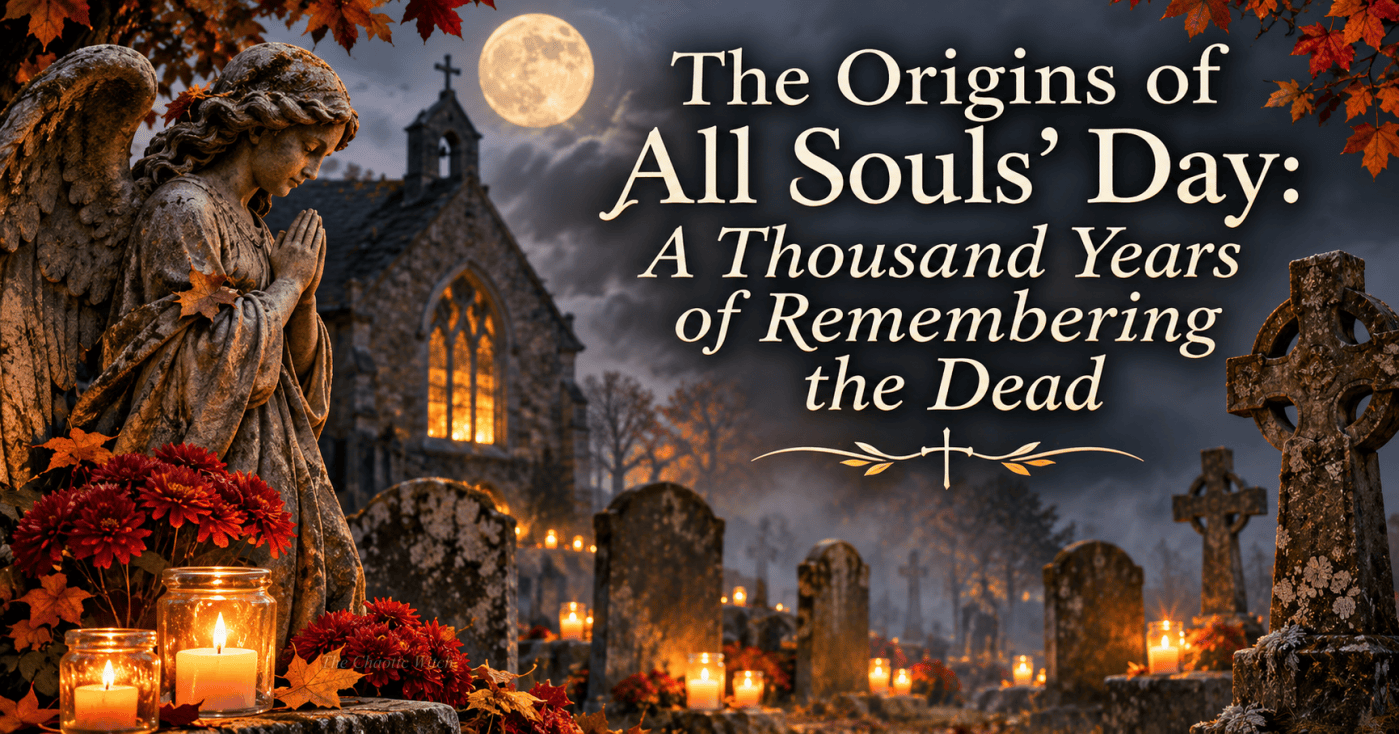
Every year on November 2, Christians around the world observe All Souls’ Day, a solemn occasion dedicated to remembering and praying for those who have died. Its history stretches back more than a thousand years, rooted in early Christian traditions of honouring the departed, medieval monastic practices, and older European customs surrounding death and remembrance.
Although All Souls’ Day is closely associated with Halloween and All Saints’ Day, each observance has its own distinct meaning and history.
The Earliest Origins: Praying for the Departed
Long before All Souls’ Day became an established feast, early Christians gathered at burial sites to remember deceased relatives, friends, and members of their communities. By the second and third centuries, prayers for the dead were already part of Christian religious life.
These practices reflected a belief that the living and the dead remained spiritually connected through faith and prayer. Early Christians commemorated the anniversaries of deaths, celebrated religious services near tombs, and offered prayers for the souls of departed loved ones.
Over time, these individual commemorations developed into broader observances for the faithful departed.
The Monks of Cluny and November 2
The establishment of November 2 as All Souls’ Day is traditionally credited to Saint Odilo, the abbot of the influential Benedictine monastery of Cluny in France.
Around 998 AD, Odilo directed the monasteries associated with Cluny to observe a special commemoration for all the faithful departed on November 2, immediately following All Saints’ Day.
The monks were instructed to offer prayers, celebrate Masses, and remember those who had died. The practice spread through Cluny’s extensive network of monasteries and gradually gained acceptance throughout Western Europe.
Although prayers for the dead existed centuries earlier, Odilo’s initiative helped establish the November 2 observance that became central to the Western Christian calendar.
Why November 2?
The placement of All Souls’ Day immediately after All Saints’ Day was spiritually significant.
All Saints’ Day, observed on November 1 in the Western Church, celebrates the saints and all those believed to have attained heaven. All Souls’ Day, by contrast, became a day of prayer for the faithful departed, particularly those believed in Catholic teaching to be undergoing purification before entering heaven.
Together, these observances expressed the medieval Christian understanding of the spiritual connection between the living, the saints in heaven, and the souls undergoing purification.
This three-day period became known as Allhallowtide, consisting of All Hallows’ Eve on October 31, All Saints’ Day on November 1, and All Souls’ Day on November 2.
The Influence of Older European Traditions
The timing of All Souls’ Day has also inspired comparisons with pre-Christian European traditions, particularly the Celtic festival of Samhain.
Samhain, celebrated around the transition from October into November, marked the end of the harvest season and the beginning of winter. Later folklore associated this seasonal threshold with spirits, supernatural encounters, and the relationship between the living and the dead.
However, historians caution against describing All Souls’ Day as simply a Christian replacement for Samhain. Christian prayers for the dead developed independently, and there is no conclusive evidence that Odilo selected November 2 specifically to replace the Celtic festival.
Nevertheless, as Christianity spread across Europe, local traditions surrounding ancestors, graves, seasonal transitions, and remembrance sometimes became intertwined with Christian observances.
Medieval Beliefs and the Souls in Purgatory
During the Middle Ages, All Souls’ Day became increasingly associated with the Catholic doctrine of purgatory, understood as a state of purification for those who died in God’s grace but were not yet ready to enter heaven.
The faithful believed that prayers, Masses, and acts of charity could benefit these souls. Churches rang bells, candles were lit, and communities gathered to remember the dead.
In some European traditions, families baked special foods known as soul cakes. These small cakes were distributed to the poor or to visitors, sometimes in exchange for prayers for deceased relatives.
The custom of souling, in which people travelled from house to house requesting food while offering prayers, became one of several historical traditions sometimes discussed in connection with the later development of Halloween customs.
All Souls’ Day Around the World
As Christianity spread, All Souls’ Day developed distinctive regional customs.
In parts of Europe, families visited cemeteries, cleaned graves, arranged flowers, and lit candles in remembrance of loved ones. In Poland, the season became associated with illuminated cemeteries, while in Italy and Portugal, regional traditions included special foods, charitable giving, and family remembrance.
In Mexico, November 2 is closely associated with Día de Muertos, or the Day of the Dead. Although it shares dates and some religious influences with All Souls’ Day, Día de Muertos is a distinct cultural tradition shaped by Indigenous Mexican practices and Catholic observances. Families create ofrendas, decorate graves, and honour deceased loved ones through photographs, flowers, food, and remembrance.
In the Philippines, families commonly gather at cemeteries during the All Saints’ and All Souls’ period, bringing flowers, candles, and food while spending time remembering relatives.
The Meaning of All Souls’ Day Today
More than a thousand years after Saint Odilo helped establish its observance, All Souls’ Day continues to hold deep meaning for millions of people.
In Catholic tradition, November 2 remains dedicated to prayer for the faithful departed. For others, the day offers an opportunity for quiet reflection, visiting graves, lighting candles, sharing family stories, and remembering those who are no longer physically present.
While Halloween often emphasizes mystery, costumes, and the supernatural, All Souls’ Day carries a quieter message: remembrance, compassion, and the enduring bonds between generations.
Its history is a reminder that humanity has long sought meaningful ways to honour the dead, preserve their stories, and maintain a connection with those who came before us.
All Souls’ Day is ultimately about something deeply human: the belief that those we have loved should never be forgotten.
Sources: Encyclopaedia Britannica, entries on All Souls’ Day and Saint Odilo of Cluny; The Catholic Encyclopedia, historical discussion of the Commemoration of All the Faithful Departed; and the United States Conference of Catholic Bishops, explanations of All Saints’ Day and All Souls’ Day.
A little magic is always waiting. Subscribe and step inside the circle. 🖤🔮✨


Leave a Reply