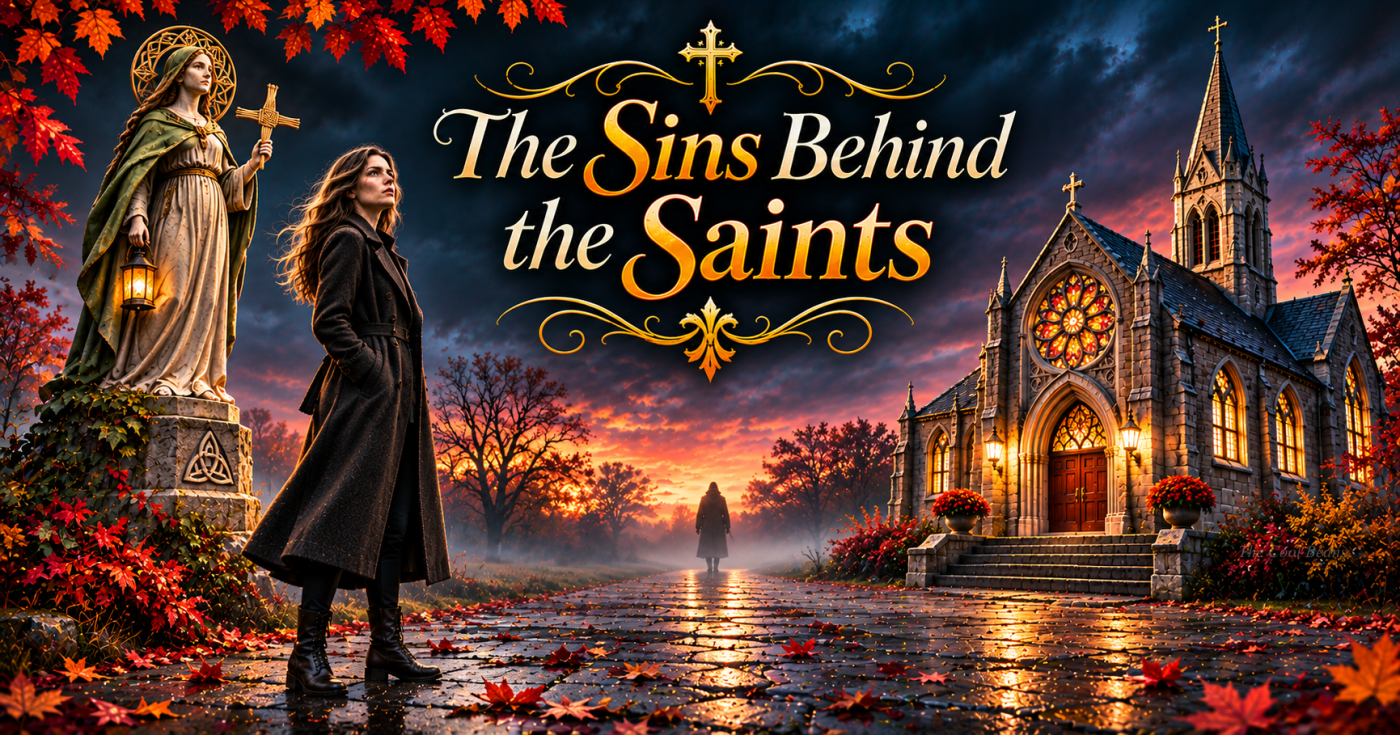
The first body was discovered on the morning of November 1, beneath the stained-glass window of Saint Brigid’s Church. The victim was seated in the front pew, her hands folded neatly in her lap, a white chrysanthemum resting between her fingers. Someone had dressed her in a long ivory gown and placed a delicate silver halo around her head. At first glance, she looked like a figure from a religious painting, peaceful and strangely untouched by the violence that had ended her life.
Detective Lucia Russo arrived shortly after seven, just as the early November fog began to lift from the streets of Ashbourne. The town was preparing for All Saints’ Day, and the church had been expecting a large congregation for its morning service. Instead, police vehicles crowded the entrance, yellow tape stretched across the stone steps, and a shaken caretaker sat in the back of an ambulance, repeatedly insisting that the church had been locked when he arrived.
Lucia had spent fourteen years investigating homicides, but there was something particularly disturbing about the care taken with this victim. The woman’s clothing was immaculate, her hair carefully arranged, and the flower in her hands looked freshly cut. Whoever had placed her there had not simply abandoned a body. They had created a display and wanted someone to see it.
The victim was identified as thirty-two-year-old Rebekah Bailey, a social worker who had spent the previous evening volunteering at a community shelter. She was well-liked, had no known enemies, and had recently been recognized for her work helping vulnerable families. Her colleagues described her as compassionate, stubborn when it came to injustice, and almost incapable of refusing someone who needed help.
As the forensic team examined the scene, Lucia noticed a small cream-coloured card tucked beneath the chrysanthemum. It contained a single sentence, printed in elegant black lettering.
Blessed are the merciful, for they shall obtain mercy.
Beneath the words was a date: November 1, 2025.
Lucia stared at it. Today was November 1, 2026. Whoever had left the message was referring to the previous year’s All Saints’ Day.
Her partner, Detective Elijah Williams, joined her beside the pew. Elijah was forty-one, broad-shouldered, and possessed the kind of dry humour that usually helped Lucia endure difficult investigations. That morning, however, he looked unusually serious.
“Someone’s trying to make a statement,” he said.
Lucia glanced toward the altar, where dozens of candles waited to be lit for the day’s service.
“Then we’d better figure out what it means before he makes another.”
By noon, the story had spread throughout Ashbourne. News outlets described the killing as ritualistic, religious leaders urged the public not to jump to conclusions, and social media filled with speculation about cults, secret societies, and ancient All Saints’ Day traditions. Lucia disliked the sensationalism. She had seen enough carefully staged murders to know that elaborate symbolism often concealed something painfully ordinary: resentment, revenge, or a desire for control.
The investigation initially focused on Rebekah’s personal life. Her apartment showed no signs of forced entry, her financial records revealed nothing suspicious, and her colleagues could not recall anyone threatening her. Yet one detail caught Lucia’s attention. Rebekah had received an anonymous letter three weeks earlier, accusing her of failing to protect someone who had trusted her.
The letter had been discarded, but a colleague remembered its final sentence.
Saints are only saints until someone remembers what they did.
Lucia asked whether Rebekah had seemed frightened after receiving it. The colleague hesitated before admitting that Rebekah had become withdrawn and had asked for access to archived case files from several years earlier. She had also visited Saint Brigid’s Church twice, despite not being a regular member of the congregation.
That evening, Lucia and Elijah returned to the church to interview Father Shane Murphy, who had served the parish for nearly twenty years. He was a gentle-looking man in his late fifties, with silver hair and tired blue eyes. He appeared deeply distressed by Rebekah’s death and explained that she had come to him seeking information about an old charitable organization once operated through the parish.
“The Saint Agnes Foundation,” he said. “It provided housing and support for young people who had nowhere else to go. It closed years ago.”
“Why was Rebekah interested?” Lucia asked.
Father Shane folded his hands. “She said someone had contacted her about what happened there. She believed a former resident had been treated terribly.”
“Did she tell you who?”
“No. But she asked whether I remembered a young woman named Amelia Byrne.”
The name meant nothing to Lucia, but Elijah immediately looked up.
“Amelia Byrne disappeared in 2009,” he said. “Seventeen years old. Never found.”
Father Shane nodded slowly. “She was living at Saint Agnes when she vanished.”
Lucia felt the investigation shift. A missing teenager, a closed charitable foundation, and a murder staged inside a church were beginning to form a pattern. She asked Father Shane for the names of everyone associated with the foundation, including former employees, volunteers, and residents.
He agreed, although Lucia noticed his hands trembling as he reached for a drawer.
Before they left, he offered one final observation.
“Detective, All Saints’ Day is supposed to honour those who lived lives of faith and goodness. But goodness is not the same thing as perfection. Sometimes people forget that.”
Lucia studied him carefully.
“Do you think Rebekah was being punished for something?”
Father Shane looked toward the darkened altar.
“I think someone believes they have the right to decide who deserves forgiveness.”
The second body was discovered just after midnight.
Dr. Henry Davis, a respected local physician and longtime supporter of the Saint Agnes Foundation, was found in the abandoned chapel of the former Saint Agnes residence. He had been positioned beneath a statue of Saint Luke, the traditional patron saint of physicians, with a white chrysanthemum resting against his chest.
A cream-coloured card lay beside him.
Physician, heal thyself.
The date beneath the message was November 1, 2016.
Lucia stood in the decaying chapel, surrounded by peeling paint and broken pews, trying to understand why the killer had chosen that particular year. Henry had been a prominent figure in Ashbourne for decades. His death would terrify the community, especially when the public learned that both victims had been associated with the same charitable institution.
Elijah examined the card while forensic investigators documented the scene.
“Ten years ago,” he murmured. “Whatever happened in 2016 matters.”
Lucia looked around the chapel. The building had been abandoned for almost eight years, yet the floor near Henry’s body had been swept clean. Several candles had been placed along the altar, and fresh flowers decorated a statue that should have been covered in dust. The killer had spent considerable time preparing the scene.
“He knows this place,” Lucia said. “And he knew we would connect the victims.”
Elijah nodded. “So why give us the clues?”
“Because he wants us to understand the story he’s telling.”
By the following morning, police had uncovered the first significant connection between Rebekah and Henry. Both had attended a private memorial service at Saint Brigid’s Church on November 1, 2016, commemorating the closure of the Saint Agnes Foundation’s residential program. The event had been attended by twelve former employees and supporters, including Father Shane.
A photograph from the service showed the group standing beneath the church’s stained-glass window. Lucia studied the faces, comparing them with the growing list of people connected to the foundation.
Rebekah had been a young caseworker at the time. Henry had served as the foundation’s medical adviser. Father Shane had chaired its board. Standing beside them was a woman named Charlotte Miller, the foundation’s former director, who now lived in a retirement community outside Ashbourne.
The photograph also contained someone Lucia did not recognize.
A young man stood at the edge of the group, partially obscured by a flower arrangement. He appeared to be in his early twenties, with dark hair, pale eyes, and an expression so severe that Lucia found herself studying him longer than the others.
“Who’s that?” she asked.
Elijah leaned closer.
“Not listed in the caption.”
Lucia turned the photograph over. Someone had written a name in pencil.
Aiden.
Nothing more.
They visited Charlotte Miller that afternoon. She was seventy-four, elegant, and remarkably composed for someone whose former colleagues were being murdered. She invited the detectives into a sitting room decorated with porcelain figurines and framed photographs, then listened as Lucia explained the investigation.
Charlotte claimed to remember very little about Amelia Byrne. She described the teenager as troubled, rebellious, and prone to running away. According to Charlotte, Amelia had left Saint Agnes voluntarily in October 2009, and there had been no evidence of foul play.
Lucia asked whether Amelia had ever made allegations against staff members. Charlotte’s expression tightened.
“Young people in difficult circumstances sometimes make accusations they later regret.”
“That wasn’t my question,” Lucia replied.
Charlotte looked away.
After a long silence, she admitted that Amelia had accused a senior employee of mistreatment shortly before disappearing. An internal review had reportedly found insufficient evidence to support the complaint, and the matter had been closed.
“Who conducted the review?” Elijah asked.
Charlotte hesitated.
“Dr. Davis was involved. Rebekah Bailey assisted with the case records, although she was very young at the time.”
“And Father Shane?”
“He was informed of the outcome.”
Lucia leaned forward. “Who was the employee Amelia accused?”
Charlotte’s hands tightened around her teacup.
“His name was Lucas Jones.”
“Where is he now?”
“Dead. He died in 2018.”
Lucia studied the older woman. “And Aiden? Who was he?”
Charlotte’s face lost its colour.
For several seconds, she said nothing.
Then she whispered, “Amelia’s brother.”
The room seemed to grow colder.
Charlotte explained that Aiden Byrne had been twenty-two when Amelia disappeared. He had spent years searching for her, accusing the foundation of concealing evidence and demanding that police reopen the investigation. Eventually, his behaviour had become increasingly confrontational, and the foundation had obtained a court order restricting his contact with certain employees.
“What happened to him?” Lucia asked.
Charlotte shook her head.
“I don’t know. He left Ashbourne years ago.”
But Lucia could see that she was lying.
As they prepared to leave, Charlotte caught Lucia’s arm.
“Detective, if Aiden is back, you need to understand something. He doesn’t believe Amelia is dead.”
Lucia frowned. “What does he believe?”
Charlotte’s voice dropped to a whisper.
“He believes she’s waiting for him to bring everyone together.”
That evening, Lucia returned to police headquarters and requested the complete investigative file concerning Amelia Byrne. The original case had been handled by another department, and the surviving records were incomplete. Several witness statements were missing, along with photographs of Amelia’s room and a medical report referenced in the initial investigation.
One document, however, caught Lucia’s attention. It was a letter Amelia had written to Aiden shortly before disappearing. In it, she described feeling frightened at Saint Agnes and claimed that staff members were deliberately preventing her from contacting her brother. She also mentioned a locked room beneath the chapel where confidential records were stored.
The final paragraph was particularly troubling.
If something happens to me, don’t let them tell everyone I ran away. They always say that when someone disappears. Promise me you’ll remember what really happened.
Lucia read the letter several times before calling Elijah.
“We need to find Aiden Byrne.”
Elijah had already begun searching. Aiden had apparently changed his surname after leaving Ashbourne and had worked in several cities under the name Aiden Ward. He had trained as a restoration specialist, repairing historical buildings, religious artwork, and antique furnishings.
Lucia looked at the photographs of the two murder scenes.
The carefully arranged clothing. The polished silver halo. The restored chapel. The precise placement of the flowers.
A man who worked with religious art would understand exactly how to create those displays.
They issued an alert for Aiden Ward.
At 10:47pm, Lucia received a call from Father Shane.
His voice was shaking.
“Detective, someone left something at the church.”
“What was it?”
“A box. It was waiting outside my office.”
Lucia asked him not to touch anything and said officers were on their way. Before she could end the call, Father Shane spoke again.
“There’s a photograph inside.”
“Of whom?”
“Amelia Byrne.”
Lucia felt her pulse quicken.
Father Shane began to cry.
“She’s standing in front of the altar. She’s wearing a white dress, and she’s holding a chrysanthemum.”
Lucia closed her eyes.
“Father, when was the photograph taken?”
There was a long silence.
Then he whispered, “Tonight.”
By the time Lucia reached Saint Brigid’s, the church had been evacuated. Officers were searching the grounds, and Father Shane sat trembling in the vestry. The box contained a freshly printed photograph showing a young woman standing inside the church. She wore a white dress and held a chrysanthemum, her face partially hidden by a veil.
On the back was a message.
The saints are gathering. One more must confess.
Lucia examined the photograph carefully. The woman resembled Amelia Byrne, but Amelia would now be thirty-four, and the figure in the image appeared younger. The lighting was poor, and the veil obscured enough of her face to prevent a reliable identification.
Elijah entered the vestry carrying a tablet.
“We’ve got something.”
Security footage from a nearby shop showed a dark vehicle stopping outside the church at 9:58pm. A man wearing a long coat stepped out and carried a small box toward the side entrance. His face was obscured, but the vehicle’s registration led investigators to a restoration company registered under Aiden Ward’s name.
Lucia felt a brief surge of satisfaction.
Then Elijah showed her the second image.
At 10:03pm, a woman in a white dress emerged from the church and entered the vehicle.
She was walking.
Alive.
Lucia stared at the screen.
“Find that car.”
The vehicle was located forty minutes later outside an abandoned convent on the eastern edge of Ashbourne. Police surrounded the property, but no one answered when officers called out. Through a ground-floor window, they could see candles burning in a large room and what appeared to be several figures seated around a long table.
Lucia entered with the tactical team after the building had been secured.
The room had once been a dining hall. Its walls were covered with faded religious paintings, and a long wooden table stood beneath a vaulted ceiling. Twelve chairs had been arranged around it, each bearing a name written on a cream-coloured card.
Rebekah Bailey. Henry Davis. Father Shane Murphy. Charlotte Miller.
The remaining names belonged to former Saint Agnes employees and supporters.
At the head of the table sat a young woman wearing a white dress.
Lucia approached carefully.
“Amelia?”
The woman lifted her head.
She was not Amelia Byrne.
Her name was Leanna Lee, a twenty-six-year-old actress who had been hired through an online casting advertisement. She had been told she was participating in an immersive historical performance about a missing woman. The man who hired her had supplied the dress, the flowers, and a script. When police arrived, Leanna had been waiting for the next rehearsal.
She had never met Aiden Ward face-to-face. All communication had taken place through encrypted messages, and the payment had been transferred electronically.
Lucia studied the table.
Twelve chairs. Twelve names.
But only eleven place settings.
The twelfth chair was empty, and its card had been placed facedown.
She turned it over.
The Confessor.
Beneath the words was a handwritten message.
You have been looking for the wrong brother.
Lucia felt a chill.
Amelia Byrne had only one brother listed in the official records. Aiden.
Unless the records were wrong.
She called Elijah and asked him to obtain Amelia’s original birth certificate, adoption records, and any documentation concerning her family. Within an hour, they discovered that Amelia and Aiden had not been biological siblings. Both had been placed in the same foster home as children and had later considered each other family.
But there had been another boy in that home.
A child named Nathaniel Cross.
Nathaniel had been adopted at thirteen, and his records had been sealed. His adoptive parents had changed his surname to Murphy.
Lucia stared at the name.
Murphy.
Father Shane Murphy.
The priest had never mentioned having an adopted son.
When Lucia confronted him at Saint Brigid’s shortly after midnight, Father Shane looked exhausted. He admitted that Nathaniel had lived with him and his late wife before he entered the priesthood. Nathaniel had struggled emotionally after Amelia disappeared, blaming himself for failing to protect her. He had eventually left home and cut off contact with the family.
“Where is he now?” Lucia asked.
Father Shane lowered his eyes.
“I don’t know.”
Lucia placed a photograph of Aiden Ward on the desk.
“Is this Nathaniel?”
The priest shook his head.
“No. That’s Aiden.”
“Then what does Nathaniel look like?”
Father Shane hesitated.
Lucia felt something shift in the room.
“Father, two people are dead. If you know something, now is the time to tell me.”
He looked toward the crucifix hanging above the desk.
“Nathaniel came back last month.”
Lucia’s pulse quickened.
“Where is he?”
Father Shane began to tremble.
“He told me he had found Amelia.”
“Did he?”
“I don’t know.”
“Where is Nathaniel now?”
The priest looked at her with an expression of terrible resignation.
“Detective, Nathaniel is the one who told me to call you.”
Before Lucia could respond, the church bells began to ring.
It was 12:13am.
All Saints’ Day had ended.
The bells sounded twelve times, each note rolling through the empty church.
Then came a thirteenth.
Lucia turned toward the window.
Outside, standing beneath the stone archway of the churchyard, was a man in a dark coat.
He was watching her.
She ran.
By the time she reached the church steps, the man was already moving through the cemetery. Lucia pursued him between the gravestones, shouting for him to stop. He disappeared behind a mausoleum, and when she rounded the corner, she found only an open iron gate leading toward the old service road.
A cream-coloured card had been pinned to the gate.
The innocent are not always good. The guilty are not always evil.
Beneath it was another message.
Ask the priest what happened to Amelia on November 1, 2009.
Lucia returned to the church and confronted Father Shane again. This time, he broke down completely.
He admitted that Amelia had not simply disappeared from Saint Agnes. On the evening of November 1, 2009, she had attempted to leave the residence after threatening to report Lucas Jones for mistreatment. An argument had followed, and Amelia had suffered a serious injury. Father Shane had been called to the residence, where Henry Davis had already arrived.
According to Father Shane, Amelia was still alive when he saw her. Henry insisted that she needed immediate medical attention, but Lucas refused to allow an ambulance to be called. He feared that Amelia’s allegations would expose what had been happening at the residence.
Father Shane claimed he left to contact the authorities, but when he returned, Amelia was gone. Henry told him she had escaped through a rear entrance. Father Shane admitted that he had accepted the explanation because he was frightened of the scandal that might follow.
Lucia stared at him.
“You knew a seventeen-year-old girl had been injured, and you allowed everyone to believe she ran away?”
Father Shane covered his face.
“I have regretted it every day.”
“Regret doesn’t tell us where she went.”
The priest began to sob.
“I know.”
Lucia immediately ordered a renewed search of the former Saint Agnes property, including the chapel’s basement and any concealed storage rooms. She also arranged for Father Shane to provide a formal statement.
By dawn, forensic specialists had discovered a sealed storage chamber beneath the chapel. Inside were old files, damaged furniture, and several boxes of records that appeared to have been hidden during the foundation’s closure.
Among the documents was a handwritten medical note bearing Henry Davis’s signature.
It described Amelia’s injuries on November 1, 2009, and stated that she had been transferred to an unnamed private facility for treatment.
Lucia read the note twice.
There was no death certificate.
No record of an ambulance.
No documented transfer.
But there was a name written at the bottom.
Patient received by N. Cross.
Nathaniel.
The missing foster brother had been involved from the beginning.
Lucia was still examining the document when Elijah entered the room carrying a folder.
“We found him.”
Nathaniel Cross had been living under the name Nicholas Crane, working as a caretaker at a private memorial garden outside Ashbourne. He had no criminal record, but investigators had connected him to purchases of white chrysanthemums, ceremonial clothing, and the silver wire used to create Rebekah’s halo.
They also discovered that Nicholas had recently rented a storage unit containing photographs of the twelve people who attended the 2016 memorial service. Several photographs had been marked with dates and religious quotations.
Lucia and Elijah drove to the memorial garden immediately.
Nicholas Crane was waiting for them.
He stood beside a small stone chapel, wearing a dark suit and holding a white chrysanthemum. He was thirty-nine, with pale eyes and a calm expression that Lucia found more disturbing than anger would have been.
“You found the room,” he said as they approached.
Lucia kept her distance.
“Put the flower down, Nathaniel.”
He smiled faintly.
“I haven’t used that name in years.”
“You’re under arrest for the murders of Rebekah Bailey and Henry Davis.”
Nicholas looked almost disappointed.
“That’s what you think this is about?”
Lucia did not answer.
He glanced toward the chapel.
“Do you know why people celebrate All Saints’ Day, Detective? They remember the holy, the virtuous, the people who lived good lives. But who decides who was good? Who gets to write the story?”
Lucia studied him.
“Rebekah Bailey helped people. Henry Davis treated sick children. Whatever happened to Amelia, killing them doesn’t make you righteous.”
Nicholas’s expression hardened.
“Rebekah signed the report that called Amelia a liar. Henry made her disappear. They spent years being praised for their kindness while everyone forgot what they had done.”
“Where is Amelia?”
For the first time, Nicholas looked genuinely uncertain.
He lowered his gaze.
“I don’t know.”
Lucia frowned.
“You don’t know?”
“I’ve spent seventeen years looking for her. Every person I questioned told me something different. Every record contradicted another. I thought if I frightened them enough, someone would finally tell me the truth.”
“And when they didn’t?”
Nicholas looked at the flower in his hand.
“They became part of the story.”
Lucia felt a cold anger rise inside her. Two people had been murdered, their bodies displayed as religious symbols, and the man responsible was speaking as though he had created some profound moral lesson.
“You didn’t bring Amelia justice,” she said. “You killed people because you wanted control over the truth.”
Nicholas’s face changed.
For a moment, the calm expression vanished, revealing something raw and furious beneath it.
Then he looked past Lucia toward the chapel.
“Perhaps,” he said softly. “But I finally made them listen.”
Officers moved forward and placed him under arrest. Nicholas offered no resistance. As he was led away, he turned once more toward Lucia.
“Ask Father Shane why he never told anyone about the second ambulance.”
Lucia watched him disappear into the police vehicle.
Then she turned to Elijah.
“What second ambulance?”
The investigation continued for weeks. Nicholas was charged with the murders of Rebekah and Henry, and forensic evidence linked him to both crime scenes. Investigators concluded that he had carefully planned the killings around All Saints’ Day, using religious imagery and references to the victims’ past actions to frame his crimes as acts of judgment.
But the question of Amelia’s disappearance remained unresolved.
Father Shane’s revised statement revealed that a second vehicle had arrived at Saint Agnes late on November 1, 2009. He had seen two people carrying a stretcher toward the rear entrance, but had never learned who they were. The vehicle had no visible markings, and he had assumed Henry Davis had arranged a private medical transfer.
Financial records eventually led investigators to a former nursing facility that had operated under several names before closing in 2014. Its surviving patient registers contained an entry for a seventeen-year-old girl admitted on November 2, 2009, under the name Eleanor Vance.
The girl’s recorded age, physical description, and injuries were consistent with Amelia Byrne.
But the register also contained a discharge date.
June 14, 2011.
The destination was listed as a private residence in another province.
There was no forwarding address.
Lucia stared at the entry for a long time. For seventeen years, Amelia’s disappearance had been treated as a possible runaway case. Now there was evidence suggesting that she had survived the night she vanished and might have lived for at least another eighteen months.
The discovery did not excuse Nicholas’s crimes. Rebekah and Henry had been killed, and nothing could undo those deaths. The renewed investigation would have to examine their roles in the events of 2009 without allowing Nicholas’s accusations to substitute for evidence.
Yet Lucia could not ignore the possibility that Amelia had been alive somewhere while the people who claimed to care about her allowed the world to believe she had simply disappeared.
On the evening of November 30, Lucia returned to Saint Brigid’s Church. The town had begun decorating for Advent, and the final autumn leaves lay scattered across the churchyard. Inside, a memorial service was being held for Rebekah Bailey and Henry Davis. Their families sat together in the front pews, grieving people whose lives had been shattered by a killer who believed he had the authority to judge them.
Lucia remained near the back, listening as Father Shane spoke about the danger of confusing vengeance with justice. His voice faltered several times, and Lucia wondered whether he would ever fully acknowledge the consequences of his own silence.
After the service, she walked outside and stood beneath the stained-glass window where Rebekah had been found. The church bells began to ring, their familiar notes carrying across Ashbourne.
Her phone vibrated.
It was a message from an unfamiliar number.
There was no greeting, no explanation, and no signature. Only a photograph of a woman standing beside a small seaside cottage, her dark hair moving in the wind. She looked to be in her mid-thirties, with a faint scar above her left eyebrow.
Lucia recognized the scar from Amelia Byrne’s childhood photographs.
Beneath the image were six words.
He never knew I was alive.
Lucia stared at the screen, her heart pounding.
A second message appeared.
And he wasn’t the one I feared.
She immediately called the number, but the line was no longer active. She forwarded the messages to the investigative team and requested an urgent trace, knowing the photograph could be old, altered, or deliberately misleading.
Then a third message arrived.
Ask who taught him to choose saints.
Lucia slowly looked back toward the church.
Through the stained-glass window, she could see Father Shane standing alone beside the altar.
For seventeen years, Amelia Byrne had been the missing girl everyone claimed to remember but few had truly searched for. Nicholas Cross had murdered two people in her name, believing that vengeance would force the truth into the open.
Now someone was suggesting that Nicholas himself had been manipulated.
Lucia looked again at the photograph on her phone. The woman by the sea was smiling, but there was something guarded in her expression, as though she knew the camera was capturing a moment she might one day need to prove had happened.
The bells stopped ringing.
For several seconds, Ashbourne was perfectly still.
Then Lucia’s phone vibrated one final time.
All Saints’ Day was only the beginning.
Lucia stood beneath the darkening sky, staring at the message.
The killer was in custody. Two murders had been solved. The missing girl’s trail had finally emerged from seventeen years of silence.
But someone else knew the truth.
And whoever it was had been waiting for Lucia to find it.
💜 Enjoying the chaos that is my life? Subscribe to The Cool Beans! It’s cheaper than therapy and slightly more organized 🤣


Leave a Reply