November 1
In the village of Bellweather, the church bells rang thirteen times on All Saints’ Day. They had done so every November 1 for as long as anyone could remember, although St. Agnes Church possessed only twelve bells, and the tower’s oldest records insisted there had never been a thirteenth. Most villagers considered it a charming local mystery. Some blamed an echo from the hills, while others suggested that the ancient stone tower distorted the sound. The oldest residents, however, knew better than to discuss the thirteenth bell after sunset.
There was a saying in Bellweather, passed down through generations of grandmothers and whispered over kitchen tables whenever November approached. On All Saints’ Day, the bells remember the innocent. On All Souls’ Day, the dead remember everything.
Clara Whitmore had heard those words throughout her childhood, usually from her grandmother, who would always glance toward St. Agnes whenever she said them. As a girl, Clara had found the saying wonderfully frightening. At thirty-six, she considered it little more than an old superstition, although she had never quite forgotten the way her grandmother’s expression changed when the church bells rang.
Clara had returned to Bellweather after seventeen years away, summoned by the death of her great-aunt Eleanor, the last surviving member of her grandmother’s generation. Eleanor had left Clara a small cottage, several boxes of family belongings, and an unusual instruction in her will. Clara was to spend the night of November 1 in Bellweather before opening the final envelope. There was no explanation for the condition. Eleanor had simply written that some things could only be understood when the bells were ringing.
Clara arrived shortly before noon, driving through streets decorated with chrysanthemums and autumn wreaths. All Saints’ Day remained an important occasion in Bellweather. Families attended church services, placed flowers on the graves of loved ones, and gathered for meals that often lasted well into the afternoon. St. Agnes stood at the northern edge of the village, its weathered limestone walls surrounded by a cemetery older than most of the houses. Its windows were narrow and dark, and a stone angel watched over the main entrance with an expression that seemed almost sorrowful.
As Clara passed the church, the bells began to ring. She counted without meaning to, listening as each heavy note rolled across the village. By the time the twelfth bell sounded, she had slowed the car almost to a stop. Then came the thirteenth. It was quieter than the others, lower and strangely distant, as though it had sounded somewhere beneath the ground. Clara stared at the tower until the driver behind her sounded his horn, startling her back into motion.
At Eleanor’s cottage, she found the house exactly as she remembered it. Dried lavender hung beside the kitchen window, old photographs crowded the mantelpiece, and the sitting room smelled faintly of beeswax and woodsmoke. The envelope lay on the dining table, sealed with dark blue wax. Clara resisted opening it and instead began sorting through Eleanor’s belongings, discovering carefully labelled photographs, letters tied with ribbon, and several volumes of village history.
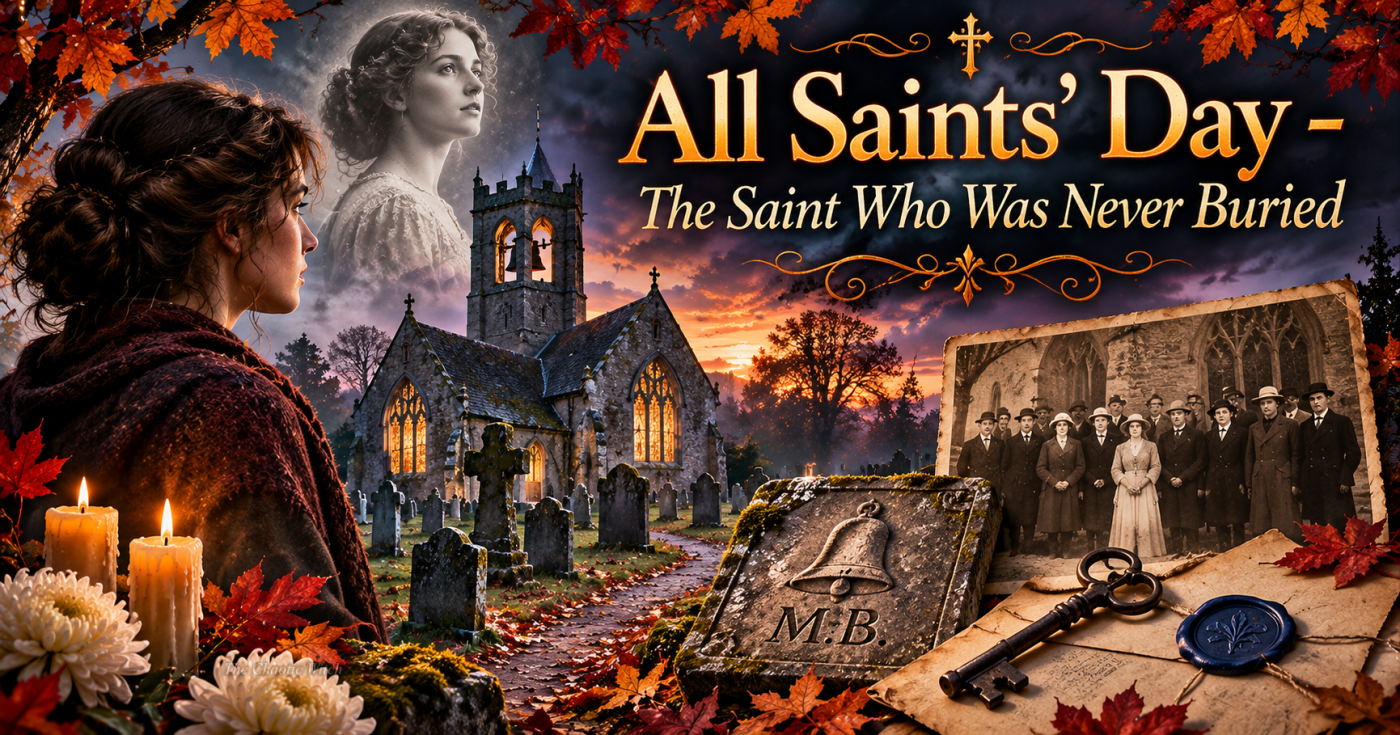
Near the bottom of a wooden chest, beneath a yellowed tablecloth, she found a photograph dated November 1, 1926. It showed eleven people standing outside St. Agnes Church. Ten were dressed in dark clothing, while the eleventh was a young woman in a white dress, her hair pinned neatly beneath a small hat. Someone had written names on the reverse. Clara recognized two family surnames and the name of a former parish priest, but beneath the photograph, in faded blue ink, someone had added a sentence that made her pause.
There were twelve of us when the bells began.
Clara examined the picture again. Eleven people. No one appeared to be standing outside the frame, and there was no obvious sign that the photograph had been cut. Yet something about the young woman in white unsettled her. Unlike everyone else, she was not looking at the camera. She was staring toward the church doors, her expression caught somewhere between fear and anticipation.
That afternoon, Clara visited the village historical society, which occupied two rooms above the old post office. Its caretaker, a retired schoolteacher named Thomas Vale, remembered Eleanor fondly and offered Clara tea before she had finished explaining why she had come. When she showed him the photograph, his expression changed immediately.
“Where did you find this?” he asked, holding it closer to the window.
“In my aunt’s house. Do you recognize anyone?”
Thomas studied the young woman in white for a long moment before answering. “I believe that’s Margaret Bell.”
Clara waited for him to continue, sensing that the name meant something.
“According to the official records, Margaret was a church volunteer who died in the winter of 1926. A fever, supposedly. She was twenty-three.”
“Supposedly?” Clara repeated.
Thomas explained that Margaret’s death certificate existed, but there was no burial record, no gravestone, and no documentation of a funeral. She had arrived in Bellweather as a young woman and worked with the parish poor relief committee, distributing food, clothing, and financial assistance to struggling families. People had called her Saint Margaret because she cared for anyone who needed help, whether they could pay or not. That reputation had lasted until a substantial amount of money disappeared from the church’s charitable fund.
Margaret had been responsible for distributing the assistance, and suspicion quickly fell upon her. She denied taking anything, but the parish council dismissed her. According to the village’s official history, she became ill shortly afterward and died. Thomas admitted that Eleanor had never believed the account and had visited the historical society every November for almost thirty years, searching for evidence that the church had concealed something.
Thomas opened a locked cabinet and removed a thin ledger. It listed charitable payments made during October 1926, including a final entry dated October 31. Beside Margaret Bell’s name was a payment of forty pounds, authorized by Reverend Samuel Ashcroft. Clara studied the signature before Thomas pointed out the detail that had troubled Eleanor for years. According to parish records, Reverend Ashcroft had died three days before the payment was authorized.
“Someone forged his signature,” Clara said.
“That would be the reasonable explanation,” Thomas replied.
“What’s the unreasonable one?”
Thomas closed the ledger and looked at her gravely. “That Reverend Ashcroft signed it after he was dead.”
Clara almost laughed, but Thomas was not smiling. He explained that Margaret had apparently discovered irregularities in the church accounts and had intended to bring them before the parish council on All Saints’ Day. Instead, she was publicly accused of stealing the money herself. The next morning, she disappeared. A private letter written by the village doctor later claimed that he had never examined Margaret’s body. He had signed her death certificate after being assured by Reverend Ashcroft’s successor that she had died while staying with relatives.
Clara felt a cold uneasiness settle over her. If the doctor’s account was true, Margaret might never have died in Bellweather at all. Thomas agreed, explaining that this had been Eleanor’s belief for most of her adult life, although she had never managed to prove what had happened.
As dusk approached, Clara walked to St. Agnes. The church was almost empty. Candles flickered along the side altar, illuminating the names of saints painted in gold beneath the stained-glass windows. A few worshippers knelt in silent prayer, and the scent of incense lingered in the air. Clara wandered toward the rear of the building, where a narrow passage led to the vestry.
A small brass plaque hung beside a locked wooden door. It read, In Memory of Those Who Served Without Recognition. Below it were eleven names, but Margaret Bell was not among them. Clara was studying the plaque when an elderly woman standing beside the last pew spoke quietly behind her.
“Some names were never meant to be written there.”
Clara turned. The woman wore a dark wool coat and held a bunch of white chrysanthemums. When Clara asked whether she had known Margaret Bell, the woman’s expression changed. She explained that her mother had been a child in 1926 and remembered Margaret as a kind young woman who had frightened some of Bellweather’s most powerful men.
“Why would they be frightened of her?” Clara asked.
“Because she kept records,” the woman replied.
Before Clara could question her further, the woman pressed a small folded paper into her hand. Eleanor had asked her to deliver it if Clara ever came looking for Margaret. The woman then moved toward the church doors, leaving Clara beneath the stained-glass window with the note.
Inside was a simple drawing of the church, with an X marked beneath the sanctuary. Underneath, Eleanor had written, The twelfth person was not in the photograph because she was already beneath their feet.
Clara read the words twice. A terrible possibility began forming in her mind. She hurried toward the vestry door, but it was locked. Then she noticed something strange about the floor beside the brass plaque. One of the limestone tiles was darker than the others, and a thin groove ran along its edge. She knelt and brushed away the dust, revealing a small bell carved into the stone. Beneath it were the initials M.B.
Clara was still examining the marking when the church lights went out. The candles continued burning, but the electric lamps vanished all at once, plunging the nave into shifting shadows. Then the bells began to ring. Clara stood slowly, listening as each heavy note echoed through the building. The church was empty now, although she had not heard the worshippers leave.
The bells continued until the twelfth had sounded. Silence followed, deep and unnatural, before a thirteenth note rose from somewhere beneath the floor. Clara felt the vibration through the soles of her shoes. A faint scraping sound followed, as though something heavy were being dragged across stone.
She backed away from the marked tile. A whisper moved through the dark church, so faint that she initially thought she had imagined it.
“Not the saints.”
Clara turned sharply, but there was no one behind her. The whisper came again, closer this time.
“Find the souls.”
Then the electric lights returned. Clara fled St. Agnes without looking back.
When she reached Eleanor’s cottage, the sky had darkened completely. She locked the door, pulled the curtains, and stood in the kitchen trying to convince herself that the whisper had been nothing more than wind passing through the old stonework. At nine o’clock, she finally opened Eleanor’s sealed envelope.
Inside was a letter, a small iron key, and a photograph of a woman Clara recognized immediately. It was Margaret Bell, older but unmistakable. Yet the photograph was not from 1926. It was dated November 2, 1954, and showed Margaret standing outside Eleanor’s cottage, smiling faintly at the camera.
Clara’s hands trembled as she unfolded the letter. Eleanor wrote that if Clara was reading it, she had probably heard the thirteenth bell and discovered that Bellweather’s story about Margaret was a lie. Margaret had not stolen the church’s money. She had uncovered what happened to it and what happened to the people it was supposed to help. She had not died in 1926, but had survived long enough to tell Eleanor everything.
Eleanor explained that Margaret was not the only person erased from the records, and the others had not been as fortunate. On All Saints’ Day, Bellweather remembered those it had chosen to honour. On All Souls’ Day, Clara would have to remember those it had chosen to forget. The key, Eleanor wrote, opened a door beneath the sanctuary. Clara must not go alone, and whatever she discovered, she must not allow them to ring the thirteenth bell again.
Clara lowered the letter and stared at the key resting in her palm. Outside, the church bells began to ring. She checked the clock. It was 9:13 p.m. There was no service scheduled, no funeral, and no reason for the bells to sound, yet they rang thirteen times.
On the final toll, someone knocked at Eleanor’s front door.
Clara approached cautiously, her heart pounding. She stopped several feet away and asked who was there. A woman’s voice answered from the other side, quiet but perfectly clear.
“My name is Margaret Bell.”
Clara went cold. She knew the photograph had been taken decades earlier. If Margaret had been twenty-three in 1926, she would now be more than a century old.
“That’s impossible,” Clara whispered.
The voice on the other side of the door was soft and terribly patient.
“I know, dear. That’s what they said the first time they buried me.”
Come back tomorrow for Part Two.
A little magic is always waiting. Subscribe and step inside the circle. 🖤🔮✨


Leave a Reply