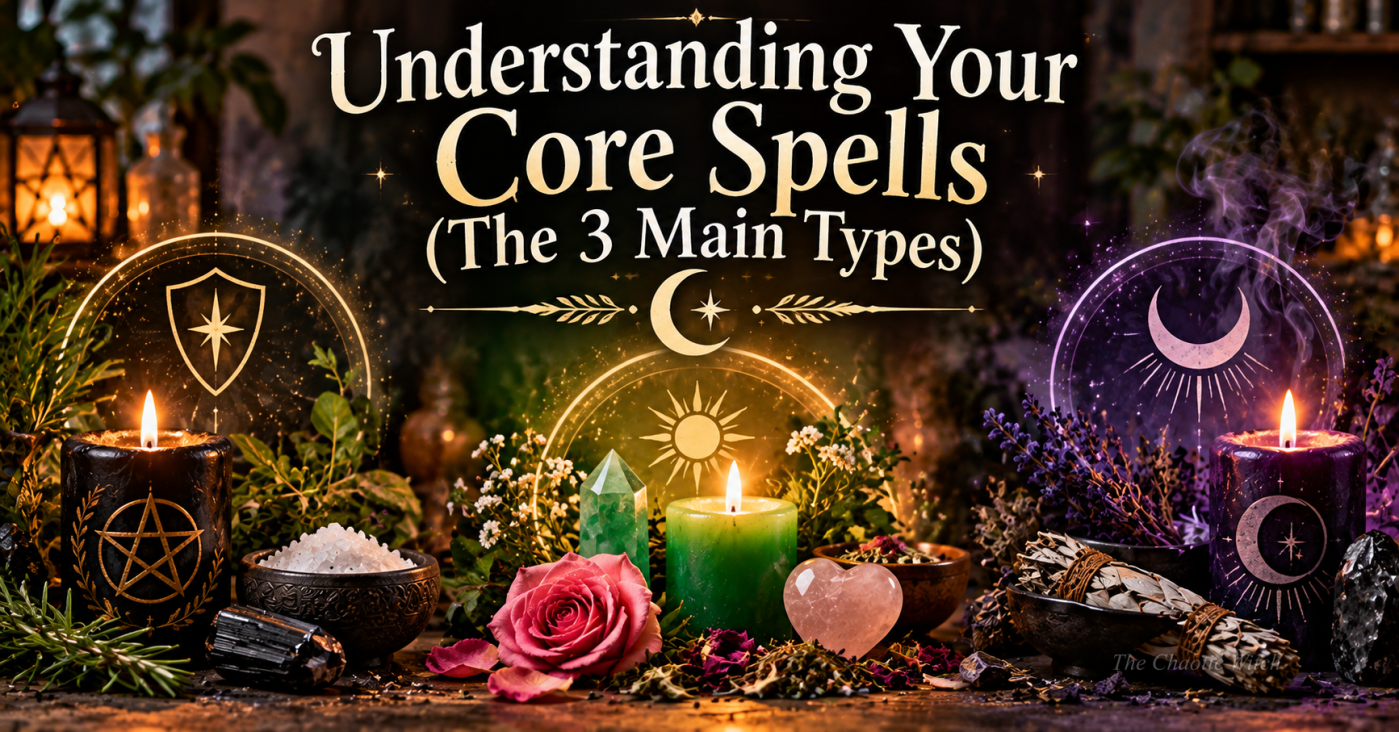
Every witch begins somewhere, and understanding the foundations of spellwork is one of the most important steps toward developing a meaningful magical practice.
When you first begin exploring witchcraft, the world of spells can seem overwhelming. There are candle spells, jar spells, herbal rituals, moon magic, knot magic, sigils, charms, and countless other practices. With so many possibilities, it can be difficult to know where to begin.
Fortunately, you don’t need to learn every magical technique at once. A helpful way for beginners to understand spellwork is to divide it into three broad categories: protection spells, attraction spells, and banishing spells.
These are not the only categories of magic, nor are they a universal classification used by every witchcraft tradition. However, they provide a practical foundation for understanding three common purposes behind magical rituals: keeping something safe, welcoming something into your life, and releasing something you no longer wish to carry.
Once you understand these three approaches, you’ll begin to recognize how many different spells fit within them.
1. Protection Spells: Creating Boundaries and Security
Protection magic is one of the oldest and most widespread forms of folk magic. Throughout history, people have used protective charms, symbols, prayers, and rituals to seek safety for themselves, their families, their homes, and their possessions.
In modern witchcraft, protection spells are often used to establish symbolic boundaries, encourage emotional security, and reinforce the intention to keep harmful influences at a distance.
Protection magic isn’t necessarily about fighting against something negative. It can simply be about creating a sense of stability, comfort, and personal strength.
Common Protection Spell Ingredients
Different traditions associate particular materials with protective qualities.
- Rosemary is associated with purification, remembrance, and protection.
- Salt is commonly used to symbolize cleansing and boundaries.
- Black tourmaline is often associated with grounding and protection.
- Bay leaves are linked with protection, wishes, and success.
- Black candles are frequently used in rituals involving boundaries, banishing, and protection.
- Iron objects, such as horseshoes, have a long history as protective charms in European folklore.
These associations are traditional and symbolic rather than scientifically demonstrated supernatural effects.
Beginner Spell: The Protective Charm Bag
This simple charm bag is a lovely introduction to protection magic because it requires no flames or complicated tools.
You will need a small fabric pouch, a pinch of dried rosemary, a bay leaf, a small smooth stone, and a piece of paper.
Begin by sitting somewhere peaceful. Take a few slow breaths and think about what protection means to you. Perhaps you wish to feel more confident, establish healthier boundaries, or create a greater sense of security in your everyday life.
Write a short intention on the paper, such as:
“I am grounded, I am strong, and I have the right to protect my peace.”
Fold the paper and place it inside the pouch along with the rosemary, bay leaf, and stone.
Hold the pouch between your hands and say:
“By leaf and stone, by earth and air, I carry strength and mindful care. My boundaries stand, my spirit’s free, and peace shall find its home in me.”
Keep the charm bag in a safe place, such as a drawer, handbag, or beside your altar.
Whenever you see or hold it, use it as a reminder of your intention to maintain healthy boundaries.
Protection rituals can be emotionally meaningful, but they should complement rather than replace practical safety measures.
2. Attraction Spells: Welcoming What You Wish to Grow
Attraction magic focuses on inviting desirable experiences, opportunities, and qualities into your life.
This category includes many familiar forms of prosperity magic, love spells, confidence rituals, friendship charms, and practices intended to encourage personal growth.
The central idea is to concentrate on what you want to cultivate rather than what you wish to avoid.
For example, instead of focusing entirely on loneliness, an attraction spell might centre on building meaningful friendships. Rather than dwelling on financial worries, a prosperity ritual might encourage you to recognize opportunities, develop useful habits, and work toward greater stability.
Attraction spells are often associated with growth, optimism, and intentional action.
Common Attraction Spell Ingredients
- Cinnamon is traditionally associated with prosperity, success, and warmth.
- Basil is often linked with abundance, good fortune, and harmony.
- Rose petals symbolize love, compassion, and emotional connection.
- Green candles are commonly associated with prosperity and growth.
- Pink candles are frequently used for friendship, affection, and self-love.
- Citrine is popularly associated with confidence, creativity, and abundance.
- Honey is used in some folk-magic traditions to symbolize sweetness and harmony.
Attraction magic does not guarantee that a particular event will happen. Its value can lie in helping practitioners clarify their desires and approach their goals with greater focus.
Beginner Spell: The Abundance Intention Jar
This simple spell focuses on welcoming opportunities and cultivating an abundance mindset.
You will need a small clean jar with a lid, a pinch of dried basil, a cinnamon stick, a bay leaf, and a small piece of paper.
Begin by considering what abundance means to you. It might involve financial security, rewarding friendships, creative opportunities, or greater appreciation for the things you already have.
Write a clear intention on your paper.
For example:
“I welcome opportunities that support my growth, stability, and happiness.”
Place the paper inside the jar, followed by the basil, cinnamon, and bay leaf.
As you add each ingredient, think about the qualities you wish to develop.
Hold the jar gently and say:
“With open heart and purpose clear, I welcome growth throughout the year. Through work and wisdom, may I see the opportunities awaiting me.”
Close the jar and place it somewhere meaningful.
Whenever you notice it, consider one practical action you can take toward your intention. This might mean applying for a new opportunity, saving a small amount of money, or reaching out to someone who inspires you.
In this way, the spell becomes both a symbolic ritual and a reminder to take meaningful action.
3. Banishing Spells: Releasing What No Longer Serves You
Banishing magic is concerned with removing, releasing, or distancing yourself from something unwanted.
While the word banishing may sound dramatic, these spells do not necessarily involve curses, confrontations, or attempts to influence other people.
Many modern witches use banishing rituals to symbolically release unhealthy habits, persistent worries, emotional attachments, or patterns of thinking they wish to change.
Banishing can also be associated with cleansing a space, ending an unwanted influence, or marking the conclusion of a difficult chapter.
The emphasis is often on making room for something healthier.
Common Banishing Spell Ingredients
- Black candles are traditionally associated with endings, boundaries, and banishing.
- Salt is frequently used in cleansing and purification rituals.
- Rosemary is associated with purification and protection.
- Bay leaves may be used in rituals involving release and transformation.
- Water can symbolize emotional cleansing and renewal.
- Paper is often used to record something the practitioner wishes to release.
Some traditions incorporate fire into banishing rituals, but burning materials is not necessary. Paper, water, and symbolic gestures can be just as meaningful.
Beginner Spell: The Paper Release Ritual
This gentle banishing spell is designed to help you acknowledge and symbolically release something you are ready to move beyond.
You will need a piece of paper, a pen, and a small bowl.
Find a quiet place where you can reflect without interruption.
Think about a habit, worry, or emotional burden you would like to begin releasing. Choose something you feel comfortable exploring.
Write it on the paper.
For example:
“I release the belief that I must be perfect to be worthy.”
Hold the paper for a moment and acknowledge the feelings associated with what you have written.
Then say:
“What has weighed upon my mind, I now begin to leave behind. With gentle strength, I choose to grow, and give myself permission to let go.”
Slowly tear the paper into small pieces and place them in the bowl.
As you tear the paper, imagine loosening your attachment to the thought or habit.
Dispose of the pieces responsibly when you are finished.
The ritual does not mean that difficult emotions will disappear immediately. Instead, it can serve as a meaningful first step toward changing how you respond to them.
Understanding the Difference Between the Three Types
Although these categories sometimes overlap, each has a different primary purpose.
| Spell type | Main intention | Examples |
|---|---|---|
| Protection | Establishing safety and boundaries | Home protection, protective charms, personal grounding |
| Attraction | Welcoming desirable qualities or opportunities | Prosperity, friendship, confidence, abundance |
| Banishing | Releasing or distancing unwanted influences | Letting go of habits, cleansing rituals, symbolic endings |
Imagine, for example, that you are beginning a new chapter in your life.
You might perform a banishing ritual to symbolically release old fears, followed by a protection spell to reinforce your personal boundaries. Finally, you might use an attraction spell to focus on confidence and new opportunities.
These practices can complement one another because they represent different aspects of personal intention.
The Importance of Intention in Spellwork
Regardless of the type of spell you choose, intention plays an important role in many contemporary magical traditions.
Intention is the purpose behind your ritual. It gives your actions direction and helps you focus on what you hope to cultivate or change.
A vague intention such as “I want things to improve” can be meaningful, but a more specific intention may help you understand what you’re working toward.
For example, you might choose:
“I am developing the confidence to speak up for myself.”
Or:
“I am making room for peaceful, supportive relationships.”
Or:
“I am releasing habits that prevent me from caring for my well-being.”
These intentions focus on your own choices, behaviours, and personal growth rather than attempting to control someone else’s feelings or actions.
In many ethical approaches to modern witchcraft, respecting personal autonomy and consent is an important consideration, particularly when exploring love and relationship magic.
Do Moon Phases Matter?
Some witches enjoy coordinating their spellwork with the lunar cycle. Although this is not required, moon phases provide a symbolic framework for organizing different intentions.
The new moon is commonly associated with fresh beginnings, planning, and setting intentions.
The waxing moon, when the illuminated portion appears to grow, is often associated with attraction, development, prosperity, and building momentum.
The full moon is frequently connected with celebration, illumination, reflection, and the culmination of intentions.
The waning moon, when the illuminated portion decreases, is traditionally associated with release, banishing, cleansing, and letting go.
These associations vary between traditions and are symbolic rather than evidence that lunar phases determine whether a spell succeeds.
You can practise any of the three types of spellwork whenever you feel the need. There is no requirement to wait for a particular moon phase.
Choosing the Right Spell for Your Intention
When deciding which type of spell to perform, begin by asking yourself a simple question:
“What am I hoping to accomplish?”
If your intention involves strengthening boundaries, creating a sense of security, or encouraging stability, a protection spell may be appropriate.
If you’re hoping to welcome opportunities, cultivate confidence, or encourage personal growth, an attraction spell might be a meaningful choice.
If you want to release an old habit, symbolically close a chapter, or move away from something that no longer benefits you, a banishing ritual may be more suitable.
You may also discover that your intention involves more than one category.
For example, moving into a new home might inspire a cleansing ritual to mark the transition, a protection charm to symbolize security, and an attraction spell to welcome happiness and harmony.
There is no need to make your practice unnecessarily complicated. Begin with one intention and allow your understanding to develop naturally.
Common Beginner Mistakes
One of the most common mistakes beginners make is believing that a spell must contain a large number of ingredients to be meaningful.
In reality, a simple ritual performed with care and attention can be more personally significant than an elaborate ceremony copied without understanding its purpose.
Another common misconception is that every spell requires a candle, crystal, or specialized magical tool. Many forms of spellwork use ordinary household objects, written intentions, spoken words, or symbolic actions.
Some beginners also worry that making a mistake during a ritual will automatically bring bad luck or unwanted consequences. There is no reliable evidence that forgetting an ingredient or saying the wrong word causes supernatural harm. You can simply correct the mistake or begin again.
It is also important not to rely on spells as substitutes for practical action. A protection charm does not replace securing your home, and a prosperity spell does not replace financial planning or pursuing opportunities.
Your magical practice can exist alongside everyday responsibility, personal growth, and informed decision-making.
Developing Your Own Magical Practice
As you become more comfortable with protection, attraction, and banishing magic, you may begin experimenting with different techniques.
Candle magic uses the symbolism of flame, colour, and intention. Jar spells combine meaningful ingredients in containers. Knot magic involves tying intentions into cords or threads. Sigil magic uses symbols designed to represent specific goals.
Herbal magic explores the traditional associations of plants, while kitchen witchcraft incorporates magical symbolism into cooking, baking, and other household activities.
You may eventually discover that certain methods feel more natural to you than others.
Some witches love working with candles and moon phases, while others prefer creating charm bags, writing intentions, or spending time outdoors.
There is no single path that every practitioner must follow.
Keeping a Book of Shadows can help you document your experiences, record correspondences, and reflect on what different rituals mean to you.
Over time, these notes may become one of your most valuable resources.
Remember: Magic Begins With Understanding
Learning the foundations of spellwork is not about memorizing hundreds of correspondences or collecting every magical tool available.
It is about understanding the purpose behind your actions.
Protection teaches us to recognize the importance of boundaries and security. Attraction encourages us to focus on growth, opportunity, and the qualities we wish to nurture. Banishing reminds us that sometimes moving forward begins with releasing something we no longer need.
Together, these three approaches offer a simple framework for exploring many forms of modern witchcraft.
As your knowledge develops, you’ll discover that magical traditions are far more varied and complex than any three categories can capture. Healing, blessing, divination, transformation, and devotional practices all have their own histories and methods.
But for someone just beginning, protection, attraction, and banishing provide an approachable place to start.
You don’t need to know everything before performing your first simple ritual. You only need curiosity, patience, and a willingness to learn.
The most meaningful magic begins when you understand not only what you are doing, but why you are doing it. Protect what matters, welcome what helps you grow, and find the courage to release what no longer belongs in your life.
A little magic is always waiting. Subscribe and step inside the circle. 🖤🔮✨


Leave a Reply