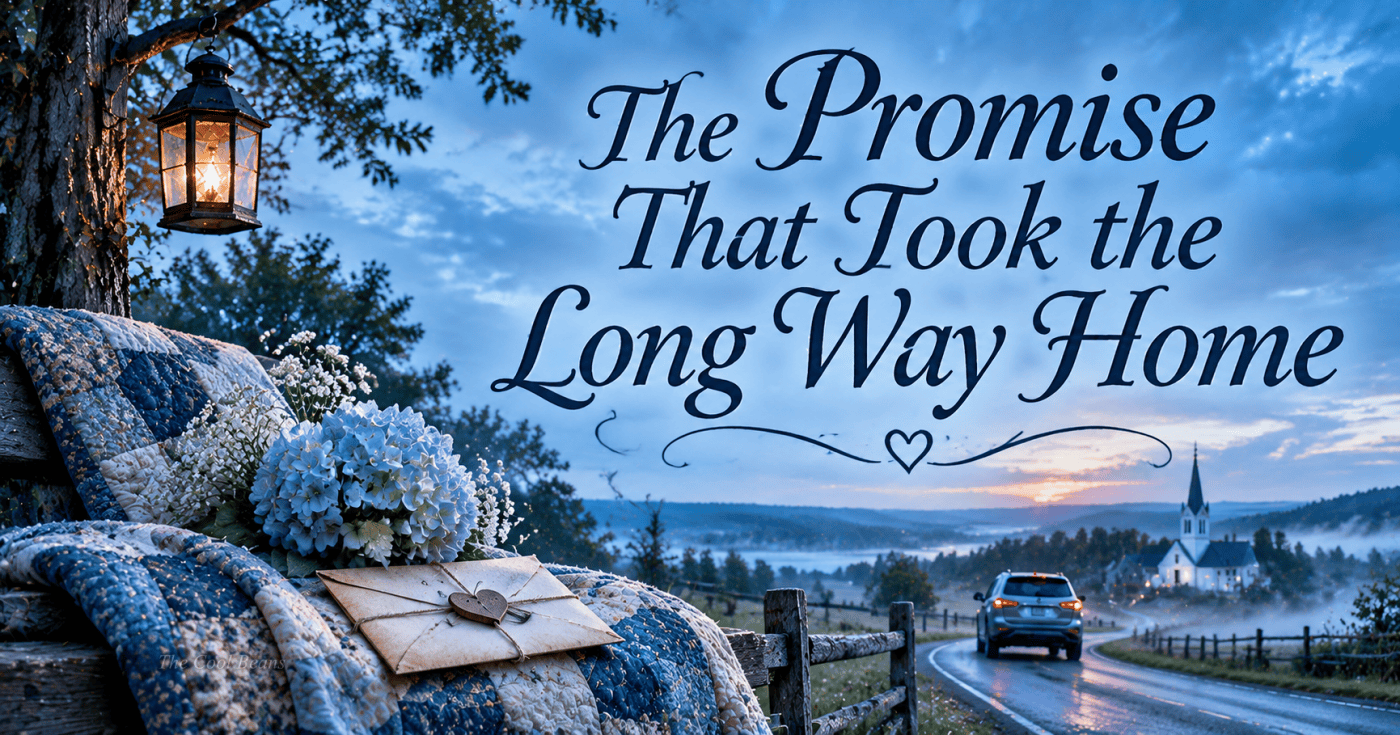
The trouble began with a blue suitcase, a jar of homemade strawberry jam, and an argument about whether anyone actually needed a paper map anymore. Seventy-eight-year-old Eleanor Bennett had spread a road map across the kitchen table, much to the amusement of her sixteen-year-old granddaughter, Sophie, who insisted that GPS had made such things obsolete.
“We have GPS, Grandma,” Sophie announced, watching her grandmother trace a route with one finger. Eleanor adjusted her glasses and informed her that she had a perfectly good sense of direction. Sophie immediately reminded her of the previous Christmas, when she’d managed to get lost on the way to the grocery store and ended up at a llama farm. Eleanor dismissed the incident as a scenic detour, adding that the llamas had been exceptionally welcoming.
From the kitchen doorway, Sophie’s mother, Claire, watched the exchange with the weary expression of a woman who had already reconsidered the wisdom of this trip approximately seventeen times. They were leaving the following morning for a journey that would take them nearly six hundred kilometres across the countryside, through small towns, winding roads, and places Eleanor hadn’t visited in more than fifty years. Their destination was a little town called Willowbrook, and their purpose was to deliver a quilt.
It wasn’t just any quilt, according to Eleanor. It was a handmade patchwork quilt that had been folded inside a cedar chest for forty-nine years, carefully wrapped in tissue paper and tied with a faded yellow ribbon. Claire had discovered it while helping her mother organize the attic, and when she’d asked why Eleanor had kept it for so long, her mother had gently run her fingers over the colourful squares and explained that she’d promised someone she would bring it to her. That someone was her childhood best friend, June, a woman Claire had never heard of before.
The next morning, the three women loaded Claire’s little silver SUV with enough snacks to survive a minor apocalypse, Eleanor’s blue suitcase, Sophie’s headphones, and the precious quilt. Eleanor insisted on sitting in the front passenger seat because, as she explained, she’d earned the right to see where she was going. Sophie climbed into the back with a dramatic sigh, complaining that she’d apparently earned the right to stare at the back of her grandmother’s head for eight hours. Eleanor suggested she consider it a privilege, since that particular head contained nearly eight decades of excellent advice.
They hadn’t even reached the highway when Eleanor announced that they needed to stop for coffee. Claire protested that they’d only just left the house, but her mother insisted that every proper journey should begin with a decent cup of coffee. Twenty minutes later, they were sitting in a roadside café, drinking coffee and hot chocolate while Eleanor examined the menu and marvelled at the prices. When she announced that breakfast had cost seventy-five cents in her younger days, Sophie leaned toward her mother and whispered that Grandma had officially begun her first “in my day” speech of the trip. Claire laughed so unexpectedly that she nearly spilled her coffee.
It was the first time Sophie had heard her mother laugh like that in weeks. Lately, everything at home had felt strained. Claire worked long hours managing a dental office, while Sophie was navigating the confusing and sometimes miserable world of being sixteen. Their conversations had become a collection of reminders, complaints, and misunderstandings. Claire thought Sophie spent too much time on her phone, Sophie thought Claire spent too much time worrying, and neither seemed particularly interested in admitting that the other might have a point. Eleanor, meanwhile, had been quietly watching them drift apart. She had suggested the road trip partly because of the quilt, but not entirely.
By midmorning, the highway had given way to rolling farmland and little villages where flower baskets hung from lampposts and old brick buildings leaned comfortably against one another. Eleanor pointed out places she remembered from her youth, including a boarded-up dance hall where Sophie’s grandfather had taken her on their third date. Claire was astonished to learn that her father had danced, but Eleanor assured her that he’d been absolutely terrible at it, possessing all the rhythm of a washing machine full of bricks. Still, he had been handsome, and when he looked at her, she’d felt like the only person in the room.
Eleanor smiled at the memory and recalled something her husband used to say about love. He believed it wasn’t about finding someone who never annoyed you, but about finding someone whose company you still wanted after they’d annoyed you all day. Claire laughed because it sounded exactly like her father. Eleanor agreed, adding that he could be a very irritating man, but her voice softened when she admitted that she would give anything to be irritated by him just one more time. The car grew quiet, and Claire reached across the console to squeeze her mother’s hand.
They drove for another hour before Sophie finally asked the question that had been bothering her since the trip began. Why had Eleanor never delivered the quilt? Her grandmother glanced at the cedar-coloured bundle resting safely beside Sophie and explained that life had simply gotten in the way. Sophie pointed out that forty-nine years seemed like an extraordinary amount of life to get in the way, but Eleanor only smiled and agreed that it was indeed quite a lot.
Eleanor began telling them about June, whom she’d met when they were fourteen. June’s family had moved into the house next door, and she’d arrived at Eleanor’s front door carrying a plate of cookies while wearing two different shoes because she couldn’t decide which pair looked better. June was the sort of person who could turn a rainy Tuesday into an adventure. She convinced Eleanor to climb trees, enter singing competitions, and once, very foolishly, help her bake a cake for the school principal. They accidentally used salt instead of sugar, and after one unfortunate bite, the principal suggested they consider careers outside the culinary arts.
For the next several kilometres, Eleanor shared stories about their friendship. The girls had been inseparable through school, sharing secrets, dreams, and an old bicycle that regularly lost its chain. When June’s mother became ill, Eleanor spent afternoons helping care for her younger siblings. When Eleanor’s father lost his job, June quietly left bags of groceries on the Bennett family’s doorstep. They supported each other through first heartbreaks, difficult winters, and all the uncertain years of becoming adults.
Then June met a young man named Robert and moved away. Before she left, Eleanor began making a quilt from scraps of fabric collected throughout their friendship. There was a square from June’s favourite childhood dress, another from the curtains in Eleanor’s first apartment, and a piece of blue fabric from the dress Eleanor wore when she married Sophie’s grandfather. Each square represented a memory, and Eleanor intended to give June the finished quilt when she visited her new home.
But Claire was born prematurely that winter, and Eleanor’s world became hospital corridors, sleepless nights, and the frightening uncertainty of whether her tiny daughter would survive. The visit was postponed, then postponed again. Eventually, the letters became less frequent, addresses changed, and the years slipped past. Eleanor always intended to find June, but the longer she waited, the harder it became to explain why she’d waited so long.
Sophie looked down at the quilt and asked whether June might be angry. Eleanor considered the possibility before admitting that perhaps she would be, although she sincerely hoped not. Claire kept her eyes on the road, troubled by how little she’d known about this part of her mother’s life. She had spent so much of her adulthood thinking of Eleanor simply as her mother, the woman who reminded her to wear a coat, worried about her driving, and insisted on feeding everyone who entered her house. It had rarely occurred to her that Eleanor had once been a young woman with her own friendships, dreams, disappointments, and unfinished promises.
They stopped for lunch in a little town called Bellflower, where a cheerful waitress recommended a bakery famous for its enormous cinnamon buns. Eleanor ordered one, Claire chose soup, and Sophie ordered a sandwich before promptly eating half of her grandmother’s dessert. Eleanor observed that Sophie had claimed not to be hungry, but her granddaughter explained that she hadn’t been hungry until she’d seen the cinnamon bun. Eleanor considered this an entirely reasonable explanation.
After lunch, they wandered through a small antique shop next door. Sophie found a box of old postcards, and Eleanor discovered a ceramic bluebird almost identical to one her mother had owned. Although she insisted she didn’t need another thing collecting dust, she continued holding it with a wistful expression. Claire quietly purchased it while Eleanor and Sophie were distracted by a display of vintage hats.
When Claire handed her the bluebird outside, Eleanor’s eyes filled with tears. She remembered her mother’s little ceramic bird and how she’d always warned Claire not to touch it when she was a child. Claire laughed and reminded her that she’d only been five, but Eleanor insisted she’d been a very talented little menace. For a moment, Claire felt like a little girl again, standing in her mother’s kitchen and wanting nothing more than to make her smile.
The afternoon brought rain, and not the gentle sort. It arrived sideways, turning the countryside into a blur and making the windshield wipers sound increasingly offended by their responsibilities. Claire gripped the steering wheel while Sophie checked the weather on her phone and announced that there was a storm warning. Eleanor studied her paper map and suggested they stop in a little town about twenty kilometres ahead. Sophie pointed out that the map was older than she was, but Eleanor replied that it was also considerably more respectful.
Claire decided to take the exit, and they soon found themselves in Maple Crossing, a charming little town with a bed-and-breakfast that had once been an old country inn. Flower-filled window boxes brightened the entrance, and a golden retriever named Biscuit greeted arriving guests as though they’d returned from a dangerous expedition. The owner, a cheerful woman named Hazel, had two rooms available, so Eleanor and Sophie agreed to share one while Claire took the other.
That evening, after dinner, the three women gathered in the inn’s sitting room while the storm rattled the windows. Hazel brought them tea and a plate of homemade cookies before retiring for the night. Eleanor settled into an armchair with the quilt across her lap, gently smoothing its faded fabric, while Sophie curled up beside her.
After a long silence, Sophie quietly asked her grandmother whether she’d ever felt like she wasn’t good enough. Eleanor looked up, surprised by the seriousness of the question, and asked what she meant. Sophie shrugged, explaining that sometimes she felt inadequate at school, with her friends, and even when she tried to make people happy.
Eleanor smiled gently and admitted that she’d spent half her youth convinced everyone else had been given instructions for life that she’d somehow missed. June had been confident and outgoing, while Eleanor was frightened of making mistakes. She’d spent years believing June was everything she wasn’t, until one day June confessed that she wished she could be more like Eleanor because she thought her friend was brave. Eleanor chuckled at the memory of two silly girls spending years admiring qualities in each other that neither could see in herself.
Claire set down her teacup and asked whether something was happening at school. Sophie hesitated before admitting that some girls she’d once considered friends had been making fun of her drawings. They’d called them childish and suggested she find something she was actually good at. Claire immediately became angry and announced that she would call the school the following morning, but Sophie begged her not to.
When Claire insisted that nobody had the right to treat her daughter that way, Sophie quietly explained that sometimes she just needed her mother to listen before trying to fix everything. The words landed harder than Sophie intended, and Claire looked down at her hands. For a moment, the only sound was the rain against the windows. Then Claire took a breath and admitted that Sophie was right.
Sophie looked startled by the admission, but Claire continued, apologizing for becoming so worried that she sometimes forgot her daughter might not need every problem solved for her. Sophie assured her that she knew her mother was only trying to help, and Claire promised she would try to do things differently.
Eleanor watched them with a small smile before reaching into her handbag and producing a folded piece of paper. It was a drawing Sophie had made when she was seven, showing the three of them standing beneath a giant purple tree. The proportions were wildly inaccurate. Claire had arms longer than her legs, Eleanor appeared to be wearing a hat shaped like a pineapple, and Sophie had given herself bright green hair.
Sophie burst out laughing and demanded to know why her grandmother had kept such a terrible drawing. Eleanor looked genuinely offended and insisted that it was a masterpiece, adding that she’d been waiting years for the Louvre to call. Claire laughed, and Sophie leaned against her mother’s shoulder. For the first time in months, the distance between them seemed to disappear.
Later that night, while Sophie slept, Claire and Eleanor sat together beside the bedroom window. The storm had passed, leaving the streets glistening beneath the lamps. Claire quietly asked why her mother had never told her how frightened she’d been when Claire was born. Eleanor explained that after her daughter survived, she’d wanted to celebrate her life rather than make her feel responsible for the fear she’d experienced.
Claire nodded slowly before admitting something she’d carried for years. She’d always thought her mother was disappointed in her, particularly after her divorce, during her financial struggles, and whenever she seemed unable to keep everything together. Eleanor was genuinely astonished. She explained that she’d worried because she could see how hard Claire was trying to carry everything alone, but she’d never once been disappointed in her.
When Claire confessed that she sometimes felt she was failing Sophie, Eleanor asked whether she loved her daughter, whether she showed up for her even when she was tired, and whether she apologized when she got things wrong. Claire answered yes to the first two and laughed shakily that she was apparently still learning the third. Eleanor squeezed her hand and assured her that she was doing better than she thought. Claire leaned against her mother’s shoulder, and for a while they sat together without speaking.
By morning, the world looked freshly washed. Biscuit supervised their departure with great enthusiasm, and Hazel packed three muffins for the road. They were only ninety kilometres from Willowbrook, and as they drove through fields bright with autumn sunshine, Sophie took out her sketchbook and began drawing Eleanor in the passenger seat, complete with her glasses, paper map, and expression of unwavering confidence.
When Eleanor asked what she was doing, Sophie claimed she was simply documenting history. Her grandmother immediately requested that Sophie capture her good side, despite the fact that she was facing forward. Sophie assured her that she would use her imagination.
By early afternoon, they reached Willowbrook, a lovely little town with a stone bridge, a winding main street, and gardens overflowing with late-season flowers. Eleanor directed Claire toward a small white house at the end of a lane lined with maple trees. The house had pale blue shutters, a porch swing, and a wooden sign beside the gate that read The Rose Cottage.
Eleanor stared at the house, barely able to speak. Claire parked, and for several moments, nobody moved. Then Sophie reached forward and touched her grandmother’s shoulder, asking if she was ready. Eleanor smiled nervously and said she thought so.
They walked up the path together, Eleanor holding the quilt against her chest while Claire knocked on the door. A woman in her late fifties answered. She had silver-streaked hair, warm brown eyes, and a curious expression. When Eleanor explained that she was looking for June Whitaker, the woman’s face softened, and she asked whether Eleanor was Eleanor Bennett.
Eleanor stared at her in astonishment before confirming her identity. The woman smiled and introduced herself as June’s daughter, Rebecca. Eleanor’s eyes filled with tears as she asked whether June was home, but Rebecca hesitated before gently taking her hand and explaining that her mother had passed away the previous spring.
For a moment, Eleanor seemed unable to understand the words. She looked down at the quilt she’d carried for nearly six hundred kilometres, then toward the porch swing. Her voice trembled as she whispered that she’d waited too long. Claire moved closer and slipped an arm around her mother’s shoulders, but Rebecca shook her head and assured Eleanor that she hadn’t waited too long at all.
Rebecca explained that June had always said Eleanor would come, and she invited them inside. The house was warm and welcoming, filled with books, family photographs, and the faint scent of cinnamon. Rebecca led them into a sunny sitting room where a large wooden chest stood beneath the window. She explained that her mother had talked about Eleanor all the time, describing her as the bravest and kindest friend she’d ever had.
Eleanor gave a small, broken laugh, remembering how June had always thought she was braver than she really was. Rebecca smiled and opened the wooden chest, explaining that her mother had left something for Eleanor. Inside was a parcel wrapped in brown paper and tied with yellow ribbon.
Eleanor’s hands trembled as she untied the bow. Inside was a handmade quilt, its squares sewn from different fabrics, some faded with age and others still bright. There were pieces of floral dresses, old curtains, embroidered handkerchiefs, and soft cotton in shades of blue and green. Eleanor covered her mouth as Rebecca unfolded a letter tucked between the layers.
June had written the letter specifically for Eleanor, hoping that one day her old friend would finally make the journey to Willowbrook. She began by teasing Eleanor about stopping for coffee at least six times along the way, and Eleanor laughed through her tears because June had always known her so well.
The letter explained that June had remembered the quilt Eleanor promised to make and had decided long ago to make one for her in return. Every square represented a piece of June’s life, including happy days, difficult moments, and times when she’d wished Eleanor were sitting beside her. June admitted that she’d once believed friendship meant never losing touch, but growing older had taught her something different.
Sometimes friendship was simply knowing that somewhere in the world, someone remembered who you were before life made you into who you became. June assured Eleanor that she’d never stopped remembering her and hoped she understood that she was never late. She had always been welcome.
By the time Eleanor finished reading, all four women were crying. Sophie reached for her grandmother’s hand and apologized that she hadn’t been able to see June one last time. But Eleanor gazed down at the quilt and smiled, explaining that in a way, she had seen her friend after all.
As she touched the colourful squares, Eleanor began recognizing pieces of a life she thought she’d lost. A piece of yellow fabric decorated with tiny white flowers came from June’s favourite dress, worn the summer they turned seventeen. Another square, made from blue gingham, had once been part of the curtains in June’s mother’s kitchen. With each discovery, memories returned in vivid detail: laughter beneath apple trees, whispered secrets in dark bedrooms, and afternoons spent dreaming about futures neither girl could possibly imagine.
Rebecca sat beside Eleanor and explained that her mother used to say the people we love never really leave us; they simply become part of the stories we tell. Eleanor smiled and remarked that June had always been better with words than she was. Rebecca laughed because June had said exactly the same thing about Eleanor.
The afternoon passed in stories. Rebecca brought out old photographs, letters, and a battered scrapbook filled with newspaper clippings and handwritten notes. Eleanor shared memories of June’s childhood that Rebecca had never heard, while Rebecca told Eleanor about the woman June had become. Claire listened to her mother laugh with a freedom she hadn’t seen in years, and Sophie filled several pages of her sketchbook with drawings of the house, the quilts, and the four women sitting together beneath the afternoon sunlight.
Before they left, Eleanor unfolded the quilt she’d carried across the countryside and explained that she’d made it for Rebecca’s mother. She wanted Rebecca to have it now. Rebecca touched the colourful squares, admiring the beautiful work and assuring Eleanor that the gift had arrived at exactly the right time.
They laid the two quilts side by side on the sitting-room floor. Their patterns were different, their fabrics were different, and their stitches reflected two women who had lived separate lives. But in the centre of each quilt was a small embroidered heart.
Eleanor stared at the matching hearts and explained that she’d sewn hers because June used to draw little hearts on all her letters. Rebecca smiled and revealed that June had included hers for precisely the same reason, remembering how Eleanor had done the very same thing. The two women laughed, realizing that some friendships had a way of remaining wonderfully unchanged.
Before the Bennetts departed, Rebecca asked them to wait while she fetched one last thing. She returned with a small envelope containing three pressed four-leaf clovers. Eleanor immediately laughed, remembering June’s unwavering belief that four-leaf clovers brought good luck. Whenever the girls found one, they made a wish, and Eleanor admitted that she’d always wished they would remain friends forever.
Rebecca smiled and suggested that her wish had come true.
They left Willowbrook just before sunset, and the drive home felt different. There were no arguments about maps, no complaints about stopping too often, and no awkward silences that needed filling. Instead, they talked. Claire told Sophie about the first time she fell in love, the terrible haircut she’d given herself at seventeen, and the dreams she’d had before becoming a mother. Sophie told Claire about the art school she secretly wanted to attend and how frightened she was of disappointing her. Claire promised they would look into it together.
Eleanor told them stories about the grandfather they missed, the young woman she used to be, and the many things she still hoped to do. At one point, Sophie leaned forward between the seats and asked whether people could ever make up for lost time. Eleanor considered the question before explaining that she didn’t believe anyone could get lost time back, but they could certainly stop wasting the time they had left.
Sophie smiled and complimented her grandmother on the advice. Eleanor proudly reminded her that she had nearly eight decades of wisdom to share, and Claire laughed that they were finally learning to listen.
They stopped for dinner at a little roadside restaurant, where Eleanor insisted they order dessert before the main course. Life was unpredictable, she explained, and it was best to make sure you got the good part. Sophie ordered chocolate cake, Claire chose lemon pie, and Eleanor ordered both.
When they finally arrived home the following evening, the three women were tired, slightly dishevelled, and carrying more memories than they had packed. Claire helped Eleanor bring her suitcase inside while Sophie carried the quilts. When she asked where they should go, Eleanor instructed her to spread them both across the living-room sofa, their colourful squares overlapping like pieces of two stories finally brought together.
A week later, Sophie presented her grandmother with a surprise. It was a framed drawing of the three of them standing outside June’s house, surrounded by autumn leaves. Eleanor held the quilt, Claire had her arm around her mother, and Sophie stood beside them, smiling. Beneath the drawing, Sophie had written a simple sentence: Some promises take the long way home.
Eleanor stared at the picture for a long time before hugging her granddaughter so tightly that Sophie laughingly complained she couldn’t breathe. The drawing was placed above the sofa, where everyone who visited could see it.
Over the following months, small things began to change. Claire and Sophie started having breakfast together on Sundays, leaving their phones in another room and talking about whatever came to mind. Eleanor began teaching Sophie how to sew, although their first attempt at making a cushion resulted in something that looked suspiciously like a lopsided potato. They laughed about it for days.
Claire started visiting her mother more often, sometimes bringing dinner and sometimes arriving with nothing more than a cup of coffee and an hour to spare. Every November, the three women planned a little adventure together. Sometimes they visited a new town, and sometimes they drove to the countryside for lunch. Once, at Eleanor’s insistence, they went to the very llama farm where she’d accidentally ended up years earlier. Sophie took approximately two hundred photographs, Claire bought a ridiculous souvenir mug, and Eleanor declared it one of the finest days of her life.
But the most important change wasn’t something anyone could photograph. It was the way they listened to one another. Claire began seeing Sophie not simply as the little girl she needed to protect, but as a young woman learning to find her place in the world. Sophie began understanding that her mother was a person with fears, dreams, and struggles of her own. And Eleanor, who had spent so many years worrying that she’d left something unfinished, finally realized that love had a remarkable ability to find its way back.
One evening, nearly a year after their trip, Eleanor sat beside the window sewing a small square of fabric onto a new quilt. Sophie looked over her shoulder and asked who it was for. Eleanor smiled and explained that she was making it for her granddaughter.
Sophie examined the growing patchwork. There was a square from the dress she’d worn to her first school dance, a piece of fabric from one of Claire’s old blouses, and a tiny patch cut from Eleanor’s favourite kitchen apron. In the centre was a piece of yellow ribbon, the same ribbon that had once held June’s quilt together.
Sophie touched it gently and told her grandmother that she didn’t have to make her a quilt. Eleanor smiled because she knew that, but she wanted Sophie to have something that would remind her, many years from now, that she came from a long line of women who loved her very much.
Sophie leaned down and kissed her cheek, assuring her that she already knew. Eleanor smiled and replied that, in that case, she’d done her job.
Outside, the evening sun slipped behind the trees, filling the room with a soft golden light. Claire called from the kitchen, asking whether anyone wanted tea, and Sophie hurried off to help her mother find the biscuits. Eleanor remained by the window for another moment, holding the unfinished quilt in her lap.
She thought of June, of all the years that had passed between them, and of the journey that had finally brought their stories together. For forty-nine years, Eleanor had believed she was carrying an unfulfilled promise. But somewhere along the way, that promise had become something much bigger.
It had brought three generations closer together, opened conversations that might never have happened, healed hurts that had quietly lingered, and reminded them that love didn’t require perfect timing. Sometimes it simply required showing up, even if the road was long and the journey took far more years than anyone had planned.
Eleanor threaded her needle, smiling to herself as she began another stitch. For the first time in a very long while, she wasn’t thinking about the years she’d lost or the things she wished she’d done differently. She was thinking about all the beautiful days still waiting to be lived, the laughter that hadn’t happened yet, the stories still waiting to be told, and the people who would be there to share them.
And as she worked another colourful square into the quilt, Eleanor understood something she wished she’d known long ago. The most beautiful promises weren’t always the ones we kept exactly as planned. Sometimes they were the ones that took us somewhere unexpected, bringing us back to the people who mattered most.
Enjoying what you find here? 💜 Consider subscribing and becoming part of our little community. It’s a simple way to stay connected, support what we do, and make sure you don’t miss what’s coming next. We’d truly love to have you here. 🌿✨


Leave a Reply