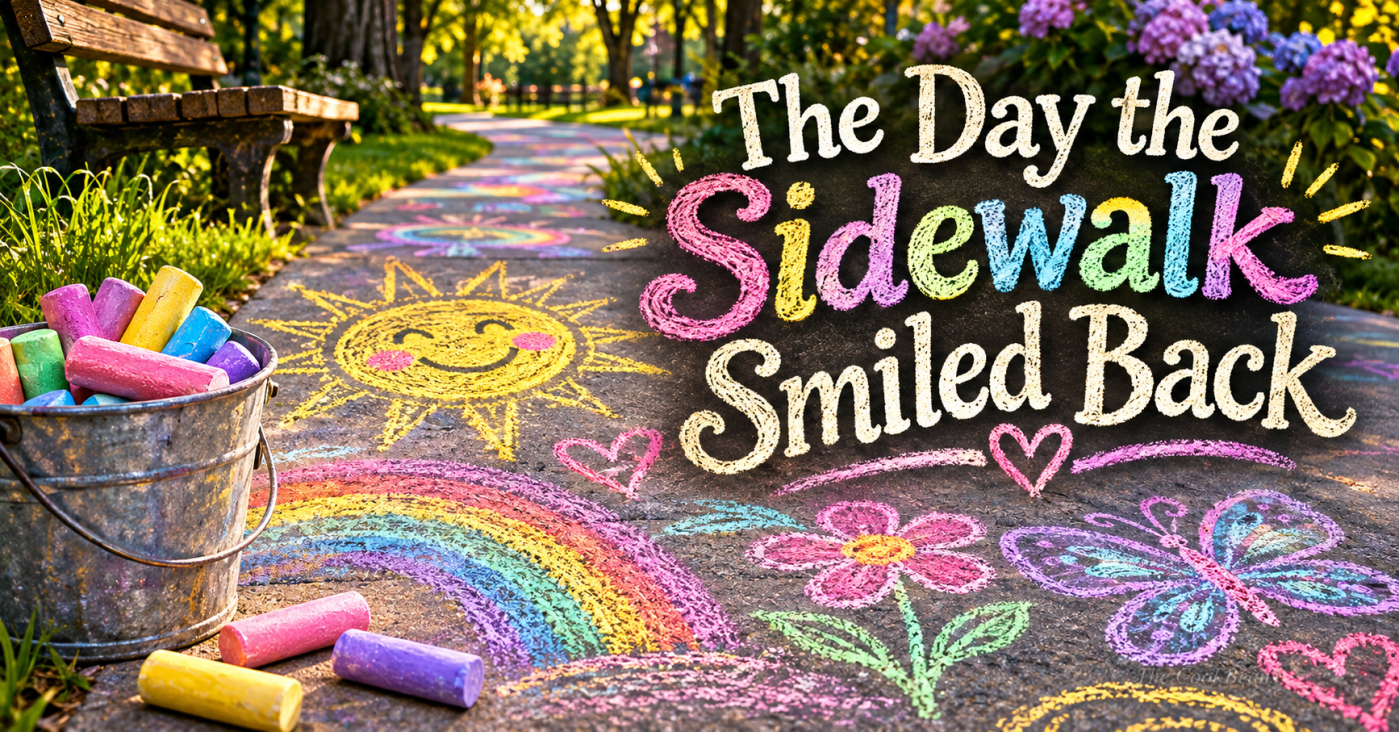
Nobody in the neighbourhood of Thornhaven had ever described Maplewood Park as particularly exciting. It had a walking path, a few wooden benches, some tired-looking flower beds, and a duck pond occupied by three ducks who appeared to have serious disagreements about absolutely everything.
People walked through the park every day. They hurried to work, exercised with headphones firmly planted in their ears, pushed strollers, walked dogs, and occasionally stopped to admire the flowers. Most passed one another without exchanging more than a polite nod.
It wasn’t an unfriendly neighbourhood. It was simply a busy one, where everyone seemed to be going somewhere and nobody had much time to stop.
That was something forty-two-year-old Nora Bennett had been noticing more and more.
Nora had lived in Thornhaven for almost fifteen years. She remembered when the neighbours held summer barbecues, children played together until the streetlights came on, and someone was always knocking on someone else’s door to borrow a cup of sugar.
These days, she barely knew the people living three houses away.
One Saturday morning, while walking through Maplewood Park with her dog, Seven, Nora noticed a little girl crouched beside the pathway. The child was drawing an enormous yellow sun with a piece of sidewalk chalk, concentrating so fiercely that her tongue poked out of the corner of her mouth.
The sun had a crooked smile, purple eyelashes, and what appeared to be a magnificent moustache.
Nora stopped.
“That’s a very impressive sun,” she said.
The little girl looked up proudly. “It’s Mr. Sunshine. He’s happy because it’s Saturday.”
“Understandable. Saturdays are excellent.”
“He’s also wearing a moustache because my grandpa has one.”
Nora nodded solemnly. “Every respectable sun should have a moustache.”
The little girl giggled, and Nora found herself smiling long after she’d continued down the path.
By the time she reached home, an idea had begun forming.
It was a ridiculous idea, really. The kind that sensible adults were supposed to dismiss immediately in favour of laundry, grocery shopping, and remembering to pay the electricity bill.
But Nora couldn’t stop thinking about that smiling sun.
What if the entire park pathway became one enormous collection of happy little drawings?
What if, instead of walking past one another, people had a reason to stop?
And what if everyone was invited to leave something cheerful behind?
By Monday, Nora had decided that the idea was too ridiculous not to try.
She contacted the local parks department, explained her plan, and received permission to organize a temporary sidewalk chalk event on a designated section of the wide park pathway. She promised to keep a clear route for walkers, wheelchairs, and strollers, and to use washable chalk that would disappear with the next rainfall.
Then she went shopping.
She bought twelve enormous boxes of sidewalk chalk in every colour imaginable. She added a few folding chairs, a little table, and a handwritten sign that read:
“THE GREAT SIDEWALK SMILE PROJECT! FREE CHALK! DRAW SOMETHING THAT MAKES YOU HAPPY, WRITE SOMETHING KIND, OR JUST COME SAY HELLO. ALL AGES WELCOME. ARTISTIC TALENT ABSOLUTELY NOT REQUIRED!”
Beneath that, in smaller letters, she added, “Stick figures are considered masterpieces.”
On Saturday morning, Nora arrived at the park at 9:00 am with Seven, her supplies, and the nervous feeling that she might be about to spend four hours drawing alone while strangers quietly questioned her mental stability.
She set up the table, arranged the chalk in colourful baskets, and began drawing a large rainbow on the pavement.
Twenty minutes passed.
Nobody stopped.
A man jogging past glanced at the sign, looked at Nora, and increased his speed.
An elderly woman walking a terrier gave her an encouraging smile but kept going.
Seven fell asleep beneath the table.
“Well,” Nora muttered, “at least one of us is having a good time.”
She was considering drawing herself a congratulatory participation trophy when a little boy approached with his father.
“What’s this?” the boy asked.
“An invitation to make the sidewalk happier,” Nora explained.
The boy studied the chalk. “Can I draw a dinosaur?”
“Absolutely.”
“Can it be a dinosaur eating pizza?”
“I would be deeply disappointed if it wasn’t.”
The boy grabbed a piece of green chalk and immediately dropped to his knees. His father stood watching for a moment before Nora offered him a piece of blue chalk.
“Oh, no,” he said quickly. “I can’t draw.”
“Perfect. Neither can I. Look at that rainbow. One side looks like it’s having a medical emergency.”
The father laughed.
Five minutes later, he was drawing an enormous slice of pepperoni pizza beside his son’s dinosaur.
Ten minutes after that, three more children had joined them.
By 10:00 am, Nora’s little project had acquired a crowd.
An older gentleman named Walter, who walked through the park every morning, stopped to investigate. When Nora handed him a piece of yellow chalk, he shook his head and explained that he hadn’t drawn anything since elementary school.
“Then you’re overdue,” Nora replied.
Walter considered this, removed his cap, and knelt carefully beside the path.
He drew a small, slightly lopsided house with smoke curling from its chimney. Beside it, he added two stick figures holding hands.
Nora smiled. “Is that your house?”
“It was,” Walter said softly. “My wife and I bought it when we were twenty-three. She always planted sunflowers along the fence.”
He added a row of tall yellow flowers.
“She passed away three years ago,” he continued. “But I still think of her every time I see a sunflower.”
Nora didn’t rush to fill the silence. She simply sat beside him while he finished drawing.
When Walter stood, he wrote a message beneath the little house.
“LOVE GROWS WHERE YOU PLANT IT.”
He studied the words for a moment, then smiled.
“I think she’d have liked that.”
Nora thought so too.
As the morning continued, the pathway transformed.
A teenager named Zoe, who had initially stood at a distance pretending to be interested in her phone, eventually approached the chalk baskets. She selected a piece of purple chalk and began drawing an enormous butterfly with intricate patterns on its wings.
Her younger brother watched in amazement.
“Since when can you draw like that?”
Zoe shrugged. “Always.”
“Why didn’t you tell anybody?”
“Because nobody asked.”
Soon, several children had gathered around her, begging her to teach them how to draw butterflies. Zoe, who had arrived looking as though she would rather be anywhere else on earth, spent the next hour patiently demonstrating wings, antennae, and tiny decorative hearts.
At the other end of the pathway, a woman in her seventies was drawing a giant cup of tea surrounded by flowers. A group of university students created an elaborate underwater scene featuring smiling octopuses, rainbow fish, and a shark wearing sunglasses.
Someone drew a cat dressed as a king.
Someone else added a crown-wearing potato beside it.
A little girl wrote, “YOU ARE BEAUTIFUL EVEN IF YOUR HAIR IS WEIRD.”
Nobody knew whether the message was intended as encouragement or a very specific observation, but everyone agreed it was magnificent.
By lunchtime, Nora’s original twelve boxes of chalk were beginning to run low.
Then something wonderful happened.
People started bringing their own.
A mother returned from home with three half-used boxes she’d found in her garage. A retired teacher arrived carrying a bucket of chalk left over from a school event. The owner of the corner convenience store walked over with several new boxes and insisted they were his contribution.
Soon, the pathway stretched before them like a bright, cheerful ribbon.
There were flowers, stars, rainbows, dogs, cats, dragons, spaceships, and an unusually large number of pizza-related illustrations.
But it was the words that Nora loved most.
“YOU’VE MADE IT THROUGH HARD DAYS BEFORE.”
“SOMEONE IS GLAD YOU EXIST.”
“RESTING IS NOT QUITTING.”
“THE WORLD NEEDS YOUR KIND OF WONDERFUL.”
“BE KIND. EVERYONE IS LEARNING.”
Near a wooden bench, someone had written, “IF TODAY IS DIFFICULT, I HOPE TOMORROW IS GENTLER.”
Nora watched people stop to read the messages. Some smiled. Others took photographs. A few stood quietly for longer than she expected.
One woman carrying grocery bags paused beside a bright pink heart containing the words, “YOU MATTER.”
She stared at it for several seconds before taking out her phone and snapping a picture.
When she noticed Nora watching, she smiled.
“I’ve had a really rough week,” she admitted. “I think I needed to see that.”
Nora felt something warm settle in her chest.
“Then I’m glad you walked this way.”
The woman nodded, looked at the heart once more, and continued down the path.
By midafternoon, the project had become something much bigger than Nora had imagined.
People who had lived on the same street for years were introducing themselves. Children were sharing chalk with strangers. Grandparents were drawing alongside grandchildren, and teenagers were laughing with people old enough to be their grandparents.
A man who had recently moved into the neighbourhood admitted that he hadn’t known anybody until that morning. Within an hour, he’d been invited to join a weekend walking group, offered gardening advice by three different people, and somehow recruited to help organize the community’s summer picnic.
“I only came here to draw a bicycle,” he told Nora.
“Well,” she replied, “that’s how they get you.”
Even Seven became involved, although his artistic contribution consisted mainly of stepping through a patch of blue chalk dust and leaving paw prints across someone’s carefully drawn rainbow.
The children declared the paw prints a masterpiece.
Seven accepted the praise with the dignity of an internationally celebrated artist.
Late in the afternoon, Nora stepped back to admire the transformation.
The ordinary grey pathway had become a sprawling gallery of happiness. Every few feet, another little piece of someone’s personality appeared. There were drawings made with tremendous skill and others that looked as though the artist had been holding the chalk with their feet.
None of it mattered.
Every contribution belonged.
And that, Nora realized, was what made it beautiful.
Just before the event ended, a quiet little boy named Oliver approached her table. He had spent most of the afternoon watching from a nearby bench while his grandmother chatted with Walter.
Nora offered him a piece of chalk.
Oliver shook his head.
“I’m not very good at drawing.”
“Neither am I,” Nora said. “That’s why my butterflies look like confused sandwiches.”
Oliver almost smiled.
After a moment, he selected a piece of white chalk and walked to an empty section of pavement.
He knelt down and carefully wrote five words.
“THANK YOU FOR INVITING ME.”
Then he stood, returned the chalk, and hurried back to his grandmother.
Nora stared at the message.
Of all the colourful pictures and elaborate designs covering the pathway, those five simple words nearly brought her to tears.
She had started the project because she wanted to make the park a little brighter.
She hadn’t realized that, for some people, being invited to participate would mean just as much as the art itself.
As evening approached, the last participants packed up their belongings. Nora gathered the remaining chalk, folded the chairs, and thanked everyone who had helped.
Walter lingered beside the drawing of his old house.
“You know,” he told her, “I haven’t spent an afternoon like this in a very long time.”
Nora smiled. “Drawing on sidewalks?”
“Feeling like I belong somewhere.”
She looked at him, suddenly unable to think of anything clever to say.
Walter patted her shoulder.
“You did a good thing today.”
After he left, Nora sat on a bench with Seven resting at her feet. The park had grown quiet again, but the pathway was still filled with colour.
She thought about the little girl who had drawn Mr. Sunshine with his magnificent moustache. One small, silly drawing had inspired all of this.
One moment of joy had become hundreds.
And not because Nora had done anything extraordinary. She had simply made a little room for people to share something good.
That night, rain began tapping against her bedroom window.
By morning, it was pouring.
Nora looked outside and felt a tiny pang of disappointment. She knew the chalk wouldn’t last forever. That was part of the arrangement. Still, it was difficult not to feel sad knowing that all those wonderful pictures would soon disappear.
When the rain stopped, she took Seven for a walk.
The park pathway was almost completely clean. Only faint traces of pink, blue, and yellow remained in the cracks. The butterflies were gone. The dinosaurs had vanished. Walter’s little house and its sunflowers had washed away.
Even the kingly cat and his royal potato companion had surrendered to the weather.
Nora stood looking at the pavement.
For a moment, she missed the colour.
Then she noticed something attached to the park noticeboard.
It was a photograph of the chalk-covered pathway, printed on ordinary paper. Beneath it, someone had written, “BEST SATURDAY EVER! CAN WE DO THIS AGAIN?”
Another person had added, “PLEASE!”
And someone else had written, “NEXT TIME I’M BRINGING MY GRANDMA.”
Nora laughed.
By the time she reached home, her phone was filled with messages from neighbours. Walter wanted to help organize another event. Zoe offered to design posters. The convenience store owner promised more chalk, and several parents volunteered to bring refreshments.
The little boy who had drawn the pizza-eating dinosaur wanted to know whether next time he could draw a dragon eating spaghetti.
Nora assured his father that such an important artistic vision absolutely deserved to be realized.
Over the following weeks, something else began happening in Thornhaven.
People started greeting one another more often.
The woman who had photographed the pink heart joined the weekend walking group. Zoe began giving free drawing lessons to younger children at the community centre. Walter planted sunflowers in the park’s community garden, with permission from the town, and invited anyone who wanted to help.
Oliver, the shy little boy who hadn’t thought he could draw, started leaving cheerful handwritten notes in the neighbourhood’s little free library.
And Nora?
Nora discovered that she couldn’t walk Seven through Maplewood Park without stopping to talk to someone.
Sometimes it took her forty minutes to complete a walk that used to take fifteen.
Seven considered this an outrageous development, particularly when the conversations interfered with his important schedule of sniffing bushes.
But Nora didn’t mind.
One evening, as the sun dipped behind the trees, she passed the spot where the first little girl had drawn Mr. Sunshine.
The pavement was plain grey again.
There was no moustached sun, no rainbow, and no colourful message reminding passersby that they mattered. Yet Nora found herself smiling. The drawings had disappeared, exactly as everyone knew they would. But the kindness they had inspired was still there, in the friendships, the conversations, and the little ways people had begun looking out for one another. She realized then that the most beautiful thing about the Sidewalk Smile Project wasn’t the artwork.
It was what happened after the chalk washed away. The neighbourhood had remembered how to be a neighbourhood. And all it had taken was a few boxes of coloured chalk, a little imagination, and an invitation that everyone was welcome to accept. Nora looked down at Seven, who was attempting to make friends with a particularly uncooperative squirrel.
“Well, buddy,” she said, “I think we accidentally started something wonderful.”
Seven wagged his tail and the squirrel remained unimpressed. Somewhere in Thornhaven, a little boy was already planning his next masterpiece. This time, the dragon would be eating spaghetti with meatballs.
Because happiness, he’d decided, should always come with extra meatballs.
Enjoying what you find here? 💜 Consider subscribing and becoming part of our little community. It’s a simple way to stay connected, support what we do, and make sure you don’t miss what’s coming next. We’d truly love to have you here. 🌿✨


Leave a Reply