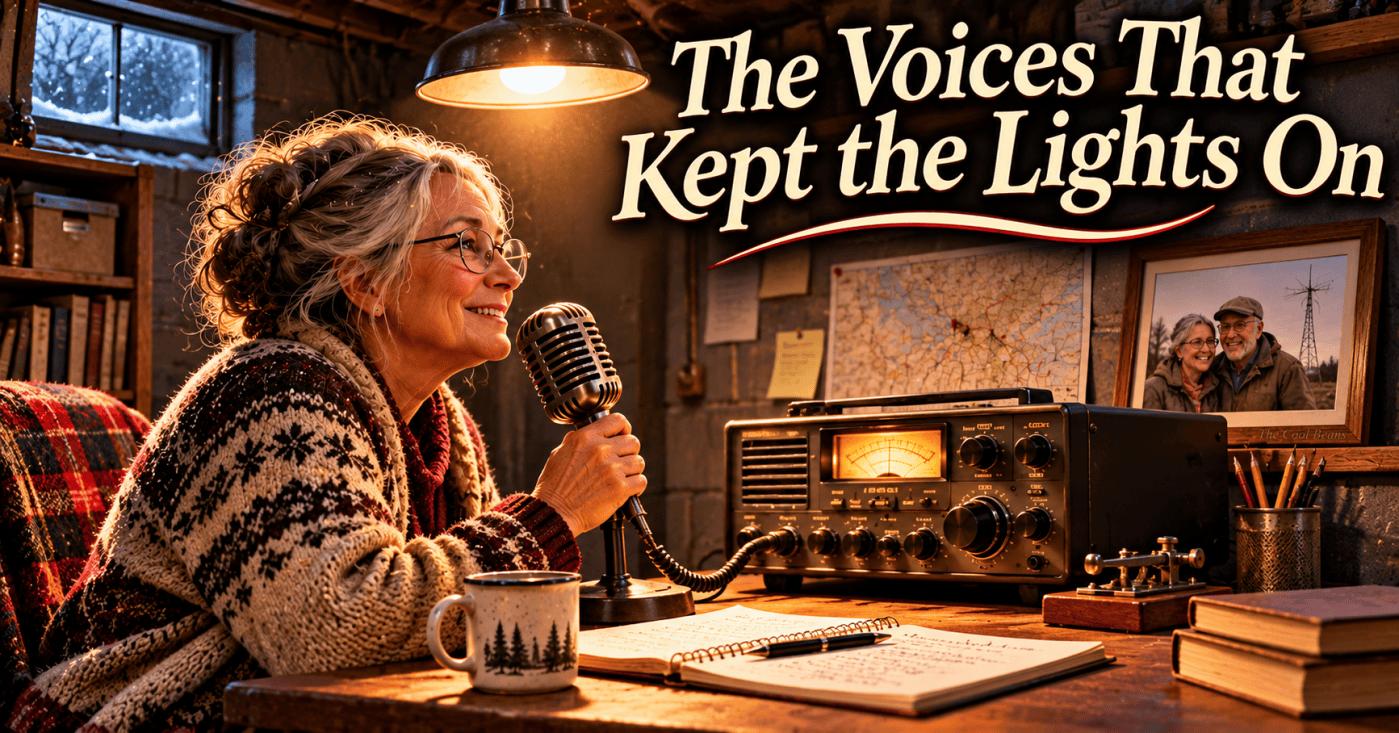
The first thing Eleanor Hayes noticed when the power went out was the silence. Not the ordinary silence of a quiet evening, but something deeper. The refrigerator stopped humming, the furnace clicked off, and the little clock above her kitchen sink went dark, its glowing numbers disappearing in an instant. Outside, the streetlights flickered once, twice, and vanished. Eleanor stood at her kitchen window, watching darkness spread across the neighbourhood. House after house disappeared into the night until the only light came from a few flashlights moving behind curtains.
A powerful ice storm had swept through the region that afternoon, coating trees and power lines in thick, glittering layers of ice. By evening, branches were snapping under the weight, roads were blocked, and thousands of homes were without electricity. At sixty-seven, Eleanor had lived through enough storms to know that the first night was usually the easiest. People still had food, their houses were warm, and their phones had batteries. It was the days afterward that could become difficult.
She pulled on a wool cardigan, picked up her flashlight, and headed downstairs to the little room her late husband had affectionately called Mission Control. It was hardly an impressive operation. A wooden desk sat beneath a window, surrounded by shelves of old radio equipment, tangled cables, notebooks, and a framed photograph of Eleanor and her husband, Samuel, laughing beside an enormous antenna. Samuel had introduced her to amateur radio forty years earlier. He had loved the idea that an ordinary person sitting in an ordinary house could speak to someone hundreds of kilometres away without needing a telephone.
After Samuel died, Eleanor had kept the equipment running. Some evenings, she spoke with operators in neighbouring towns. Other nights, she simply listened to distant voices travelling through the static. Her children called it her old-fashioned hobby, although Eleanor preferred to think of it as keeping a little piece of Samuel alive. That night, however, her beloved hobby became something much more important.
Eleanor connected her radio equipment to its backup battery, adjusted the controls, and leaned toward the microphone. “This is Victor Echo Three Echo Hotel, calling any station monitoring. We have a widespread power outage in our area. Is anyone receiving?” A burst of static answered, followed by a familiar voice. “Reading you loud and clear, Eleanor. This is Peter, about twenty kilometres east. We’ve lost power here, too.” Eleanor smiled and settled into her chair. “Well, Peter, it looks like we’re having ourselves a little adventure.” Neither of them knew just how important that conversation would become.
By morning, the neighbourhood had changed. The roads were still buried beneath fallen branches, cell service had become unreliable, and the local grocery store had closed. With the temperature dropping, people began gathering outside their homes, exchanging worried looks and whatever information they had managed to collect. Eleanor stood on her porch with a notebook and a thermos of tea, watching her neighbours shuffle carefully along the icy sidewalks. When several of them gathered near her driveway, she raised her voice and announced that anyone who needed something should come and tell her. She had a radio that still worked, she explained, and she knew people who knew people.
Her neighbour, Daniel Brooks, laughed when he heard her announcement. “You’re telling me that enormous antenna of yours is finally going to be useful?” he asked. Eleanor gave him a look of exaggerated offence before replying, “Daniel, I’ve been waiting twenty years for you to say that.” He became her first volunteer, and within hours, Eleanor’s notebook was filled with names, addresses, and requests. Mrs. Patel, who lived alone at the end of the street, needed drinking water. A young couple with a newborn was running low on baby supplies. An older gentleman named Arthur couldn’t safely walk across his icy driveway. Several households had little food that could be prepared without electricity.
Eleanor contacted other amateur radio operators, who passed along information to local emergency volunteers and neighbouring communities. Through their connections, they learned where supplies were available, which roads were passable, and where warming centres had opened. Daniel organized a small team of neighbours to deliver whatever they could safely carry. A teenager named Sophie offered to check on residents who lived alone, while the retired mechanic across the street volunteered his truck once the main road was cleared. What had begun as one woman sitting beside an old radio was quickly becoming a neighbourhood-wide effort.
By the second afternoon, Eleanor’s dining room had become an unofficial neighbourhood headquarters. Her kitchen table was covered with handwritten lists, maps, pencils, and scraps of paper bearing telephone numbers and addresses. Someone taped a sign to her front door that read, “NEED HELP? HAVE HELP? COME INSIDE.” Underneath, in smaller letters, Daniel added, “PLEASE BRING BISCUITS. MANAGEMENT IS VERY DEMANDING.” Eleanor laughed when she discovered his addition and decided to leave it there. By evening, someone had delivered an entire tin of homemade shortbread, which Daniel immediately declared proof that his advertising campaign was working.
On the third night, something unexpected happened. A little girl named Lily arrived at Eleanor’s door holding a flashlight and a folded piece of paper. Her pink winter hat was pulled almost to her eyebrows, and her cheeks were bright red from the cold. She explained that her grandmother had told her about Eleanor’s radio and wanted to know whether Eleanor could ask somebody to tell her a bedtime story. Their house had become terribly quiet without the television or music, and Lily was finding the darkness unsettling. Eleanor looked down at the little girl and realized that, for three nights, everyone had been talking about broken power lines, food, batteries, and cold houses. Nobody had mentioned how frightening the silence could be, especially for children.
Eleanor crouched beside Lily and offered to tell her a story herself. Lily considered the proposal carefully before asking whether Eleanor was any good at storytelling. “Absolutely terrible,” Eleanor admitted with a grin. “But I make excellent sound effects.” That evening, after the urgent radio messages had been handled, Eleanor arranged a short storytelling session with a few amateur radio friends. Several households with suitable battery-powered receivers could listen from home, while nearby families gathered in Eleanor’s living room and on her sheltered porch.
She began with a story about a stubborn little dragon who was afraid of the dark. Peter, listening from the next town, contributed the voice of a very dramatic wizard, while another operator named Ruth supplied the sound of a dragon sneezing. Eleanor improvised the story as she went along, occasionally forgetting the names of her own characters and once accidentally turning the wizard into a talking potato. By the end, Lily was laughing so hard that her grandmother had to remind her to breathe. When the story finished, the little girl announced that it had been the best night of the entire blackout, which Eleanor considered a rather impressive achievement for a story featuring a confused potato.
The next evening, twelve children arrived. By the fifth night, the storytelling sessions had become the most anticipated part of the blackout. Someone brought a book of fairy tales, while another neighbour contributed a collection of old ghost stories, although Eleanor insisted that anything too frightening would be postponed until the lights came back on. A retired teacher volunteered to read poetry, and Arthur, the gentleman who had needed help crossing his driveway, surprised everyone by telling hilarious stories about his childhood on a farm. He had an extraordinary talent for making ordinary events sound ridiculous, especially when describing the time a particularly determined rooster had chased the local postman into a pond.
The radio operators began sharing stories from their own communities, too. A woman from a nearby town described the time her family accidentally brought a goat to a wedding, while a man from farther north told the children about seeing the northern lights for the first time. One evening, a young radio enthusiast read a story he had written himself. His voice trembled at first, and he stumbled over several sentences, but Eleanor encouraged him to continue. By the time he reached the ending, he was speaking confidently, and the children applauded so enthusiastically that he promised to write another story for the following week.
The neighbourhood began changing in ways nobody had expected. People who had lived three houses apart for fifteen years learned each other’s names. A widower who rarely left his home discovered that the teenager next door loved the same old detective novels he did. Two families who had exchanged nothing more than polite waves for years began sharing meals. Someone found an old camping stove and helped prepare hot food outdoors in a safe, sheltered spot. Others brought blankets, board games, and spare batteries, while the children made colourful signs thanking the volunteers. Even those who had nothing material to contribute discovered that they could offer something valuable, whether it was a story, a listening ear, or a few minutes of companionship.
Every night, just before the storytelling began, Eleanor would ask the same question: “Before we start, does anybody need anything?” Sometimes the answer was food, and sometimes it was a warm place to spend the afternoon. Occasionally, someone needed help clearing a walkway or finding a way to contact a family member. More often than Eleanor expected, people simply needed someone to talk to. She began to understand that loneliness could be just as difficult to endure as the cold, and that a few kind words could make an enormous difference to someone who felt forgotten.
On the sixth night, Eleanor received a message that made her sit very still. It came from a radio operator in a neighbouring community, where an elderly woman named Margaret had been trying to reach her sister. Their usual telephone calls had stopped when the power failed, and Margaret was becoming increasingly frightened. When Eleanor heard the sister’s name, she recognized it immediately. Margaret was trying to reach Mrs. Patel, who lived at the end of Eleanor’s street.
Daniel walked down the street to check on her and returned with the reassuring news that Mrs. Patel was safe and comfortable at a neighbour’s house. Eleanor passed the information back through the radio network, and a few minutes later, Margaret’s voice came through, faint and crackling. She asked Eleanor to tell her sister that she loved her. Eleanor swallowed the sudden lump in her throat and promised that she would. There was a brief pause before Margaret added that her sister still owed her twenty dollars. Eleanor burst out laughing, and when she delivered the message, Mrs. Patel laughed so hard that tears rolled down her cheeks. “Tell her she’ll get it when she learns to behave herself,” she replied.
For the first time since the storm, Eleanor felt something inside her settle. Samuel had always said that radios were wonderful machines, but the people at either end were what made them extraordinary. Now she understood exactly what he meant. The equipment could carry a voice across great distances, but it was the kindness behind those voices that mattered. A simple message could reassure a frightened sister, make a lonely neighbour smile, or remind someone that they had not been forgotten.
On the seventh afternoon, the electricity returned. It happened without ceremony. The refrigerator hummed, the furnace started, clocks flashed meaningless numbers, and porch lights glowed in the fading daylight. Across the neighbourhood, people cheered. Children ran from house to house announcing that their televisions worked again, someone opened their garage door simply because they could, and Daniel stood in his driveway applauding a streetlight. Eleanor watched from her kitchen window, smiling at the excitement spreading along the street.
Then she went downstairs and switched off her backup radio equipment. For the first time in a week, Mission Control was quiet. She should have felt relieved, and part of her certainly was. The houses would be warm again, the roads would soon be cleared, and people could return to their ordinary routines. Yet as she looked around the little room, Eleanor felt strangely lonely. The house seemed much larger without the constant footsteps, conversations, and laughter that had filled it throughout the week.
The following Sunday, Eleanor was sitting at her kitchen table when the doorbell rang. When she opened the door, she found Lily standing on her porch. Behind her were Daniel, Sophie, Arthur, Mrs. Patel, and at least fifteen other neighbours. Lily held a homemade sign decorated with stars, hearts, and a rather lopsided dragon. With an expression of great seriousness, she informed Eleanor that she was late. Eleanor blinked in confusion and asked what she was late for. “Story night!” Lily announced, as though the answer should have been obvious.
Eleanor laughed and reminded her that the power had come back on. Lily looked genuinely puzzled and simply asked, “So?” Daniel stepped forward carrying a tray of biscuits and explained that the neighbourhood had taken a vote. Apparently, Eleanor was stuck with them. She tried to protest that everyone had perfectly good televisions and radios again, but nobody seemed particularly interested in her argument. Within minutes, her living room was full of people, the biscuits were disappearing, and Arthur was already preparing another ridiculous story about his childhood. Eleanor laughed until her eyes filled with tears, realizing that the connections they had made during the blackout were not going to disappear simply because the lights had returned.
Within a month, Sunday storytelling had become a neighbourhood tradition. During warmer weather, everyone gathered in the little park at the end of the street. When winter returned, they met at the community centre. Children read stories they had written themselves, adults shared memories, poems, and jokes, and occasionally someone attempted a song with considerably more enthusiasm than talent. Peter and Ruth sometimes joined through the radio, much to the children’s delight. Lily eventually wrote her own adventure about a dragon who was afraid of the dark, dedicating it to Eleanor and the talking potato that had somehow become a neighbourhood legend.
The neighbourhood also established a volunteer group to check on residents during storms, organize supplies for emergencies, and make sure nobody felt forgotten. They called it The Neighbourhood Connection, although Eleanor insisted that the name was far too sensible. She preferred Daniel’s suggestion, “The Society of People Who Finally Learned Their Neighbours’ Names.” While the official name remained unchanged, Daniel’s version became the group’s unofficial motto, appearing on everything from handwritten meeting notices to the annual neighbourhood picnic invitations.
There was one tradition Eleanor refused to change. Every Sunday evening, before the first story began, she stood before the gathering and asked her familiar question: “Does anybody need anything?” And every Sunday, someone had an answer. Sometimes it was a ride to an appointment, help carrying groceries, a friendly visit, or an extra pair of hands in the garden. Other times, nobody needed anything at all. They simply wanted to be together, sharing the comfort of knowing that they belonged somewhere and that the people around them genuinely cared.
One evening, almost a year after the storm, Eleanor found Lily sitting beside the old radio in Mission Control. The little girl had grown taller, and her questions had become more thoughtful. As she examined the equipment, she asked whether Eleanor thought the power would ever go out again. Eleanor considered the question and admitted that it probably would someday. Lily grew quiet before asking whether they would be okay if it happened. Eleanor looked at the little girl, then through the window toward the houses glowing warmly along the street. She smiled and told her that she thought they would be just fine.
Lily wanted to know whether that was because of Eleanor’s radio. Eleanor shook her head gently and explained that the radio had helped them find one another, but they were the ones who had decided to stay connected. Lily thought about that for a moment before reaching for Eleanor’s hand. Together, they sat quietly beside the equipment that had brought so many people together, listening to the gentle hum of a house filled with electricity and the distant laughter of neighbours gathering outside.
Years later, people in the neighbourhood would still talk about the great blackout. They remembered the icy roads, the cold houses, and the endless nights without electricity. But mostly, they remembered the voices. They remembered the woman who asked if they needed anything, the strangers who became friends, the stories that made children laugh when the world outside seemed frightening, and the people who showed up carrying blankets, food, and kindness. They remembered how an ordinary neighbourhood had become a community, not because of a grand plan or an extraordinary act, but because people had chosen to care for one another.
And Eleanor, who had spent so many years speaking into a radio, discovered that the most beautiful thing about being heard wasn’t having someone answer from far away. It was knowing that, when you needed them, the people closest to you would answer, too. She had spent decades believing that Samuel’s greatest gift to her had been teaching her how to communicate with the world. In the end, she realized that his greatest gift had been teaching her the importance of listening.
Because sometimes, when the lights go out, we finally begin to see one another. And sometimes, the connections we make in the darkness become the brightest things we carry into the light.
Enjoying what you find here? 💜 Consider subscribing and becoming part of our little community. It’s a simple way to stay connected, support what we do, and make sure you don’t miss what’s coming next. We’d truly love to have you here. 🌿✨


Leave a Reply