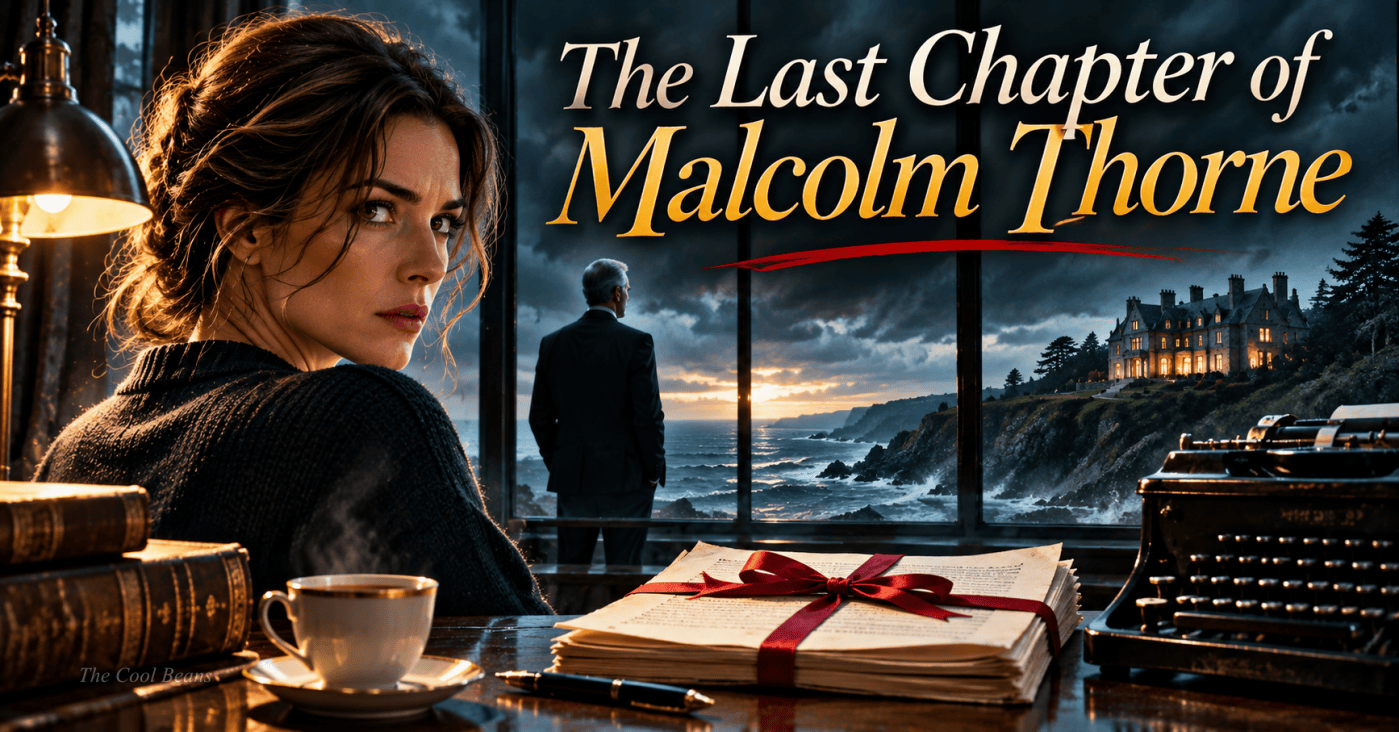
The first thing Iris Calder noticed about Malcolm Thorne was that he never answered a question without first deciding how much of the truth she deserved. The second was that he never seemed to forget anything. Not a date, not a conversation, not the colour of a stranger’s coat from thirty years earlier. His memory was extraordinary, almost unnaturally precise, which Iris supposed was one of the reasons he had become one of the wealthiest men in the world.
Malcolm had built Halcyon Systems from a modest computer software company in 1989 into a technological empire worth billions. He had revolutionized digital information storage, government recordkeeping, and corporate security long before most people understood what the internet would become. Now, at sixty-eight, he lived alone in a sprawling estate overlooking the Atlantic, surrounded by expensive artwork, silent security personnel, and enough technological equipment to operate a small country. He rarely appeared in public, refused interviews, and hadn’t attended a company event in nearly twelve years. His photographs were almost always decades old, and rumours about his health had become a favourite subject of financial journalists.
Which was why Iris couldn’t understand why he had chosen her to write his memoir. She was forty-one, divorced, and three months behind on her mortgage. Her first novel had received respectable reviews and disappointing sales. Her second had been rejected by eleven publishers, and her literary agent had recently suggested that perhaps she should consider writing something more commercially appealing. When Malcolm’s representative offered her $175,000 to ghostwrite his autobiography, she assumed there had been a mistake. There hadn’t been.
The contract was unusually strict. Iris would live at the estate for six weeks, conduct interviews exclusively on the property, and surrender all recordings and working drafts to Malcolm’s private archive. She was forbidden from discussing the project with anyone until publication. The confidentiality agreement was nearly forty pages long, and the penalties for violating it were enough to frighten someone considerably wealthier than she was. Her agent called it the opportunity of a lifetime. Iris called it a way to keep her house. She signed.
Ashdown House stood on a rocky peninsula three hours from the nearest major city. The building was a magnificent contradiction of old-world elegance and modern technological paranoia. Its stone exterior resembled a nineteenth-century manor, but the windows contained reinforced glass, the doors operated through biometric locks, and discreet cameras watched every corridor. Malcolm greeted Iris in a library overlooking the ocean. He was tall and painfully thin, with silver hair, immaculate clothing, and pale grey eyes that seemed to examine people the way a scientist might examine an unfamiliar specimen.
“Miss Calder,” he said, extending his hand. “I’ve read everything you’ve written.” Iris smiled politely and replied, “That can’t have taken very long.” To her surprise, Malcolm laughed. “Self-deprecation. A useful defence mechanism. Particularly among people who are afraid of being underestimated.” She wasn’t sure whether he’d complimented or insulted her.
He gestured toward a leather chair opposite his desk and asked whether she believed everyone deserved to have their story told. Iris considered the question before replying that she thought everyone had a story worth understanding. “Even terrible people?” Malcolm asked. “Understanding someone isn’t the same as forgiving them,” she answered. Malcolm studied her for several seconds before smiling. “Excellent. I believe we’ll get along very well.”
For the first four days, the interviews were exactly what Iris had expected. Malcolm spoke about his childhood in a struggling industrial town, his fascination with mathematics, his difficult relationship with his father, and the early years of Halcyon Systems. He described sleeping beneath his desk, surviving on instant coffee, and persuading investors to support technologies they barely understood. He was charming when he wanted to be, occasionally funny, and surprisingly candid about his business failures.
Yet there was something unsettling about the way he told stories. He never seemed to remember people as individuals. They were obstacles, opportunities, disappointments, or useful connections. Even his former wife appeared in his recollections primarily as someone who had distracted him during a critical product launch. Iris began to notice that Malcolm could describe a financial transaction from thirty years earlier in extraordinary detail but rarely mentioned how anyone involved had felt about it.
On the fifth afternoon, Iris asked about the company’s expansion during the 1990s. Malcolm leaned back in his chair and stared through the library windows. “The nineties,” he murmured. “An extraordinary decade. Everyone was convinced technology would make the world more transparent. They never considered how much easier it would become to hide things.” When Iris asked what he meant, he replied, “Anything. Money. Mistakes. People.” He smiled faintly before adding, “People are surprisingly easy to erase, Iris. Particularly when nobody important is looking for them.”
She waited for him to elaborate, but he had already moved on to discussing a government contract signed in 1993. Later that evening, while reviewing her notes, Iris found herself returning to that sentence. People are surprisingly easy to erase. She underlined it twice, although she couldn’t have explained exactly why it disturbed her.
The following morning, Malcolm told her about a young woman he had met in a roadside diner in October 1993. He didn’t mention her name, only that she had been twenty-four, worked nights, and wanted to become a photographer. “She wore a red coat,” he recalled. “Terrible quality. The lining was coming apart, so she’d sewn seven little blue stitches into the left cuff. She was very proud of having repaired it herself.”
Iris wrote down the detail and asked what had happened to her. Malcolm looked toward the window before replying, “She disappeared.” When Iris asked whether he meant the woman had disappeared from his life, he corrected her. “From everyone’s.” He allowed the silence to stretch between them before continuing. “Some people spend their entire lives waiting for someone to notice they’re gone.”
Iris felt an uncomfortable tightening in her stomach and asked whether the woman had ever been found. Malcolm turned back toward her with an expression she couldn’t quite interpret. “Would that make the story better?” he asked. It was the first time Iris realized that his questions were sometimes more revealing than his answers.
That night, she searched the internet for missing women from October 1993. After nearly two hours, she found an archived newspaper article about a twenty-four-year-old diner waitress named Elena Price, who had vanished from the town of Bellweather on October 17, 1993. Elena had dreamed of becoming a photographer, and the article included a photograph of her smiling beside an old camera. She was wearing a red coat.
Iris stared at the screen. There was no mention of blue stitching. She told herself it was a coincidence. Malcolm had lived in the area during the early years of his company. Perhaps he’d known Elena. Perhaps he’d even been interviewed by police. But when she searched his name alongside Elena’s, nothing appeared.
The next morning, Iris asked whether he remembered the woman’s name. Malcolm didn’t hesitate before telling her that, of course, he remembered it. When she asked whether he would tell her, he regarded her with mild amusement. “Why? Do you intend to write her into my autobiography?” Iris replied that she might. Malcolm smiled. “Then call her Elena.”
Iris’s pen stopped moving. She hadn’t told him she’d found the article, yet Malcolm watched her expression change as though he’d been expecting precisely that reaction. “Something wrong?” he asked. Iris forced herself to smile and told him everything was fine. His smile widened almost imperceptibly. “Good. Shall we continue?”
Over the next week, the interviews became increasingly disturbing. Malcolm spoke about a mechanic who had threatened to expose irregularities in Halcyon’s early contracts. He described the man’s habit of chewing peppermint gum and the way he always left his car keys on the dashboard. Iris later found a cold case from 1995 involving Peter Bell, a mechanic whose abandoned vehicle had been discovered beside an old quarry. Police had never established whether he’d disappeared voluntarily or met with foul play.
Then Malcolm recalled a woman who had worked briefly as a financial consultant for his company in 1998. “Very clever,” he said. “Far too clever for her own good. She believed that if she uncovered something dishonest, the truth would somehow protect her.” When Iris asked what had happened to the woman, Malcolm folded his hands and replied, “She made the mistake of assuming that being right was the same as being safe.”
Iris felt cold. She asked whether the woman had disappeared too, but Malcolm didn’t answer immediately. Instead, he asked, “Have you ever wondered why some people leave without saying goodbye?” The question struck her with such unexpected force that she nearly dropped her pen.
Her mother had disappeared in November 1998. June Calder had been thirty-six years old, an accountant who worked on short-term contracts for several technology companies. One Friday evening, she had told eleven-year-old Iris that she needed to attend a meeting and would be home before bedtime. She never returned.
For years, police had treated June’s disappearance as a possible voluntary departure. There had been no evidence of violence, no confirmed sightings, and no indication that she had been abducted. Eventually, the investigation had grown cold. Iris had spent much of her childhood wondering why her mother had left her. Even now, twenty-eight years later, the unanswered question lived inside her like a room she had never been able to enter.
Iris looked at Malcolm and demanded to know why he would ask her about people leaving without saying goodbye. He tilted his head, pretending not to understand what had upset her. When she repeated the question, he answered simply, “Because you understand what that feels like.”
Her heart began pounding. She wanted to know how he could possibly know anything about her mother’s disappearance. Malcolm reached for his glass of water and explained that he’d researched her before offering her the position. Surely, he said, she hadn’t imagined he would invite a stranger into his home without knowing something about her.
Iris forced herself to remain calm and reminded him that her mother’s disappearance had nothing to do with his memoir. Malcolm regarded her with an expression that made her stomach turn. “Doesn’t it?” he asked softly. Then he glanced at his watch and announced that they’d done enough for the day.
That evening, Iris called her agent. The call connected, but the reception was poor. She explained that she wanted to leave the estate and finish the project remotely. Her agent sounded confused and reminded her that she was barely halfway through the assignment. Iris lowered her voice and admitted that something wasn’t right. When her agent asked what she meant, Iris glanced toward the closed bedroom door and whispered that she thought Malcolm Thorne knew something about her mother.
There was a brief silence before her agent asked whether she’d read the background material sent before she signed the contract. Iris frowned and asked what background material he meant. “The private briefing,” he replied. “About your connection to the company.” Iris sat upright and demanded to know what connection he was talking about, but before her agent could answer, the call disconnected.
A message appeared on her phone informing her that the network connection was unavailable. She tried calling back, but nothing happened. A moment later, the bedroom intercom crackled, and the estate manager’s voice reminded her that personal calls should be made through the designated communications office. Iris stared at the speaker. She had never been told there was a designated communications office. She had also never told anyone she was making a call.
The following morning, she confronted Malcolm. He was sitting in the library, reading a newspaper, when she demanded to know whether her mother had worked for him. Malcolm greeted her pleasantly, but Iris repeated the question until he finally folded the newspaper and admitted that June had been an exceptionally intelligent woman.
Iris felt the room tilt. He knew her mother. When she demanded to know why he hadn’t told her, Malcolm replied that she hadn’t asked. She pressed him to explain what had happened to June, but he described the question as complicated. “Then give me a complicated answer,” Iris snapped. Malcolm smiled and remarked that she was finally beginning to sound like a writer.
Iris stood and announced that she was leaving. Malcolm told her she was free to go, although he encouraged her to read the next chapter before making that decision. He slid a thin folder across the desk. Inside were photocopies of financial documents, internal company correspondence, and a photograph of June Calder standing beside Malcolm at a corporate event in 1998.
Iris stared at her mother’s face. June looked younger than Iris remembered, smiling politely at the camera, her dark hair tucked behind one ear. Beneath the photograph was a handwritten note that read, She knew about the others.
When Iris asked what others the note referred to, Malcolm’s expression changed. For the first time since she’d arrived, the amusement disappeared from his eyes. He named Elena Price and Peter Bell, then mentioned two more people Iris hadn’t discovered yet. She could barely breathe as she asked what he was trying to tell her.
Malcolm leaned forward and explained that June had discovered something she should never have seen. Iris stared at him and asked the question she’d been afraid to speak aloud. “Did you kill her?” The words hung between them while waves crashed against the rocks outside. Malcolm didn’t look away, but he didn’t answer directly.
Instead, he asked whether Iris knew what separated a confession from a story. When she remained silent, he answered his own question. “The person who controls the telling.” He pushed the folder closer and explained that June had wanted to expose him. She believed truth was a weapon, he said, but she hadn’t understood that the person holding a weapon wasn’t necessarily the person who got to use it.
Iris stared at him in disbelief. She accused him of confessing to murder, but Malcolm remained calm. He insisted that he was merely telling a story about a man who had made difficult decisions while constructing an empire. Whether those decisions constituted murder, he suggested, depended entirely on the language they chose.
Iris felt sick. He wasn’t frightened. He was enjoying himself. That was when she understood something far more terrifying than the possibility that Malcolm Thorne was responsible for her mother’s disappearance. He had wanted her to discover it.
Every detail, every carefully chosen sentence, and every unsettling pause had been deliberate. The red coat, the blue stitches, the mechanic’s keys, and the woman who believed the truth would protect her weren’t accidental slips. They were invitations. Malcolm had been leading her toward these discoveries from the moment she’d arrived.
When Iris asked why he’d chosen her, Malcolm’s expression softened into something that might have resembled sympathy if it hadn’t been so calculated. He explained that her mother had been the only person who ever came close to destroying him. He had wanted to know what June’s daughter would do when she learned the truth.
Iris glanced toward the library door, and Malcolm immediately noticed. He assured her that she could leave whenever she wished, but encouraged her to consider what evidence she possessed. A few ambiguous conversations, some old newspaper articles, and her own childhood trauma would hardly be enough to accuse one of the world’s wealthiest men of murder.
He reminded her that he’d spent thirty years preparing for people to misunderstand his life, while she’d spent only ten days trying to understand it. Iris realized he had already rehearsed every possible accusation. He had lawyers, influence, security systems, and an entire company built around controlling information. She had a notebook, and he knew it.
That afternoon, Iris returned to her room and began packing. She moved slowly, trying to steady her breathing while she considered what to do next. Then she noticed something strange. Her laptop had been moved, only slightly, but enough that she recognized it. The screen had been angled differently, and the charging cable was tucked beneath the desk instead of hanging over the edge.
She opened the computer and discovered that her manuscript was gone. In its place was a new document titled The Necessary Evil: The Life of Malcolm Thorne. The first several chapters contained her original writing, but later sections had been altered. Malcolm’s comments about the missing people had been rewritten as hypothetical business lessons. Elena Price had become an unnamed employee who left after a disagreement, while Peter Bell was described as a disgruntled contractor.
June Calder appeared as a troubled accountant who had allegedly falsified records and disappeared to avoid prosecution. At the bottom of the document was an author’s note claiming that Iris had found no credible evidence connecting Malcolm Thorne to criminal wrongdoing. It stated that her personal family history had initially clouded her judgment, but that the records spoke for themselves. Beneath the note was Iris’s name.
She stared at the screen as the truth finally became clear. Malcolm hadn’t hired her to confess. He had hired her to create the definitive version of events, one that would carry the credibility of the missing woman’s daughter. If the cold cases were ever reopened, he would have a published memoir, a respected writer, and an apparently independent investigation declaring him innocent.
He was turning her mother’s disappearance into a footnote in his own defence, and he expected Iris to help him. For nearly an hour, she sat motionless, staring at the altered manuscript. Then she closed the laptop. Malcolm had made one mistake. He believed that because he understood how people behaved when they were afraid, he understood what they would do when they were angry.
At dinner, Iris told him she had reconsidered and wanted to finish the book. Malcolm studied her over his wineglass before congratulating her on making an excellent decision. She agreed to continue but explained that the manuscript needed work. When Malcolm asked why, Iris told him that the current version made him sound defensive.
He seemed genuinely offended by the suggestion. Iris explained that he kept describing why people had disappeared without acknowledging what he’d actually done, making him appear frightened of the truth. Malcolm set down his glass and insisted that he wasn’t frightened of anything. Iris challenged him to stop writing like a man who was hiding.
For a moment, she wondered whether she’d gone too far. But Malcolm’s vanity was stronger than his caution. He asked what she would suggest instead, and Iris proposed a private chapter, something honest that wouldn’t necessarily be published but would help her understand his motivations. Malcolm recognized that she was asking for a confession, but Iris carefully reframed the idea. She wanted the version he would write if he weren’t worried about what anyone thought.
Malcolm considered the proposition before smiling. He found the idea interesting, and Iris knew she’d found the weakness she needed. Over the next three days, she worked carefully, allowing Malcolm to believe he was guiding her toward a more sophisticated understanding of his life.
She challenged his descriptions, questioned his motives, and deliberately misunderstood details until his irritation overcame his restraint. Whenever he described a victim as foolish, she asked why someone so foolish had been a threat. Whenever he spoke about unfortunate accidents, she asked why an innocent man had gone to such extraordinary lengths to conceal them. And whenever he tried to dismiss June Calder as insignificant, Iris reminded him that her mother had frightened him enough to remain in his memory for nearly thirty years.
Malcolm hated that suggestion. He hated it so much that he began correcting her. One afternoon, he revealed that June hadn’t simply discovered the financial records. She had copied them from a private server in the old research building. When Iris asked how he knew, Malcolm admitted that he’d been there when she did it.
Iris kept her expression neutral and asked whether he’d confronted her. Malcolm confirmed that he had, explaining that June had refused to surrender the documents. Iris glanced at her notes and suggested that he’d allowed her to leave. Malcolm laughed, a short and unpleasant sound, before telling her not to be ridiculous.
She waited patiently as he looked toward the window. Eventually, he explained that June had been stubborn. She believed she could threaten him with the authorities and had assumed there were still people in government who couldn’t be bought, frightened, or persuaded. When Iris asked whether such people existed, Malcolm admitted that they did. That, he explained, was why the situation had become so inconvenient.
Iris’s pen moved steadily across the page as she asked where he’d taken her mother. Malcolm was silent for several seconds before revealing that there had been an old pumping station beneath the research facility. The building had been demolished in 2004, but the foundations had never been removed.
Iris felt her pulse hammering. She asked whether that was where June had died. Malcolm turned toward her, and for the first time, something resembling uncertainty crossed his face. He told her she was asking the wrong question. When she asked what the right question would be, he looked at her notebook and asked why he had allowed her to write any of it down.
Iris went cold as Malcolm pressed a button beneath his desk. A soft electronic chime sounded, and the library door locked. He asked whether she had genuinely believed he would allow her to sit in his home collecting evidence against him.
Malcolm gestured toward the ceiling and explained that every conversation in the house was recorded, every document was stored on his servers, and every device she used belonged to him. She had written nothing he hadn’t already read. He stood and walked toward her, reminding her that he’d offered her an extraordinary opportunity. She could have written the book of her career, but instead, she’d decided to become her mother.
Iris slowly closed her notebook and asked why he had told her where June was. Malcolm smiled and replied that knowing something and proving it were two entirely different things. He reached for the notebook, and Iris handed it over without resistance.
Her compliance surprised him. When he asked whether she intended to fight him, Iris quietly replied that she believed he’d already won. For the first time, Malcolm appeared genuinely pleased. He unlocked the door and informed her that she could leave in the morning. The contract would be terminated, the advance forfeited, and the manuscript destroyed.
Iris thanked him, returned to her room, and waited until midnight. She had known for days that the house was monitoring her laptop, phone, and digital recordings. She had also noticed that Malcolm insisted on using expensive fountain pens and heavy stationery during interviews. He liked the permanence of handwritten corrections, particularly when they were his own, and he had a habit of pressing very hard when he wrote.
Earlier that afternoon, Iris had placed several sheets of thin carbon paper beneath the pages on which Malcolm had been making corrections. She had presented him with a deliberately inaccurate account of the pumping station, knowing his need for precision would compel him to correct it. He had crossed out her description of the old facility, written the actual location, and corrected the date.
Most importantly, Malcolm had added a sentence in his own handwriting: June Calder was still alive when I ordered the entrance sealed.
Iris had left the corrected pages in his possession, but the carbon copies were hidden inside the lining of her suitcase. She knew they weren’t enough to guarantee a conviction. A defence lawyer could question their authenticity, and Malcolm would undoubtedly claim the material was part of a fictional writing exercise. But they contained a location, a specific place that had never appeared in any police report. If her mother’s remains were there, the truth would no longer depend entirely on Malcolm’s words.
At seven the following morning, Iris walked out of Ashdown House carrying her suitcase and a small handbag. Malcolm stood beneath the entrance portico, watching her leave. He told her that some stories were better left unfinished, and Iris looked at him thoughtfully before agreeing. Malcolm smiled, apparently satisfied. Then Iris added, “But not this one.”
Two hours later, she walked into a police station and asked to speak to someone in the cold case unit. At first, the detectives were understandably cautious. Iris had no recordings, no original documents, and a story involving one of the most powerful men in the country. But when she described the old pumping station beneath Halcyon’s demolished research facility, one detective stopped taking notes.
His name was Daniel Reeves, and he’d spent the previous eighteen months reviewing unsolved disappearances linked to the company’s earliest operations. He asked how Iris knew about the building, and she placed the carbon copies on his desk. “Because Malcolm Thorne told me,” she replied. Daniel studied the pages for several moments before making a telephone call.
The investigation that followed took eleven months. Search warrants were challenged, lawyers filed motions, and Halcyon’s representatives issued statements condemning what they called a malicious attempt to damage the reputation of a respected businessman. Malcolm denied everything. He claimed Iris had misunderstood hypothetical discussions about corporate ethics and accused her of fabricating documents and exploiting her mother’s disappearance for publicity.
But the investigation continued. Beneath the concrete foundations of the former research facility, forensic teams discovered a sealed underground chamber. Inside were human remains and personal effects that investigators eventually linked to June Calder. Additional records recovered from a long-forgotten storage unit led detectives to evidence connected to Elena Price and Peter Bell. The discoveries prompted renewed investigations into two other disappearances from the 1990s.
For the first time in decades, the cases were no longer simply collections of unanswered questions. They were connected. Malcolm Thorne was arrested the following spring, and the news dominated television broadcasts, newspapers, and social media for weeks. Commentators debated how someone so powerful could have escaped scrutiny for so long, while former employees began speaking publicly about intimidation, missing records, and a corporate culture built around secrecy.
Iris watched the coverage from her living room, where the curtains were open and a half-finished manuscript lay on the coffee table. She had expected to feel triumphant, but instead, she felt exhausted. Finding her mother hadn’t restored the childhood she’d lost. It hadn’t erased the years she’d spent wondering whether June had abandoned her, and it hadn’t brought back the people whose lives had been stolen. But it had given her something she hadn’t possessed since she was eleven. An answer.
Several months after Malcolm’s arrest, Iris received a letter from his attorney. Malcolm wanted to see her. He claimed he had information about the remaining cases and would speak only if she agreed to visit him. Daniel warned her that Malcolm was probably attempting to regain control of the narrative. Iris understood the risk, but after several days of consideration, she agreed to one supervised meeting.
They sat across from each other in a small institutional room, separated by a metal table. Without his expensive suits and carefully arranged surroundings, Malcolm looked smaller. His silver hair was uncombed, his skin had a greyish pallor, and the confidence that once seemed to fill every room had diminished. But his eyes were unchanged.
Malcolm had heard that Iris was writing a book and immediately wanted to know whether it was about him. Iris replied that it wasn’t exactly about him, but Malcolm smiled faintly and insisted that everything that had happened was about him. He believed she knew that as well as he did.
Iris studied him for a moment. She saw the man she’d met at Ashdown House, the brilliant storyteller who could make cruelty sound like necessity and murder sound like a regrettable business decision. Then she remembered the photograph of her mother smiling beside him in 1998. She told Malcolm that he’d only ever wanted her to believe everything was about him.
His smile disappeared, and he reminded her that she wouldn’t have found any of the evidence without him. Iris agreed, but when he leaned forward and insisted that she owed him something, she shook her head. She owed him nothing.
Malcolm’s expression hardened. He claimed that he’d made her career by giving her the story of a lifetime. Iris replied that he’d given her the truth about her mother because he’d believed he could control what she did with it. When he looked away, she waited until he faced her again.
She explained that she’d finally understood why he’d hired her. He hadn’t wanted someone to write his memoir. He’d wanted someone he could manipulate into telling his story exactly as he wished. He couldn’t bear the thought that another person might decide which details mattered, which people deserved to be remembered, or which lives could no longer be reduced to a sentence. He had wanted the final word.
Malcolm stared at her and asked what would happen now. Iris stood and replied that he no longer got to decide how the story ended. She left before he could answer.
The book was published the following autumn. It wasn’t called The Necessary Evil, and Malcolm’s face didn’t appear on the cover. Instead, the title was simple: The Chapters He Buried.
The opening chapter told the story of Elena Price, a young woman who loved photography and dreamed of seeing the world beyond her small hometown. The next described Peter Bell, a mechanic who enjoyed fishing with his brother and never missed his daughter’s birthday. Another introduced the families who had spent decades waiting for answers that never came.
Only later did the book turn to Malcolm Thorne. When it did, Iris refused to describe him as a misunderstood genius, a visionary, or a complicated man who had made difficult choices. She described what the evidence showed, the people who had disappeared, and the extraordinary lengths one powerful man had taken to ensure their stories would never be told.
The final chapter was about June Calder. Iris wrote about her mother’s love of terrible jokes, her habit of singing while cooking, and the little handwritten notes she used to leave inside Iris’s school lunches. She wrote about the night June had promised to return before bedtime and the decades of uncertainty that followed.
Then she wrote about the moment she finally understood that her mother had never chosen to leave her. June had been trying to do the right thing. She had uncovered something terrible, and she had refused to look away. For twenty-eight years, Iris had believed her mother’s last act was abandonment. Now she knew it had been courage.
On the evening before publication, Iris sat alone at her desk, reviewing the final printed copy of her book. Outside, rain tapped gently against the windows. A cup of tea cooled beside her laptop, and the house was wonderfully, reassuringly quiet. She turned to the final page, where beneath the last paragraph, she’d included a short dedication.
For June Calder, Elena Price, Peter Bell, and everyone whose story was taken from them. You were here. You mattered. And you deserved to be remembered.
Iris closed the book. For years, she’d struggled to write an ending that felt right. Every novel she’d attempted seemed to unravel in its final chapters, as though she couldn’t quite believe that stories could reach a conclusion without leaving something essential unresolved. Now she understood that some endings weren’t about restoring what had been lost. They were about refusing to let the loss become the only thing that remained.
Her phone vibrated, and a message from Daniel appeared on the screen. The prosecutor had confirmed that additional evidence had been admitted, and he’d thought she would want to know. Iris read the message twice before looking at the book resting on her desk.
Somewhere in a prison cell, Malcolm Thorne was waiting for a courtroom to decide his future. Perhaps he was still rehearsing explanations, constructing arguments, and imagining the version of events that would restore his reputation. Perhaps he was still convinced that every story could be controlled if the right person held the pen.
Iris reached for her notebook and opened it to a clean page. For the first time in years, she wasn’t writing for money, survival, or someone else’s approval. She was writing because she wanted to. As the rain continued falling beyond her window, she began the first sentence of a new novel. This time, the story belonged entirely to her.
Hundreds of miles away, in a room where every word was recorded and every visitor carefully documented, Malcolm Thorne sat staring at the cover of the book that had finally been published. He had spent his entire adult life deciding what the world was allowed to know. He had buried evidence, destroyed records, silenced witnesses, and built an empire powerful enough to make the truth seem negotiable.
Yet the one person he had chosen to preserve his legacy had become the person who dismantled it. Malcolm opened the book to its first page and read the opening sentence. Then he read it again.
My mother did not leave me. Someone made sure she couldn’t return.
For the first time in his life, Malcolm Thorne had reached the beginning of a story whose ending he could no longer control. And there was nothing he could do to rewrite it.
Some secrets are buried because people are afraid of the truth. Others are buried because the people responsible believe they are powerful enough to keep them hidden forever. But even the most carefully constructed lies have a weakness: sooner or later, someone begins asking the questions that were never supposed to be answered.
Heart-stopping twists, delivered weekly. Subscribe so you don’t miss a beat.


Leave a Reply