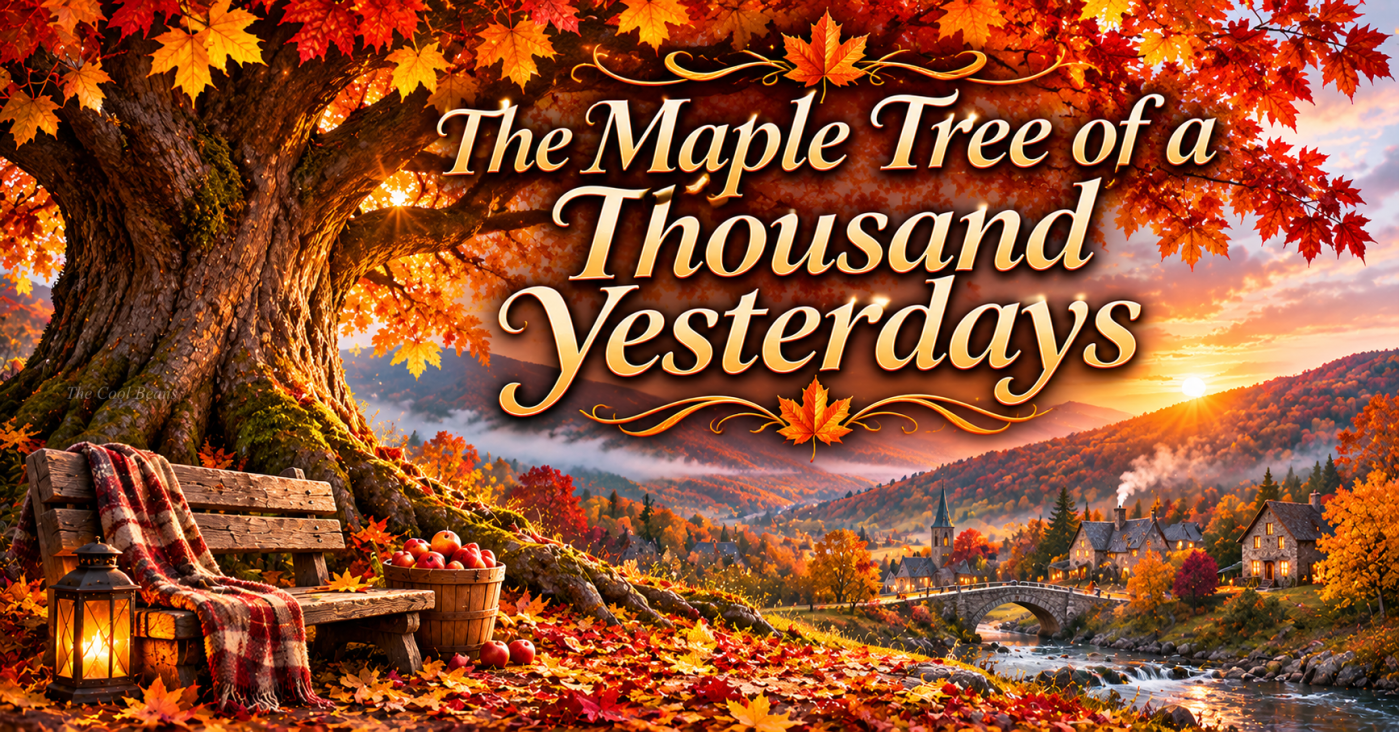
There was a little valley tucked between two mountains where autumn seemed to linger longer than anywhere else in the world. The hills glowed with shades of amber and crimson, the air smelled of woodsmoke and freshly baked apples, and a narrow cobblestone path wound through a village so small that everyone knew when a stranger arrived. At the heart of the valley stood an ancient maple tree. Its trunk was wider than three grown men could embrace, its branches stretched across an entire clearing, and its leaves shimmered with a golden light that seemed to come from somewhere deep within them.
Nobody knew exactly how old the tree was. Some said it had stood there for a thousand years. Others insisted it had been growing since the very first autumn. But everyone agreed on one thing. The tree was magical. Once each autumn, when the first cold wind swept down from the mountains, the maple released a handful of extraordinary golden leaves. Anyone fortunate enough to catch one before it touched the ground would be transported into their happiest autumn memory. Not merely remembering it, but experiencing it again, complete with the sounds, smells, warmth, and wonderful feelings of that long-ago moment.
People travelled from distant villages hoping to catch one of those leaves. Some wanted to revisit childhood adventures. Others longed to hear the laughter of someone they had lost. And a few simply wished to remember what happiness felt like. One chilly October afternoon, a weary traveller named Elias Mercer arrived in the valley carrying a battered leather suitcase and a heart that had forgotten how to feel light.
Elias was sixty-two years old, although the exhaustion in his eyes sometimes made him appear older. He had spent much of his life travelling between towns, repairing clocks, mending furniture, and taking whatever work he could find. Once, he had enjoyed the freedom of the open road. Lately, however, every new destination felt exactly like the last. His father had died the previous winter, and with him had gone the last familiar place Elias had truly called home. Since then, he had wandered without much purpose, telling himself that somewhere beyond the next hill he might discover something worth stopping for.
He first heard about the magical maple tree from an elderly woman selling apples beside the village fountain. “You’re just in time,” she told him, noticing the suitcase at his feet. “The golden leaves haven’t started falling yet.” Elias managed a tired smile and asked what exactly happened if someone caught one. The woman looked at him with eyes that seemed to understand far more than he had said. “You get to visit a day your heart has never forgotten.” Elias looked toward the distant grove, where the enormous maple rose above the surrounding trees like a golden crown. For the first time in months, he felt something resembling curiosity.
The following morning, he made his way to the grove. He had expected to find a quiet, solemn gathering of people waiting beneath the ancient branches. Instead, he discovered something that looked remarkably like a village picnic. Children raced through piles of fallen leaves, two elderly gentlemen argued cheerfully over a game of checkers, and a woman arranged apple pastries on a wooden table while a little boy attempted to sneak one when she wasn’t looking. Someone had brought a fiddle, and somewhere nearby, a kettle whistled over a small outdoor stove.
Elias stood at the edge of the clearing, uncertain whether he had arrived at the right place. “You look lost,” announced a small voice. He glanced down to find a girl of about nine standing beside him. She had enormous brown eyes, a crooked woollen hat, and a leaf stuck in her hair. “Perhaps I am,” Elias admitted. “That’s all right. Most people are when they first come here.” She extended her hand with tremendous seriousness. “I’m Nora. I’m in charge of welcoming people.” Elias raised an eyebrow and asked whether that was an official position. “Very official,” Nora assured him. “Grandma says I’m the only person in the village who can talk for twenty minutes without breathing.” Elias laughed before he could stop himself, and Nora beamed, apparently delighted by her success.
She took his hand and led him toward the enormous maple. Its branches swayed gently overhead, although there was barely any wind. Nora asked whether he had ever caught a golden leaf, and when Elias shook his head, she smiled reassuringly. “Well, don’t worry. They’re very good at finding the people who need them.” Elias wondered what she meant, but before he could ask, a sudden breeze swept through the clearing. The villagers grew quiet as the ancient branches began to shimmer. Hundreds of ordinary red and orange leaves fluttered through the air, and among them drifted a few extraordinary ones, glowing like tiny pieces of captured sunlight.
One golden leaf floated directly toward Elias. He reached out instinctively, and the moment it touched his palm, the world disappeared. Suddenly, he was nine years old again, standing in an apple orchard beneath a brilliant October sky. His father was balancing a basket of apples on his head, pretending to be a grand and important king. His mother was laughing so hard that she had to lean against a tree, while his little sister chased a butterfly through the fallen leaves.
Elias remembered this day. It had been the last autumn before his mother became ill, before responsibilities and worries began changing the shape of their family. They had spent the entire afternoon picking apples, eating far too many of them, and inventing ridiculous games. His father had declared himself King of the Orchard, and Elias had been appointed Royal Inspector of Worms. He could hear his father’s laughter again, not as a distant memory, but as clearly as if the years between them had never existed.
Then his father crouched beside him, his eyes warm and smiling. “Remember something, Elias,” he said, placing a hand on his shoulder. “The best days aren’t always the grand ones. Sometimes they’re just ordinary days when you’ve got the right people beside you.” Young Elias had nodded without understanding, but now, more than fifty years later, he understood perfectly. The orchard slowly dissolved, and Elias found himself standing beneath the ancient maple again, tears streaming down his cheeks. He looked at the golden leaf in his hand. Its glow had faded, leaving behind an ordinary autumn leaf, soft and fragile.
For several moments, Elias couldn’t speak. Nora stood quietly beside him, giving him time to collect himself before asking whether it had been a good memory. Elias wiped his eyes and smiled. “The very best,” he whispered. Nora nodded as though this were exactly what she had expected. “Then you should probably have some pie.” And just like that, she took his hand and led him toward the picnic tables.
Elias had intended to leave the valley that afternoon. He had planned to catch his leaf, revisit whatever happiness it offered, and continue travelling before sunset. But somehow, leaving became surprisingly difficult. First, Nora insisted that he meet her grandmother, Mrs. Bell, who made the finest apple pie in the valley and was apparently incapable of serving anyone a slice smaller than a dinner plate. Then a friendly baker named Thomas discovered that Elias knew how to repair clocks and begged him to examine the old grandfather clock in the village bakery. Before Elias could agree, someone else mentioned a broken garden bench, and another villager asked whether he might be able to fix a little wooden wagon.
By late afternoon, Elias had repaired a clock, tightened the wheels on a child’s wagon, and eaten enough apple pie to make walking uphill an ambitious undertaking. Somewhere along the way, he had begun laughing. Not the polite, halfhearted laughter he had grown accustomed to offering strangers, but the kind that made his stomach ache and his eyes water. He laughed when Nora attempted to teach him how to skip stones and accidentally threw one backward. He laughed when Thomas’s dog stole an entire bread roll and then looked offended when asked to return it. And he laughed hardest when Mrs. Bell confidently declared that she had never lost a game of checkers, only to be defeated by a six-year-old who barely understood the rules.
As evening approached, the villagers began preparing their annual autumn supper beneath the maple. Long wooden tables were carried into the clearing, lanterns were strung between the branches, and baskets of bread, roasted vegetables, warm cider, and homemade desserts appeared from every direction. Elias offered to help, carrying chairs, repairing a wobbly table, and showing Nora how to make a little wooden bird from scraps of fallen branches.
“You’re very good at fixing things,” Nora observed as she watched him work. Elias smiled and told her he’d had a lot of practice. She studied him thoughtfully before asking whether he could fix anything. “Not everything,” he admitted. Nora considered this for a moment. “Well, you fixed Grandma’s bench, and you fixed Thomas’s clock, and you made me a bird. That’s quite a lot for one day.” Elias looked at the little wooden bird in her hands and felt something shift inside him. For years, he had thought of himself as a man who had lost almost everything that mattered. Yet here was a child reminding him of everything he still had to give.
Just before sunset, a strong gust of wind swept through the grove. One of the long tables tilted dangerously, sending a basket of apples tumbling across the grass. A string of lanterns came loose, and several napkins sailed into the air like startled birds. Everyone scrambled to rescue the supper. Elias caught the falling lanterns while Thomas steadied the table. Mrs. Bell chased an escaping tablecloth, and Nora attempted to collect the rolling apples in her hat. Within minutes, the clearing was filled with laughter, shouted instructions, and the sort of cheerful confusion that could only happen when twenty people were trying to solve the same problem at once.
When everything was finally restored, Elias found himself standing beside Mrs. Bell, slightly breathless and grinning. She brushed several leaves from her apron and shook her head. “Well, that was a disaster.” Elias chuckled and replied that it had been a rather enjoyable one. Mrs. Bell smiled knowingly. “Those are often the best kind.”
As darkness settled over the valley, the villagers gathered beneath the glowing lanterns. Someone began playing the fiddle, and soon children were dancing between the tables while the adults clapped along. Elias sat with a warm mug of cider between his hands, watching the little community celebrate. He thought about the memory the maple had given him that morning. For years, he had wished he could return to that orchard, to the sound of his father’s laughter and the uncomplicated happiness of childhood. And for a few extraordinary moments, he had.
But now, looking around the clearing, he realized something that made his heart ache in an entirely different way. He had spent so long wishing to return to the happiest day of his life that he had almost forgotten he was still allowed to have another one. The thought settled gently inside him, bringing with it a feeling he hadn’t experienced in a very long time. Hope.
Nora appeared beside him, carrying two enormous slices of apple pie. “Grandma says you look like someone who’s thinking too much,” she announced. Elias smiled and replied that her grandmother was a very observant woman. “She says thinking is fine, but pie is better.” Elias accepted his slice and declared that Mrs. Bell might be the wisest person he’d ever met. Nora settled beside him, and together they watched the lanterns sway gently beneath the maple.
After a few quiet moments, Nora asked whether he would be leaving tomorrow. Elias looked toward the cobblestone path that led out of the valley. For so many years, the answer had always been yes. He had become so accustomed to moving on that staying somewhere felt almost impossible. But then he looked at the little wooden bird Nora had tucked carefully into her coat pocket, the villagers laughing around the tables, and Mrs. Bell waving for him to come and join a game of checkers.
“Actually,” Elias said slowly, “I think I might stay a little longer.” Nora’s face lit up immediately. She informed him that Thomas’s bakery door squeaked, Grandma needed someone to help with her garden, and she herself had approximately a hundred things she wanted to learn how to make. Elias laughed and asked whether she was certain about that number. “Possibly a hundred and twelve,” Nora admitted. “Well,” Elias replied, smiling, “we’d better get started tomorrow.” And so, for the first time in a very long while, Elias made plans that didn’t involve leaving.
He stayed through the rest of autumn, repairing broken furniture, helping neighbours prepare for winter, and teaching Nora how to carve little wooden animals. When the first snow arrived, Mrs. Bell insisted he take the empty cottage beside her garden rather than continue sleeping at the village inn. By spring, he had opened a small workshop near the village square. Above its door hung a hand-painted sign that read, Mercer’s Repairs — Broken Things Welcome.
The villagers quickly discovered that Elias was exceptionally good at fixing clocks, chairs, toys, and occasionally wounded spirits. He always kept a kettle warm, an extra chair beside his workbench, and a jar of biscuits for anyone who needed a little company. Sometimes people arrived carrying something broken, and other times they came with nothing more than a story they needed someone to hear. Elias welcomed them all. As the months passed, the weary traveller gradually became someone the villagers couldn’t imagine their valley without.
When autumn returned, so did the golden leaves. On the anniversary of his arrival, Elias walked to the ancient maple with Nora, Mrs. Bell, Thomas, and half the village following behind. The branches shimmered, and the first golden leaves began drifting through the cool morning air. One floated directly toward Elias, and he lifted his hand, ready to catch it.
But just before the leaf reached his fingers, he noticed a young woman standing alone at the edge of the clearing. She wore a travelling cloak and held a small suitcase. Her expression was tired, and her eyes followed the golden leaves with a longing Elias recognized immediately. He remembered the loneliness of arriving somewhere unfamiliar, the heaviness of carrying too many goodbyes, and the desperate hope that something beautiful might still be waiting around the next corner.
Without hesitation, Elias stepped aside. The golden leaf drifted into the young woman’s outstretched hand, and a moment later, her surroundings seemed to disappear from her awareness. When the magic faded, tears filled her eyes, and a beautiful smile spread across her face. Elias watched quietly, remembering exactly how that moment felt.
He approached her gently and asked whether it had been a good memory. The young woman nodded, unable to find her words. Elias smiled and gestured toward the picnic tables, where Mrs. Bell was already cutting generous slices of apple pie. “Then I think you should meet some people,” he suggested. The young woman looked uncertain and asked whether anyone was expecting her. Elias glanced back at the villagers, at Nora waving enthusiastically, at Thomas setting out another chair, and at the golden maple spreading its branches over all of them. “They weren’t,” he replied warmly. “But that’s never stopped us before.”
Together, they walked toward the laughter, and the young woman soon found herself surrounded by friendly faces, warm conversation, and the comforting smell of fresh apple pie. Nora immediately introduced herself as the village’s official welcoming committee, while Mrs. Bell insisted that nobody should attempt to make important decisions on an empty stomach. Elias watched the young woman’s shoulders slowly relax as she began to smile. He remembered how a little girl’s kindness had changed the direction of his own life, and he wondered whether this might be the beginning of something equally wonderful for someone else.
That evening, Elias sat beneath the ancient tree as the sun painted the valley in shades of amber and rose. He still treasured the memory of his childhood orchard. He always would. The sound of his father’s laughter remained one of the most precious things he carried in his heart. But now he had other memories, too. A little girl wearing a crooked woollen hat. A grandmother who believed pie could solve almost anything. A baker with a mischievous dog. A village full of strangers who had somehow become family.
He remembered the extraordinary autumn afternoon when a tired old traveller had arrived looking for a piece of his past, only to discover an entirely new future waiting for him. He thought of all the ordinary moments that had become extraordinary simply because he’d shared them with people who cared. The laughter around the supper table, the satisfaction of repairing a broken toy, the warmth of being welcomed into someone’s home, and the quiet comfort of knowing there would be familiar faces waiting for him tomorrow.
The ancient maple continued to scatter its golden leaves each year, offering visitors precious glimpses of their happiest autumn memories. But Elias never felt the need to catch another. He had discovered that the greatest gift the tree could offer wasn’t the chance to return to yesterday. It was the reminder that tomorrow might become a memory worth treasuring, too.
And in a quiet valley between two mountains, beneath the branches of an ancient golden maple, a man who had once believed his happiest days were behind him discovered that some of the most beautiful ones were only just beginning. He no longer measured his life by the places he’d travelled or the things he’d lost, but by the friendships he’d made, the kindness he’d shared, and the countless little moments that gave each new day its meaning.
Because the past may hold the memories that made us, but the people we welcome into our lives today can give us a thousand new reasons to smile tomorrow.
Sometimes the greatest magic isn’t found in reliving the happiest moments of yesterday, but in realizing that we still have the power to create beautiful memories today.
Enjoying what you find here? 💜 Consider subscribing and becoming part of our little community. It’s a simple way to stay connected, support what we do, and make sure you don’t miss what’s coming next. We’d truly love to have you here. 🌿✨


Leave a Reply