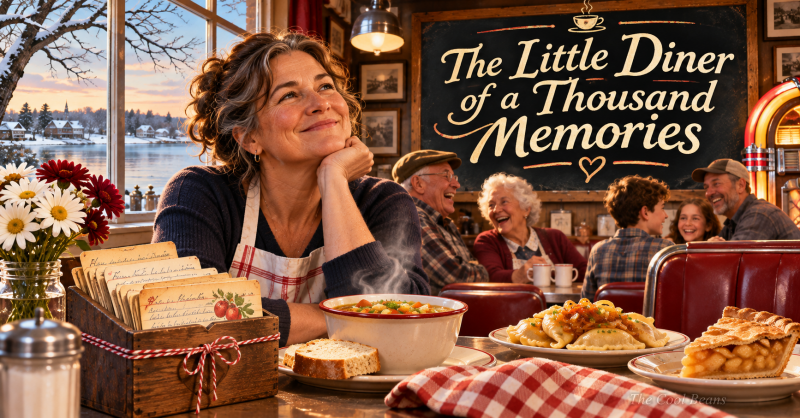
Nobody would have described Nora Lewison as particularly adventurous. At fifty-three, she had spent most of her life doing the same things in the same order, and she liked it that way. Every morning at five-thirty, she unlocked the front door of Lewison’s Diner, switched on the coffee machines, tied a faded blue apron around her waist, and began preparing breakfast for the familiar faces who would soon arrive. She knew who liked their eggs scrambled, who insisted on burnt toast, and who would complain about the coffee before drinking three cups of it.
The diner sat on a quiet street in a small lakeside community along the shores of Lake Scugog, Ontario, where the surrounding countryside offered peaceful views of rolling farmland, wooded trails, and the beautiful lake that had drawn generations of families to the area. It wasn’t particularly fashionable, and its orange vinyl booths had seen better decades. The chrome trim was scratched, the jukebox occasionally played the wrong song, and one of the ceiling fans made a clicking noise that Nora had been promising to fix since 2019. Nevertheless, Lewison’s had been feeding the neighbourhood for thirty-seven years, first under Nora’s father and then under Nora herself.
It was the sort of place where people came for breakfast and stayed until lunch, where strangers became acquaintances over bottomless coffee, and where the regulars considered themselves unofficial members of management despite having absolutely no authority whatsoever. Nora loved the diner, but lately something had been missing. The conversations were familiar, the menu never changed, and even the daily specials had become painfully predictable. Monday was meatloaf, Tuesday was chicken pot pie, Wednesday was shepherd’s pie, Thursday was beef stew, and Friday was fish and chips. One morning, while staring at the chalkboard behind the counter, Nora realized she could have written the entire week’s specials with her eyes closed.
That was when she had an idea. It wasn’t an especially complicated idea, but for a woman who considered changing coffee suppliers an act of rebellion, it felt positively revolutionary. She placed a small wooden box beside the cash register, filled it with blank index cards, and wrote a message on the chalkboard inviting customers to share their favourite comfort-food recipes. Each day, she would choose one to prepare as the diner’s special, giving the person who submitted it a little moment of culinary fame. For good measure, she added a drawing of a smiling saucepan. It looked more like a potato wearing a hat, but Nora was satisfied.
Her first customer of the morning was seventy-eight-year-old Harold Jenkins, a retired railway worker who had occupied the same stool every weekday for fourteen years. Harold read the chalkboard, adjusted his glasses, and stared at Nora as though she had announced plans to replace the diner with a petting zoo. When he asked whether she was changing the menu, Nora explained that she wanted customers to share their own recipes. Harold considered this while adding an alarming quantity of sugar to his coffee before announcing that his mother had made the best cabbage rolls in Ontario.
Nora encouraged him to write down the recipe, but Harold insisted that he couldn’t because his mother had never written it down herself. When Nora suggested he must remember at least some of the ingredients, he began listing cabbage, ground beef, rice, and tomato sauce. Then, after a thoughtful pause, he added that his mother always yelled at his father whenever he entered the kitchen. Nora asked whether shouting at his father was an essential part of the recipe, and Harold solemnly assured her that it absolutely was.
By eight o’clock, the entire counter was discussing the idea. By nine, three people were arguing about the correct way to make mashed potatoes. By ten, Nora had received seven recipe cards, although one was simply a drawing of a hamburger accompanied by the words “MORE PICKLES.” She tucked them all into the wooden box, delighted that something so simple had managed to stir up more excitement than the diner had seen in months.
The first official customer-created special came from Mrs. Beatrice Kowalski, an eighty-two-year-old widow whose pierogies were legendary among her family and almost entirely unknown to everyone else. Beatrice arrived carrying a yellowed index card covered in handwriting so tiny that Nora needed her reading glasses to decipher it. The recipe called for potatoes, cheese, flour, butter, onions, and something described only as “enough salt.” When Nora asked how much salt was enough, Beatrice replied that she should keep adding it until the mixture tasted right. When asked about the flour, she explained that Nora should use enough to make the dough feel happy.
Nora stared at her, wondering how she was supposed to measure the emotional well-being of pastry dough. Beatrice looked genuinely offended when Nora requested actual measurements, insisting that happiness simply couldn’t be measured. Eventually, Nora persuaded her to come into the kitchen and demonstrate. The following morning, the chalkboard proudly announced that the day’s special was Beatrice’s Happiness Pierogies, served with buttery onions, sour cream, and thirty years of grandmotherly wisdom.
Beatrice nearly cried when she saw her name written on the chalkboard. Then she immediately complained that Nora had spelled pierogies incorrectly. By lunchtime, the diner had sold out, and Beatrice spent the afternoon sitting near the counter, accepting compliments as though she had just won a national cooking competition. She told everyone about her mother teaching her to cook in a tiny kitchen, about the Christmas dinners when the whole family gathered around the table, and about her late husband, Stanley, who could eat twenty pierogies without pausing for air.
When Beatrice proudly announced that Stanley had once eaten thirty-two pierogies in a single sitting, Harold looked up from his coffee and suggested that such an accomplishment was less impressive than it was a medical emergency. The diner erupted in laughter, and Beatrice laughed harder than anyone. For the first time in months, Nora noticed that nobody seemed particularly eager to leave.
The following week, the recipe box began filling faster than she could empty it. There was Mr. Patel’s mother’s spiced lentil soup, which he insisted could cure everything except a broken heart and a parking ticket. There was Donna Miller’s Sunday chicken casserole, which required precisely one can of cream of mushroom soup and an unreasonable amount of cheddar cheese. There was also a retired firefighter named Frank who submitted his famous meatloaf recipe under the title “The Meatloaf That Made My Wife Marry Me.” When Nora asked whether the meatloaf had genuinely been responsible for his marriage, Frank shrugged and admitted that it certainly hadn’t been his dancing.
Every morning, the chalkboard featured a new name, a new dish, and a little piece of somebody’s life. Customers began arriving specifically to see whose recipe had been chosen. Some brought photographs of the relatives who had taught them to cook, while others shared stories about family celebrations, childhood kitchens, and recipes passed down through generations. The diner began to feel less like a restaurant and more like an enormous family kitchen where everyone had a story worth telling.
One afternoon, a woman named Priya Sharma brought in her grandmother’s recipe for cardamom rice pudding. She explained that her grandmother had made it whenever someone in the family needed cheering up. The scent of warm milk, cinnamon, and cardamom had always reminded her of being a little girl sitting at her grandmother’s kitchen table, listening to stories about a childhood in India. Nora featured it as a dessert special the following Thursday.
When Priya arrived with her two daughters, she found the words “Grandma Sharma’s Comfort-in-a-Bowl Rice Pudding” written across the chalkboard in large, cheerful letters. Her daughters immediately began asking questions about the great-grandmother they had never met, and Priya spent the next hour telling them stories she hadn’t thought about in years. Watching them, Nora began to understand that the recipe cards were doing something she hadn’t anticipated. People weren’t simply sharing food. They were sharing the people they missed, the places they remembered, and the moments they wanted to keep alive. Somehow, her little diner was becoming a home for all of it.
Not every submission was a success, of course. Harold’s cabbage rolls turned out beautifully, although he insisted they lacked the proper amount of maternal disapproval. Frank’s meatloaf was delicious, but the recipe somehow contained four separate instructions to add more ketchup. One particularly enthusiastic customer submitted a recipe for tuna and marshmallow casserole, which Nora politely declined on humanitarian grounds. Then there was the Great Chili Incident, an event that would be discussed around Lake Scugog for months afterward.
It began when two brothers, Raymond and Dennis Cooper, submitted competing chili recipes on the same day. Raymond claimed his was the finest in the province, while Dennis insisted Raymond’s chili tasted like something scraped from the bottom of a lawn mower. Rather than choose between them, Nora announced a Saturday chili competition. The brothers arrived wearing matching aprons, although Dennis had crossed out the words “World’s Best Cook” and replaced them with “Better Than Raymond.”
By noon, half the neighbourhood had gathered to judge the contest. The local librarian brought scorecards, the hardware store owner donated a ridiculous golden trophy shaped like a saucepan, and Harold declared himself head judge without consulting anyone. Raymond’s chili was rich, smoky, and full of flavour, while Dennis’s was fiery enough to make a grown man reconsider his life choices. Harold sampled both, drank three glasses of water, and announced that he could no longer feel his tongue.
The competition ended in a tie after the judges discovered that neither brother would accept defeat without demanding a recount. Nora awarded them joint custody of the golden saucepan, which they were instructed to display on alternating weekends. For weeks afterward, customers continued laughing about the competition, and the brothers became minor local celebrities, although neither was willing to admit that the other’s chili had been remotely edible.
The recipe box had become the most popular thing in the diner, but one Tuesday afternoon, a card appeared that made Nora stop smiling. It was written in careful, uneven handwriting and contained only four ingredients: two slices of white bread, butter, brown sugar, and cinnamon. Beneath the instructions, someone had written that his father used to make the toast whenever he was sad. His father had died the previous year, and although he wasn’t sure whether something so simple counted as a real recipe, it had always been his favourite.
The card was signed by a thirteen-year-old boy named Oliver Bennett.
Nora knew Oliver. He sometimes came into the diner after school with his grandmother, sitting quietly in the corner booth while she drank tea. His father had died unexpectedly the previous winter, and Nora remembered how small the boy had looked at the funeral, standing beside his grandmother in a suit that was slightly too big. She read the card again, thinking about the little boy who had lost someone he loved and the ordinary piece of toast that still connected him to his father.
It wasn’t complicated enough to be a daily special, at least not by ordinary restaurant standards. It was simply cinnamon toast, the sort of thing almost anyone could make at home. But the more Nora thought about it, the more she realized that was precisely why it belonged on the menu. The next morning, she arrived early, prepared a fresh batch of cinnamon sugar, and wrote the day’s special on the chalkboard. It read, “Oliver’s Dad’s Special Toast — Warm cinnamon toast, made with love. Served with hot chocolate and a little extra kindness.”
When Oliver arrived after school, he stopped so suddenly in the doorway that his grandmother nearly walked into him. He stared at the chalkboard, hardly believing that his little recipe had been chosen. Nora came around the counter and explained that she thought it deserved a place on the menu. Oliver wanted to know whether people were actually ordering it, and when she assured him that they were, he seemed astonished that anyone would pay for something as ordinary as toast.
Nora knelt slightly so she could meet his eyes and told him that sometimes the simplest things were the ones people remembered most. Oliver looked down at his shoes before explaining that his father used to make the toast whenever he had a bad day at school. He always cut it into triangles and insisted that triangles tasted better than squares. When Nora asked whether he had been right, Oliver smiled for the first time since entering and assured her that he obviously had.
That afternoon, Nora served forty-three orders of cinnamon toast, every single one cut into triangles. Customers who had never met Oliver’s father ordered it simply because they wanted to honour a memory that mattered to someone. Beatrice declared it the best toast she had ever eaten, Frank ordered two servings and insisted he needed to investigate the triangle theory more thoroughly, and Harold complained that the portions were too small before quietly paying for Oliver’s hot chocolate.
Oliver’s grandmother sat in the corner booth with tears in her eyes, watching her grandson laugh as customers asked him about his father. Later, she approached Nora at the counter and told her that she had no idea what she had done for the boy. Nora looked toward Oliver, who was explaining the importance of proper cinnamon distribution to a thoroughly captivated Harold, and gently replied that she thought his father had done most of the work.
As autumn settled over Lake Scugog, the trees surrounding the shoreline turned brilliant shades of red, orange, and gold. The wooded trails and quiet country roads became a patchwork of autumn colours, while cool breezes swept across the lake, carrying the unmistakable scent of falling leaves and approaching winter. Inside Lewison’s Diner, the coffee was always hot, the conversations were lively, and the recipe box continued to fill with stories.
A reporter from the local community newspaper wrote an article about the unusual tradition, and soon people from nearby Port Perry and other communities around Lake Scugog began visiting. Some brought their own recipes, while others simply wanted to taste the dishes and hear the stories behind them. Nora’s quiet little diner was busier than it had been in years, but the growing popularity wasn’t what pleased her most. It was watching strangers become friends over bowls of soup and slices of homemade pie.
Yet with all the excitement, Nora noticed something peculiar. Everyone had shared a recipe except her. One morning, Beatrice pointed this out while watching Nora rearrange the index cards. She wanted to know why the woman who had started the entire tradition hadn’t contributed anything herself. Nora shrugged and explained that she cooked the same things every day, but Beatrice wasn’t satisfied. She reminded Nora that her father had taught her everything she knew about cooking and suggested that surely he must have had a favourite dish.
Nora grew quiet. Her father, Walter Lewison, had opened the diner when she was sixteen. He had been a broad-shouldered, cheerful man who believed that nobody should leave his restaurant hungry and that most problems could be improved with a decent meal. He had taught Nora to make pancakes, roast chicken, apple pie, and the perfect grilled cheese sandwich. But his favourite dish had been something he called Rainy Day Soup.
It was an ordinary vegetable soup made from whatever happened to be in the kitchen, with tomatoes, potatoes, carrots, onions, and a handful of pasta. Walter had invented it during a particularly difficult winter when money was scarce and the family couldn’t afford anything fancy. He always made it when the weather turned miserable, insisting that nothing could chase away the cold quite like a steaming bowl of homemade soup.
When Nora was little, she would sit on a stool beside the stove and watch him stir the enormous pot. He would tell her that the secret ingredient was patience, although he usually added a little extra garlic when he thought nobody was looking. Sometimes he would hand her a wooden spoon and let her stir while he hummed old songs terribly off-key. Those afternoons had been among the happiest moments of her childhood, although she hadn’t fully appreciated them until they were gone.
Nora hadn’t made the soup since her father died. She wasn’t entirely sure why. Perhaps it was because she remembered him so clearly whenever she thought about it, standing in the kitchen with his sleeves rolled up, humming and pretending not to notice when she stole pieces of potato from the cutting board. The memories were beautiful, but they also carried an ache she had never quite learned to live with.
Beatrice listened quietly as Nora explained. Then she reached into the wooden box, pulled out a blank index card, and placed it on the counter. She told Nora that it was time her father had his turn. Nora stared at the card for a long moment before finally picking up a pen and beginning to write.
The following Monday, the chalkboard announced that the day’s special was Walter’s Rainy Day Soup, a warm bowl of vegetables, pasta, and the belief that tomorrow would be better, served with homemade bread. It happened to be raining that morning. A cold November drizzle had settled over Lake Scugog, turning the sidewalks silver and sending people hurrying beneath umbrellas. The lake was hidden beneath a blanket of low grey clouds, and the trees along the shoreline swayed gently in the chilly wind. Inside the diner, however, the windows glowed warmly, the coffee was fresh, and the kitchen smelled of simmering tomatoes and garlic.
Nora had barely finished preparing the first pot when Harold arrived. He read the chalkboard and smiled, immediately recognizing Walter’s famous soup. He took his usual stool, removed his cap, and looked toward the kitchen with an expression Nora couldn’t quite identify. Then he told her that Walter had once made that very soup for him when he lost his job at the railway. Her father hadn’t charged him a penny, explaining that a man couldn’t think straight on an empty stomach.
Nora swallowed hard. She had never known about that small act of kindness, and Harold smiled into his coffee before telling her that Walter had done a great many things he never talked about. As the morning continued, other customers began sharing their own memories of him. Beatrice remembered Walter delivering meals to her house when Stanley was recovering from surgery. Frank recalled the time Walter had quietly fed a family whose house had burned down. Priya remembered visiting the diner as a little girl and being given a free cookie because she had earned a good report card.
Nora listened to every story, sometimes smiling and sometimes wiping tears from her cheeks with the corner of her apron. She had spent so many years missing her father that she had forgotten how many other people remembered him, too. Walter had never been wealthy or famous, and he had never travelled very far beyond the peaceful lakeside community he called home. Yet through something as simple as feeding people, he had left behind a remarkable collection of memories.
By lunchtime, the diner was packed. Rain tapped against the windows while customers gathered around steaming bowls of soup, passing baskets of warm bread and sharing stories that stretched back decades. Some remembered Walter’s terrible jokes, while others recalled the way he always seemed to know when someone needed a little extra kindness. The room was filled with laughter, and Nora found herself wishing her father could see what his little diner had become.
Oliver arrived with his grandmother and asked whether the soup had been invented by Nora’s father. When she told him that it had, he wanted to know whether Walter had been a good cook. Nora smiled and assured him that he had been the very best. Oliver considered this for a moment before suggesting that perhaps his father and Nora’s father were sharing recipes somewhere. Nora felt her eyes fill with tears as she told him that perhaps they were.
That evening, after the last customer had gone home, Nora stood alone behind the counter, looking at the chalkboard. The words had begun to smudge, and the soup pot was empty. The diner was quiet except for the familiar clicking of the ceiling fan. She thought about all the people who had walked through the doors over the past few months, carrying index cards covered in faded handwriting, grease stains, crossed-out ingredients, and memories.
Some recipes had been passed down for generations. Others had been invented out of necessity, love, or whatever happened to be left in the refrigerator. Some were elegant, some were ridiculous, and some were nothing more than cinnamon toast. But every single one had meant something to somebody.
Nora opened the wooden recipe box and began sorting through the cards. Beatrice’s pierogies, Harold’s cabbage rolls, Priya’s rice pudding, Frank’s meatloaf, Oliver’s cinnamon toast, and dozens more were tucked neatly inside. She realized that she was holding something far more valuable than a collection of cooking instructions. She was holding pieces of people’s lives, lovingly preserved in flour-dusted handwriting and memories that might otherwise have faded.
The following morning, Nora introduced a new tradition. Beside the daily special, she placed a small photograph or handwritten note explaining where the recipe had come from. Customers could read about the grandmother who made pierogies every Christmas, the father who believed toast tasted better in triangles, or the retired railway worker whose mother insisted that proper cabbage rolls required both patience and a little shouting.
Soon, people began bringing in photographs to accompany their recipes. The walls of the diner gradually filled with family portraits, wedding pictures, faded holiday snapshots, and handwritten memories. Some photographs were decades old, their corners curled and their colours faded. Others showed smiling children, grandparents, family reunions, and kitchens filled with people who were no longer there. Each picture had a story, and Nora made sure there was room for every one of them.
The restaurant became a living scrapbook of the Lake Scugog community, and the strangest thing happened. People who had barely spoken to one another for years began sitting together. Teenagers asked older customers how to make dishes their grandparents remembered. Neighbours exchanged recipes, shared leftovers, and occasionally argued passionately about whether raisins belonged in butter tarts.
Harold maintained that they absolutely did not, while Beatrice insisted that the entire argument was ridiculous because everyone knew butter tarts were better with pecans. The disagreement continued for six weeks and eventually required Nora to feature both versions as competing dessert specials. Nobody won, but everybody ate pie, which Nora considered a perfectly satisfactory outcome.
By Christmas, Lewison’s Diner was busier than ever, but Nora no longer measured its success by the number of customers or the money in the register. She measured it by the laughter coming from the booths, the conversations that stretched long after the plates were cleared, and the way people smiled when they saw a familiar name written on the chalkboard.
On Christmas Eve, the regulars surprised her with a gift. It was a beautiful wooden recipe box, handcrafted by Raymond Cooper, with a brass plaque on the front. The plaque read, “The Lewison’s Diner Recipe Collection — Every Dish Has a Story. Every Story Has a Home.”
Inside were copies of every recipe submitted since the day Nora had placed that first little box beside the cash register. Each card had been carefully rewritten, preserving the original names, instructions, and personal notes. At the very front was Walter’s Rainy Day Soup, and beneath the recipe, someone had added a message signed by nearly every regular customer. It thanked Nora for giving their memories a place at the table.
Nora stood behind the counter holding the box, unable to speak. She looked around at the familiar faces gathered before her, some laughing, some smiling, and others wiping away tears of their own. Harold eventually cleared his throat and informed everyone that while the moment was touching, some of them were getting hungry. The entire diner burst into laughter, and Nora laughed along with them, wiping her eyes with the corner of her apron.
She had always believed that owning a diner meant feeding people. Her father had taught her that a warm meal could make a difficult day a little easier, and she had spent thirty-seven years trying to live up to that simple idea. But somewhere along the way, she had discovered that feeding people was only half of it.
Sometimes a bowl of soup could bring back a father’s voice. Sometimes a plate of pierogies could make a widow feel like a young bride again. Sometimes a piece of cinnamon toast could remind a grieving child that love didn’t disappear simply because someone was no longer there to make breakfast. And sometimes, all it took to bring a neighbourhood together was a wooden box full of index cards and a woman willing to listen.
The next morning, Nora arrived at the diner just before sunrise. Snow was falling softly over the Lake Scugog area, covering the parked cars, quiet sidewalks, and surrounding countryside in a fresh blanket of white. The rooftops glistened beneath the pale winter sky, and beyond the buildings, the lake stretched quietly toward the distant shoreline. Everything seemed wonderfully peaceful as the first Christmas morning light crept over the water.
She unlocked the front door, switched on the coffee machines, and tied her faded blue apron around her waist. Then she picked up a piece of chalk and wrote something new beneath the daily special. It was a simple message reminding everyone that good food filled the stomach, good memories filled the heart, and there was always room for both at their table.
Nora stepped back, admired her handiwork, and smiled. Outside, the first customers were already approaching through the snow. Harold would complain about the weather. Beatrice would ask whether there was enough butter in the kitchen. Frank would probably have another ridiculous meatloaf idea, and Oliver would arrive later with his grandmother, ready to tell Nora about his latest adventures at school.
It would be another ordinary day at Lewison’s Diner, nestled in its little lakeside community along Lake Scugog, and Nora couldn’t imagine anything more wonderful. Because the best recipes weren’t always the ones with the finest ingredients or the most complicated instructions. Sometimes, the best recipes were the ones that reminded people where they belonged, who had loved them, and how even the smallest traditions could carry the greatest meaning.
And at Lewison’s Diner, everyone had a place at the table.
Enjoying what you find here? 💜 Consider subscribing and becoming part of our little community. It’s a simple way to stay connected, support what we do, and make sure you don’t miss what’s coming next. We’d truly love to have you here. 🌿✨


Leave a Reply