The trouble began at precisely 10:14 on a Saturday morning, when someone paid eighteen pounds for a perfectly timed thunderclap. This was particularly concerning because the historic town of Rye, in East Sussex, had neither the equipment nor the authority to manufacture thunderstorms, and the woman accepting the money had absolutely no idea what she was doing.
Her name was Nell Barlow, and until that morning, her greatest public responsibility had been judging the annual vegetable-growing competition, during which she had accidentally awarded first prize to a marrow that turned out to be a particularly convincing watermelon. Now she was standing behind a wooden podium in the town hall, holding an auction catalogue that appeared to have been assembled by someone experiencing a rather spectacular nervous breakdown.
“Lot number seven,” she announced, squinting at the page. “One perfectly timed thunderclap.”
“Eighteen pounds!” shouted Mr. Pritchard from the third row.
Nell blinked. “You do understand that we’re not selling an actual thunderstorm?”
“Twenty pounds!” called Mrs. Fenwick, who had once purchased a canoe despite being terrified of water. “Twenty-five!” Mr. Pritchard countered.
Nell looked helplessly toward her aunt Beatrice, who was sitting beside the refreshment table eating a biscuit with the calm satisfaction of a woman who had already accepted that the universe was beyond repair. “Just sell it, darling,” Beatrice whispered. “We need the money.”
And that was how Rye’s first Auction of Impossible Things began.
The event had originally been intended to raise money for the town library, whose roof had developed a leak directly above the historical fiction section. This had resulted in several unfortunate incidents, including the partial destruction of a biography of Napoleon and the discovery that the librarian, Mrs. Wicks, could swear with astonishing creativity.
Local residents had donated perfectly ordinary items: homemade preserves, gardening tools, a grandfather clock that ran seven minutes fast, and a ceramic duck of questionable artistic merit. Unfortunately, Beatrice had sent the auction catalogue to the printer alongside an old collection of theatrical improvisation exercises from the town’s former drama society. Somehow, the two documents had become hopelessly entangled.
Instead of advertising a secondhand lawnmower, the catalogue offered “One Spectacular Entrance.” Instead of a basket of homemade jam, there was “An Apology from a Goose.” And where the grandfather clock should have appeared, someone had printed “A Standing Ovation for Someone Who Doesn’t Expect One.”
Nell had discovered the mistake approximately six minutes before the auction began. “Why didn’t you cancel?” she whispered to Beatrice during a brief interruption. “Because forty-three people turned up, the cakes are already sliced, and Mr. Pritchard has been waiting twenty years for an opportunity to purchase something ridiculous.”
As it turned out, the residents of Rye were considerably more enthusiastic about impossible experiences than they had ever been about secondhand gardening equipment. Mrs. Fenwick purchased the Spectacular Entrance for thirty-six pounds. “I’ve been entering rooms normally for seventy-two years,” she explained. “Frankly, it’s becoming repetitive.”
The harbour’s most notorious goose, Admiral Pickles, became the subject of a furious bidding war when several residents competed for the right to receive his formal apology. Admiral Pickles had terrorized the town for nearly a decade. He had stolen sandwiches, chased cyclists, interrupted a wedding, and once cornered the mayor inside a public toilet for forty-five minutes. His apology eventually sold for sixty-two pounds.
Then a small boy in an orange raincoat raised his hand. “Five pounds,” he said.
Nell smiled. “And what would you like to bid on, sweetheart?”
“The standing ovation.”
“Who’s it for?”
“My dad.”
The boy’s name was Oscar, and his father, Darren, had recently learned to swim at the age of fifty-three. “He was scared of the water for ages,” Oscar explained. “But he kept practising, and yesterday he swam all the way across the pool. Nobody clapped because they didn’t know how hard it was.”
The room became unusually quiet. Then Mrs. Fenwick cleared her throat. “Five pounds seems a little low for a proper standing ovation.”
“Ten!” shouted Mr. Pritchard. “Fifteen!” called someone else.
Within seconds, the entire room was contributing money toward Oscar’s purchase. Nell eventually brought down her wooden hammer. “Sold,” she announced, her voice catching slightly. “To the young gentleman with excellent taste in fathers.”
By lunchtime, the auction had raised more than nine hundred pounds. There was only one small problem. They now had to deliver everything.
Over the following week, Rye became a town of extraordinary preparations. The retired music teacher, Mr. Bell, volunteered to organize the thunderclap using the enormous bass drum that had been gathering dust in his attic since 1986. The local gardening club agreed to provide Mrs. Fenwick’s Spectacular Entrance, although negotiations became complicated when she requested a red carpet, dramatic music, and “possibly a horse.”
“Absolutely not,” Nell told her.
“A small horse?”
“No.”
“A pony with ambition?”
“Mrs. Fenwick.”
“Fine. But I expect trumpets.”
Meanwhile, Beatrice undertook the delicate task of securing Admiral Pickles’s apology. This involved writing a formal letter expressing regret for his years of antisocial behaviour, obtaining a decorative wax seal, and attempting to persuade the goose to place his webbed foot upon an ink pad.
The first attempt ended with Admiral Pickles stealing the letter. The second ended with Beatrice losing a shoe. The third produced a satisfactory footprint, although the goose expressed his displeasure by biting the corner off the document. “That,” Beatrice declared, “is as close to remorse as we’re going to get.”
Nell found herself enjoying the preparations more than she cared to admit. For years, she’d been the sensible one. The woman who knew how to mend a broken umbrella, organize a cupboard, and calculate exactly how many sandwiches were required for a village gathering. She was also the woman who had spent three years secretly dreaming of turning an abandoned delivery van into a travelling repair shop.
The van sat behind her cottage, painted a cheerful shade of blue, its shelves installed and its windows decorated with tiny painted umbrellas. She had never quite found the courage to open it. What if nobody came? What if people laughed? What if she discovered that being good at repairing things wasn’t the same as being brave enough to build something of her own?
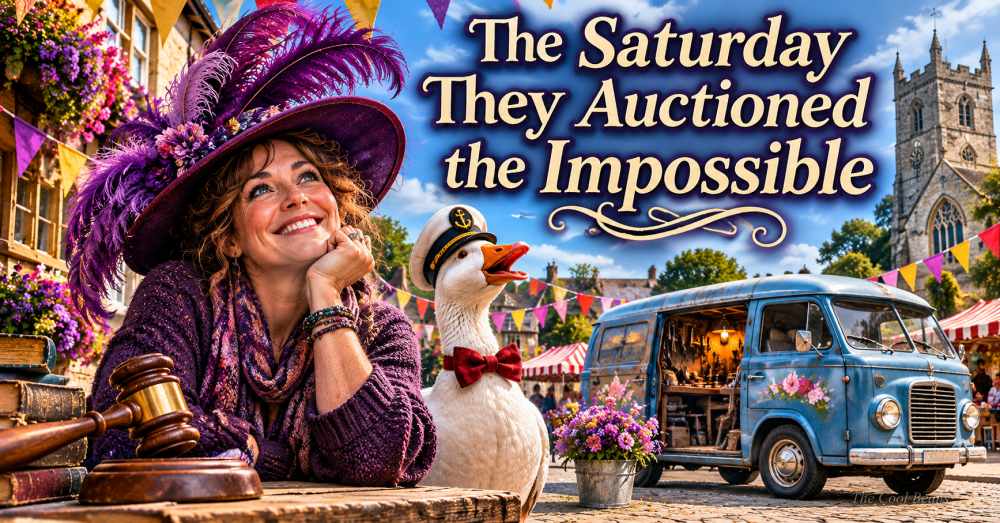
Then, on Thursday afternoon, Mrs. Fenwick arrived at her doorstep carrying a magnificent purple feathered hat. “I’ve decided I don’t want my Spectacular Entrance anymore,” she announced.
Nell stared at her. “You’ve changed your mind?”
“Not exactly. I’m giving it to you.”
“Me?”
“Yes, darling. You’ve spent your entire life making sure everyone else gets where they’re going. I think it’s about time you made an entrance yourself.”
Before Nell could protest, Mrs. Fenwick placed the hat on her head. It was enormous, ridiculous, and quite possibly visible from space. “Saturday morning,” she said. “Bring your van.”
Saturday arrived beneath a sky full of suspicious-looking clouds. By ten o’clock, the town square was crowded. There was bunting, homemade cakes, a brass band, and an alarming number of people carrying umbrellas despite the weather forecast promising sunshine.
Mrs. Fenwick stood beside the fountain wearing a velvet cape. “Places, everyone!” she shouted.
Mr. Bell raised his baton. The brass band began playing something triumphant, although the trombonist appeared to be performing an entirely different tune. Then, from the far end of the square, Nell’s little blue van appeared.
Someone had tied purple ribbons to its mirrors. A handwritten sign above the windscreen read, “NELLY’S FIX-IT WAGON — IF IT’S BROKEN, LET’S SEE WHAT WE CAN DO.”
Nell drove slowly through the crowd, laughing so hard she could barely see. Mrs. Fenwick swept her cape dramatically through the air. “BEHOLD!” she cried. “THE WOMAN WHO CAN REPAIR PRACTICALLY ANYTHING EXCEPT MY TERRIBLE DECISIONS!”
The crowd erupted. Someone released a handful of confetti. Unfortunately, a sudden gust of wind blew most of it directly into the mayor’s mouth. The trombonist hit a spectacularly wrong note, and Nell, who had spent years worrying about looking foolish, climbed out of her van wearing a giant purple feathered hat and took the most ridiculous bow of her life.
It was magnificent.
By noon, she had repaired three umbrellas, a broken handbag clasp, and the handle of a child’s beloved toy suitcase. She also had bookings for the following two weekends. But the day’s loveliest moment was still to come.
Oscar had brought his father to the square under the pretence of buying ice cream. Darren looked thoroughly confused when Mr. Bell approached him carrying a small wooden platform. “Would you mind standing here for a moment?” he asked.
“Why?” Darren replied.
“Community business.”
Darren stepped onto the platform, and Oscar took his hand. “My dad learned to swim,” he announced proudly. “And I think that’s brilliant.”
For one heartbeat, nobody moved. Then every person in the square rose to their feet. They clapped. They cheered. Someone whistled through their fingers. Mrs. Fenwick shouted, “BRAVO!” with such enthusiasm that several pigeons abandoned the church roof.
Darren looked around in disbelief. Then he looked down at Oscar, who was grinning so widely that his cheeks had turned pink. “You did this?” he asked.
Oscar nodded, and Darren knelt to wrap his son in an enormous hug. The applause grew louder. Nell watched from beside her little blue van, smiling through unexpectedly watery eyes. Somewhere behind her, Admiral Pickles honked furiously, apparently furious that somebody else was receiving attention.
By late afternoon, the library had enough money for its new roof, Nell had her first proper customers, and Beatrice had successfully presented the goose’s apology to the mayor. The mayor accepted it with considerable dignity. Admiral Pickles immediately stole his sandwich.
As the festivities drew to a close, Mr. Pritchard approached Nell. “There’s still one thing missing,” he said.
Nell frowned. “What?”
“My thunderclap.”
“Oh, goodness.”
Mr. Bell hurried toward his bass drum, which had been positioned behind the bandstand. He raised his mallet, and just as he brought it down, a tremendous crack of thunder rolled across the sky.
The entire square fell silent. Mr. Bell stared at his drum. Nell stared at the clouds. Then Mr. Pritchard threw both arms into the air and shouted, “BEST TWENTY-FIVE POUNDS I’VE EVER SPENT!”
The laughter that followed was so enormous that it almost drowned out the rain beginning to fall. People hurried beneath awnings, sharing umbrellas and rescuing cakes. Nell opened the back of her van and began handing out repaired umbrellas to their delighted owners. Mrs. Fenwick stood in the rain wearing her velvet cape and announced that the weather was an excellent special effect.
And Nell, standing in the middle of it all beneath her ridiculous purple hat, realized that the best thing about the day wasn’t that everything had gone according to plan. Almost nothing had. It was that something wonderfully unexpected had happened, and everyone had decided to enjoy it together.
By evening, the square was empty, the library roof was finally scheduled for repair, and Rye had already begun discussing next year’s auction. Beatrice suggested they return to selling ordinary household items, but nobody agreed. After all, once you’ve successfully auctioned a thunderclap, a standing ovation, and an apology from a thoroughly unrepentant goose, a secondhand lawnmower seems rather disappointing.
As Nell drove her little blue van home through the rain, she couldn’t stop smiling. Tomorrow, she’d open her repair shop again. Next Saturday, she’d visit the neighbouring village. And somewhere along the way, she suspected, there would be more wonderful things she hadn’t yet imagined.
Because sometimes life doesn’t hand you the opportunity you’ve been waiting for. Sometimes it hands you a completely ridiculous catalogue, a purple feathered hat, and a town full of people willing to applaud.
And somehow, against all reasonable expectations, that’s even better. 💜
Enjoying what you find here? 💜 Consider subscribing and becoming part of our little community. It’s a simple way to stay connected, support what we do, and make sure you don’t miss what’s coming next. We’d truly love to have you here. 🌿✨


Leave a Reply