November 2
Clara stood motionless in the hallway, staring at the front door. Outside, the wind rattled the bare branches of Eleanor’s apple tree, and somewhere in the village a dog began barking. She could hear someone breathing on the other side of the door, slowly and evenly, as though the visitor had all the time in the world.
“Margaret Bell died decades ago,” Clara said, struggling to keep her voice steady.
“So did Eleanor,” the woman replied. “Yet here you are, carrying out her wishes.”
Clara swallowed and asked how she could know who was standing outside. The woman told her to remember the little silver bell her grandmother had kept in her sewing basket. Clara’s heart lurched. The bell had been no larger than a thimble, and her grandmother had never allowed anyone to ring it. Whenever Clara asked why, she always said it was a reminder that silence could be dangerous.
“What did she call it?” Clara whispered.
“The witness.”
Clara slowly opened the door. An elderly woman stood on the doorstep, wrapped in a dark green coat. Her white hair was pinned beneath a scarf, and her face was deeply lined with age. She looked impossibly old, but not supernatural. Her hands trembled slightly as she held a leather satchel against her chest.
“I’m not Margaret,” the woman admitted before Clara could speak. “My name is Ruth Bell. Margaret was my mother.”
Clara stared at her in disbelief. Ruth explained that she had used her mother’s name because it was the only way to be certain Clara understood the importance of her visit. Ruth was eighty-six years old and had spent most of her life away from Bellweather. Eleanor had contacted her several years earlier, determined to uncover the truth about the events of 1926.
Ruth stepped inside, bringing the cold November air with her. Once they were seated at the dining table, she explained that Margaret had survived the accusations against her only because someone had helped her escape the village. She had been hidden in a cellar for three days before a family who owed her their lives took her away. Margaret had not gone to the police because, according to Ruth, the local authorities were involved in the very wrongdoing she had uncovered.
Ruth opened her satchel and removed a bundle of papers tied with black ribbon. Margaret had kept copies of everything: the money, the names, the orders, and the payments. She knew who was responsible, and she had preserved the evidence because she feared the original records would be destroyed.
Clara spread the documents across the dining table. The first was a list of twelve families who had applied for financial assistance during the winter of 1925. Several had lost their homes after a severe flood destroyed fields and damaged cottages along the river. The second document recorded payments from the parish relief fund, but the money had never reached the families.
Instead, it had been transferred into an account controlled by three members of the parish council: Reverend Samuel Ashcroft, wealthy landowner Henry Voss, and the village magistrate, Edmund Pike. Ruth explained that the men had used the money to purchase flooded properties for almost nothing, then sold the land at a substantial profit when the railway announced its expansion.
Margaret had discovered the scheme, but the missing money was only part of what frightened her. Ruth unfolded a third document, a handwritten statement from a woman named Agnes Miller. Agnes had been a widow with three children. When she challenged the parish council over the missing assistance, she was threatened with eviction. Two weeks later, her cottage caught fire. The official report called it an accident, but Agnes and her youngest son died inside, while her two surviving children were sent away.
Margaret believed the fire had been deliberately set. Among her papers was a letter written by Edmund Pike to Henry Voss, instructing him to ensure that the Miller property was cleared before the next parish meeting. Although the letter did not explicitly order a fire, Margaret believed it demonstrated a conspiracy to force the family from their home.
Clara struggled to understand how such allegations could have gone uninvestigated. Ruth reminded her that Pike had been the magistrate, Voss had owned much of the village, and Ashcroft had controlled the parish records. People who spoke against them risked losing their jobs, their homes, or their reputations. Some had disappeared entirely.
When Clara asked how many people had vanished, Ruth looked down at the documents before answering. There were seven whose deaths had never been properly recorded. Some had been officially listed as having moved away, while others were described as vagrants who had left the district. Margaret believed their remains might have been concealed beneath St. Agnes.
Clara remembered Eleanor’s letter and the iron key. Margaret had returned to Bellweather in 1954, bringing copies of her records to Eleanor. Together, they had approached the police, but the original conspirators were already dead, and the church had undergone extensive renovations. The authorities had searched the accessible cellar and found nothing. Without physical evidence, the investigation had ended.
Clara looked at the key lying beside Eleanor’s letter. Perhaps the police had searched the wrong place. Ruth followed her gaze, and for the first time since arriving, she seemed hopeful. Eleanor had believed the same thing.
They agreed to wait until morning before approaching the church. Clara barely slept. Each time she closed her eyes, she imagined the dark limestone tile, the tiny carved bell, and the whisper that had risen from beneath her feet. At dawn, she woke to the sound of church bells. This time, she counted only twelve. The thirteenth never came.
All Souls’ Day had begun.
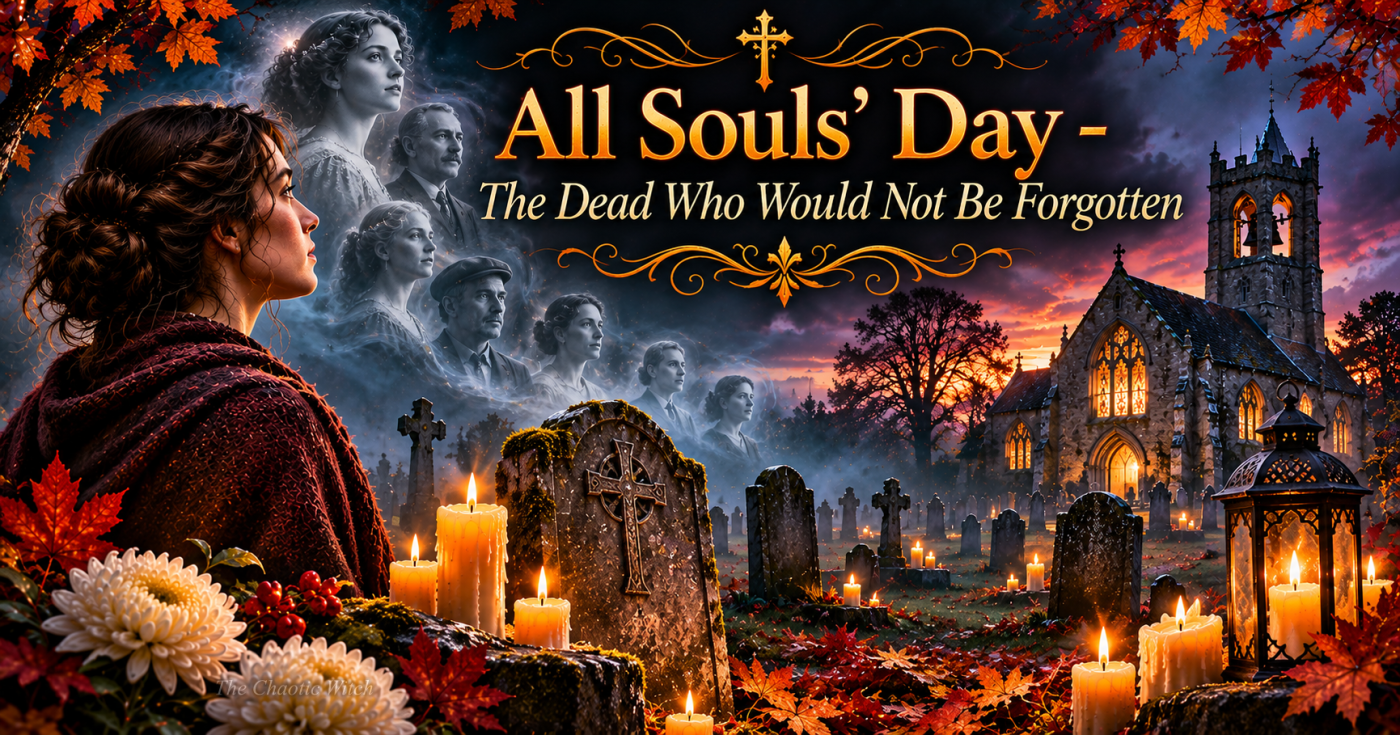
By nine o’clock, the village cemetery was crowded with families carrying flowers and candles. Unlike the more celebratory atmosphere of All Saints’ Day, November 2 was quieter and more reflective. People moved between graves, brushing away fallen leaves and speaking softly about relatives who had died. Clara watched an elderly man kneel beside a weathered headstone and place a single white rose at its base. For the first time, she wondered how many names in the cemetery had stories that no one living remembered.
Clara and Ruth met Thomas Vale outside the church. When Clara showed him Eleanor’s letter and Margaret’s documents, he became visibly shaken. He had known Eleanor suspected corruption, but he had never imagined that the story might involve multiple deaths and concealed remains. Clara reminded him that they did not yet know whether all seven missing people had been murdered. What they did know was that something had happened, and the evidence deserved a proper investigation.
Thomas suggested they speak to the current vicar. Reverend Daniel Mercer was a thoughtful man in his early fifties who had served St. Agnes for eleven years. He listened without interrupting as Clara explained the accusations, the missing people, and the possibility of a concealed burial chamber. When she finished, he examined the documents for several minutes before assuring them that the police would be contacted and that he would cooperate fully with any authorized search.
There was, however, something he wanted them to see first. Daniel led them into the vestry, where an old wooden cabinet stood against the wall. Inside were parish registers dating back more than two centuries. He removed a narrow book bound in cracked black leather, explaining that it had been discovered during repairs to the bell tower the previous winter. He had assumed it was an old memorial register, but parts of it appeared to have been written in a cipher.
Across the top of one page, in faded ink, were the words The Register of Those Without Witness. Below were seven entries, each containing a name, a date, and a small drawing of a bell.
The names were Agnes Miller, Peter Miller, Joseph Hart, Evelyn Marsh, Thomas Reed, Beatrice Cole, and Samuel Finch. Clara recognized Agnes and Peter from Margaret’s documents. Daniel explained that the final entry was especially troubling. Beside Samuel Finch’s name was the date November 2, 1926, and underneath someone had written that the last witness had been silenced beneath the thirteenth bell.
Ruth covered her mouth. Her mother had told her about Samuel, the church sexton who had helped her escape. If the register was accurate, he had returned to Bellweather after Margaret fled and had died shortly afterward.
Daniel turned to the next page, revealing a rough drawing of the church’s original floor plan. Beneath the sanctuary, a narrow passage connected the crypt to the base of the bell tower. The passage no longer appeared on modern architectural plans, and Thomas immediately wondered whether it might explain the mysterious sound of the thirteenth bell.
They contacted the police, and by early afternoon officers had arrived with a specialist familiar with historic buildings. After reviewing the documents and inspecting the church, the authorities authorized a limited examination of the concealed passage. The congregation was asked to leave, and the church doors were closed while the specialist examined the marked limestone tile.
He carefully removed the surrounding mortar, revealing a rusted iron ring beneath the stone. With the assistance of another officer, he lifted the slab. A narrow staircase descended into darkness, and cold air rose from below, carrying the smell of damp earth and old stone.
Daniel crossed himself, while Thomas stared in astonishment. Clara could barely look away from the opening. For years, Eleanor had searched for a hidden place beneath the church, and now it lay exposed before them.
The officers descended first, followed by the specialist. Clara and the others were instructed to remain upstairs. For nearly twenty minutes, they heard only muffled voices and the scrape of equipment. Then one of the officers returned. His expression told Clara that something significant had been discovered before he spoke.
Human remains had been found in a concealed chamber. There appeared to be several individuals, although the officer cautioned that nothing could yet be said about their identities or the circumstances of their deaths. The site would require a careful forensic examination, and the church would remain closed while the investigation proceeded.
Ruth closed her eyes as tears began to fall. Clara took her hand, feeling a mixture of horror and relief. After a century, the people Margaret had tried to protect might finally be found. Their names might be restored, their stories investigated, and their families given answers that had been denied for generations.
Yet something still troubled Clara. The register listed seven names, including Agnes and Peter Miller, who had supposedly died in the cottage fire. Samuel Finch was recorded as dying after Margaret’s escape, although he had helped her flee. The dates and circumstances did not fit together as neatly as they should have.
She asked Ruth whether Margaret had ever explained what happened to Samuel. Ruth shook her head. Her mother had only said that Samuel promised to keep the evidence safe. She had never seen him again after leaving Bellweather.
Clara looked toward the open staircase. Perhaps Samuel had kept his promise, but not in the way anyone expected.
By late afternoon, forensic personnel had secured the crypt, and the police had begun examining the surviving records. Before leaving St. Agnes, Clara asked Daniel whether anyone had ever seriously investigated the thirteenth bell. He explained that the tower had been inspected several times over the years, but nothing unusual had been found.
Thomas, who had continued studying the old register, suddenly called them over. Beneath Samuel Finch’s name was a small diagram showing a vertical shaft connecting the crypt to the bell tower. At its base was a chamber containing a wheel and counterweight. Thomas suggested that Samuel might have installed a hidden mechanism capable of producing an additional bell note, perhaps hoping that someone would eventually investigate the crypt.
Clara considered the possibility. It would explain the sound, but not why the bell appeared to ring only on November 1 or why she had heard it from beneath the church floor. Thomas admitted that he had no answer.
They returned to Eleanor’s cottage as evening settled over Bellweather. Ruth had brought one final item from her satchel, a letter Margaret had written shortly before her death in 1971. It was addressed to Eleanor but had never been delivered.
Clara opened it carefully. Margaret wrote that she had spent her life regretting that she escaped when others could not. Samuel had promised not to abandon them, and she believed he had kept his word. He had told her that if the church would not remember the dead, he would make certain it could never forget them.
The bell had been his idea. Thirteen strikes for thirteen witnesses: the twelve who knew the truth and the one who would someday uncover it. Margaret did not know what had become of Samuel after he returned to Bellweather, but she hoped that one day someone would speak his name without fear. She ended the letter by asking Eleanor to tell the village that she had never stopped remembering.
Clara reread the passage about the witnesses. She remembered the photograph from 1926, with eleven people standing outside St. Agnes and Eleanor’s handwritten message claiming there had been twelve when the bells began. The photograph had seemed straightforward when she first discovered it, but now she wondered whether she had misunderstood everything about it.
She took the photograph from her bag and placed it beneath the lamp. Thomas leaned over her shoulder, studying the young woman in white. Clara asked him whether he was absolutely certain the woman was Margaret Bell. Thomas hesitated, then admitted that he had assumed her identity based on the photograph’s date and the village stories surrounding Margaret’s disappearance.
Clara turned the photograph over and examined the handwritten names again. One name had been partly obscured by a fold in the paper. She smoothed it carefully, bringing the faded writing into view.
The young woman in white was not labelled Margaret Bell.
Her name was Beatrice Cole.
One of the seven names recorded in the register.
Ruth took the photograph and stared at it for a long time. Her expression shifted from confusion to certainty. She had seen enough photographs of her mother to know that the woman in white was not Margaret. Someone had allowed the misidentification to persist, perhaps because it distracted attention from Beatrice’s role in the events of 1926.
Clara examined the photograph again, searching for anything that might explain why Beatrice had been present. She noticed a faint reflection in the church window behind the group. A young woman appeared to be standing behind the camera, her dark hair visible in the glass. Ruth leaned closer and recognized her immediately.
It was Margaret.
Beside her reflection stood a man wearing a sexton’s coat.
Samuel Finch.
Clara slowly lowered the photograph. If Margaret and Samuel were standing behind the camera, then the eleven people in front of it had gathered for a reason that no one had yet discovered. She examined the date written on the reverse and noticed that the ink appeared darker in one place. Holding it beneath the lamp, she could just make out a second date scratched into the paper.
November 2, 1926.
Someone had changed the date to November 1.
The photograph had been taken on All Souls’ Day, the day after Margaret was supposed to have disappeared. Beatrice Cole, whose name appeared in the register of the missing, had been standing outside the church alongside several people associated with the parish council.
Clara felt the mystery shift beneath her feet. Perhaps Beatrice had not been one of the original victims. Perhaps she had been a witness who later disappeared because she knew too much.
Ruth remembered something her mother had once mentioned. A woman named Beatrice had helped the parish council maintain its accounts. She had known where every payment went and had apparently been frightened to testify when Margaret uncovered the financial irregularities.
Clara returned to the register, wondering whether the seven names had been misunderstood. The book might not have been a burial record at all. It could have been a list of people who knew the truth, some of whom had died, some of whom had disappeared, and others whose identities had been deliberately concealed.
At the bottom of the final page, beneath Samuel Finch’s name, she found a line written in much smaller handwriting.
Those who confessed were given a place among the dead, so their names might survive the living.
Clara read the words aloud. For the first time, the register made a terrible kind of sense. Samuel might have been recording not only the dead, but those who had risked everything to expose what happened. By placing their names in a book associated with the dead, he had preserved their testimony in a place where no one would think to look.
The discovery beneath the church remained horrifying, and the identities of the people buried there would require careful investigation. The photograph and register raised more questions than they answered. Yet the surviving evidence suggested that Margaret and Samuel had been working together, preserving records and gathering witnesses even after Margaret’s supposed death.
At eight o’clock that evening, Bellweather gathered outside St. Agnes for its traditional All Souls’ Day remembrance. The church remained closed, so Reverend Mercer conducted the service beneath the ancient yew tree beside the cemetery. Candles illuminated the faces of villagers who had come to honour parents, grandparents, friends, and neighbours.
The names of those buried in the churchyard were read aloud, followed by the seven names from the recovered register. Daniel explained that their histories were still being investigated and that no one yet knew whether all seven had died in Bellweather. Nevertheless, their names had been found in a record deliberately hidden for a century, and they deserved to be remembered.
When Samuel Finch’s name was spoken, Ruth began to cry. Clara took her hand, thinking of Margaret’s lifelong regret, Eleanor’s decades of searching, and the courage of those who had tried to preserve the truth when speaking openly had been dangerous.
As the final prayer ended, the church bells began to ring. The villagers fell silent, listening as the familiar notes drifted across the cemetery. Clara counted each one, watching the candle flames flicker in the evening breeze.
The twelfth bell sounded, and for a moment, everything was still.
Then came the thirteenth.
It was low, deep, and almost sorrowful. Clara felt the familiar vibration beneath her feet, but this time she did not feel afraid. The note seemed to linger longer than the others, travelling through the cold November air before fading into silence.
From somewhere near the old church wall, Clara thought she heard a voice.
“Thank you.”
She turned quickly, but there was no one there. Only a few fallen leaves moved across the grass, stirred by a breeze that seemed to come from nowhere.
That night, back at Eleanor’s cottage, Clara placed Margaret’s photograph beside the old family portraits. Next to it, she set a copy of the register containing the seven names. There were still unanswered questions, and the identities of those buried beneath St. Agnes had not yet been established. The precise role of each witness remained uncertain, and the police investigation might take months or even years.
But Clara knew one thing. Eleanor had spent her life trying to restore the names of people history had chosen to forget. Margaret had carried the truth through decades of silence, and Samuel had apparently risked his life to preserve it. Now, at last, their work had begun to bear fruit.
Before going to bed, Clara opened the final page of Eleanor’s notebook. There, beneath a pressed white chrysanthemum, her aunt had written one last sentence.
The saints are remembered because their stories were told. The forgotten souls are waiting for someone to tell theirs.
Clara closed the notebook and looked toward the distant church tower. For the first time in her life, she understood why her grandmother had called the little silver bell the witness. It was never meant to summon the dead. It was meant to remind the living to listen.
And in Bellweather, after a hundred years of silence, someone finally had.


Leave a Reply