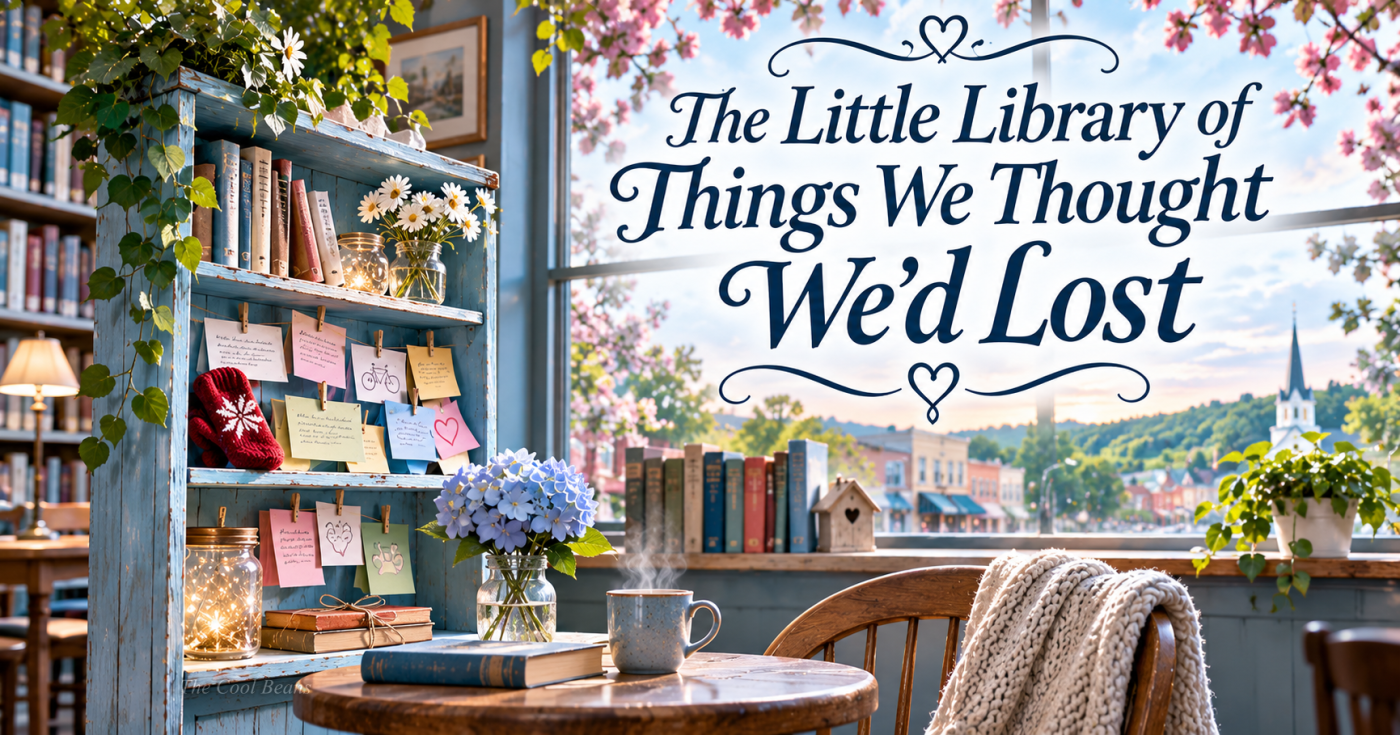
On the corner of Willow Street and Maple Avenue, in a town where everyone knew everyone else’s business but rarely knew what was happening in their hearts, stood a little brick library with green shutters, crooked bookshelves, and a front door that squeaked whenever it rained.
The library wasn’t particularly grand. Its carpet had seen better decades, the heating system made suspicious noises every November, and the children’s section contained a stuffed giraffe named Gerald who had been missing one ear since 1998. But it was warm in the winter, cool in the summer, and smelled of old books, fresh coffee, and the faint lavender perfume of its librarian, Clarissa Moore.
Clarissa was fifty-six, wore colourful scarves regardless of the weather, and believed that almost every problem in life could be improved by three things: a good book, a decent cup of tea, and someone willing to listen. She had worked at the library for twenty-eight years, during which she’d helped children discover their first favourite stories, elderly residents learn to use computers, and countless people locate books whose titles they couldn’t remember.
Her favourite requests were the mysterious ones. Someone would wander up to the desk and say they were looking for a book with a blue cover, possibly about a woman who owned a bakery, and Clarissa would somehow find it. She considered this a professional superpower, although her assistant, twenty-four-year-old Noah Bennett, insisted it was more accurately described as an alarming ability to remember useless details.
One rainy Tuesday in October, Clarissa discovered a small red mitten beneath a chair in the children’s section. It was knitted from thick wool, decorated with a crooked white snowflake, and clearly belonged to someone with very small hands. She placed it in the library’s lost-and-found drawer, where it joined three umbrellas, a pair of sunglasses, two water bottles, a single earring, and a mysterious plastic dinosaur that nobody had claimed in six months.
As she closed the drawer, Clarissa sighed. The collection reminded her of all the things people misplaced without realizing how much they mattered. Sometimes it was a mitten or a wedding ring. Sometimes it was an opportunity, a friendship, or the courage to try something new. She had been thinking about such things more often lately, especially since the library board had announced another round of budget discussions.
Attendance had been declining for years, and Clarissa worried that the building she loved might eventually be considered unnecessary. People still borrowed books, of course, but fewer came simply to spend time there. The reading tables were often empty, the community noticeboard displayed advertisements nobody seemed to read, and the comfortable chairs beside the windows had become more decorative than practical.
That afternoon, Clarissa took an empty bookshelf from the storage room and dragged it into the library’s entrance. It was narrow, slightly wobbly, and painted an unfortunate shade of mustard yellow. Noah watched her struggle with it for several minutes before offering to help.
“What are we doing?” he asked as they positioned it beside the front window.
“Starting something.”
“That sounds ominous.”
Clarissa ignored him and retrieved a tin of leftover paint from the maintenance cupboard. By closing time, the shelf had been transformed into a cheerful shade of sky blue. She decorated it with paper flowers, placed a basket of colourful cards on the top, and hung a handwritten sign above it.
LOST & FOUND STORIES
Beneath the title, she added a short explanation.
Have you lost something? A treasured object, a missed opportunity, an old friendship, a little courage, or even a piece of yourself? Write it down and leave your story here. Someone might have found what you’re looking for. And if they haven’t, perhaps they’ll remind you that you’re not looking alone.
Noah read the sign twice before turning toward Clarissa with a doubtful expression. He wondered whether anyone would actually participate, particularly in a town where people considered admitting they needed help almost as embarrassing as accidentally waving at someone who wasn’t waving at them.
Clarissa smiled and placed the little red mitten on the first shelf, accompanied by a note explaining where it had been found. Then she wrote a second card and placed it beside the mitten.
Lost: The confidence I had when I was twenty. I used to believe I could change the world. Somewhere along the way, I started worrying about whether the world would change without me.
She didn’t sign her name. Instead, she tucked the card into a small wooden stand and stepped back to admire her work.
“Well,” Noah said, “if nothing else, it’s a very attractive shelf.”
Clarissa patted his shoulder. “That’s the spirit. Aim for enthusiasm, settle for mild approval.”
For three days, absolutely nothing happened.
People walked past the shelf, glanced at the sign, and continued toward the circulation desk. One gentleman asked whether it was a new system for reporting missing library books. A woman wanted to know if she could leave her husband’s car keys there because he was forever losing them. Noah suggested that perhaps they should reconsider the idea, but Clarissa remained patient.
Then, on Friday afternoon, a little girl named Lily arrived with her grandfather. She was eight years old, had two uneven pigtails, and wore a purple raincoat covered in yellow ducks. After studying the shelf for several minutes, she approached Clarissa’s desk and asked whether it was really possible to leave a story about something that had been lost.
“Of course,” Clarissa replied. “Anything at all.”
Lily thought about this before selecting a pink card and writing carefully in large, uneven letters.
Lost: My cat, Pickles. He died last month. I miss how he sat on my homework and made it impossible to finish. I know he can’t come back, but I wish I could tell him he was a very good cat.
She placed the card on the shelf and hurried back to her grandfather, looking slightly embarrassed. Clarissa felt her heart tighten as she watched them leave. She wanted to write something comforting immediately, but she decided to wait and see whether someone else might respond.
The next morning, a blue card appeared beneath Lily’s note.
Dear Lily, I lost my dog, Muffin, two years ago. He used to steal my slippers and hide them behind the sofa. I still miss him, but now I laugh whenever I find a slipper in a strange place. I think Pickles would be very proud of how much you loved him. Love, Mrs. Patterson, age 81.
By Monday, three more replies had appeared. One person suggested drawing Pickles as a superhero whose special power was preventing homework. Another shared a story about a rabbit who ate an entire birthday invitation. A third left a tiny knitted cat with a note explaining that it was not a replacement for Pickles, just a little friend to keep his memory company.
When Lily returned to the library and discovered the replies, she read every one of them. Then she carefully picked up the knitted cat, hugged it to her chest, and smiled for the first time since Clarissa had met her.
That was when the shelf began to change.
Within a week, there were notes tucked into every corner. Some were funny, some heartbreaking, and others so ordinary that Clarissa found herself wondering why they were moving her to tears. People wrote about missing wedding rings, misplaced photographs, childhood friendships, forgotten dreams, and the strange loneliness of growing older in a town where everyone assumed you were doing just fine.
One note came from a man who had lost his favourite fishing hat and suspected his wife had secretly thrown it away. His wife responded the following day, explaining that she had not thrown it away, although she had seriously considered doing so on account of its smell. She added that it was currently hanging in the garage, where it had been since June. Someone else contributed a card recommending that the hat be returned to the lake for the benefit of the fish.
Another note came from a teenager who had failed his driving test three times and was beginning to believe he’d never pass. Within days, half a dozen residents had written about their own disastrous driving experiences. One woman admitted she’d driven directly into a hedge during her first lesson. A retired mechanic confessed that he’d failed his test four times before eventually becoming a driving instructor. A local farmer offered to help the teenager practise parking in an empty field, provided he promised not to frighten the cows.
The teenager passed his test six weeks later. He returned to the library with a photograph of himself holding his new licence and a note thanking everyone who had encouraged him. Beneath it, someone wrote that the cows had requested a moment of silence.
Clarissa began noticing something remarkable. People who had lived on the same streets for decades were discovering things about one another that had never come up during conversations about the weather or the price of groceries. The quiet man who always borrowed gardening books had once dreamed of becoming a musician. The cheerful woman who ran the bakery sometimes struggled to believe she was good enough. The elderly gentleman who appeared to have an opinion about everything admitted that he missed having someone to argue with since his wife died.
And then there was the note about the yellow bicycle.
It appeared on a Wednesday morning, written in neat handwriting on a pale green card.
Lost: My courage to ride a bicycle. I fell off when I was eleven, broke my wrist, and never got back on. I’m sixty-three now, and I still wish I could ride along the river like everyone else. It seems ridiculous to admit that something so small has frightened me for fifty-two years.
The following day, someone responded with an offer to teach the writer in the school parking lot on Sunday mornings. Another resident offered a bicycle with a comfortable seat and a basket. A third suggested that if anyone laughed, they would personally come and have a word with them.
Two weeks later, Clarissa looked out the library window and saw a woman in her sixties wobbling down the pavement on a bright yellow bicycle. She was wearing a helmet covered in daisies and laughing so hard that she could barely steer. Beside her, a younger woman jogged along with both arms outstretched, ready to catch her if she fell.
Clarissa stood at the window for a long time, smiling.
Noah joined her and watched the cyclist make a triumphant, if slightly crooked, turn.
“I think your shelf might actually be working,” he admitted.
Clarissa gave him a satisfied look. “Careful. That almost sounded enthusiastic.”
As autumn deepened, the library grew busier. People stopped in during their lunch breaks to read the latest notes, and some began leaving small gifts beside the stories. There were packets of flower seeds, homemade bookmarks, photographs, recipes, and handwritten invitations to community events. Clarissa introduced a few gentle rules to keep the shelf welcoming. Personal information could be shared only with permission, unkind replies would be removed, and anyone who wanted to respond privately could leave a sealed envelope with the library staff.
She also added a second basket labelled Found Something Worth Sharing, where visitors could leave stories about unexpected kindness, second chances, and little moments of happiness. A young father wrote about finding the patience to teach his daughter how to tie her shoes. A widow described rediscovering her love of dancing after joining a beginner’s class. A woman who had recently retired admitted that she’d found the courage to start painting, even though her first attempt at a landscape looked suspiciously like a bowl of overcooked broccoli.
The shelf was becoming the heart of the library, but one particular note would soon change everything.
It appeared on a cold Monday morning in November, written on plain white paper rather than one of Clarissa’s colourful cards. The handwriting was careful and slightly shaky, as though the writer had spent a long time deciding what to say.
Lost: My older brother, Alexander. We haven’t spoken in thirty-eight years. We had a terrible argument after our mother died, and I said things I wish I could take back. He moved away, and I convinced myself there would always be time to make things right. Now I’m seventy-two, and I don’t know where he is. I don’t even know whether he’s alive. I don’t need him to forgive me. I just want him to know that I never stopped loving him. His little sister, Aurora.
Clarissa read the note several times. There was something especially painful about the phrase there would always be time. She had heard variations of it throughout her life, often spoken by people who discovered too late that time had never made such promises.
She wondered whether Aurora had left her note hoping someone might recognize Alexander, or whether she simply needed somewhere to place a sorrow she’d carried for almost four decades. Either way, Clarissa wanted to help, but she knew better than to begin searching for someone without permission.
That afternoon, she placed a small reply beneath Aurora’s note.
Dear Aurora, thank you for trusting us with your story. If you would ever like help looking for your brother, please speak with Clarissa at the front desk. There are ways we might be able to help, and we would be honoured to try.
For several days, there was no response.
Then, on Thursday afternoon, a small woman wearing a navy-blue coat approached the circulation desk. Her silver hair was pinned neatly behind her ears, and she held a folded piece of paper so tightly that its edges had become crumpled.
“Are you Clarissa?” she asked.
Clarissa smiled. “I am. How can I help you?”
The woman hesitated before explaining that she had written the note about her brother. Her name was Aurora Ross, and she had lived in the neighbouring town of Fairhaven for most of her life. She had visited the library after hearing about the Lost & Found Stories shelf from a friend, and something about the idea had made her feel brave enough to write down the words she’d been carrying for so long.
Clarissa invited Aurora to sit beside the window and brought her a cup of tea. They talked for nearly an hour, and Aurora gradually explained what had happened between her and Alexander.
Their mother had died unexpectedly when Aurora was thirty-four and Alexander was thirty-nine. The siblings had always been close, but grief had made them impatient and defensive. During an argument about selling the family home, Aurora accused Alexander of caring more about money than their mother’s memory. Alexander, hurt and exhausted, replied that Aurora had no idea how much responsibility he’d carried while their mother was ill.
They both said cruel things. Alexander left the house that afternoon, and although Aurora expected him to return once he’d calmed down, he never did. He moved west for work, and their occasional letters became less frequent until they stopped altogether. Aurora had married, raised two children, and built a good life, but the absence of her brother remained like an empty chair at every family gathering.
“I thought he’d contact me eventually,” she admitted. “Then I thought I should contact him. And after enough years passed, I became ashamed of how long I’d waited. I suppose I was afraid he’d tell me he didn’t want a sister anymore.”
Clarissa listened without interrupting. When Aurora finally finished, she asked whether she would like help trying to find Alexander. Aurora nodded, although her eyes filled with tears.
“I don’t want to upset his life,” she whispered. “If he doesn’t want to hear from me, I’ll respect that. I just need to know I tried.”
With Aurora’s permission, Clarissa and Noah began looking through publicly available directories, old newspaper archives, and community records. They discovered that Alexander Ross had worked as a carpenter and later as a furniture restorer, moving between several towns before settling somewhere near the coast. The information was incomplete, and Clarissa was careful not to promise more than they could deliver.
Meanwhile, Aurora’s note continued attracting responses. Some people shared stories of reconnecting with relatives after decades apart. Others admitted they were still hoping for a similar opportunity. One person wrote that forgiveness did not always arrive in the form of a grand conversation; sometimes it began with a simple hello.
A week later, an envelope arrived at the library addressed to the Lost & Found Stories shelf. Inside was a photograph of a beautifully restored wooden rocking chair and a short note.
My father used to say that broken things weren’t always beyond repair. Sometimes they just needed someone patient enough to understand where the damage began. I hope Aurora finds her brother.
The note was signed Alyssa Ross.
Clarissa stared at the surname.
She contacted Aurora, who confirmed that Alexander had once mentioned wanting to name a daughter Alyssa. It was a possibility, nothing more, but Aurora gave Clarissa permission to respond. Clarissa wrote a careful letter explaining that a woman named Aurora Ross was hoping to reconnect with her brother Alexander, and asked whether Alyssa might be willing to pass along a message if the names meant anything to her.
Three days later, the library telephone rang just before closing.
Clarissa answered, expecting a question about opening hours.
Instead, a woman asked whether she was the librarian who had written about Aurora Ross.
“Yes,” Clarissa replied.
There was a pause.
“My name is Alyssa. Alexander Ross is my father.”
Clarissa sat down.
Alyssa explained that she had discovered the library’s shelf while visiting an old friend in town. She had been touched by the notes and left the photograph of her father’s rocking chair because she thought his favourite saying might encourage someone. She hadn’t realized the story about the estranged brother concerned her own family until Clarissa’s letter arrived.
“My dad talks about Aunt Aurora sometimes,” Alyssa said quietly. “He never says very much, but I know he misses her.”
Clarissa asked whether Alexander might be willing to receive a message. Alyssa promised to speak with him, although she warned that he was a stubborn man who had spent a lifetime pretending not to be sentimental.
Clarissa laughed softly. “That sounds like half the people who visit this library.”
The following afternoon, Alyssa called again. Alexander had agreed to read a letter, and Aurora spent nearly two hours writing one at Clarissa’s kitchen table. She began several times, crossing out sentences that sounded too formal or too apologetic, until Clarissa gently suggested that she stop trying to find perfect words and simply write the truth.
In the end, Aurora’s letter was only three pages long. She told Alexander that she was sorry for the things she’d said, that she understood now how frightened and exhausted he’d been during their mother’s illness, and that she wished she’d been kinder. She wrote about her children, her grandchildren, and the little garden she’d planted in memory of their mother.
Most importantly, she told him that she had never stopped loving him.
Alyssa delivered the letter personally.
For four days, Aurora heard nothing.
She tried to be patient, but Clarissa noticed her visiting the library more frequently, pretending to browse the shelves while glancing toward the telephone. On the fifth day, Aurora arrived carrying a tin of homemade shortbread and announced that she’d decided not to wait for an answer. She wanted to thank Clarissa and Noah for helping her, regardless of what happened next.
They were sitting together in the reading area when the library’s front door squeaked open.
An elderly man stepped inside. He was tall, with a slightly stooped posture, a neatly trimmed white beard, and a brown coat that looked as though he’d owned it for twenty years. He paused just inside the entrance, studying the shelves with an expression of uncertainty.
Noah approached and asked whether he needed help.
The man cleared his throat.
“I’m looking for a woman named Aurora Ross.”
Clarissa turned toward the reading area.
Aurora had gone completely still.
The man saw her.
For several seconds, neither moved. Thirty-eight years stood between them, filled with birthdays missed, holidays spent apart, and countless ordinary days when one had thought about calling the other but hadn’t.
Then Alexander smiled, a small, familiar smile that Aurora remembered from childhood.
“Hello, Rorie.”
Aurora covered her mouth with both hands.
Nobody had called her Rorie in decades.
She stood slowly, her eyes filling with tears, and managed to whisper his name. Alexander took a few hesitant steps toward her before stopping, as though uncertain whether he had the right to come any closer.
“I got your letter,” he said.
Aurora nodded, unable to speak.
“I tried to write back,” Alexander continued. “But everything I put on paper sounded foolish. So Alyssa told me to stop being an old idiot and get in the car.”
Aurora gave a shaky laugh.
“She sounds sensible.”
“Unfortunately, she takes after her mother.”
They both smiled, and something in the room seemed to soften. Alexander reached into his coat pocket and removed a small wooden box. Inside was a delicate silver bracelet with a tiny blue stone.
Aurora recognized it immediately.
Their mother had given it to her on her eighteenth birthday, and Aurora had lost it shortly before the family home was sold. She’d always assumed it had disappeared during the move.
“I found it under the old kitchen cabinet,” Alexander explained. “I meant to give it back to you. I suppose I kept waiting for the right moment.”
Aurora stared at the bracelet.
“Thirty-eight years?”
Alexander nodded sheepishly.
“I’ve never been particularly good with timing.”
Aurora laughed through her tears, and then she stepped forward and wrapped her arms around her brother. Alexander held her tightly, closing his eyes as though he were afraid the moment might disappear if he let go.
Clarissa quietly turned away, pretending to straighten a shelf of dictionaries. Noah suddenly became very interested in a stack of overdue notices, although he was wiping his eyes with the back of his hand.
For nearly two hours, Aurora and Alexander sat together beside the window, talking about their mother, their families, and the years they’d missed. They did not pretend that everything could be repaired in a single afternoon. There were difficult memories to discuss and questions that would take time to answer. But they had begun, and for that day, beginning was enough.
Before leaving, Alexander approached the Lost & Found Stories shelf. He studied Aurora’s original note for a long time, then selected a yellow card and wrote a reply.
Found: My little sister. She was here all along. We were both just too stubborn to look in the same direction. Alexander.
The note became one of the most beloved stories on the shelf. People stopped to read it, smiling at the thought of two siblings finding their way back to each other after so many years. But Clarissa was careful to remind everyone that not every lost relationship could or should be restored, and that sometimes healing meant finding peace without receiving the answer we hoped for.
Still, Aurora and Alexander’s reunion seemed to give others permission to take small steps of their own. A woman called an old friend she’d been avoiding after a misunderstanding. A man apologized to his adult son for a harsh conversation. Two neighbours who hadn’t spoken since a disagreement about a fence finally shared a cup of coffee, although they continued to disagree about where the fence should be.
By December, the library was busier than it had been in years. People attended craft afternoons, storytelling evenings, and informal gatherings where they could share memories or simply enjoy company. Noah started a monthly event called The Things We Found, where residents could talk about small victories, unexpected kindnesses, and the sometimes ridiculous ways life surprised them.
One evening, a retired teacher brought in a photograph of herself at twenty-five, standing beside a classroom full of children. She explained that she’d lost touch with most of her former students and sometimes wondered whether she’d made any difference in their lives. Before she finished speaking, a man in the audience stood up and introduced himself as one of those students.
He told her that she’d once stayed after school to help him learn to read, and that he’d never forgotten her patience. He was now a grandfather who read bedtime stories to his grandchildren every night, and he wanted her to know that the kindness she’d shown him had travelled much further than she could have imagined.
The teacher cried. So did the man. So did approximately half the audience, including Noah, who claimed afterward that he was suffering from seasonal allergies.
As Christmas approached, the library board met to discuss the following year’s budget. Clarissa attended with a folder of attendance figures, community letters, and photographs from the Lost & Found Stories shelf. She had prepared a careful presentation explaining why the library mattered, but when she arrived, she discovered that the meeting room was already full.
Residents had come to speak on the library’s behalf. There was Lily and her grandfather, the woman who had learned to ride a bicycle, the teenager who had finally passed his driving test, and the retired teacher whose former student had found her again. Aurora and Alexander sat together in the front row, sharing a packet of peppermints and quietly disagreeing about whether the room was too warm.
One by one, people stood and explained what the library had given them. Some spoke about books, computers, and educational programs. Others talked about companionship, encouragement, and the relief of discovering that their private struggles weren’t quite as unusual as they’d believed.
When Clarissa’s turn came, she stood before the board and looked at the familiar faces filling the room. She had spent weeks preparing a speech, but suddenly the pages in her hands seemed unnecessary.
“I’ve worked at this library for twenty-eight years,” she began, “and for a long time, I thought my job was to help people find the books they were looking for. I still love doing that. But this year, I’ve learned that sometimes people come through our doors looking for something they don’t know how to ask for.”
She glanced toward the crowd, where Lily sat holding her little knitted cat.
“Sometimes they need a place to grieve. Sometimes they need encouragement to try again. Sometimes they need someone to remind them that they’re still important, even when life has made them feel invisible. And sometimes they simply need somewhere to sit until they’re ready to begin again.”
Clarissa paused, gathering herself.
“A library is full of stories, but not all of them are written in books. Some walk through the front door every morning. I hope we’ll always have room for those stories too.”
The board approved continued funding for the library, along with a modest grant to expand its community programs. When the announcement was made, the room erupted in applause, and Noah hugged Clarissa so enthusiastically that her glasses ended up crooked.
“I told you the shelf would work,” he declared.
Clarissa raised an eyebrow.
“You most certainly did not.”
“Well, I thought it very loudly.”
By spring, the Lost & Found Stories shelf had become a permanent fixture. The original blue paint had acquired a few scratches, and the baskets needed replacing because so many people used them. Clarissa added a small table beside the window where visitors could write their notes, along with a box of tissues that was replenished almost as frequently as the paper.
Aurora and Alexander became regular visitors, often arriving together for the library’s Thursday morning coffee gathering. They were still learning how to be siblings again, discovering that thirty-eight years had changed them in some ways and not at all in others. Aurora had developed a fondness for gardening, while Alexander had become an excellent cook. They argued about recipes, shared photographs of their grandchildren, and occasionally bickered over who had been responsible for breaking their mother’s favourite vase in 1959.
One afternoon, Alexander brought Clarissa a small wooden plaque he’d made in his workshop. The lettering was beautifully carved, and the wood had been polished until it glowed. Clarissa hung it above the Lost & Found Stories shelf, replacing the original handwritten sign.
It read:
Some things are lost forever. Some things find their way back. And some things become easier to carry when we discover we don’t have to carry them alone.
Clarissa stood admiring the plaque long after Alexander had left. It expressed something she’d been trying to put into words since the day she’d painted that old shelf blue. The library hadn’t solved everyone’s problems, and it certainly hadn’t returned every missing thing. But it had given people a place to be honest about what they were carrying, and that honesty had created connections none of them could have predicted.
One warm afternoon in May, Clarissa was sitting behind the circulation desk when Noah approached with a small envelope. He explained that someone had slipped it into the basket without leaving a name. The envelope was addressed simply to The Librarian Who Started It All.
Inside was a single card.
Lost: The belief that I mattered.
Found: A little blue shelf where strangers reminded me that I do.
Clarissa read the words twice, feeling an unexpected tightness in her throat. She looked around the library, where sunlight streamed through the windows and the familiar sounds of everyday life filled the room.
Lily was sitting cross-legged in the children’s section, reading a book about animals. The woman with the yellow bicycle had stopped by to borrow a gardening guide. Two elderly gentlemen were debating whether a particular mystery novel had a satisfying ending, while a young mother helped her son choose his very first library card.
At the table beside the window, Aurora and Alexander were looking through an old family photograph album, laughing about something that had happened long before Clarissa was born. Noah was helping a teenager print a school assignment, and someone had left a fresh batch of homemade cookies beside the coffee station.
It was an ordinary afternoon in an ordinary small-town library.
And Clarissa thought it was one of the most beautiful things she’d ever seen.
She slipped the anonymous card into her desk drawer, where she kept the little notes that meant the most to her. Beside it lay the first card she’d written months earlier, the one about losing the confidence she’d had when she was twenty.
Clarissa took it out and read it again.
She remembered the woman she’d been back then, full of ambitious plans and convinced she could make the world a better place. Somewhere along the way, she’d become so focused on the things she couldn’t change that she’d overlooked the difference she was already making.
Smiling, she picked up a pen and wrote a reply to her younger self.
Found: The courage to try something small without knowing whether it would work. It turns out changing the world doesn’t always require doing something extraordinary. Sometimes it begins with an old bookshelf, a tin of blue paint, and the simple decision to make room for someone else’s story.
She placed the card on the shelf, tucked between a note about a missing umbrella and another about a woman who had finally found the courage to sing in public.
Then Clarissa returned to her desk, poured herself another cup of tea, and opened the library’s front door to let in the warm spring breeze.
Outside, the town continued with its ordinary business. Cars passed along Willow Street, someone called a greeting from across the road, and the bells of the little church rang three o’clock. Nothing particularly remarkable seemed to be happening.
But inside the library, something wonderful was taking place.
People were finding one another.
Not always the people they’d lost, and not always in the ways they’d imagined. Sometimes they found new friends, unexpected kindness, or the courage to begin again. Sometimes they discovered that the things they’d believed made them different were the very things that connected them to everyone else.
And sometimes, when they were very lucky, they found their way back to a person they’d been missing for thirty-eight years.
Clarissa looked at the little blue shelf and smiled, remembering how Noah had once wondered whether anyone would use it. She had no idea how many more stories would arrive, how many hearts might be comforted, or how many small acts of kindness would begin there.
But she knew one thing for certain.
Every person who walked through the library doors carried a story worth hearing.
And sometimes, the most beautiful thing we can give someone isn’t an answer, a solution, or even the thing they’ve lost.
Sometimes it’s simply the reassurance that their story matters, that their absence would be noticed, and that somewhere in the world, there is still a place where they belong.
Enjoying what you find here? 💜 Consider subscribing and becoming part of our little community. It’s a simple way to stay connected, support what we do, and make sure you don’t miss what’s coming next. We’d truly love to have you here. 🌿✨


Leave a Reply