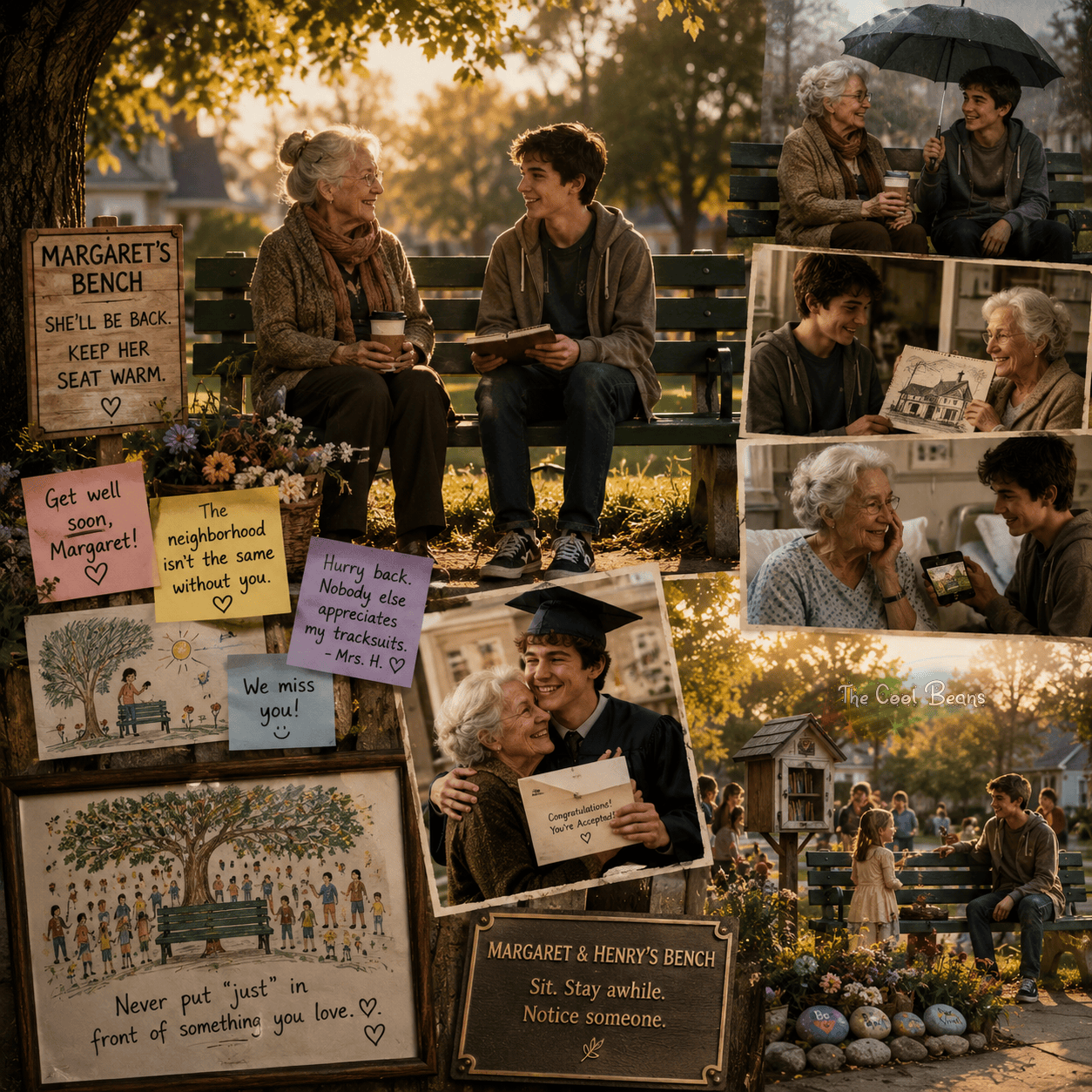
Every morning at 8:30, Margaret Ellis sat on the green bench at the end of Maple Street. Nobody really knew why. She didn’t feed pigeons, she didn’t read a newspaper, and she didn’t walk a dog. She simply arrived carrying a travel mug of coffee, sat down, and watched the neighborhood wake up. At seventy-six, Margaret had decided that mornings were highly underrated. “People complain about getting older,” she’d once told her neighbor, “but nobody mentions that eventually you get old enough that people stop expecting you to be productive before noon.” Margaret considered this one of retirement’s greatest benefits.
For almost twelve years, she’d shared her mornings with her husband, Henry. They would walk to the bench together, drink their coffee, criticize people’s questionable lawn ornaments, and invent elaborate stories about strangers walking past. Then Henry died. For several months afterward, Margaret stopped going to the bench. The coffee didn’t taste the same without someone stealing the first sip. Eventually, though, she returned. The first morning back was terrible. The bench felt enormous. But Margaret returned the following morning, and the morning after that. Eventually, the bench became less about remembering what she’d lost and more about noticing what was still there.
There was Mr. Patel from the corner store, who waved every morning while unlocking his shop. There was Mrs. Henderson, who power-walked past at precisely 8:42 wearing increasingly ridiculous neon tracksuits. And then there was Daniel. Daniel was about seventeen and walked past Margaret every weekday on his way to school. For months they ignored each other, until one rainy Tuesday when Daniel finally stopped. “Why do you sit here every day?” he asked. Margaret looked at him and replied, “Waiting for Ryan Reynolds.” Daniel stared at her. “Seriously?” Margaret shrugged. “No. But wouldn’t that be something?” Daniel laughed, and that was how their friendship began.
After that, Daniel started saying good morning. Eventually, he began sitting beside her at first only for a minute, then five, and sometimes ten. Margaret learned that Daniel lived with his mother and younger sister. His father had left years earlier, his mother worked two jobs, and Daniel worked evenings at a grocery store to help pay the bills. He wanted to become an architect, but he was convinced he wasn’t smart enough. Margaret disagreed. “You know what Henry used to say?” she asked him one morning. Daniel shook his head. “If you’re going to tell yourself a story, at least make yourself the hero.” Daniel frowned. “That sounds cheesy.” Margaret nodded. “It absolutely is. Henry was extremely cheesy.”
One morning Daniel brought a sketchbook with him. Inside were drawings of houses, but not ordinary houses. There were tiny cottages surrounded by gardens, modern homes with enormous windows, and apartment buildings with rooftop parks. Margaret slowly turned through the pages. “These are wonderful,” she told him. Daniel shrugged. “They’re just drawings.” Margaret immediately closed the sketchbook and looked at him. “Never put the word just in front of something you love.” Daniel didn’t say much in response, but he remembered those words.
Months passed and winter arrived, but Margaret still sat on the bench every morning. Daniel couldn’t understand it. “It’s freezing,” he complained one day. Margaret took another sip of coffee. “I survived childbirth twice and forty-three years of marriage. I can handle February.”
Then one morning, Margaret wasn’t there.
Daniel noticed immediately. The following day, the bench was empty again. By Friday, he was worried enough to ask Mr. Patel whether he’d seen her. That was when Daniel learned Margaret had fallen and broken her hip. She was in the hospital. Daniel stood staring at the empty green bench for a while, and then he had an idea.
The following morning, a handwritten sign appeared on the bench. MARGARET’S BENCH. SHE’LL BE BACK. KEEP HER SEAT WARM. Mrs. Henderson noticed it first and sat down for five minutes. Mr. Patel brought his coffee over during his break. Then a mother sat there with her toddler. Someone added another note that read, Get well soon, Margaret. Someone else added, The neighborhood isn’t the same without you. Within days, the bench was covered with messages. Children drew pictures. Someone left flowers. One person left a chocolate bar, and another left a lottery ticket. Mrs. Henderson left a note saying, Hurry back. Nobody else appreciates my tracksuits.
Daniel photographed everything. When he visited Margaret in the hospital, he handed her his phone and let her scroll through the pictures. She looked at them silently until tears began running down her cheeks. Daniel immediately panicked. “Oh no. Are you okay?” Margaret wiped her eyes. “Of course I’m not okay. I’m crying in a hospital gown. Nobody looks dignified crying in a hospital gown.” Daniel laughed. Then Margaret stopped on one particular photograph the bench covered in messages. “I thought nobody noticed me sitting there,” she said quietly. Daniel looked at her. “Everybody noticed.”
Margaret recovered slowly. Meanwhile, Daniel was approaching graduation. He had applied to architecture programs but hadn’t told Margaret because he was terrified he wouldn’t get accepted. One afternoon, an envelope arrived. Daniel stared at it for nearly twenty minutes before finally opening it. He’d been accepted. Not only had he been accepted, he’d received a scholarship. His mother screamed, his sister cried, and Daniel grabbed his jacket and ran.
Margaret had finally returned to the bench two weeks earlier, now using a cane decorated with stickers her grandchildren had given her. She saw Daniel sprinting down Maple Street toward her. “Either you got into university or you’re being chased by a bear,” she called out. Daniel handed her the letter. Margaret read it once and then read it again before looking up at him. “I knew it.” Daniel laughed. “No, you didn’t.” Margaret nodded confidently. “I absolutely did.” Daniel reminded her, “You said I might not get in.” She waved a hand dismissively. “I was managing expectations.” Then she stood and hugged him.
That autumn, Daniel left for university. Before he went, he gave Margaret something he had made for her. It was a drawing of the green bench beneath a huge maple tree. Around it were dozens of people – children, neighbors, strangers and families. At the bottom he’d written the words Margaret had told him months earlier: Never put “just” in front of something you love. Margaret framed the drawing.
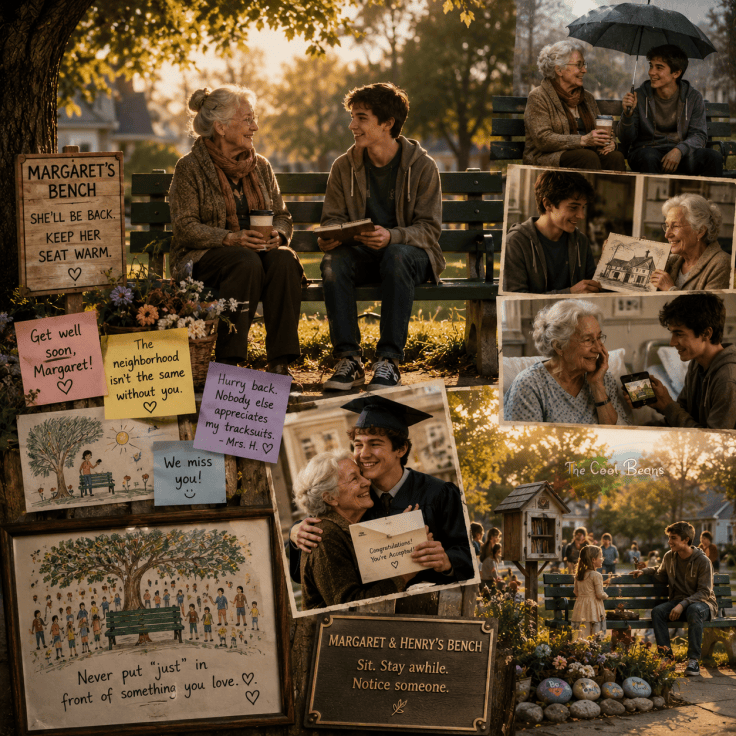
Years passed. Daniel became an architect and Margaret grew older. Eventually, she could no longer make the walk to the bench every morning. But by then, something wonderful had happened. Other people had started sitting there. People talked to one another. Neighbors who had lived three houses apart for years finally learned each other’s names. Someone installed a little community library beside the bench. Children left painted rocks around it, people exchanged books, and flowers were planted around the maple tree. What had once simply been Margaret and Henry’s place to drink coffee had quietly become a gathering place for an entire neighborhood.
When Margaret died at eighty-nine, Daniel returned home for her funeral. Afterward, he walked alone to the end of Maple Street. The old green bench was still there. Beside it stood a small plaque that hadn’t been there the last time he visited.
MARGARET & HENRY’S BENCH
Sit. Stay awhile. Notice someone.
Daniel smiled and sat down.
A little girl walking past with her father noticed him and stopped. She looked at Daniel curiously. “Why are you sitting there?” she asked.
Daniel considered telling her the truth. Instead, he smiled.
“Waiting for Ryan Reynolds.”
The little girl stared at him.
“Seriously?”
Daniel laughed. “No.”
She laughed too.
And somewhere, Daniel liked to imagine, Margaret was laughing with them.
Because sometimes changing someone’s life doesn’t require doing something extraordinary. Sometimes you simply sit on a bench and listen. You remember someone’s dreams. You notice when they’re missing. You tell them they’re capable when they’ve forgotten how to believe it themselves.
And sometimes the smallest kindness travels much farther than the person who started it ever gets to see. 💜🌿


Leave a comment