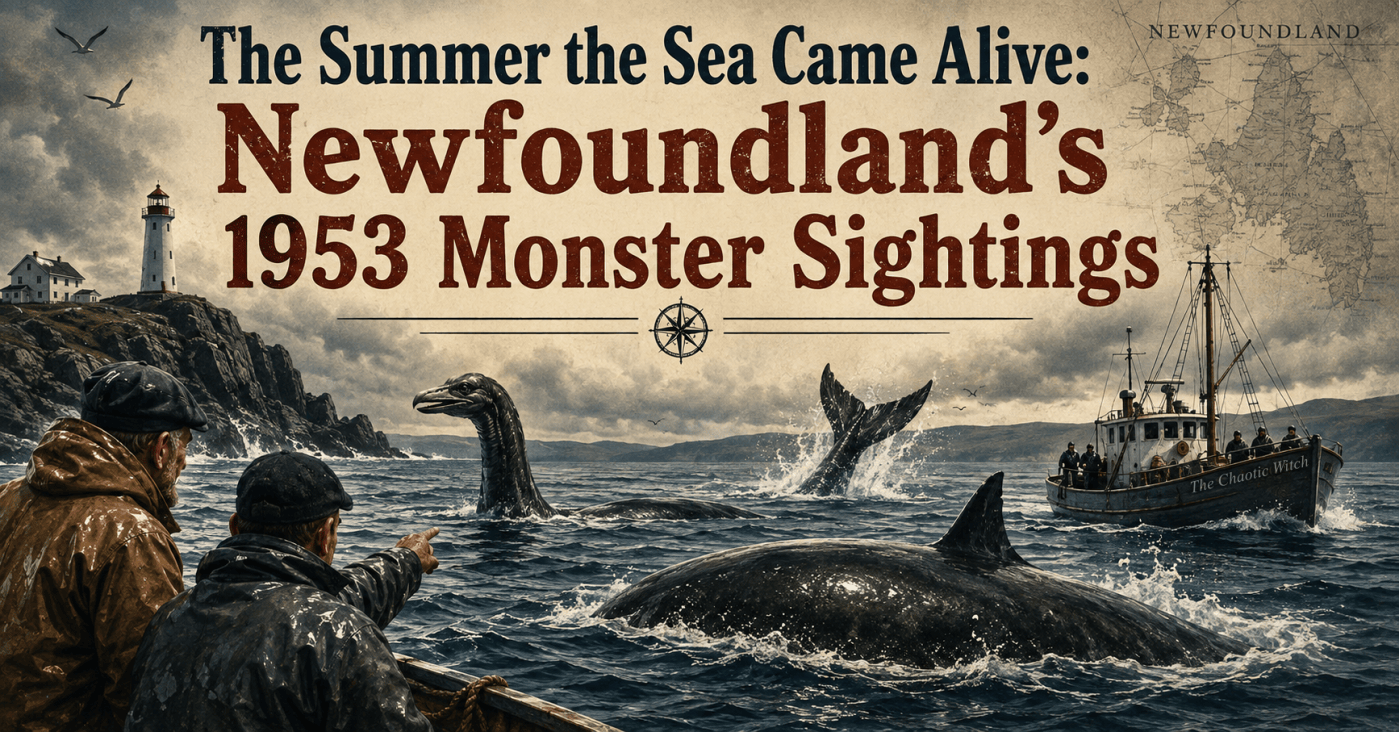
For generations, Newfoundland fishermen have returned from the Atlantic with stories of things they couldn’t explain – enormous shapes beneath their boats, serpentine bodies breaking the surface and creatures unlike anything they recognized from a lifetime spent on the water. But during the summer of 1953, something particularly strange happened. Over the course of just several weeks, witnesses in different parts of Newfoundland began reporting encounters with enormous unidentified creatures. The sightings became so numerous that newspapers started talking openly about sea monsters.
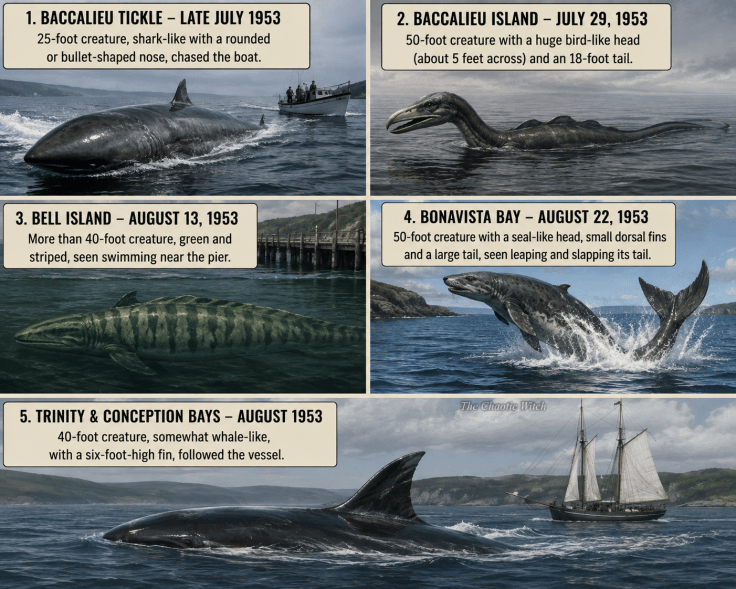
The strange summer appears to have begun near the end of July in Baccalieu Tickle, the narrow stretch of water separating Baccalieu Island from the northern Avalon Peninsula. Two fishermen from Bay de Verde, William Baker and Francis Sullivan, were travelling through the area when something appeared behind their boat. Whatever it was, the men believed it was pursuing them.
Baker and Sullivan estimated the creature was approximately 25 feet long. They compared its general appearance to an enormous shark, but there was something unusual about its head. Instead of the pointed snout they expected, they described a strange rounded or bullet-shaped nose. More unsettling was its speed. The creature reportedly followed – or chased – their boat through the water, frightening the fishermen enough that their encounter soon found its way into the newspaper.
If that had been the only sighting, the story might have disappeared almost as quickly as the creature itself. But only about two days later, another witness reported something extraordinary in almost the same part of Newfoundland.
This time the witness was Alton F. Dingee of Gagetown, New Brunswick, who was aboard the Canadian hydrographic survey vessel Acadia near Baccalieu Island. Dingee wasn’t describing a 25-foot shark-like animal. What he claimed to see was much larger and much stranger.
Dingee noticed an enormous creature trailing behind the Acadia. He estimated it at approximately 50 feet long. Its head alone appeared to him to be roughly five feet across, and he compared its shape to the head of a bird. Behind it stretched what he estimated was an 18-foot tail.
Unlike Baker and Sullivan’s frightening chase, Dingee apparently had time to watch his creature. It remained visible at the surface for several minutes before finally disappearing beneath the Atlantic. When Dingee tried to describe what he had witnessed, one comparison stood out: to him, the creature looked almost prehistoric or dinosaur-like.
Two enormous unidentified animals had now reportedly appeared around Baccalieu within days of one another, yet their descriptions were so different that it was difficult to imagine they were the same creature.
Then the sightings spread.
On August 13, 1953, another strange animal was reported near Bell Island in Conception Bay. This time witnesses could apparently see the creature from land as it moved through the water near Bell Island’s iron ore pier.
They estimated it was more than 40 feet long.
And unlike the dark shark-like creature at Baccalieu, this one was reportedly green and striped.
Contemporary reporting described the creature as swimming or playing around in the water in plain view. Whatever the witnesses were watching, it apparently remained visible long enough for its unusual colour and considerable size to make an impression.
By now, Newfoundland had three extraordinary reports involving creatures that sounded remarkably different from one another. But one of the strangest encounters of the entire summer was still to come.
On August 22, fishermen in Bonavista Bay, around Cabot Island and Change Rock, reported another huge creature. Their animal was said to be approximately 50 feet long, but its head reminded witnesses of a seal. It reportedly possessed small fins along its back and an enormous tail.
Then it did something difficult to overlook.
Witnesses said the creature began leaping from the water.
Its enormous body would emerge before crashing back into the sea, its tail striking the surface and throwing up a tremendous splash. The creature was reportedly seen more than once around the area, suggesting that whatever people were encountering wasn’t merely a single momentary glimpse of an indistinct object far offshore.
During one encounter, a fisherman apparently became convinced enough of what he was seeing that he fired a shot at the creature. The mysterious animal subsequently disappeared into the water.
While people around Bonavista Bay were talking about the leaping, seal-headed monster, sailors aboard another vessel were having an encounter of their own.
Crew aboard the schooner Norma L. Conrad reported seeing a huge animal while travelling along Newfoundland’s east coast near Trinity and Conception Bays. Something appeared beside their vessel and began travelling parallel to it.
The sailors estimated the creature at approximately 40 feet long. They thought its body looked somewhat like that of a whale, but one feature immediately separated it from an ordinary whale in their minds: rising from its body was an enormous fin reportedly standing about six feet high.
Even more unnerving, the creature didn’t simply appear and disappear.
It reportedly followed alongside the vessel, remaining close enough that the sailors had time to watch it. The unidentified animal eventually disappeared, leaving the crew with another story to add to what was becoming an increasingly bizarre Newfoundland summer.
Within only a few weeks, reports had now emerged around Baccalieu Island, Bell Island, Bonavista Bay, Trinity Bay and Conception Bay. Fishermen and sailors weren’t merely reporting distant splashes. They were describing enormous animals with distinctive heads, fins, tails, colours and behaviours.
And newspapers were paying attention.
By early September, the stories had become common enough that the Sunday Herald offered a $100 reward for a photograph of one of the mysterious creatures being reported around Newfoundland. That was a significant amount of money in 1953 and demonstrates just how much attention the sightings had attracted.
Then, on September 8, it appeared that the mystery might finally have washed ashore.
A strange carcass was discovered near Old Perlican, drawing curious residents who wondered whether one of Newfoundland’s elusive sea monsters had finally been found. The decomposed animal looked bizarre enough to generate considerable excitement.
But this particular monster could be identified. It was the badly decomposed carcass of a pothead whale, now generally called a pilot whale. Exposure, decomposition and scavenging had altered its appearance enough to make a familiar animal initially look decidedly unfamiliar.
That discovery solved the mystery of the Old Perlican carcass.
It did not, however, tell anyone what Baker and Sullivan believed chased their boat through Baccalieu Tickle. It didn’t identify the enormous bird-headed creature Dingee watched behind the Acadia. It didn’t explain the green-striped animal reportedly swimming near Bell Island, the seal-headed creature leaping through Bonavista Bay, or the 40-foot animal with the towering fin that sailors said followed the Norma L. Conrad.
And then, almost as suddenly as they had begun, the monster reports faded away.
No photograph appears to have won the newspaper’s reward. No mysterious creature was captured and presented for scientific examination. No preserved specimen emerged that could conclusively establish that an unknown species had been swimming through Newfoundland waters.
What remains are the witness accounts.
Perhaps that is what makes the summer of 1953 so intriguing. Newfoundland’s coastline was populated by people intimately familiar with the Atlantic. Many of the people reporting these encounters weren’t seeing the ocean for the first time, they were fishermen and sailors whose livelihoods depended upon understanding the water and the animals living within it.
That doesn’t mean every mysterious creature they encountered represented an undiscovered species. Whales, sharks and other large marine animals can appear remarkably strange when only portions of their bodies break the surface, particularly at a distance. But those possibilities don’t erase what the witnesses themselves believed they experienced.
They believed they were seeing sea monsters.
Perhaps there wasn’t one Newfoundland monster at all. The dramatically different descriptions could suggest several different creatures were being encountered during that extraordinary summer. Or perhaps unusual conditions brought rarely seen animals closer to Newfoundland’s shores.
There is another possibility, the one that keeps stories like this alive.
Maybe some of those fishermen really did encounter something that has never been satisfactorily identified.
More than seventy years later, the creatures themselves are gone, the witnesses are largely gone, and the Atlantic has long since swallowed whatever traces they might have left behind. All that remains are old newspaper reports describing several strange weeks when enormous unidentified animals seemed to be appearing everywhere along Newfoundland’s coast.
For one brief summer in 1953, people looked out across Newfoundland’s familiar waters and found something unfamiliar looking back.
And whatever those creatures were, the sea never gave up their secret.
Sources: Sunday Herald (Newfoundland), Daily News (St. John’s), Evening Telegram, Observer’s Weekly, historical newspaper accounts from August–September 1953, Robert Hiscock/Product of Newfoundland, and archival information concerning the CSS Acadia and Alton F. Dingee.
A little magic is always waiting. Subscribe and step inside the circle. 🖤🔮✨


Leave a Reply