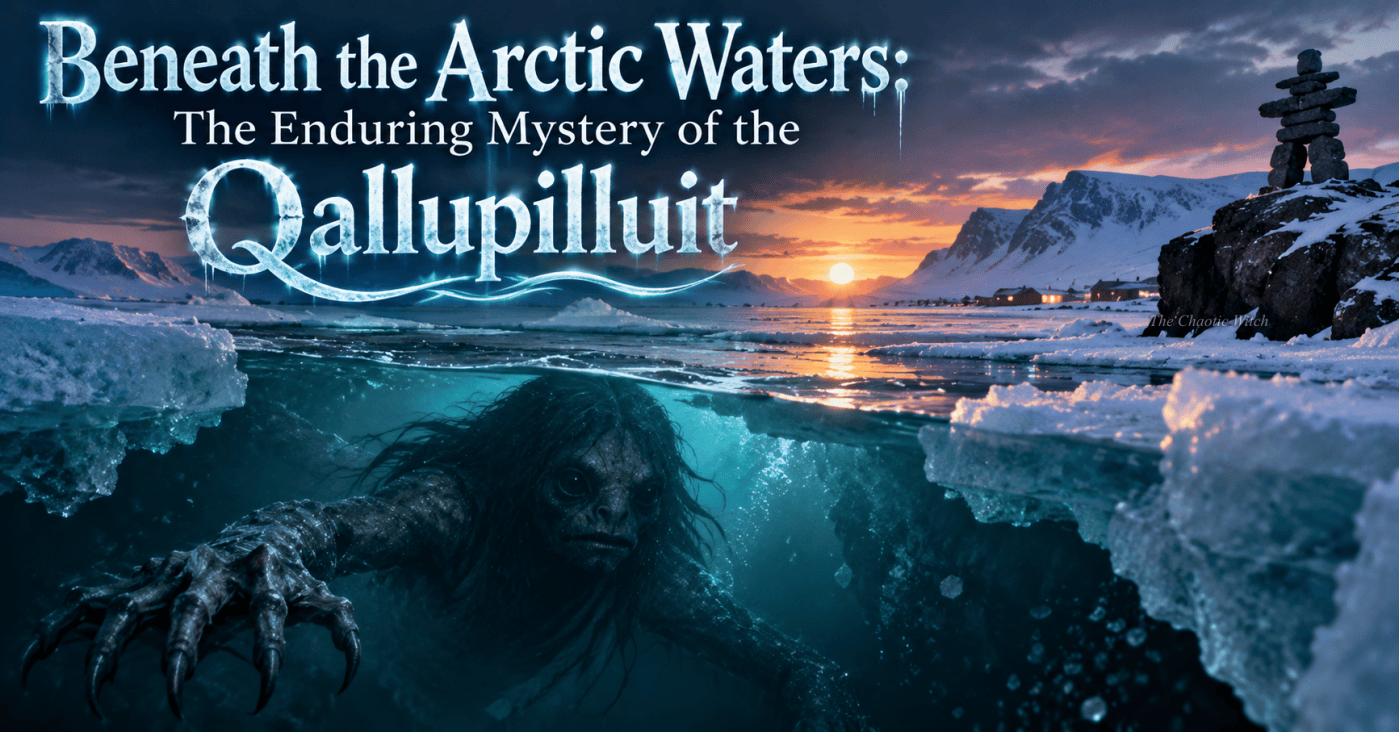
Across the vast Arctic landscape of Nunavut, the sea has always been a source of life – and a place deserving enormous respect. For generations, Inuit oral traditions have told of strange beings inhabiting the cold waters along the shoreline and beneath the sea ice. Among the most mysterious are the Qallupilluit.
Stories about the Qallupilluit vary between communities and storytellers, as oral traditions often do. They are generally described as strange humanoid beings associated with the ocean, shorelines, cracks in the ice and the dangerous floe edge where solid ice gives way to open water.
In some traditions, their appearance is unsettling. They have been described with unusual faces, long hair, strange skin and hands unlike those of ordinary humans. Some accounts speak of clothing made from bird or animal skins. They were said to remain close to the water, sometimes hidden beneath the ice, emerging when someone ventured too near.
Children were especially warned about them.
A child wandering alone toward thin ice or open water might be told that a Qallupilluk was waiting below. In some stories, the creature could reach from the water and seize an unsuspecting child, carrying them beneath the surface.
It was a powerful warning in a place where the difference between safe ice and dangerous ice could mean the difference between life and death.
But within Nunavut’s preserved oral histories are accounts suggesting that, for some people, the Qallupilluit were more than something spoken about around children.
One particularly intriguing recollection came from Aivilingmiut elder Philip Qipanniq.
His account was preserved in Uqalurait: An Oral History of Nunavut, an extensive collection of Inuit testimony documenting traditional knowledge, experiences and memories.
Qipanniq remembered an encounter from a time when the sea was free of ice.
He was on a beach.
And he wasn’t alone.
Several people were reportedly there when something caught their attention near the water.
Against a rock along the foreshore was a figure.
Qipanniq identified it as a qallupilluk.
For a moment, there was apparently enough uncertainty that the group remained where they were.
Then the figure moved.
Whatever hesitation existed disappeared instantly.
The people on the beach ran.
Qipanniq remembered being overwhelmed by fear. The encounter frightened him so badly that his memories immediately afterward became confused. He believed he began crying as everyone fled from whatever they had just witnessed beside the water.
He never forgot it.
And according to his recollection, he never saw another Qallupilluk again.
There is something particularly haunting about the simplicity of the account.
There was no dramatic chase through the Arctic darkness. No elaborate description of a monster rising from the ocean. No sensational ending.
There was simply a beach, several people, a strange figure leaning beside a rock—
and then it moved.
That small detail transforms the story.
A motionless shape along a distant shoreline might easily disappear into the landscape. But whatever Qipanniq and the others saw apparently behaved in a way that convinced them they were looking at something alive.
And they were frightened enough to run from it.
His recollection also provides an intriguing glimpse into the complicated place beings such as the Qallupilluit occupied within Inuit tradition. Some stories were passed down as warnings, particularly for children tempted to venture toward dangerous water and unstable ice.
Yet other people maintained that they had actually encountered the beings described in those stories.
That leaves an enduring mystery.
Perhaps stories of the Qallupilluit survived for generations because they carried an essential warning about the Arctic sea. They taught children to respect water, unstable ice and the invisible dangers beneath the surface.
But oral traditions can preserve more than lessons.
They can preserve memories.
And somewhere in those memories are people like Philip Qipanniq, who did not merely recount a story someone had once told him.
He remembered standing on a beach with other people.
He remembered seeing something beside a rock.
He remembered watching it move.
And he remembered running.
Whatever stood along that Nunavut shoreline that day disappeared back into history, leaving behind only the testimony of those who were there.
But generations later, the Qallupilluit are still remembered.
And beneath the dark Arctic water, beyond the shoreline and underneath the shifting ice, the mystery remains.
Sources: Uqalurait: An Oral History of Nunavut, Inuit oral traditions concerning the Qallupilluit, Inuit Art Foundation, and published collections of Inuit traditional knowledge and mythology.
A little magic is always waiting. Subscribe and step inside the circle. 🖤🔮✨


Leave a Reply