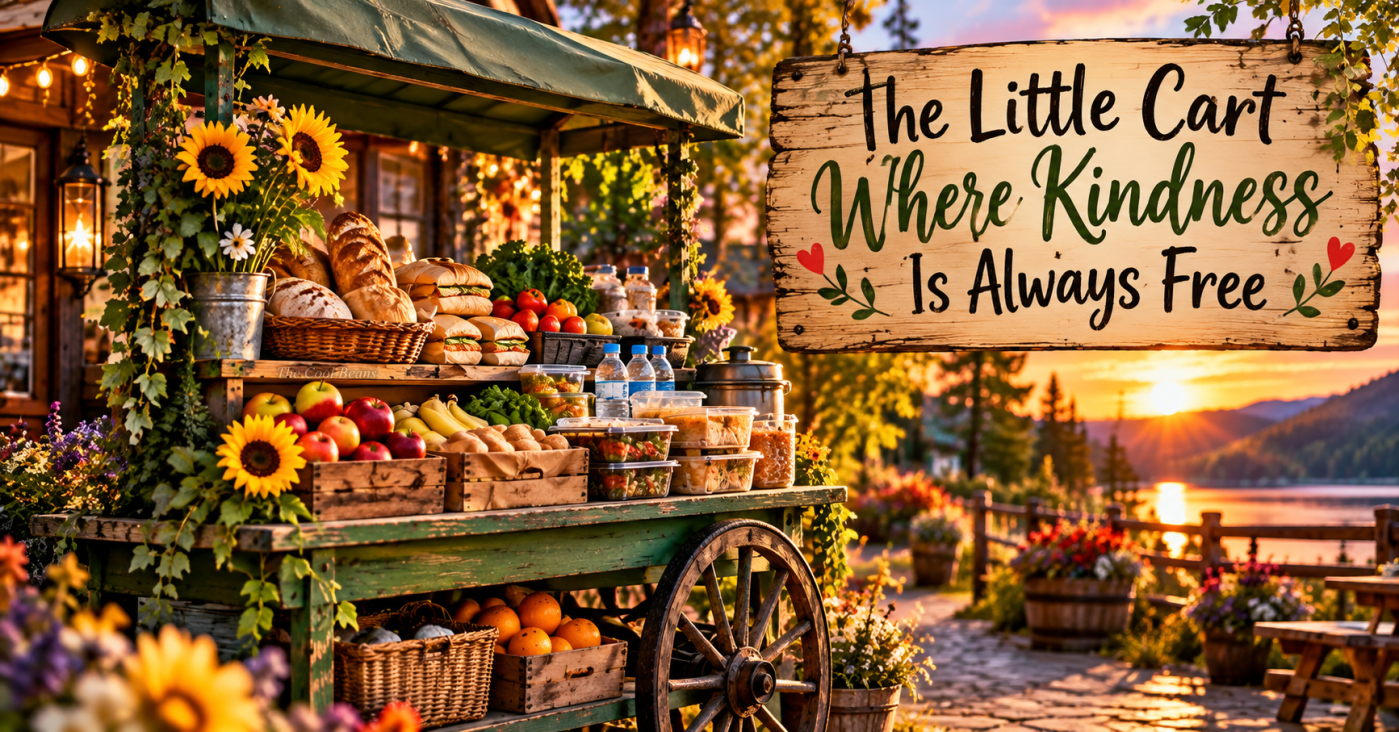
The cart appeared on a Tuesday morning.
It wasn’t particularly impressive. It had four slightly crooked wheels, a faded green canopy, and a hand-painted wooden sign hanging from the front that read:
TAKE WHAT YOU NEED.
EVERYTHING IS FREE.
EVERYONE IS WELCOME.
There was no cash register, no donation jar, no price list – just food.
Fresh bread sat in baskets beside apples, oranges, potatoes, and onions. There were containers of soup, sandwiches wrapped neatly in paper, granola bars, bottled water, and a small cooler filled with milk and yogurt. Someone had even placed a vase of sunflowers in the corner, although nobody was entirely sure who had brought them.
The woman behind the cart was named Nora.
She had spent years working in restaurants and knew something most people never thought about: an astonishing amount of perfectly good food never reached a plate. Bakeries had bread left at closing. Grocery stores had produce that was still good but wouldn’t look perfect on tomorrow’s shelves. Restaurants occasionally prepared too much soup. Cafés had sandwiches approaching their sell-by dates.
At the same time, people in the neighbourhood were struggling. Nora couldn’t stop thinking about the distance between those two realities. So she borrowed an old cart, painted it green, and started asking businesses one simple question.
“If you have something you can’t sell but someone could still eat, can I have it?”
The bakery said yes first, then the little grocery store across the street joined in, then the café. Then a restaurant began setting aside containers of soup twice a week. A produce market started donating boxes of fruit and vegetables. A local convenience store offered bottled water and snacks. Before long, Nora’s tiny cart was being supported by businesses all over the neighbourhood.
There was only one rule: Nobody had to prove they needed anything.
There were no forms to complete, no identification to show, and no uncomfortable questions about income or circumstances. If you walked up to the cart and wanted something, you could take it.
At first, people were hesitant.
“How much?” an older man asked while holding a loaf of bread.
“Nothing,” Nora said.
He stared at her.
“Nothing?”
“That’s the going rate.”
He laughed. It became Nora’s favourite sound. Soon the cart became part of the neighbourhood.
A construction worker grabbed an apple on his way to work after realizing he’d forgotten his lunch. A mother picked up soup and bread during a week when an unexpected car repair had emptied her grocery budget. A teenager took a sandwich every afternoon and eventually began helping Nora unload boxes.
An elderly woman named June came almost every Thursday.
She always took two oranges.
One afternoon, she quietly explained that she lived alone and sometimes groceries became difficult near the end of the month.
Then she reached into her purse and Nora immediately shook her head.
“No money.”
“I’m not giving you money,” June replied.
She pulled out a small packet of seeds.
“Marigolds.”
The following spring, marigolds grew in pots around the cart.
Something strange began happening after that.
People stopped seeing the cart simply as a place where food was given away.
It became a place where things circulated.
Someone who took bread one week returned the next with jars of homemade jam. A gardener brought zucchini during the summer because, as gardeners everywhere eventually discover, growing zucchini is less a hobby and more an agricultural hostage situation.
A mechanic from down the street repaired one of the cart’s wheels for free.
Children painted new signs.
A local carpenter replaced the battered shelves.
Someone knitted scarves and hung them from the side during winter with a note that said, PLEASE TAKE ONE IF YOU’RE COLD.
The businesses became surprisingly competitive about donating.
The bakery bragged about providing the best bread.
The café responded by sending muffins.
The restaurant retaliated with chili.
The produce market apparently considered this an act of war and delivered two enormous crates of apples.
Nora happily stayed neutral.
Her official position was that everyone should continue escalating.
Then, one bitter January morning, Nora arrived to discover something unexpected.
The cart was already full.
Bread. Fruit. Soup. Coffee. Gloves. Granola bars. Sandwiches.
She stood staring at it.
The bakery owner stepped out of his shop across the street.
“We handled it,” he called.
Nora looked around.
People were standing in doorways and windows along the block. Business owners. Employees. Neighbours. People who had donated. People who had once taken food themselves.
It had snowed heavily overnight, and everyone knew Nora normally arrived before sunrise to collect donations.
For the first time since she’d started the cart, someone had decided she shouldn’t have to do it alone.
Nora wiped her eyes.
The bakery owner pointed at her.
“Don’t make this emotional. I have a reputation.”
“You donated cinnamon buns.”
“Those were inventory management decisions.”
“Of course.”
Within an hour, people were gathered around the cart drinking coffee while snow fell quietly around them.
Some people came because they needed food.
Others came because they had food to give.
And after a while, it became difficult to tell who was helping whom.
That was exactly how Nora wanted it.
Years later, the little green cart was still there.
The paint had been touched up several times. The wheels had been replaced. The canopy was new, and the marigolds returned every spring.
But the original sign remained.
TAKE WHAT YOU NEED.
EVERYTHING IS FREE.
EVERYONE IS WELCOME.
Because sometimes changing a community doesn’t begin with a huge organization, a massive budget, or an elaborate plan.
Sometimes it begins with a loaf of bread that would have been thrown away, a person who could use it, and someone willing to move the two a little closer together.
And once people realize how easy kindness can be, they have a funny habit of adding to it.
Enjoying what you find here? 💜 Consider subscribing and becoming part of our little community. It’s a simple way to stay connected, support what we do, and make sure you don’t miss what’s coming next. We’d truly love to have you here. 🌿✨


Leave a comment