For forty-six years, Clara Bennett believed that being a good daughter meant being the one who never complained. She was the peacemaker, the problem solver, the person who remembered everyone’s birthdays, organized holiday dinners, and apologized for things she hadn’t done simply because it was easier than enduring another argument.
In her family, love came with conditions. Affection was offered when she behaved as expected and withdrawn whenever she dared to disagree. Her accomplishments were minimized, her feelings were dismissed, and her boundaries were treated like personal insults. If someone was unhappy, Clara was expected to fix it. If someone behaved cruelly, Clara was expected to forgive them. And if she ever expressed how much something hurt, she was accused of being dramatic, selfish, or overly sensitive.
She had spent so many years trying to earn the kind of love that should have been freely given that she had almost forgotten what it felt like to be herself.
Every holiday followed the same exhausting pattern. Clara would spend days preparing food, buying thoughtful gifts, and making certain everyone felt included. She would arrive with a smile, hoping that perhaps this time would be different. Perhaps this would be the gathering where nobody criticized her appearance, questioned her decisions, or made jokes at her expense.
And every year, she would drive home with tears burning behind her eyes, wondering what she could have done differently.
It never occurred to her that the answer might be nothing.
That changed one Thanksgiving afternoon.
Clara had arrived at her mother’s house carrying a homemade pumpkin pie, a basket of fresh dinner rolls, and a casserole that had taken nearly two hours to prepare. Before she had even removed her coat, her older sister commented that the pie looked a little uneven. Her brother asked why she hadn’t brought something more substantial, and her mother sighed dramatically because Clara had apparently forgotten the cranberry sauce.
Clara smiled, as she always did.
She helped set the table. She washed dishes that weren’t hers. She listened quietly while relatives discussed her life as though she weren’t sitting among them.
Then, during dinner, her mother made a cutting remark about Clara’s decision to remain single after her divorce.
“Well, some people just aren’t meant to have a family of their own,” she announced.
A few relatives chuckled. Clara looked down at her plate. For years, she would have swallowed the hurt, forced a laugh, and pretended the words hadn’t mattered. But something inside her had grown tired. Not angry, not bitter – simply tired.
She placed her fork beside her plate, folded her napkin, and stood.
“Actually,” she said quietly, “I think everyone deserves to feel loved by their family.” The table fell silent.
Her mother rolled her eyes. “Oh, don’t start being sensitive.”
Clara took a slow breath. “I’m not starting anything. I’m leaving.”
Her sister laughed. “You’re seriously going to ruin Thanksgiving over a joke?”
Clara picked up her coat. “No,” she replied. “I’m finally going to stop letting Thanksgiving ruin me.”
She walked out before anyone could argue and for the first time in her life, she didn’t turn around. The drive home was strangely quiet. Clara expected to feel triumphant, perhaps even relieved, but instead she felt a complicated mixture of sadness, guilt, fear, and something she couldn’t quite identify.
Freedom, she would later realize, sometimes feels unfamiliar before it feels wonderful. She parked outside her little house, carried her purse inside, and stood in the kitchen looking at the flowers she had bought herself the day before. Her golden retriever, Maple, greeted her with the enthusiasm of someone who believed every homecoming deserved a parade. Clara knelt and wrapped her arms around the dog’s warm neck.
“Well, Maple,” she whispered, “I think I just changed my life.”
Maple licked her cheek. It wasn’t particularly profound advice, but it helped. That evening, Clara made herself a grilled cheese sandwich, poured a glass of sparkling apple cider, and watched an old comedy while Maple slept beside her.
Her phone buzzed repeatedly with messages from relatives. Some demanded apologies. Others accused her of embarrassing the family. One suggested that she had always been difficult and that everyone was tired of walking on eggshells around her. Clara read the messages with a familiar tightening in her stomach. Then she did something extraordinary.
She turned off her phone. Nothing terrible happened. The world continued turning. The moon rose. Maple snored. And Clara slept more peacefully than she had in months.
The following weeks weren’t easy. There were moments when Clara questioned herself, moments when she missed the family she had always hoped to have, and moments when loneliness made her wonder whether she had made a terrible mistake. She had spent decades believing that maintaining family relationships was her responsibility, no matter how much they hurt. Learning otherwise took time, but something beautiful began happening as she stopped pouring all her energy into relationships that left her feeling empty.
She started noticing the people who had quietly cared about her all along.
There was Ruth, her sixty-eight-year-old neighbour, who always brought extra tomatoes from her garden and never failed to ask how Clara was doing. Unlike her relatives, Ruth actually listened to the answer.
There was Daniel, the cheerful owner of the little bookstore downtown, who saved Clara copies of novels he thought she would enjoy and insisted that her terrible jokes were the highlight of his Tuesdays.
There was Maya, a woman Clara had met at a community gardening workshop, who had the loudest laugh Clara had ever heard and a remarkable talent for turning minor inconveniences into hilarious adventures.
And there was Thomas, a retired schoolteacher who volunteered at the local animal shelter and had somehow become Maple’s favourite person despite repeatedly insisting that he wasn’t really a dog person.
These people had been part of Clara’s life for years, but she had never fully allowed herself to depend on them. She had always been too busy being dependable for everyone else. One chilly Saturday morning, Ruth knocked on Clara’s door carrying a container of homemade soup.
“I made too much,” she announced.
Clara smiled. “You always make too much.”
“Of course I do. Otherwise, how would I have an excuse to check on you?” Clara laughed and invited her inside.
They sat at the kitchen table for nearly three hours, drinking tea and talking about everything from gardening to childhood memories. Eventually, Clara told Ruth about Thanksgiving. She expected advice about forgiveness, family obligations, or being the bigger person.
Instead, Ruth reached across the table and gently squeezed her hand. “Clara, sweetheart, you can love people and still decide that being around them isn’t good for you.”
Clara looked down at their joined hands. “But they’re my family.”
Ruth nodded. “Yes, they are. And you deserved kindness from them.”
Something in Clara’s chest loosened. For the first time, someone had acknowledged her pain without asking her to excuse it.
Ruth continued, “You know, I spent years thinking family was something you were assigned at birth. But life taught me differently. Sometimes family is the person who brings soup when you’re sad. Sometimes it’s the friend who remembers how you take your tea. Sometimes it’s the neighbour who notices your porch light hasn’t been on and comes knocking to make sure you’re all right.”
Clara smiled through sudden tears. “That sounds rather lovely.”
“It is,” Ruth replied. “And there’s plenty of room at my table.”
Those words stayed with Clara. There’s plenty of room at my table. They were such ordinary words, yet Clara couldn’t remember the last time anyone had made her feel so welcome.
As autumn gave way to winter, Clara began rebuilding her life in small, wonderful ways. She joined a weekly book club at Daniel’s shop. She and Maya started taking weekend hikes, usually accompanied by Maple and a ridiculous amount of snacks. She volunteered at the animal shelter with Thomas, where she discovered that helping frightened animals learn to trust again felt strangely healing.
She started painting, something she had loved as a teenager but abandoned after years of hearing that she wasn’t particularly talented.
Her first painting was a crooked little cottage surrounded by flowers. It wasn’t perfect, but Clara hung it above her fireplace anyway.
When Maya saw it, she gasped. “Clara! You painted that?”
Clara shrugged. “It’s nothing special.”
Maya stared at her. “Are you kidding? It’s gorgeous! It looks like the kind of cottage where a mysterious woman makes excellent tea and knows everyone’s secrets.”
Clara laughed so hard she nearly spilled her coffee. “Well, the tea part is accurate.”
“Then we’re halfway to greatness.”
Clara began painting more often. She also began saying no. At first, the word felt awkward in her mouth, as though she were speaking a foreign language. She worried that people would be disappointed, that friendships would end, or that she would somehow become a selfish person.
But something surprising happened.
When she told Maya she was too tired to go out, Maya said, “No problem. Rest up. We’ll do something next week.”
When she declined an invitation from Daniel, he simply smiled and said, “Another time.”
When Ruth asked whether Clara could help with a gardening project and Clara explained that she already had plans, Ruth replied, “Of course, dear. Enjoy yourself.”
Nobody punished her, nobody withdrew their affection, nobody demanded an explanation. Clara began to understand that healthy love didn’t require constant proof of loyalty. It simply allowed people to be human. By the following autumn, her life looked entirely different. Her home was filled with laughter, her calendar included activities she genuinely enjoyed, and her heart had begun to feel lighter.
She still thought about her relatives sometimes. There were birthdays she didn’t attend and conversations she chose not to have. Occasionally, a photograph or familiar song brought back memories of happier moments, and she would feel the quiet ache of what might have been. But she no longer confused missing someone with needing to return to a harmful situation. She had learned that grief and growth could exist together.
Then, one October afternoon, Clara received a message from Maya.
Important question: What are we doing for Thanksgiving?
Clara stared at the screen. Thanksgiving. The word still carried memories of tense dinners, forced smiles, and the exhausting effort of trying to make everyone happy. She considered staying home with Maple, but then she remembered Ruth’s words. There’s plenty of room at my table.
Clara typed a reply.
What if we have Thanksgiving at my place? Everyone welcome. No drama allowed. Elastic waistbands encouraged.
Maya responded almost immediately.
I’M BRINGING DESSERT AND EMOTIONAL SUPPORT CARBS.
Within an hour, Daniel offered to bring fresh bread, Ruth volunteered her famous stuffing, and Thomas announced that he would handle the mashed potatoes.
“Just so everyone knows,” Thomas wrote in the group chat, “I make enough mashed potatoes to feed a small army.”
Maya replied, Excellent. I’ve always wanted to be part of a small army.
Clara laughed until her stomach hurt. And just like that, a new tradition began.
On Thanksgiving morning, Clara woke to sunlight spilling through her bedroom curtains. Maple was already standing beside the bed, tail wagging enthusiastically.
“Today’s the day,” Clara told her. Maple sneezed.
“Yes, I know. Very exciting.”
Clara spent the morning preparing dinner, but something felt wonderfully different. There was no knot of dread in her stomach. She wasn’t worrying about whether the food would be criticized, whether someone would make a cruel remark, or whether she would have to spend the afternoon pretending not to be hurt. She was simply excited.
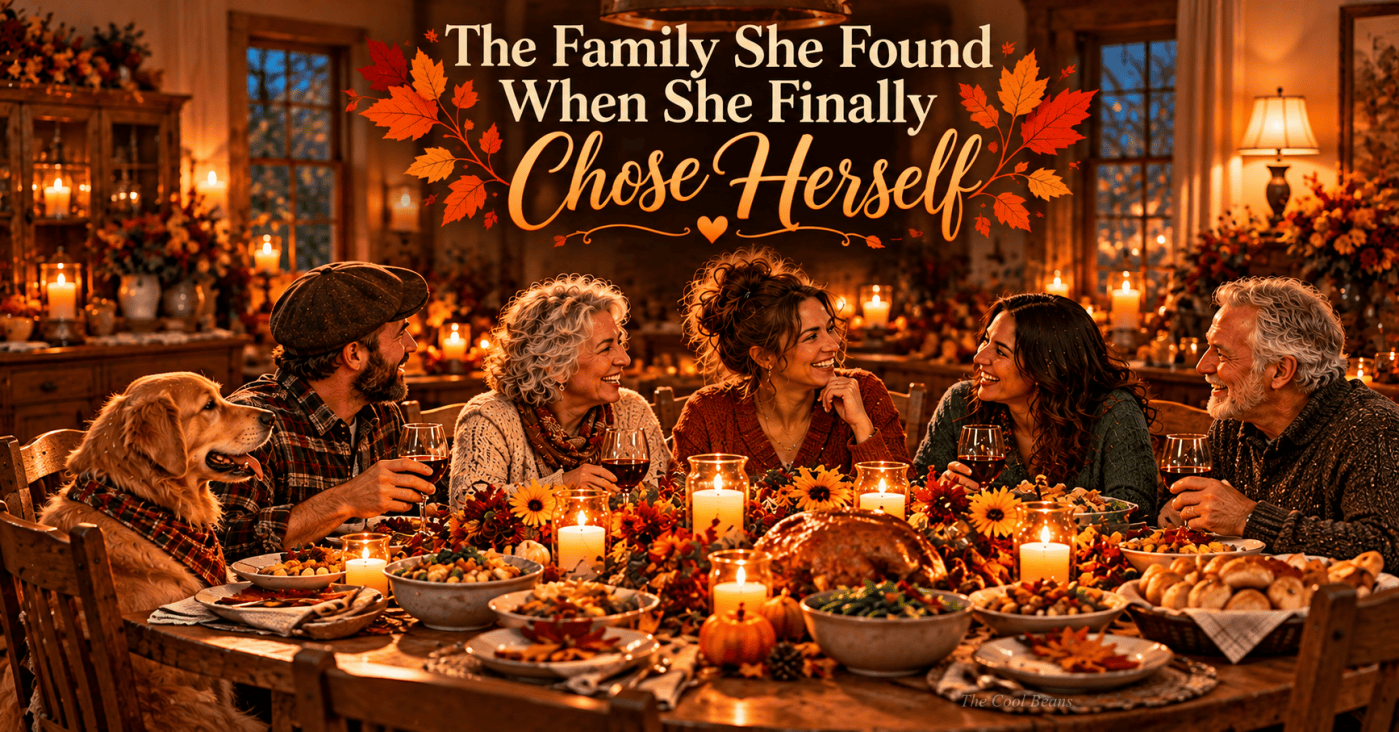
By three o’clock, the house smelled of roasting turkey, cinnamon, fresh bread, and pumpkin pie. Ruth arrived first, carrying stuffing, roasted vegetables, and an enormous bouquet of autumn flowers.
“I thought your table needed something pretty,” she announced.
Clara hugged her. “You’re pretty enough.”
“Oh, stop it,” Ruth said, smiling. “You’ll make an old woman blush.”
Daniel arrived with two loaves of bread, a bottle of sparkling cider, and a stack of books tied together with ribbon.
“What’s this?” Clara asked.
“Thanksgiving gifts.”
“Daniel, people don’t give books for Thanksgiving.” He looked genuinely offended.
“Then people are doing Thanksgiving wrong.” Maya burst through the door twenty minutes later carrying three pies and wearing a sweater decorated with an enormous turkey. Across the front were the words Let’s Get Basted.
Clara doubled over laughing. “Please tell me you’re wearing that all day.”
“Obviously. Fashion is about making a statement.”
Thomas arrived last, balancing a giant pot of mashed potatoes in one hand and a bag of dog treats in the other. Maple immediately abandoned everyone else.
“See?” Thomas announced. “At least somebody appreciates me.”
The afternoon unfolded in a beautiful jumble of laughter and conversation. Maya accidentally dropped a dinner roll into Ruth’s glass of cider. Daniel told a story about a customer who had tried to return a book because the ending made her cry. Thomas insisted that mashed potatoes were the foundation of civilization, while Ruth argued that anyone who believed that had clearly never tasted her stuffing.
Clara laughed until her cheeks hurt. There were no cruel jokes disguised as humour, no whispered criticisms, no uncomfortable silences. When someone spilled gravy, everyone helped clean it up. When dinner ran twenty minutes late, nobody complained and when Clara accidentally burned the bottom of the dinner rolls, Maya declared that they were “artisanal, aggressively toasted bread products” and ate two.
As they finally gathered around the table, Clara looked at the people seated before her. Ruth, smiling warmly beside the flowers. Daniel, already reaching for the bread. Maya, attempting to convince Thomas that pumpkin pie counted as a vegetable. Thomas, pretending not to feed Maple a piece of turkey beneath the table.
For a moment, Clara couldn’t speak. These people weren’t related to her. They hadn’t grown up together. They didn’t share childhood photographs, family traditions, or the same last name, but they knew her. They knew she loved rainy afternoons, hated olives, cried at animal rescue videos, and always bought more books than she could possibly read.
They celebrated her accomplishments without turning them into competitions, they respected her boundaries without making her feel guilty, they showed up when life was difficult and stayed when there was nothing to gain and perhaps most importantly, they allowed Clara to be herself.
Not the version of herself who kept everyone comfortable, not the version who apologized for existing.
Just Clara.
Ruth noticed her expression. “Everything all right, sweetheart?”
Clara nodded, blinking back tears. “More than all right.”
Maya lowered her fork. “Oh no. Are we doing feelings? Because I was not emotionally prepared for feelings before dessert.”
Everyone laughed.
Clara smiled. “I just wanted to say something.”
The table grew quiet. “For a long time, I thought family meant the people you were born with. I thought being loved meant making yourself smaller, staying quiet, and accepting things that hurt because that’s what families were supposed to do.”
Her voice trembled slightly. “When I walked away, I thought I was losing my family. And for a while, I felt like I had lost everything.”
Ruth reached for her hand. Clara looked around the table. “But I hadn’t lost everything. I was making room for something better.”
Maya’s eyes filled with tears. “Oh, for heaven’s sake,” she muttered. “Now I’m going to cry into my potatoes.”
Clara laughed softly. “You’ve all taught me that love doesn’t have to hurt to be real. That I don’t have to earn a place at the table. That I can have bad days, make mistakes, disagree, and still belong.”
She lifted her glass. “So here’s to the people who choose us, the people who stay, and the people who remind us that home isn’t always where we started.”
Daniel raised his glass. “To chosen family.”
“To chosen family,” everyone echoed.
Thomas cleared his throat. “And to mashed potatoes.”
“Thomas!” Ruth exclaimed.
“What? They’re important!” The entire table erupted in laughter.
Later that evening, after the dishes had been washed and the leftovers divided into containers, everyone gathered in Clara’s living room. A fire crackled in the fireplace. Maple slept across Thomas’s feet, apparently having decided he belonged to her now. Ruth knitted quietly in an armchair while Daniel and Maya argued good-naturedly over which holiday movie they should watch.
Clara sat on the sofa, wrapped in a soft blanket, listening to the sounds of people she loved. Her phone rested on the coffee table. Earlier that afternoon, a message from her mother had appeared.
I suppose you’re still too stubborn to spend Thanksgiving with your real family.
Clara had read it and for a moment, the old guilt had stirred. Then she had looked around her kitchen, where Ruth was stirring gravy, Maya was stealing bits of pie crust, Daniel was setting the table, and Thomas was telling Maple that she was a very distinguished lady.
And she had realized something. She didn’t need to argue, defend herself or to prove that her happiness was justified. She could simply choose it. She had put the phone away and returned to the people waiting for her.
Now, as the firelight danced across the room, Maya leaned her head against Clara’s shoulder. “Same time next year?”
Clara smiled. “Absolutely.”
Ruth looked up from her knitting. “Next year, we should invite Mrs. Henderson from down the street. Her children live overseas, and she spends the holidays alone.”
“Definitely,” Clara said.
“And my friend Oliver,” Daniel added. “He just moved here and doesn’t know many people.”
“Bring him,” Clara replied.
Thomas raised his hand. “I know a fellow from the shelter who could use some company.”
“Bring him too.” Maya grinned.
“Clara, at this rate, we’re going to need a bigger table.”
Clara looked around the room, her heart overflowing. “Then we’ll get a bigger table.”
And she meant it. Over the years that followed, Clara’s Thanksgiving dinners became something of a neighbourhood legend. The guest list grew to include widows, single parents, newcomers, elderly neighbours, friends going through difficult divorces, and people who simply had nowhere else to go. There were mismatched chairs, borrowed dishes, extra tables pushed together, and always far too many desserts. Some guests came every year while others stayed only long enough to find their footing before moving on to new chapters of their lives. But everyone was welcomed.
Nobody had to explain why they were alone. Nobody had to prove they deserved a place. There was always another chair and every Thanksgiving, before dinner began, Clara would raise her glass and offer the same simple toast.
“To the family we find, the love we choose, and the beautiful truth that nobody should have to earn the right to belong.”
Sometimes she thought about the woman she had been on that painful Thanksgiving afternoon years earlier. The woman who had walked out of her mother’s house with trembling hands, convinced she had just destroyed everything familiar. Clara wished she could reach back through time, take that frightened woman by the hand, and tell her what was waiting. She would tell her that the loneliness wouldn’t last forever and that the guilt would eventually grow quieter. She would discover friendships more nourishing than relationships she had spent a lifetime trying to repair.
That one day, she would laugh so freely at a Thanksgiving dinner that she would forget to worry about whether anyone approved of her.
And that the home she had always dreamed of would eventually exist. Not because someone finally decided she was worthy of love. But because she finally understood that she always had been.
One evening, many years later, Clara stood in her kitchen after another wonderful Thanksgiving gathering. The house was quiet. The candles had burned low. A few crumbs remained on the table, and the refrigerator was stuffed with leftovers.
On the wall hung a photograph taken during that very first chosen-family Thanksgiving. Ruth was laughing. Daniel was holding a loaf of bread. Thomas was pretending to steal the turkey, and Maya was making an outrageous face at the camera. Clara stood in the middle, smiling so widely that her eyes had nearly disappeared.
Beneath the photograph was a small wooden sign Maya had given her.
It read:
Family isn’t always the people who share your blood. Sometimes it’s the people who help you heal, make room for your joy, and love you exactly as you are.
Clara touched the edge of the frame and smiled. She had once believed that leaving her family meant giving up on love, but walking away from what hurt her had never been the end of her story. It had been the beginning of a beautiful new one and the greatest gift she had ever given herself wasn’t the courage to leave. It was the permission to build a life where love felt like peace, laughter came easily, and nobody had to shrink themselves to belong because sometimes the most wonderful families aren’t the ones we inherit.
They’re the ones we find along the way, the ones we nurture with kindness, and the ones who choose us just as wholeheartedly as we choose them.
And sometimes, the happiest ending isn’t finding your way back to the place you came from.
It’s discovering that you can create a home somewhere entirely new. ❤️🍂
Enjoying what you find here? 💜 Consider subscribing and becoming part of our little community. It’s a simple way to stay connected, support what we do, and make sure you don’t miss what’s coming next. We’d truly love to have you here. 🌿✨


Leave a Reply